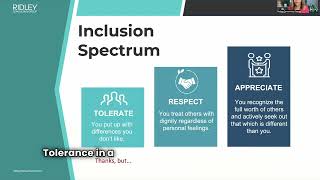
Beth Ridley maps three levels of inclusion: tolerant (polite but distant), respecting (acknowledging differences), and appreciation (actively seeking diverse perspectives). A meeting example shows how each plays out in practice, and she challenges you to build strategies that move beyond tolerance.
Chapters
And I should say pillar of belonging is inclusion. I don't mess with inclusion. I don't get a lot of pushback on inclusion. Most people like inclusion, it feels inclusive. But the only pushback I get is people say, we all need dei, we're a polite and professional culture. We're nice to everybody. And then I remind them like, well, nice, polite and professional. That's not quite inclusive. That's a lot of times just tolerant of different people. And I sort of go through the spectrum of inclusion so they can appreciate true inclusion means more than what you think. And to get there, we got to do more than what you think. So on the low end of inclusion is tolerant, polite, professional, we're kind to everybody. We say, good morning. We appreciate that everyone is different, not too interested. I'm going to stick with, you know, what I know in my comfort zone. We'll stick to the sports and the weather that feels good and it's not bad. But what I tell my clients, you know, we're not going for a not bad culture. We gotta plus it up a little bit with some effort and intentionality to be great. A great culture that people wanna come and stay. That means we gotta think about not just tolerant of differences, but respecting differences. That's harder because that means you acknowledge there are differences. You don't like ideas, you don't like beliefs, you don't like values that maybe you didn't grow up with. They may not be important to you, but I acknowledge they are important to others. A little harder to do. So people start to see, oh, yeah, yeah, I can see where we got to work on that. And then true inclusion means appreciation. That means I believe so much in the value of people feeling that sense of belonging. I'm willing to go out of my own comfort zone to uncover, explore differences that that may be holding people back from feeling that sense of belonging. So people kind of start to understand like, oh, it's more than just being polite. Got it. It's still a little high level. So I try to make it a little bit more tangible with an example of what does this look like in a meeting? Tolerance in a meeting may look like, hey, you know, everybody's talking about the plan, the goal in mind, and somebody raises their hand and said, I got an out of the box idea. What do y' all think? And people say, oh, thanks for sharing, but let's just get back on track. We're going to go down that path. So it was polite, it was professional, no one was hurt. But the person who shared the idea might be thinking in their mind, why did I bother anyway? Not horrible, but kind of like what respect would look like in meeting is the same person says, here's an idea, and even if it's not an idea that you like, even realistically, we're not going to change the plan. The fact that someone raised it. Let's acknowledge right and say, well, okay, why don't we explore how your ideas may impact what we're trying to do here. They were thoughtful enough to raise it. And I think acknowledging that there might be something there before we dismiss it. And then true appreciate true appreciation means in a meeting, we're actually going above and beyond. We're being proactive, and we're not settling for just the ideas that were in the room. Because what do we know? There could be different ideas that, that push us to be even better and more thoughtful. So we say, actually, what. What are some differences that are not represented in the room? Who's not in the room, who maybe should weigh in before we say the decision is final? So when I give those concrete examples, people start to appreciate inclusion a little bit better and I don't get as much pushback. Like, but we're already inclusive. They can see themselves where, oh, oh, yeah, I think we do have more work to do. And then it's like, okay, well, why don't you help us with our strategies to do that?