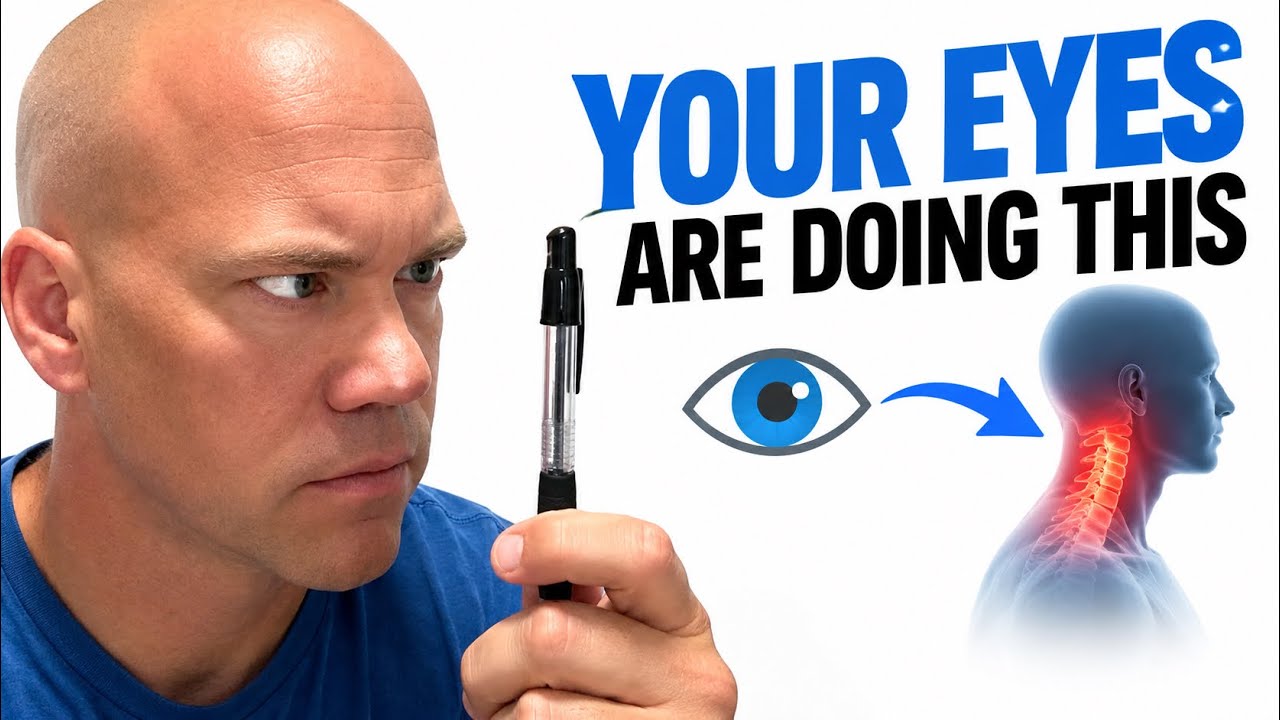
Bill from Beyond Fitness shows how screen time strains your eyes and neck, then teaches two drills to fix it: cupping your eyes closed for 30 seconds and rapid blinking, plus a pencil push-up where you focus on your thumb moving toward your nose. Both exercises stimulate the oculomotor nerve to restore eye control and neck mobility.
Chapters
Staring at screens all day could be giving you headaches, neck strain, and even causing poor posture. Hi, I'm Bill from Beyond Fitness, and today I'm going to show you an exercise to help counter that. First thing we want to do is we want to check our range of motion. So first, check how far can you turn right, turn left, how far can you tilt right and left, how high up can you look and down. Notice if there's any restriction, any pain. One particular direction feels worse than any of the others. I also recommend getting a Snellen chart, which is this right here, and checking your vision. That way we can also see if this impacts how you see. What tends to happen with people, especially people who have desk jobs and stare at a screen all day, is that the eyes start to strain and we start to get into this tired, poor posture this way. The eyes are strained, the neck is strained, and the— we start to round in the back and that creates poor posture. When these things happen for hours upon hours upon hours every day, over time those things become the norm and it ends up being very uncomfortable. So now that we've got a baseline, what we're going to do is we're going to try to stimulate a nerve in the brainstem that's going to help bring everything back. That nerve is cranial nerve 3, also known as the oculomotor nerve. It controls a lot of different movements of the eyes. Basically every direction you push the eye, except for down towards the tip of your nose and out if you're looking far away, the cranial nerve 3 is involved in that. But it's also involved in the ciliary muscles, and the ciliary muscles are the little muscles in the lens of your eye that change the shape of your eye depending on whether you're looking far or near, and that's why it can impact your vision. So it's a very simple series of drills we're going to do for this, and the first one is called a visual reset. If you want more information on that, I've got that video right up here. So we're going to cup the hands, close the eyes, cover the eyes, and we're going to stay that way for about 30 seconds. When you're done with that 30 seconds, you're going to blink the eyes rapidly for 15 more seconds. That gets the eyes to relax and kind of resets them. Now that may be enough for you already to have better neck range of motion and even better vision, but we're going to take this one step further because that's not what we're after today. We're after trying to— Tackle that cranial nerve. After the visual reset, we want to go to the pencil push-up. Now we're going to use our thumb for this, but you could also use a pen or any object that you can hold in your hand that you can keep your eyes on. We're going to keep it on our thumbnail here. We're going to bring it towards the bridge of our nose, trying to see it clearly and only see one thumb. If it pops into 2 or gets really blurry, we're going to stop and come back out really slowly, and we're going to keep doing that. Trying to hold that vision of one thumb. Now, as you do this, you might see that, oh, I can get a little closer each and every time, but we are trying to go cross-eyed and trying to keep focus on something close to make those ciliary muscles really work. We're going to do that for 10 repetitions. Each repetition should take you 2 to 4 seconds, so we're talking close to a minute of work here. Now that we've done that, We're going to go ahead and retest our neck range of motion. Retest the one that felt the most restricted to you. If it was rotation, see if you can rotate a little further, or if you can look up higher or tilt further, whatever it was for you. Also, go back to that Snellen chart and see if you can see a little bit more clearly. Odds are you will be able to see something a little bit better. So give this a try. Let me know in the comments below how this worked for you and what improved most. And if you want more information like this, I post 2 videos a week, so don't forget to like and subscribe. And until next time, live healthy.