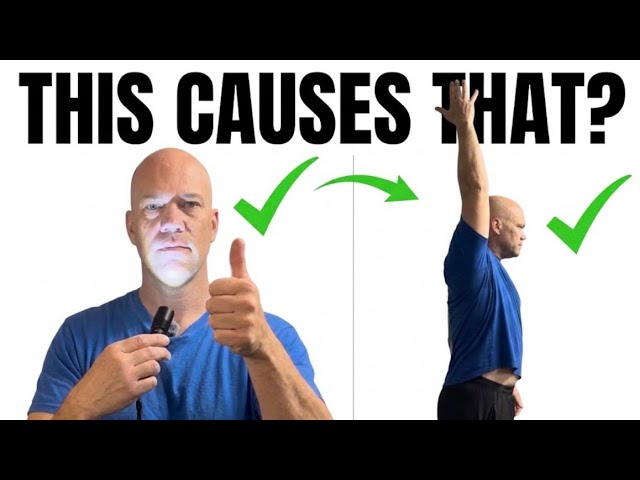
A simple 3-second drill trains your eyes to move smoothly between near and far focus, which can unlock shoulder and spine flexibility. Look at your thumb for three seconds, then a distant target for three seconds, repeat ten times. Most people notice smoother eye movement and better forward bends right after.
Chapters
If your eyes get tired while you're reading or you lose your place easily, or even if you get headaches after screen time, it might not be a vision problem. It might be an eye tracking problem, and we can fix that. The first thing we're going to do is we're going to test your eyes. So here's what you need to do. You need a target off in the distance. I'm going to use the camera, and then you need a target that's close. We can use our thumb. What you're going to do is bring that thumb close to you where you can still see it clearly. So as you can see, it's about a foot away from my face. My second target's directly behind that, and I'm looking at the camera. I'm going to look at my thumb, see it clearly, then I'm going to look at the camera. Once I see that target clearly, I go back and forth as quickly as I can, but without ever jumping before you see the target clearly. So what you need to notice is, how does it feel while your eyes are jumping from a near target to a far target and then back? Does it feel like your eyes are moving smoothly? Does it feel jumpy? Does it take a while for your eyes to focus on the target when you change the distance? We also want to test flexion motion. So shoulder flexion is when we take the arm and lift it this way and see how far you can go and get an idea of what that looks like. You could also test things like a forward bend and see how far forward you can reach. You can test flexion with your elbow. You can test flexion with your knee. If you have any restrictions there or any pain, this drill should be able to help with those. Make a mental note of how that feels, and if it's helpful, you can even put a number on it, 1 to 10, to give you a quantifiable score. So we're going to implement the drill now, which is very similar to the test. What we're going to do is a near-far drill. We're going to have that thumb right in front of us, and we're going to have our distant target, and we're going to intentionally look at each one for a full 3 seconds. So we look at the thumb, 1, 2, 3, see it clearly, then immediately jump To the distant target, and look at that for 3, then back to the thumb, 1, 2, 3, then back to the distant target. And we're going to repeat this 10 times. So it's going to end up taking you about a full minute to do this. It's okay to blink, but try to remember to relax and let the shoulders relax. Try to breathe normally. And if you start feeling really sweaty, you start breathing heavy, these are signs that this is a lot for you and you need to slow Slow it down and maybe do less reps. So from there, we're going to take a break. We're going to take one big, slow, deep breath, and then we're going to see how quickly we can do that drill when we reassess. So now we're in the measure stage of AIM. We're going to hold this here. We're going to go back and forth, seeing them clearly before we switch. Notice if it feels easier, if you feel like you're going faster. These are all good signs that you have now really activated the muscles that control the eyes. to see far and near and adjust in that position really quickly. You can also retest your flexion motion. So if we're using the shoulder, how far up this way can you go? If you're bending over forward, can you get your hands closer to the floor? These are all good signs that this has been a good drill for you. Now, if you've noticed some improvement with how your eyes are functioning, that's fantastic. If you've noticed that your flexion movements have improved, that's also great. These are common things that happen when we do this exercise. But if we need to take it to the next level, all you need is a simple tool, and that tool is going to be a flashlight. Now, it doesn't need to be a super bright flashlight, but it needs to flash enough where you see it out of your peripheral vision. And we're going to hold it below our eyes, flashing into the eyeball area, but not looking directly at it. Now, what this does is this activates part of the parietal lobe, which helps us See things in space. So since we are changing directions from near to far, sometimes the eyes have a hard time functioning because they have a hard time understanding where they are in space. This activates that part of the brain, so we may do this a little bit better now. So we're going to hold this here, we're going to hold the near target right there, and we're going to do the same drill. 3 seconds on the thumb, then 3 seconds in the distance. 3 seconds on the thumb, 3 seconds in the distance. Again, do that for 10 reps or about a minute, and then retest yourself. How quickly can you go back and forth between the 2 targets? And if it's improved even more, that's fantastic. Also, don't forget to check your flexion motion, whether it's bent forward bend or shoulder flexion, and see how much that's improved. This is a really important drill to do because your eyes and your brain work together to make these micro adjustments all day long. When you're looking at something here versus here versus here versus off in the distance, your eyes are working really, really hard. If it's not trained appropriately, you are expending a lot of energy to do that, and it's going to be very difficult to keep things clear. It's going to be very difficult for your brain to be able to interpret what's there, and that can lead to a whole host of other problems like pain, stiffness, and all kinds of other protective movements. I hope you found this helpful. If you want to know more about this, I did write a book called Rewiring Pain. If you want a link to buy this book, just leave a comment below and I'll send that to you myself. It's all about how things work in the brain and how to improve your movement and reduce your pain. And if you have any other questions, leave them in the comments below. Don't forget to like and subscribe, and until next time, live healthy. Bye.