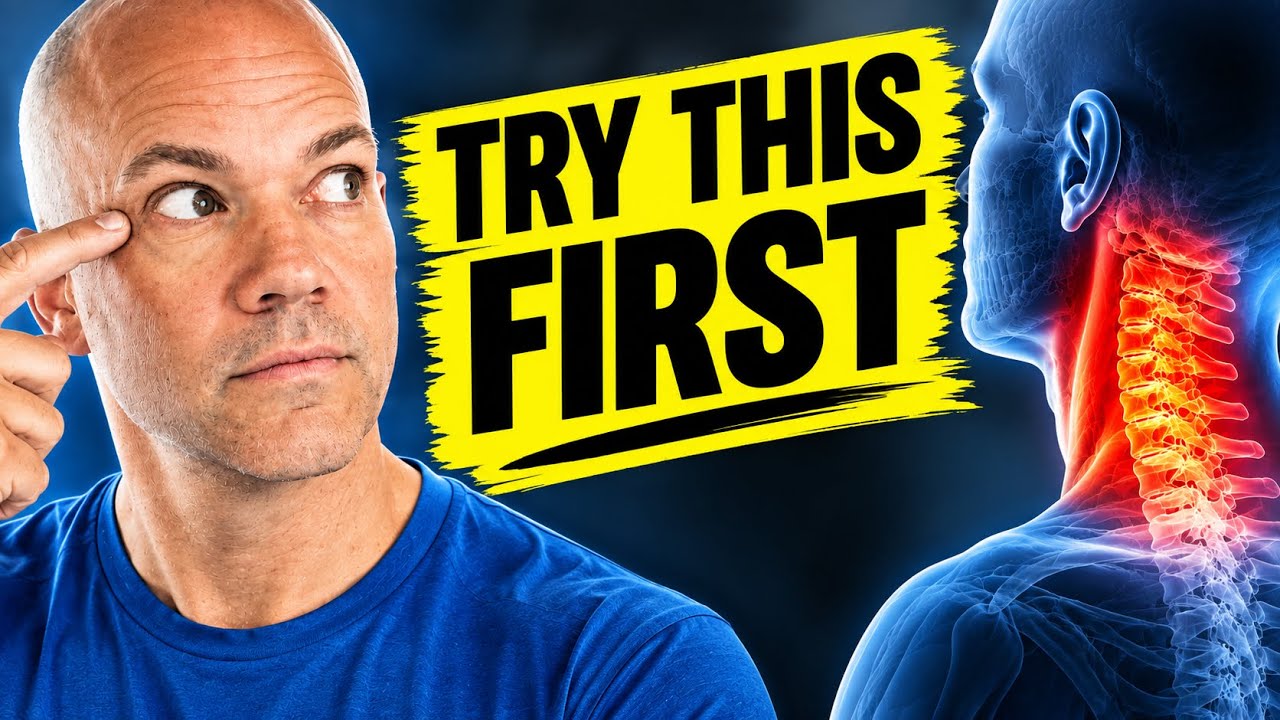
Your eyes and inner ear control how tight your neck feels. Try these two exercises: follow your thumb with just your eyes while keeping your head still, then keep your eyes on a target while turning your head. Most people notice their neck moves better right after.
Chapters
If your neck feels tight or stiff when you try to turn it, don't stretch it. Try this first. What I'm going to have you do is just test where your neck can move. So turn it to the right and turn it to the left. And we're not trying to force it into a big range of motion. We're just trying to get an idea of how far does it really go on its own. Now, from there, what I want you to do is if we're going to test to the right, get an idea of how far you can go. Come back to the middle. We're going to turn our eyes all the way to the left. So you're looking over to the left and you're going to hold them there. Now turn your head to the right, again keeping your eyes over here, and see what you feel. Try the same thing the other way. Turn your head to the left, come back, keep your eyes to the right, and now turn your head left and see what happens. Now there's no right or wrong answer here, but the idea is it shows that your eyes can impact how your neck moves, which means if there's stiffness or pain in your neck, that your eyes can definitely have something to do with that. So what I want you to do is try this quick, simple drill. We're going to do what's called a smooth pursuit and see how it impacts our neck movement. So once again, let's get that baseline. Turn your head to the right. See how far you can go comfortably. How does it feel? Is there any restriction, any pain? Do the same thing to the left. And that's your baseline assessment. Now what we're going to do is we're going to take our thumb, we're going to put it out in front of us. You're going to have it at eye level, and you're just going to follow it with your eyes left and right. Now, only go as far as you're comfortable going. Don't feel like you need to get way out here beyond your range that your eyes can actually go, but we're keeping the head still and just following it left and right. So we're going to do that 5 times, about 1 second in each direction each time. So you're doing this about 10 seconds total. Then we're going to take this one step further. We're going to do a VOR. Now I did another video on VOR. You can find that one right here. So what we're going to do is we're going to keep the eyes on the target, tuck the chin just a little bit, and we're going to turn the head left and right, keeping the eyes on that target the whole time. Same pace, about 10 times, 1 second in each direction. So now that we've done that, we're going to reassess and see how much that impacted our neck movement. So we're going to turn our head to the right and just see if it's any better. We're going to turn our head to the left and see if that's any better. Notice if there's— if it feels any different, if there's any less restriction or anything like that. So now that you've seen that the eyes do impact the neck, let's talk about what's really going on. It's common to think that the muscular system in the neck works independently of the visual system, which works independently of the vestibular system. And so on, but that's not true. The brain takes in all of this information from all of these systems and determines what's happening around you. And if it feels that something is not safe, then it is going to limit your movement or even give you pain. So what we've done here is we've just started to get the eyes to move in a different way to allow the neck to move better because the brain now thinks it's safer. So when you move your eyes, you're not just moving your eyes. You're changing the sensory information going to the brain, and that's telling the entire system how to move. So we don't need to force the neck with a big stretch to get it to move better. We just need to investigate all of the systems playing a role in that, and in this case, we use the visual system. So the next time your neck feels tight, don't assume you need to do a big stretch or get a deep tissue massage to make it feel better. That may help, but try doing simple things like visual exercises and vestibular exercises and see if that helps it to improve. So if you got a noticeable difference from this, let me know in the comments below how it worked for you and what kind of difference you felt. And if you want more information like this, like and subscribe so that you can see the videos that I post every week. And until next time, live healthy.