Building Strong Relationships with Technicians | CSR / Dispatcher Lunch & Learn Sessions
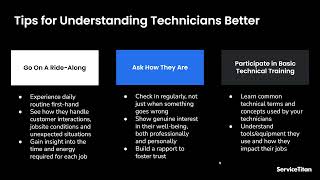
CSRs and dispatchers learn how field technicians face hoarding, pet smells, extreme weather, and safety risks. Ride-alongs, check-ins, better job details, and public recognition improve morale and first-time fixes.
All right, so today's topic is on building strong relationships with technicians. So this is a big one for dispatchers, but it can also be a big one for our CSRs too. And I know that we're all, all thinking, why do we need to focus on this when our main priority is making our customers happy? But if you really think about it, happy and well respected technicians turn into better performing technicians. It's more likely that they're going to have first time fixes, quick, quicker fixes. They're not going to have as many errors. So they're happy, they're performing better. And that ultimately also leads to happy customers. So this does really cater to that ultimate goal of serving our customers well. This also can affect a bunch of other things. Offhand, we know that it's going to make their job satisfaction better. It's probably going to make your job satisfaction better too. It's going to increase morale, it's going to increase team collaboration. You're going to see better problem solving and communication, good consistency in service. So it just really does have a big trickle down effect. So something I really recommend prioritizing if you can. So I do want to open it up to the group. What are some things that our technicians are going to face out in the field that we are not going to face in the office? And feel free to come off mute if you're comfortable. You're also welcome to drop it in the chat if you're more comfortable sharing there. And don't be shy. I will call on you.
Anything.
I have something.
Go ahead, Michelle. Thank you.
So we've been doing songs in the office. This was our first week doing it and I went on my ride along and there was eight cat boxes and the smell was just overwhelming. And the text said that that's something that they deal with often.
Really? That's a good one. You're gonna say a pet smell. Like cat smell. Yeah.
Yeah.
The pictures that they take is disgusting. I can smell them through the screen.
Oh my gosh. See, I didn't even think of that one. I'm so glad I asked y' all because that's not even one that crossed my mind. But true. Yes. Bad.
I cannot wait to change my clothes. Like, it was gross. So.
Oh, man. Wow, that's a great one. Thank you, ladies, both of you. Sarah, I just saw you come off mute. What do you have? We have a couple of houses that have hoarding situations. That's a great one. Yes. That's so uncomfortable. Right? Because if you're trying to Navigate around things. What if they have a stack of things in front of the access panel they need to get to? Or the closet that the water heaters in or that the furnace is in? I mean, it's so uncomfortable. That's another great one. Y' all are bringing up things I didn't even think of. There's so many things. What else is out there? We were just talking about weather. I'll give you a hint. Traffic. Oh, my gosh. Talk about one thing I wish we could just eliminate with the snap. The thanos snap is traffic. I can't stand sitting in traffic. And they deal with it every day. Oh, it's horrible.
I had a tech who, the lady swears that I quoted a price and it was way lower than what our prices were, and she started crying.
Oh, no. Talk about uncomfortable. Especially for a technician, like a male that's really uncomfortable around a female crying. No, don't cry. Amanda, you said bad service. Are you talking about cell service? Yes. That is so annoying too. They are not on WI fi usually. That's super annoying. Oh, my gosh. These are great ones. Does anybody else have others that come to mind before I share the six I came up with? We've had technicians before at places I've worked that have had to get out in like the snow and stuff and have actually been stuck. We've had to go pull them out at four in the morning at Papal Styles.
Yes.
That's. See, that's crazy. It doesn't matter if it's raining, snowing, they have to go. They're going out in crazy weather sometimes. And not only is it uncomfortable, but sometimes it's unsafe and they. They just do it. It's crazy. That's a great one, Paula. Thank you. All right. Those were so awesome. Thank you so much, everybody that shared some of the ones that I thought of. Weather conditions. Paula mentioned again, they don't get to choose what it's like outside. And also on top of that, think of. I mean, I'm in Houston again. It get godly hot in the summer and all of our stuff is up in the attic. So think about how hot it is outside. If it's 110, it's probably 130 up in that attic. And it's just disgusting. They have to deal with that. And while we're sitting in air conditioning or heating, depending on the time of year, they also have unpredictable job sites. So think about those cat litter boxes. Sometimes, like I'll tell you, in my house, the crawl space in my attic is Horrible. A lot of contractors won't touch it because they're afraid of falling through the ceiling. Maybe they need a really sketchy ladder or there's an access hole that they can't get to. You never know. Especially on a new customer's job site, you have no idea what you're going to run into. Physical demands, they're lifting heavy things a lot. Again, being out in the elements is really hard. Amanda or. Sorry. Yeah, no, it was Amanda. Amanda mentioned traffic. They're in their vehicles a lot. And we know sitting in vehicles can be very uncomfortable depending on what you're driving. So hopefully they all have chiropractic memberships. And then we talked about customer expectations on site. If they thought the price was going to be lower, they might get emotional. We also know sometimes customers might be standing over them asking, hey, how much longer? How much longer? Especially if you're on time and materials and they're getting charged by the minute. So that can be. That can be crazy, too, because think about when we're on the phone and a customer says something funny to us. We can make a face and they're not going to see it. Technicians can't. They can't. They got to control their faces. Right. They also have that pressure of finishing on time. Maybe they have a job lingering and they have to get to that one on time. But they also don't want to rush and make their job not. Not perform as well. They want to get everything done in a timely manner manner, but make it also high quality, too, and safety hazards. I mean, like I mentioned, my crawl space is terrible. Nobody wants to crawl through attics and scale on roofs and everything. So just if you're ever getting frustrated with a technician, put yourself in their shoes for a second and just remember all of the crazy things that they're having to deal with on a daily basis that they're not even sometimes warned about. Any thoughts on that? Anything else come to mind before we move on off of this topic? Off of technician perspective? Awesome. Thank you all so much. Y' all have been so engaging so far. So I wanted to give some tips on how we can understand technicians better. Michelle mentioned she just went on a ride along. Highly, highly recommend a ride along. In fact, I think it should. Not even just for CSRs and dispatchers. I think everybody should go on a ride along so you can experience that routine firsthand. See what it's like interacting with customers face to face. Look at some of those job site conditions. If you're able, get in that attic with them and just feel that heat. And then you can kind of see what they. What they're going through. On a daily basis, you're sitting in the van with them. That's not always fun. Vans are not very comfortable to sit in. Also, this is not on this slide. I think I might mention it later, but you may actually want to flip that too. See if the technicians can sit with you for a second because you're important, too. We. We want you both to understand each other. We're talking today about how to understand them better. But if they can sit in the office with you and listen to a call you're taking, they'll also understand you better as well. Also check in and ask how they are. Um, and not just when something's wrong, but maybe on a. On a daily basis. Hey, how are you doing today? Because if, you know, oh, little Jimmy's sick, he's probably not going to be on his A game that day because he's worried about his sick kid or whatever's going on. So if we have a good pulse on that, we can maybe lighten the load on their schedule or maybe we can give them a little bit more grace if something, something bad happens or if they speak to you funny, but check in with them and actually mean it and show genuine interest them. They're also going to be more willing to work with you if they feel like you care about them and just make it a point to really build a good rapport with them. I'm sure a lot of you already do this, by the way. I know it's so fun sometimes to have those friendships with technicians. It's just such an interesting and fun dynamic. Then also participate in some basic technical training. If you're an H vac or in plumbing or electrical, whatever the trade may be, there should be a basic 101 course that you can take. And if there's not, ask your technicians what is something that you want me to know so that I can support you better. What are some terms that would be helpful for me to know so that when you're speaking to me, I understand, and it's not like you're speaking Chinese to me. And then understand some of the tools and equipment that they use that's really important to them? For example, when I worked in plumbing, I just thought a drain snake, they were all the same size. Apparently there's a bunch of different sizes. And so they would be out on a job site and say, I need the other one. I'm like, what's wrong with the One you got. Oh, well, it's not long enough, but I didn't know that. So it's important to kind of understand those two. Adrian said our office tries to keep the CSR and the text to not work together. The DSR should be the only one that interacts with the tech. I totally agree with that. Absolutely, 100% agree with that. I don't know if you do the same thing, Adrian, but the way that we used to do it is if the DSRs were in a meeting or if the phones were just going crazy and there were too many technicians on the line, the csrs were the backup for that. I don't know if you'll do that, too, but I do know that there are going to be some ways in which you probably cross over with them. And one I can think of is if a customer reaches out and says, hey, your technician did really, really well today, call them up, tell them that. I mean, I don't know if your company has a policy against interacting with the tech, but you should be able to, in my opinion, at least tell them, hey, you got really good feedback today from a customer. I just want you to know that. Awesome. And then some effective communication strategies. So even if you are not talking directly to that technician, there's some things you can do to support them. So one is gathering all the important details. So CSRs are the ones taking the calls. So we want to make sure we're asking all the right questions, utilizing those job summaries and custom fields so that we can remember what those questions are. That way, when that technician goes on site, he feels prepared. Even if he hasn't seen the job before, he knows everything that you know, everything that the customer wants him to know or her to know. So make sure you're gathering all of those important job details, giving timely updates. So if the customer has anything that they need that technician to know, letting him know as soon as possible if it's urgent, being as proactive as possible with them. And then also if you are talking directly to the technician, engaging in active listening, and I'm pretty sure all of us know what that is, but just in case you don't, active listening means repeating back what that technician is saying to you to show understanding. So if the technician says, I'm nervous, I'm not going to make my next call on time and it's making me feel rushed. Okay, I understand. I think you said that you are starting to get stressed and it's affecting the quality of your work. You're running a Little bit behind what? And sorry, I totally butchered that, but I think you understand what I mean. We're repeating back what they're saying. We're showing that we understand what's going on in the emotion associated with it. Any questions so far, Adrienne? I want to make sure I address your comment really quick.
Just.
Just want to make sure that that made sense as to why we're talking about this for csrs, too.
Oh, yeah, you're good.
Okay, cool. Awesome. Any questions so far? Any comments? Even if there's anything I miss, I want to know. I want you guys to be able to weigh in too, if you have good feedback. All right, next up, going above and beyond fear, technicians. So this might be more on the. Actually, no, it'll be on CSR side, too. One is up your technicians to your customers. So when you're talking to your customer, if you already know who that technician is, feel free to highlight their expertise, talk about how awesome they are. Maybe if they've been to your house before, you can say, oh, man, they just. They just helped me install a new garbage disposal, and I love it. They did such a great job. They even put my sink back together, put underneath my sink back together in a more organized manner before they left. So just tee up that great experience for both parties. And then again, if you hear positive feedback from a customer, make sure you tell the technician, because that's going to make their day. In a lot of cases, we also want to try and take note of special days or special interests. So if you can take note of their birthday, maybe anniversaries, work anniversaries, kids, birthdays, that kind of stuff that will make them feel really special, even that you just remembered. So consider like one of those perpetual written calendars or a digital calendar that can remind you so that you can remember and say something to them and then also take note of their interest, too. Especially if those interests are common. I had a plumber. We had the same favorite birth baseball team. So we were always talking about how our baseball team did, and it was. It was great. Because even if he was having a bad day. Hey, Astros won last night. Oh, I. I shouldn't have said Astros. Now everybody on this call is going to hate me. Amanda said we do birthday and anniversary gifts. That's awesome. Amand, do you mind sharing? Sharing what those gifts are?
Can you hear me okay?
Yes, I can.
So any new employee we get, we have them fill out an about me sheet. So it's got a list of, like, favorite things, gift Cards that they would want. So actually our dispatcher, Amber, utilizes that sheet and just gets them a small gift. Sometimes it's their favorite food and drink. We've talked about kind of upping that for anniversaries and maybe doing, like, gift cards. Right now. It's just like a small little, typically, like food and beverage to get them by through the day as a thank you for all they do and a happy birthday. And we get the day off and they get the day off paid.
Okay, we love that. We love free day offs. That's amazing. I also love the favorite things idea. That's so great. Especially if you have it in a binder that's accessible to everyone. Like, we had a technician that really, really loved Sonic Cherry Limeade. And so once in a while our dispatcher would run out for lunch and she'd figure out which job site he was at and go bring him one. And you can do that with anybody. If there's somebody you're trying to brighten their day and you want to just bring them a soda, you can check the binder and see what that soda is. So great idea. Thank you, Amanda, for calling that out.
Yeah, one thing too, is in your, like, extreme weather. One thing that we found that kind of goes above and beyond for our field team, like extreme heat is doing goodie bags and sneaking out and hiding in their trucks with like, Gatorade cooling rags, things like that too. And that's really built, I think, rapport over the years because it's not expected.
Oh, I love that so much. Especially if your company is letting you do it as the CSR dispatcher, it just, it just makes that relationship so much sweeter and it makes them look at you differently. Oh, I love that. I love that so much. Paula said a company I worked for gave everyone their favorite drink and candy for their birthday, and we always recognize them during weekly meetings. I love that. And it's so simple. You have everything written down and you. And everybody remembers, like, oh, I love Snickers and diet lemonade from Chick Fil A. Like, I'll make my birthday every year, every time. That's amazing. Awesome. I also just want to say hi to Angie. Hello. Hey.
Sorry I'm late. My other webinar.
That's okay. And then lastly, we've already kind of talked about this a little bit, but shout out your technicians and make sure they see it. It's one thing to just tell their manager, but it's another to in an all hands company meeting, shouting out that technician like, hey, I just talked to this customer. They had a rave review or hey, they just did something at my house and it was amazing. But just really blowing them up is going to make them feel so good and it's going to make them feel really respected by you too. And they're more likely to collaborate more effectively with you when you're doing that. As far as going above and beyond for our technicians, does anybody else have other ideas or things that they do to try and make their technicians feel special above and beyond the day to day? If you think of anything, drop it in the chat. I'd love to know. All right, all right. How can managers help? So sometimes there are things that a manager could do proactively to help foster that CSR tech or DSR tech relationship. One is get a feed feedback loop going. Make sure your asking for feedback from both the technicians and the office staff. How's communication going? Is there anything that could be improved? It could be as simple as having a suggestion box. I know how silly that sounds, but sometimes people just don't feel comfortable sharing. So if they're able to just drop it in the box, that's enough in my opinion. Establishing solid procedures, it's so important to have those procedures in place because sometimes CSR or DSR versus a technician, they might be arguing over something that happened and they have very different opinions on what happened. But if we have a solid procedure to look back on and say no, no, no, in this scenario, XYZ is what we do, then there's no room for that argument to happen. So that's another reason. There's so many reasons why procedures are important, but that's one that stands out to me is just avoiding conflict if at all possible and then also setting up those collaboration opportunities. So we talked about ride alongs, maybe establish a routine for it. If at minimum, maybe when a new hire starts, that's part of their onboarding. If you can afford it, maybe on an annual basis at least going on one ride along and it doesn't even have to be for the whole day. But also having that technician shadow your CSR or DSR so that they can also see what you're doing and they can understand you better too. Any feedback on how managers can help? Is there anything else that we can do proactively to set up our CSRs and dispatchers for success? Angie, what do you think? Is there anything else you would add here?
You know, I think making it part of the process, like just making technician and CSR office collaboration like a standard opera like it's something we do. Providing opportunities for that. Providing opportunities. I think I may have shared this on a previous call and maybe you shared this earlier in the presentation somewhere. But I think one time in our company we had a. I split the team into two teams. So I had technicians and CSRs on a team. I had them on, on another team and we had this contest to see who could sell the most memberships. And I know sometimes members can be a, a touchy subject, but like is it okay if the office sells them or should we just leave them for the technicians to sell them? But it was like, no, you're on the same team and we want everybody to sell them. So it was a contest between that and. So we created that opportunity for them to work together and to cheer each other on and to do that together. And the winning team, I think I told you it was our steak and beans contest. So at the end of the month, the team that sold the most, they got to have steaks at the barbecue. The other team got hot dogs and beans. And so it was a competition. But I think providing opportunities like that for your, your csars to work closely with the technicians to have team building opportunities like that I think is a really fun way. So just be intentional with that as well. I'm sorry if you've already covered that.
No, no, that's great. No, I, I love that. Thank you for bringing that up. I do love having team building activities when you kind of grab like a technician and a CSR and a dispatcher and it just, they get to know each other so much better. So that's great. Thank you for call. Paula also said when I had technicians that I worked with daily for their schedules, I always thank them, each one personally every day for running the calls. I had to assign to them to show them I appreciated them for all they do for the company. But, but for me as well, that is so huge. Just showing gratitude. I don't think any of us show gratitude enough even just for the day to day things that we have, but also for each other. That is so awesome that you do that, Paula, because it's, it, it just, it makes them feel so loved and appreciated. That's a huge one. Tammy said we have meetings a couple of times a week with our CSR and go over calls. We practice pretending where the customer and see how the call goes. So funny you mentioned that Tammy. So funny because I. My next slide is about training. Training is not just for customer calls. You can actually role play talking to technicians too. And you might actually want to heavily consider that if you have new people coming in. I have on more than one occasion witnessed a new hire talking down to a technician and they just don't get it to them. They're like, oh well, these are just blue collar workers. They're rough. They, they. You can talk to them however you want. Not really. They actually are very sensitive, we're finding. I know you guys know that. So consider role playing technician communications too, not just your customer calls. And I also, I wanted to bring this up. I can't remember if I meant to say it earlier or just on this slide. The other reason for that is especially if you have a lot of men technicians, which the majority of technicians are men. Men have an inherent need to feel respected. So it is so important to, to practice speaking respectfully to them. I, this is an odd example, but my husband's company, one of his co workers actually just quit their company because one of the female employees, in response to him saying he wasn't feeling well, she told him, oh, just pop a Midol and change your socks. Like, excuse me, he quit the company over that. And it just goes to show how important respect is. That one comment like that meant he left the company completely, got a new job. So, so again, practicing, especially with new people, new hires is super important. And also we've done a training on this with Angie before, but consider doing company wide personality testing and training on it. Angie's done disc profiles in this lunch and learn before, so I don't know that that one's reported though I'm not.
Sure if it is. We may need to redo that one.
Yeah, I think so. I think so. Where there's also Myers Briggs, there's so many different ones. The one that we did here at Service Titan, similar to disc, but we had birds that were assigned to us. It was owl, parrot, I can't remember all of them.
Eagle, eagle, Dove, maybe. Maybe, yeah.
But if you're understanding how each of your people operate and communicate, then when you go to approach them, you're able to communicate with them better because you know what they expect from you and how, how to get your point across. Some people need you to be direct and some people need you to sugarcoat everything. Me? I need you to sugarcoat everything.
I think that's a really good point, Brittany. I remember when I first bought my business, I had one technician and he was the, I love talking to him over the phone as I was dispatching and he'd call me back and whenever I'd Give him his next call, he'd be like, thank you very much. And it was just like, he was so respectful to me. I just really appreciated him. I didn't know he was doing side work behind my back, but he smooth. You know, the way he treated me was so respectful other than the side work, but I just. I appreciated that. And it. When we were training our CSRs and dispatchers, that that level of respect and the way you speak to each other, it matters. And so when we're. We were. Were training on some of our customer service training and, you know, saying my pleasure versus no problem just because no one problem are two negative words and changing the language to my pleasure or you're welcome, two positive words. It changed. And they were very intentional about doing that with customers. And my. My dispatcher hated that. She's like, oh, I don't like to talk like that. I just. I don't like the words my pleasure out of my mouth. It's not how I talk. I. I say, no problem. And I'm like, well, no, you say my pleas. And. And so when she got so used to it that she got off the phone one day, she's like, I just said my pleasure to a technician. And I was like, yeah, because.
And.
But, you know, it changed, and it became a new level and a new standard of communication and respect between the dispatcher and the technicians and the CSRs and the technicians. And I appreciated that. And so I love that you touched on that, because I feel like that should be a standard that we set. I know. You know, co workers, sometimes it's fun to just, hey. And you tease around and you. You can kind of tease like that. But to. To be able to add that level of respect, I think is so important and can elevate. Elevate what you do.
Absolutely. Thank you, Ang. We'll. We'll do another disc training. I think it's so important. I think everybody should be one. Everyone should know what they are at least.
And we'll be doing them for Torch Network. If you're in Torch Network.
It's true. A couple weeks. Weeks. Sarah said. She said says you bet. To customers that were not a pleasure.
Well, it's better than you're a problem and I don't want to talk to you again.
It's better than hanging up, too. All right, y' all have been so engaged today. I really appreciate it. Some key takeaways that we have have your happy technicians will equal happy customers. Really work to understand your technician's perspective. Go on a ride along so that you can experience the weather and the cat litter boxes and all of the other awkward things that they have to deal with day to day. Prioritize communication, getting all of their job details to them. If you need to set up service Titan, well, to do that, do it whatever you can to make sure that they're prepared for that job and they feel comfortable. Make them feel special and loved on and then practice if you need to practice, practice, practice talking to those technicians. Michelle said, I always say I take care of my tech so they can take care of the customer. That is the, that's the note. That is the summary of what we're trying to get across here. Taking care of your text will take care of your customers too. Thank you for sharing that. Any questions that have come up or any other follow up comments that we have on this topic because you y' all have had some amazing things to say. Michelle, you're getting so many hearts. I'm going to add one.
There we go.
All right, we will go ahead and stop the recording there.
More from Bill



Capturing the 80%: How SmartAC’s Gen-2 Targets Non-Membership Homeowners | Podcast Ep. 296

Build better customer data with every booking in ServiceTitan | TAD Tune-Up Series

The Biggest Change for Roofers Coming From Other Roofing Software to #ServiceTitan?


