Data-Driven Growth and IT Crisis Management in the Trades | Podcast Ep. 213 | Toolbox for the Trades
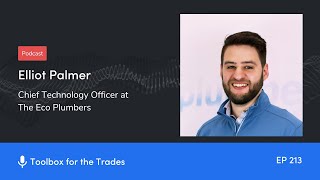
Elliot Palmer, CTO at Eco Plumbers, Electricians and HVAC Technicians, talks about moving from retail data work at Victoria's Secret into the trades, managing IT operations and KPI reporting, and how transparent metrics drive daily decisions at his company.
Elliot Palmer, you are the CTO at Eco Plumbers, Electricians and H vac Technicians. Thank you for joining me live here at Pantheon for Toolbox for the Trades.
Thank you for having me. It's, it's great to be here.
I am excited to chat with you. I'm going to ask you the question I ask every single person here, which is how did you get into the trades?
Well, that story is somewhat interesting. My dad runs a company called Jim Palmer's well Service in Columbus, Ohio. He's run that for almost 50 years now. Yeah. And has been doing it largely his whole life, doing well drilling back in the day and then just doing water well service and pump service. And so kind of, I grew up riding in the truck with him, getting tools out of the back of the truck, holding the flashlight. And then when I got older and cocky as a high schooler, he had me dig ditches and pull, pull pumps out of the ground and stuff. So despite the fact that I'm into technology now and have the very soft hands of only touching a keyboard, I have actually helped with some real work from time to time.
All right. Actually, I wasn't expecting that at all because before we hit record, you were telling me about all these brands that you worked for. So, like from your dad's. Well, business.
Yeah.
How did you end up at Ego?
Yeah. So I think also in that path I decided I didn't want to do that kind of work every day. Sure appreciate it. Believe that it's, you know, one of the most important things. It keeps our economy going, but wasn't particularly for me. So after high school I went to Ohio State, studied finance and economics and then eventually worked for Victoria's Secret and Bath and Body Works as a brand. Definitely a different product in the trades for sure, 100%. You know, a lot of very awkward things that you might say from a lingerie company were just commonplace in my day to day. I won't share them here, but if, you know, if anybody ever finds me, I'll regale them with those fun titles. Spent about eight years at Victoria's Secret and L Brands doing data quality, finance, payroll reporting, payroll testing, sales forecasting, customer analytics, data science. We could go on of my titles, but a pretty well rounded career or start of my career in data and technology.
Very cool. So do you feel like that was actually really helpful having you have this retailer experience and bringing it into the service industry?
Yeah, I do think so. You know, somebody asked me this question yesterday and they said, well, you came from this really different background. How did that get applied to the trades? And you know, I think overall, whether it's selling underwear for Victoria's Secret or it's selling home services, largely the metrics and the data is very much the same, right. Whether it's how many transactions we sold, how many people came into the store and how many did we convert, and how big was that average ticket. You know, those are the same fundamental metrics that we use in the home services that we use in retail. So it was a really natural transition. Very much the same type of data just communicated in a different way.
Very, very cool. So tell me a little bit about your day to day at Eco.
My day to day at Eco can go multiple directions because I both handle our data and our reporting and maybe more broadly our insights to the company as well as our IT and traditional, you know, swapping out computers, making sure technicians have iPads and Internet working. So my day to day varies a decent amount. But most days it's either developing new reporting and meeting with teams and making sure they know how to use our reports and what data works, as well as fixing reports that are broken and working with my team to help deliver that to the team. Or it could be a day where we have to just do all hands on deck because the Internet going down in a building, we need to get hotspots set up and backups set up for teams and working with my IT team to make that happen and communicate that out to the company.
Okay, well, IT emergencies, and we actually haven't talked about them that much on this podcast, which is actually very, very surprising. And I love that you're also in the weeds with that in addition to all of the reporting stuff.
Yes.
So what's your piece of advice for contractors listening who have one of those IT disaster days, not that the software they use ever has outages, but never that ever if they have any other outages. Like how do you heard stories of.
Other softwares that have had outages like that?
Perhaps, yes. How do you go about problem solving for that in real time?
I mean, I think as with so many emergencies, preparation is the first step. Right. Making sure that you have a process in place and backups in place. You know, for instance, if a said software went down, that you have manual backups in place, for instance, a list of jobs that were already on the board. So for instance, as a backup, we're automatically pulling jobs every minute from service site and that are currently still scheduled. So if for some reason it's difficult to get in for a Moment, there's a list of jobs readily available for dispatch to look in and they at least have the information for the techs to give to them at that time. We also have backups in case like say Internet goes down. A few months ago at&t went down across the country and we were an ATT provider. So you know, making sure that we have good communication with the techs and that dispatch is calling them directly and feeding them all the information and manually handling job connection that they can't input on their iPads because they don't have service. But it really just came down to having preparation in place and just making sure that was communicated to all of our teams.
All right, excellent advice. Preparedness is certainly key. So let's pivot a bit to how you're constantly using reports to actually take action on the business. So what are some of the most important reports for you guys at Ego?
You know, when I think about our kind of top five reports, it's probably not the quote unquote sexy reports that and really pretty dashboards. It's more about just the day to day tactical reporting. And in my, my talk that I'll give tomorrow, my number one report is, you know, just your piano. Just understanding if you're profitable or not on a, on a monthly basis at minimum. Right. That you've got your books closed, that you know if you're making money or not. Because we're all in this to make money. But beyond that, we have what we call our KPI report, which is just technician performance from service titan reformatted and matched with our goals for each technician. Because what I'll talk about a lot is when it comes down to reporting and it comes down to this business, there's really only two problems. It's either a people problem or it's a process problem. And our KPI report kind of helps uncover both of those because it tells you very quickly, is it a whole department that's not hitting our budgets or is it certain technicians that are, that are lagging behind and we need to coach them up? So it's a report that we send out daily that has pretty much a whole snapshot and can pretty much tell the entire story of how the business is operating at any given point. It doesn't give all the answers, but certainly if it is a people problem, you can quickly get to that one really quick and then we have subsequent reporting if it's a process problem. Beyond that, we have weekly scorecards that are more for management to see trends. Very similar performance KPIs really helps you see if it's a process problem or a manager problem. That's going to be something that happens over time. Right. That's not an individual piece. And then in the day we have something we call our operations board, which gives us how is our revenue, how are our calls stacked up for the day, and what high value calls do we have on the board that we can optimize in a simple dashboard that's really quick to view and really helps our managers get the day started and communicate effectively about strategies for the day.
That's awesome. So are these all reports that you just pull manually from ServiceTitan? Are these like ones that you've kind of customized with other tools? Tell me a bit about how you build these reports.
Yeah, so really this whole custom reporting is really what I was brought on the team for about five years ago. And you know, certainly Service Titan is advanced in that time, but you know, five years ago it was a little bare from what was capable in that standpoint. So we built a whole kind of infrastructure of extracting data from the API from custom reports and building our own kind of cloud data warehouse where then we can connect all these business intelligence tools or just simple spreadsheets and automation together to give us really fast insights at a really high level and at the level that our team needs to take action when ServiceTitan doesn't have that report there. One part of my talk will be a little bit about where do I think Service Titan data really shines in the tool? And that's when you're acting on jobs in the detail and you need to know what's happening on this job at this time. We need to manage these invoices and do this job costing. And I really see at that detail level it really shines. Cause it's all there. It's real time. It's absolutely what's happening. Where I think we can benefit sometimes in outside of Service Titan reporting is, you know, that that whole encompassing view of the business at one time and the way that you're used to seeing it and the metrics that you know are most important to your business and the way you like to see it is where I think it shines on the outside.
I would love to talk to you a bit about taking action on numbers and trends that you're seeing because you know, it's one part to actually build out these complex reports and it's a whole other thing to actually use them.
Absolutely.
Use them effectively. So given your experience and the way you think about things. How would you recommend folks to.
Yeah, and I think it's just integrating it into the weekly pulse of your business and having it in each of those places. So, for instance, we have a daily huddle, and we integrate these reports and this data into the daily huddle. And that's every morning looking at how the day is stacking up, what opportunities are on the board and what strategies do we need to take. Do we have enough calls or too many calls? Do we have the right calls or the wrong calls? And then that helps the team develop those strategies. On. Do we need to be way more involved in working with every tech for every call? Because every opportunity is the most important one of. And they shouldn't be leaving without making sure those options are there and everything like that. Or it's a day where it's, you know, 105 degrees outside and we've got a ton of maintenance on the board that we need to get rebooked, and we need to make sure the guys are ready to, you know, hand service all of those calls as much as we can. Right. And so really, on a daily basis, there are those flows with those reports. And then on a weekly basis, we have manager meetings and executive meetings where those will come in, and we'll use those to assess the performance of the business as well as monthly, quarterly, and then annually. Right. So I think it's finding your cadence and your pace and then getting the reports and data in there where you're making the decision so that they're in the right place at the right time.
Excellent answer. Given that you guys are so informed by numbers. Do you know, by the way, off the top of your head, how many people are at ECO?
We're about 350 employees right now.
The 350 employees, how familiar are they with your KPIs, with your reporting? You guys very transparent?
We're extremely transparent. Pretty much every wall in the building has some TV on it with some form of our reporting up at all times. Whether it's who's the leading salesperson for the day that updates every couple minutes with live sales data, or if it's our targets for the day, you know, which department is winning or losing in a given day or in our call center, who's booking the most calls. It's very much a part of how we've developed our spaces to put our data forefront so. So that people understand how we're doing, whether we're winning and losing on a daily basis, and ideally that people can make a faster decision about doing Something different in some sense, maybe, maybe we're too transparent. But as far as our over company culture goes, like we share just about everything and hide just about nothing, I.
Really don't see a downside when it comes to transparency. And this conversation has peaked up a little bit throughout the years that I've been doing this show. There's some people that want to keep their books pretty close to their chest, but then there's other folks that really believe that open book management is the most effective way to manage a team and get everyone on the same page. And I think I agree with that.
I absolutely agree with it because I think it just builds a lot of buy in from the team that they don't feel like something's being hidden from them, that they have a part in it. And I think that's really what we try to try to engage the team with.
All right, very cool. So what is your hope for the talk that you're going to give? What is your hope that people will leave your talk with?
The fundamentals are not that fancy, that we can build out all this complex structure. But at the end of the day, the most important things are starting slow and building the data and the reporting that you need to take action today. And that, that probably doesn't look as fancy as some of the things that you're going to get sold, but when you want it, you can build the capabilities to do that and you can do more with the data that you have.
What would you say to folks that have never considered the trades as an. I mean you're, you're a CTO at a plumbing H VAC and electrical company. Actually, I don't see that title that often. And so it's really incredible how this industry is just exploding, loaded with technology and all these opportunities. So what would you say to folks who are like, what are you doing at Eco when you used to be working for these like more recognizable brands? Like, what would you say to people?
I just think that there's so much opportunity, right. The space is maturing year in and year out and I think more of these companies are bringing even more sophistication over time and that there is a lot of opportunity for technology and impact. I mean, I think one of the reasons I came from retail to the trades is that, you know, if you're selling really fancy, expensive underwear, we can make up all the meaning in the world about that. But when I think about the trades or solving real problems for real people on a daily basis, right, Somebody has sewage coming up out of their basement or they're legitimately in an unsafe environment because it's too hot outside. Right.
Yeah.
You know, providing these services can actually save lives. And it's part of public health. And there's so many reasons that it's a very essential product. And the very essential services that we do that I think I can find real meaning, find supporting that through technology.
Amazing. Elliot, thanks so much for stopping by Toolbox for the trades and chatting with me today.
It was a great time. Thank you.
More from Bill



Capturing the 80%: How SmartAC’s Gen-2 Targets Non-Membership Homeowners | Podcast Ep. 296

Build better customer data with every booking in ServiceTitan | TAD Tune-Up Series

The Biggest Change for Roofers Coming From Other Roofing Software to #ServiceTitan?


