Fix Sales First: The Key to Growing Your Commercial Service Business| Podcast Ep. 237
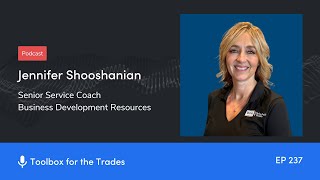
Jennifer Shushanian, a service coach at BDR, explains why commercial service businesses should fix their sales process before scaling. She covers pricing for profit, building maintenance agreements, and matching clients to team capabilities, drawing on 21 years of coaching experience.
Questions this video answers
From $600,000 per year to $2.3 million per year (with fewer technicians).
21 years (joined as the first remote coach).
At minimum $2 to $4 in repair and replacement work for every $1 spent on commercial maintenance (often higher).
80% of sales happen on the 5th to the 12th contact.
Hello, contractors and welcome to Toolbox for the Trades. My name is Jackie Aubel and today I am chatting with Jennifer Shushanian, a senior service coach at bdr. Jennifer is an expert at growing and scaling commercial service departments and she shares a wealth of information during our interview. I hope you find our conversation as insightful as I did. Jennifer Shushanian, you are the senior service coach at bdr. Today you and I are going to be talking about building a strong commercial social service department with foundations for sustainable growth. Welcome to the Toolbox for the Trades podcast.
Hi, Jackie. Thank you so much. I'm excited to be a part of it. So thank you for having me on.
Thanks for joining me. So we're going to kick this off with an icebreaker like I love to do. What is the best piece of advice you've received?
It's actually easy. I've been carrying it my whole life. My parents are very much about honesty and integrity, but my dad always said to me above all else, do what's right even if it's hard. And so whether that's in our personal life or work life, you know, I've always lived by that. Do what's right even when it's hard.
I love that. That's a great and wonderful wholesome answer. So let's get into the beginning. How did you get into the trades?
So earlier in my life I was part of a family owned plumbing business and they focus primarily on new construction. We'll just say life moved in a different direction and I joined an H Vac contractor in the Portland market as their new construction coordinator. The skills were very transferable. And then a short time after that, Jay Cut Heening was looking to expand their new construction department and they acquired the company I was working for along with some of the team members. And so then I have stayed in the industry since that time.
Oh, got it. So you started actually in a family owned. Was it your own family plumbing business? Your own family's plumbing business?
It was my husband's. Yeah.
Okay, there you go. And then so you eventually made the transition over to H Vac, your. The place that you started working at. They eventually got acquired by Jacobs Heating and Air where you then stayed for 13 years.
I did, I did, yeah.
And you held various roles there becoming before becoming the service manager. So I would love to know what were some of the key lessons you learned in those initial roles that helped you later in management?
Absolutely. I was not in management before I became the service manager. The second half of my career was a service manager. At Jacobs Heating the first half of that career, again, that was several different positions. And I'm very much about people, you know, you have to have the right people on board and the right culture. And so for me, having positive workplace relationships with my co workers and creating a positive culture was very important. And I saw the results of that by improving the that in the departments I was in, increasing the communication and improving the relationships. And then the second piece I saw the benefit from was building out solid workflows and procedures. And when we looked at our new construction specifically, the manager said to me at one point, he said, jennifer, how does all this get done? And I literally processed it, mapped it on blueprint paper and put it on his wall. And so literally drawing out a process map or a flowchart so he could see what. How each step in the process occurred. And then when I stepped back from that, it helped me identify what procedures really needed to be developed so that the department could become scalable. And those became really important as well when I moved out of that department and became the service manager. So it made the training process of any new person coming on board much easier. I like to fix things and I like to know what the plan is. Now I can go on the fly and I can fix things on the fly, but I like to know what is our primary way of doing things. So doing those two things were very helpful into moving into that service management role. Got it.
I have a question. When your boss at the time asked you, like, how does all of this get done? And you process mapped it on blueprint paper, was that the first time you were ever writing it down or were you just making wow. And so you just had it all in your head and was there a moment where you were like, oh, I should really like standardize this and I should really like put it in writing so everyone else understands it.
And that's what led into the building of the procedures, you know, and then I realized, I was like, there was all this stuff in my head, but the manager didn't know how to do it. And once we had that process mapped, then others could come in and see. I'm like, hey, look, you know, when you miss this step in the process, we don't get the right sales information. Look at how many things downstream from here could be negatively impacted by our service delivery or getting this job done efficiently. And that has proved true today, especially in service operations. You know, when you start process mapping things like that, it really exposes where your opportunities are, but also what procedures do I really need to get documented. That's when it became very apparent to me that I needed to get what was in my head, out of my head and on paper. Because what if something happened to me or what if I wasn't there? Who would step in and know what those steps would be? So.
Exactly. Yeah, I know this is something that continuously comes up on the show is the importance of having systems written down, processes written down and updated and, you know, kept in a nice place and train people on that, laying the foundations for sustainable growth. So I'm so happy that you kind of had that moment early on in your career and it definitely, I know, informed the work you continue to do at Jacobs and then what you're doing now at bbr. So you eventually made it to the service manager level at Jacobs Heating, where you grew the department from 600,000 a year to 2.3 annually with actually fewer technicians. And I want to hear a little bit about what were the initial challenges you faced in this role and what strategies you implemented to achieve such significant growth and increased profitability.
One of the first challenges was the team. And so as I mentioned earlier about the importance of having a really good team, the team really wasn't happy, you know, and people that aren't happy within their. That wasn't the case throughout the whole company. This department needed a reset and that's why they made a decision to make a change. And so really with the people was building relationship with them and they needed that reset. They needed consistent and positive leadership and they needed their voices to be heard. And so being able to create that communication and open that up. And then once we opened up that communication, we were able to start coming together with what are the root challenges and things that we need to overcome. I mean, at one point I literally had a suggestion box outside my office door because once I opened the, like, hey, this is an open door, you got an issue, let's talk about it. They just started flooding in and I couldn't keep up with them. We would literally at our service meetings, draw one out of the box and say, is this one we want to work on today? You know, and so by doing that and opening up the communication, when we would start to make change or improvements, I had everybody's buy in because you can't make change or progress if you don't have people coming along with you on that journey. And so those kind of, those kind of really come together and building that relationship and then couple that. I was a young female service manager and at that time I was responsible for technicians that were older than my father. And so I didn't see that necessarily as an issue. But what I knew is do the right thing, be honest, upright, and follow through and treat them with respect. And so we had a very mutual respect for each other as that went on. And I always told them, look, I'm not here. I'm only technical enough to be dangerous. You guys are the professional. What I want to do is bring what you are doing and bring our process together so we can, you know, be the best that we can. And so I never got into that like technical power struggle that maybe some other managers that maybe have come up through the field have had to deal with. So they, the technicians were able to share their knowledge and then we could come to solutions and the office staff as well, but really just the people that part of it that was what first significant piece in it, this other component was kind of put together is I. I knew just a few things when I started in service. I needed knew we needed to make sure our pricing was set for profitability and once that's the case, make sure we're billing for all, bill and collect for all the work that we do. Can't do any of that without having calls on the schedule. And then when we have those calls on the schedule, are we getting them done in the most efficient way possible? And so focusing on those items, that's really. That first year as a service manager was really just kind of getting my bearings straight. And then I had the privilege and opportunity to have Bruce Wiseman, one of the owners of bdr, become my coach and provide me with more resources and tools and just point me in the direction I needed to continue to move forward on.
Yeah, and we're going to talk about Bruce in a second, but before we do, I love how you talked about your time as a service manager and really turning that department around. I know it's been a while since you were in this, but could you get a little bit more specific about what were some of the people issues that you were seeing in terms of. You mentioned like maybe the leadership wasn't quite there, but I would love it if you could get specific a bit.
So a lot of unhappy people as a result of lack of consistent leadership. So not following processes, people running rogue, you know, like not being at work on time. Some of the core things that you need to have with any business, you know, people need to show up and they've known me for a long time because I'd worked for the company, but Now I'm their service manager. What does she know about service? So my role was really to break that down is like, honestly, I don't know anything about service. You guys need to teach me the technical side of it. But here's what I do know. I know how to fix things in an organization, in an office. I know how to build out procedures. I know how to provide excellent customer service. And I'm big on making sure that we can get everything done as efficiently as possible. And I said, so you guys need to teach me the rest. You need help me understand what that looks like and how what you do in the field brings that together from the office and really completes the wheel so that we can have a strong, profitable, growing service department. Because that really just benefits all of us.
Yeah, I can see how not having specific rules and processes in place can cause a lot of unease and unpredictability. That can make people feel frustrated and kind of on high alert in a job capacity.
Yeah, there were some great people and, you know, ownership. Brent Jacobs knew a change needed to be made, and he made the hard decision and made the change, even knowing that it was going to cause a bump in the process. But if he hadn't made that change, their service department wouldn't have have been able to grow and flourish and get better. Because Brent always had a mind geared towards the importance of service. That was a blessing to me. There's different theories out there in business, service exists to help, support, install, or the necessary evil. But that was never how Brent looked at it. He knew that it could be a profit center because it had been a profit center. And then when Bruce Wiseman joined on to help our company as well, he had that same mindset. And so, you know, we have a. We have a saying at bdr. Your business, to make a profit every day. Let's do that, you know, and so we don't. We. We focus on building that service department to be a profitable resource to the company.
So let's talk about Bruce Weissman, presently the owner of bdr, and he coached you at Jacob's Heating. So how did this experience influence your decision to join BDR as a coach?
Just a little backstory behind that is I was relocating from Oregon to Michigan. I knew I wanted to stay in the industry, but hadn't really determined if I wanted to be a service manager, if I wanted to go into sales, maybe did I want to work on the distribution side. When Bruce started talking to me about joining bdr, I had two people, primarily in the industry that have had a substantial influence over how I learned service and really being mentored. And that was Brett Jacobs, who was the owner of Jacobs Heating, and Bruce Wiseman. And he was my coach. And so any good coach knows how to build a relationship with those that they're working with. And with that. It was a level what actually made me decide to go ahead and do that. It was that level of trust I had with my coach, Bruce, of trying something new. And it's not anything I had ever thought about doing. I actually laughed at him when he said, well, what are you going to do when you go to Michigan? I'm like, I don't know. Pretty sure they have heating and air conditioning there. And we talked about, you know, the different things. And he says, well, why don't you come to work for bdr? I was like, doing what? And he said to me, working with companies one on one, leading training classes, and helping others do what you did here at Jacob's Heating. And so with the trust that I had with Bruce and what I had learned over that period of time, it really fit in my DNA, because I thrive on helping others be successful. It's not my success that wins. It's for me. I don't feel successful if those that I'm working with or the team that I work with isn't successful. And I like to fix things.
I like, I was just gonna say that. Yeah, you mentioned you're like, I like to fix things. So, like, put me on coach.
It did. So I joined BDR as their first remote coach over 21 years ago. And then so other than marrying my husband, it was one of the best decisions I ever made in my life.
That is awesome. That's so cool. So you've been coaching for 21 years. On top of the incredible experience you had as a service manager at Jacob's Heating, I want to kind of pivot now to this part of our conversation. We're going to talk about building a strong commercial service department. So what are the key elements or foundations that contractors should prioritize when they're looking to build a robust commercial service business?
So I work with a lot of companies that do residential and commercial, and many that are strictly the commercial mechanical. If we pull the residential side of that out, if you're just looking at the commercial side of the business, there's a couple things that I want to look at. First, assuming we have the right team members, right. We have the technicians that could do the work. That's all set aside because we can pivot off on that discussion for many hours. So let's make the assumption that we have individuals in place that we can provide good commercial service. These aren't necessarily in order, but all equally as important optimization of the labor. So when you look at your technicians, they are, you can't go just pick them off of a tree, right? And it's hard to find technicians. So we need to make sure that we're utilizing them as effectively, as efficiently as possible. So making sure through efficient scale scheduling and dispatching practices that we're really optimizing our labor so we can maximize profitability and efficiency as well. And of course also provide an excellent, you know, customer service experience as well. The second piece of building the right type of commercial service department is seeking out the right type of clients and types of work so that you can focus in on it like a laser and really provide a great service. So for example, if I had technicians that can handle 20 ton and under equipment, and I have maybe one technician that could work on larger equipment or more industrial equipment or chillers and things like that, seeking out that type of work wouldn't be a good fit because it set ourselves up potentially for failure. So build those clients, look at the type of clients you want to bring on board. Then seek out, actively seek out those type of commercial service customers that match the skill set of your team. Price the services to be profitable, and then be a reliable service provider. Keep your promises to your customers. What I love about commercial service, in many ways, it's less stressful in my mind than residential service. So I came from the background of new construction, right? So I'm used to relationships with builders. So they knew I do what I say I'm going to do. We kept our promises. I stayed in good communication with them. And so if we had to change something or have a negative impact on their schedule, certainly would be given grace because we've been successful in all these other ways. So you build those relationships. The same thing is true within commercial service. And that's what I really loved about commercial services. Now these are relationships where that you can build a trust and do the right thing for them. So those are some of the key things I look at, you know, price your service properly, get the right types of clients and mass match your skill set. You know, have good team, you know, technically be strategic in how you use your labor so that you can continue to provide the best service possible.
Man, when you, when you just scroll and you answered my question, you made it sound so easy, Jennifer. You made it sound so easy. And I'm curious, like in your coaching relationships with clients on the commercial side, you know, these are steps that I've heard. You know, we've been doing two walks of the trades now for almost we're heading towards 250 episodes, which is incredible. And a lot of themes pop up consistently, which is one of the reasons why I think the trades is such a cool place to work and to be in, because you have such a vast community that you can tap for resources because people are more or less doing the same thing. In your relationship with commercial contractors, like that list you just said that you just put forward sounds so like straightforward, like, duh, do that. What do you find yourself doing with your clients as they're trying to build up a commercial service department? And like those steps are pretty straightforward. What do you find that they're struggling with on Day to day? Is it staying on task? Is it, you know, keeping their eye on the prize? Is it like, what are the things that you are actually helping them realize.
Day to Day with any service department that I start working with, we have a saying at, at BDR Fix, sales first. So think about what that means for a moment, right? You've got to make sure you're pricing your services properly. And so we can be as effective and efficient as possible, have all the right client type of customers and those type of things. But if we haven't set our pricing structure correctly, then it's going to be much harder for us to be successful. And so when you look at that, I always go back on, and first of all, look at, looking at companies in individual costs. What price point did they need to be at to be profitable. This is where we, we start having a bit of a collision. And the collision comes with, well, we can't sell it for that. We can't do it for that much money. You know, Billboard Bob is offering it at, you know, this price. And so the first thing to overcome is, all right, let's identify that this is where we need to be, make sure our prices are serviced properly. And then what's really holding you back? Just really trying to find out what's holding them back from earning or being profitable. As well they should, as they should be because you owe it to your company to make sure that your departments are profitable because profitable for growth. That's how we, you know, build. That's how we offer more training. And those companies that are more profitable typically continue to grow because they, they've started to get, they have the fund funds to be able to do so, so just hitting that part where pricing what we can do in the marketplace and what we're worth and what we need to be so really bringing those numbers together and, and sometimes that could. Those are harder discussions.
Yeah, yeah. No, those are also really personal discussions from what I've talked to about entrepreneurs and I know Ellen Rohr, who's on our team now is very, very. That's one of her favorite things to talk about is pricing your services appropriately. And it can be a really emot. While you were at Jacob's Heating, you actually hired a commercial maintenance salesperson to grow the service department. And I want to hear more about the strategies you recommend for going to market and securing commercial maintenance agreements because we haven't talked about that much on the show.
So that's the, that's like setting the ground floor and the foundation for growing commercial service. It's true for residential service as well, but even more so with commercial service. And, and what I love about that again is you're building relationships and when you build those relationships, deliver on your service, your commercial service department will grow because as you're adding on new accounts, the retention is generally very high. On commercial maintenance agreements, they don't shop you nearly as often. And it's harder to go out and say, well, if you compare it to residential, right? You look at residential and somebody offers a tune up. That's. It's right there. Well, those commercial maintenance agreements, they're all custom pricing because every application is different. Your go to market, right? You have to define what your target market is. So there's five steps that you look through when, when you're looking to grow your service department, you've got that commercial maintenance base is what will help you flourish and grow. And it won't just impact the service department, it will also impact our installation department. Because when you look at, for every dollar spent in commercial maintenance, at a minimum, you should be getting 2 to $4 in repair and replacement work. That is a benchmark that has never failed me. And then even over the times, you know, as pricing increasing, the ratio is still the same. So you might, when you get a new account, that ratio might be a lot higher. It might be 15 or $20 for every dollar. Commercial maintenance, because the equipment needs to be replaced, you know, it hasn't been properly maintained. But over time you can look at it. If I have $100,000 in commercial agreements, I should at a minimum be getting 2 to $400,000 in repair placement work out of it. So that being said, it's really important. Define the target market. Review the company's current capabilities. Identify if there's any holes that need to be addressed. So when I talk about capabilities, it's also a skill set as well. So I'm going to identify what is the skill set of my service team. Do I have any holes that I need to address? Well, if we're doing well in commercial service, then our next is do we have the replacement capacities? Do we have control capabilities? Do we have design capabilities? So it's not just looking at reviewing your capabilities for your service department, but what does that look like for additional work in the future? So once you do identify what that looks like, then you can start identifying what type of clients and buildings fit within your capabilities. That was step two. Step three is to look at the geographic area. We don't have to be all things to everyone right out of the gate or even at work. When we look at the type of accounts in the geographic area, can we respond to them effectively? You know, where do we want to focus our business and stay within that circle before you accept expand out. And then step four, once you've put those pieces together, then you've got to look at where's my target market? And use different resources and tools and create your marketing list of your list of opportunities. It's going to start out, it might only start out with an address. Okay, I want these. I want 30,000 square feet, combination warehouse office space. Because that fits really good within our core capabilities. All right, I'm going to use different resources, third party resources to go get that information. Right? Okay, here's my list. Then you take that list and you start working, working it, trying to get those appointments. And then as you're going along and you're learning from those experiences, once you have this target market, start building out. It's literally a profile. What have you learned by each one of them? Have a market profile. So I want to know who the key technical decision makers are, who the actual financial decision makers are, because those could be the same or they could be different in that what type of systems are typical within that target market? What are the most common problems or motivations for them? Is it keeping overall expenses down? Is it making sure that they don't end up in the situation because they have a retail environment, that the problems we have is too hot or it's too cold and how it's impacting our customers, like understand that type of client so you know how best to serve them and then you build those out and then do they have any in house staff and what's the capabilities of their in house staff so that we're not going in. And if they've got somebody that's going to change the filters for them, well then maybe we only we're going in four times a year for service, but we're not doing monthly or quarterly filter changes. Right. So understanding that that comes through having a really good first sales appointment with them and then what other type of services do they outsource? Especially for those companies that are multi trade. So if you know you have a commercial company or even residential. Right. That commercial company, if they are multi trade. Now how do we start bringing in those commercial maintenance agreements to include plumbing service and maintenance and same with electrical as well. Create your list of opportunities and start pursuing, you know, the sales opportunities and trying to gain sales appointments.
That's incredibly detailed. Thank you for that answer. What I'm seeing kind of as a through line in the way you're talking about growing this profitable commercial service department is really being hyper aware of. If I'm the service manager of this commercial service department, right. I'm hyper aware of the skillset of my team members. I'm hyper aware of the needs of my clients and what types of clients we're specifically trying to target. I'm hyper aware of how much profit I'm pulling in from each job. And it's all of those. Being able to juggle all of those pieces and make sure they're working, they're working in tandem.
Exactly.
One of the questions I wanted to ask you like is about farming for commercial accounts for future replacement opportunities rather than waiting for equipment to fail early on. In the days of this podcast, a big sentiment I heard from mostly residential contractors was that residential was easy because it's cash on demand and there's a lot of opportunity there. And we kind of got, I kind of got this sense like commercial was a, was a different beast. Right. And I think you hearing you talk about the commercial maintenance system, I'm like, oh, of course, yeah, this is very different than a traditional residential maintenance program because this is tailored pricing. It's tailored services depending on what the building already has in terms of staff and what their needs are. So I want to hear a little bit about when we first talked, you talked about farming commercial accounts for future replacement opportunities rather than waiting for the equipment to fail. So tell me a little bit about that too.
I love this subject because I see it missed often with contractors and dealers. Right. And so when I look at this, when you bring that up. I, it gets me excited because I see so much opportunity with that account performance reviews at a minimum of once a year now there's more strategies behind that as well. So what's an account performance review at their anniversary date? Or if it's a larger one, you might even do this quarterly. Hey, we've estimated our commercial maintenance to take this amount of time. Are we meeting those expectations? I'm going to look at the pricing of the agreement to make sure that what was sold is being the same as what's executed. What was bid is what was did. Right. And so if we estimated this for 40 hours, are we getting it done in 40 hours or is it taking us 50? And if it is taking us longer, what do we need to look at? So I'm going to look at the performance of the agreement itself because that, that may dictate what their price increase might, might be. So once I look at that agreement on that account performance review, I'm also going to look at do they have any open service repairs? They haven't approved those service quotes. Why? Or when I look at the agreement, I'm like, wow, we're quoting all of these service repairs. They have us do the maintenance and diagnostic and emergency, but then they're shopping us on the repair that might not be an account that is really the best fit. You know, I want a relationship so that if we say this, what needs to be done, we're the ones doing that work. So then I'll also look at when I'm doing that performance review, do we have any service issues, any equipment that's aging? And we need to start having those discussions about budgeting. Okay, so just to back up, how much have they spent with us as well? So how much have they spent on commercial service repairs? How much have they spent with us on commercial maintenance? And then if we've done any replacement, what was the value of that? Because I wanted to go back and measure what that ratio is. Am I getting that two to four dollars in repair and replacement, Is it high, is it low? If it's low, we're missing something along the way. So that becomes one of your key indicators on your dashboard and your scoreboard. That's your check engine light. And if we're not getting that, then we go back to our processes and find out why. And there's a ton of reasons why those account performance reviews are critical. But along with that, not just reaching out to them just one time per year, maintaining a check in process, whether that be from the service manager or owner or the commercial maintenance salesperson, either one of those. And during that relationship, you need to know when they are doing their budgeting and planning. If we don't know that information, then we can't mine that opportunity quite as well. And so you want to be the first at the table to assist them on the replacement strategy. An example, recently, a newer account for me, but not for bdr, we started looking at pricing, fixed sales first going through all the process, and we were looking specifically at commercial service. This particular client brought one to the table. He went and did all of his homework and brought this information back. Really great account. They've been doing all of the repairs that have been quoted. The maintenance agreement is profitable. They've done multiple replacements, but they still have 22 replacement units that need to be done because all of this equipment is aging. And the average sale on that replacement is about 16 to $17,000. So when we're looking at pricing and should we increase this, we're going to keep that price increase very minimal because there's a substantial amount of opportunity there. They initially were not looking to start that performance review process. And after looking at this one, the service manager, it became very apparent to him, I need to find out when they're doing their budgeting. So what are those strategies for that replacement opportunity? Here's an estimated price subject to equipment price changes, right? Here's an estimated price price that if you need to fix it and you're doing a one at a time, here's your price. But what if we made it up a plan to do a certain number of them quarterly? Well, there's reduced mobilization to replace two rooftop units than it is one at a time. So really kind of showing. Well, if you replaced three units at a time per quarter, this is what your average price per system would be versus $17,000 if you're just doing it on emergency replacement. And then we looked at one more strategy was what would that price point be if they did the work during the shoulder season? So you know, what does that look like? And then you can start incorporating leasing, financing and things like that as well, depending on the client. So it's important circling back, it's important to know that you're doing, you have a good process for your performance reviews, but know when your client does their budgeting because if you don't, then you can't be a part of their strategies for. For replacement as effectively.
Well, Jennifer, if I wasn't already convinced that you were very knowledgeable from your title and tenure at BDR this podcast certainly did it, man. I thank you for sharing all of that information. I mean, that is great. And I'm sure our listeners are going to be thinking and taking some action on some of the stuff that you suggested today. I want to start bringing our conversation to a close. So what's one piece of advice you would give to a service manager today who's just starting to build out their commercial division?
Understand and build out your sales process. Because we know to grow the commercial service division, you need commercial maintenance accounts, right? That's your steadying force that keeps you from having seasonality, keeps you from having shoulder seasons in the service department. So you need to have a say, understand and build a sales process so that you hire a commercial maintenance salesperson. But you don't have to be a service manager that sells commercial maintenance. I didn't, but I knew the sales process and we constructed, you know, here's how you price them, here's what our proposal looks like. Here's what our renewal and terms and conditions are. This is what we expect when someone wants to entertain an option for commercial maintenance that we're going to do a site survey, we're going to gather all the information so we know that we can deliver on that service. So really understand what are the steps in the sales process to be able to grow that commercial maintenance and have some of that put together before you go hire a commercial salesperson. The right commercial maintenance salesperson. I got lucky the first time, really and truly. I made. I didn't hire the right people in other times as well. And I could tell so stories about that. But once you have that and it is a hard position to hire for, I think it is one of the hardest positions to find that right person. Because when you're looking for a commercial maintenance salesperson, you need to find a hunter, not somebody that sits back and waits for the work to come to them, that they're proactively seeking out those relationships, right? I joke with my commercial service managers. I was like, yeah, don't try to manage the salesperson. They're like, what do you mean? I said, because they're an individual that needs a level of flexibility, make sure they're following the sales process. But I don't try to micromanage a sales position. But what I do manage is their activity. So I know that you need to have X number of appointments per month to generate X number of proposals to get X number of sales, right? And so, but even before that, how many contacts do we need to start with to Start getting those appointments. So I'm watching that activity, and to be honest, I made my mistakes in that area. And I kept people on board longer than they should have because I wasn't fully managing that activity. And so really making sure you've got that piece, the other component, if you don't get it right, do the right thing. And most people, we all make mistakes. We have these relationships with our commercial accounts, and we might mess up once in a while, but be transparent about it, fix it, and make sure you have a high level of service people will allow you to make a mistake. It's how you recover from that that really matters. We have callbacks and warranties and things like that. And then when you're building out that commercial service division, make sure you're following up on all the recommended repairs and repair quotes that were sent to your customers and follow up on them frequently. Most contacts in the commercial service side, the H Vac systems are not their primary job function. They're CEOs, CFOs, they're the doctor, they're the dentist. They have all these other roles of just running the business. And so it's not always top of mind awareness that, hey, you need to get this done, and here's why. So you've got to follow up on recommended work. There's a statistic out there that I love, and it goes through several other components, like how often salespeople follow up or how often do we follow up on sales and the percentages. But the one that hits me the Most is that 80% of sales happen on the 5th to the 12th contact 5th to the 12th. And so if you think back to that, I can assure you that most do not follow up on open sales. And whether it's replacement or repair. And 48% of people, salespeople might have a potential prospect, and they don't even follow up on that. So, you know, you start looking at that. If 80% of sales are made on the 5th to the 12th contact, what do we need to do? Make sure we have a good process to follow up on any recommendations that are not being done. Because again, it's not their primary focus. It'll only become their primary focus when it breaks down.
And that fifth to 12th, that's specifically for commercial.
It's all sales.
Oh, wow.
Dang.
All right, well, Jennifer, thank you so much for sharing your expertise on today's show. Dude, I learned a lot and I know the people listening learned a lot, so thank you so much there. Any final words you want to leave us with.
Thank you so much. Appreciate you having us on here. And if there's any listeners that really want to expand on it more and learn, like all the steps to in building that commercial service department, we have a great training class that we do every year, our commercial maintenance sales class. And it's not just a sales class. It's all of these things encompass together on how to build the sales process, how do you manage the agreements in dispatch and all those components. I have not seen a lot of that training out in our industry, but it's something that we've been doing for a long period of time. And actually one of my favorite training classes that we lead.
Well, thank you so much for joining us on Toolbox for the Trades, Jennifer.
Thank you, Jackie. It's been it's been great.
More from Bill



Capturing the 80%: How SmartAC’s Gen-2 Targets Non-Membership Homeowners | Podcast Ep. 296

Build better customer data with every booking in ServiceTitan | TAD Tune-Up Series

The Biggest Change for Roofers Coming From Other Roofing Software to #ServiceTitan?


