Getting Unstuck: How to Break Through $1 Million | Podcast Ep. 36 | Mastering ServiceTitan
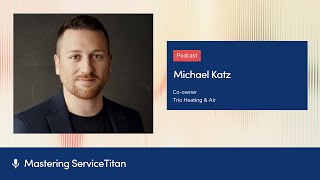
Michael Katz, co-owner of Trio Heating Air and Plumbing, grew his business from zero to nearly $10M in two years. He shares what it takes to hit your first million: pick one trade, answer calls fast, collect reviews, and keep processes simple. Start with job booking, dispatch, and follow-up in ServiceTitan.
If you did a bad experience and you haven't taken care of your customer and the customer gives you a negative review, you are a year behind on all the work you did for a few months. You have to work really hard. The customer has a gun to your head at that point. And that's the name of the game. Don't hate the player, hate the game.
Welcome to Mastering Service Titan, where you get expert advice from power users. I'm your host, Josh Luke, and today I'm joined by Michael Katz, the co owner at Trio Heating Air and Plumbing. And today's episode is a little bit different. We're doing a little mini series on getting to your first million, getting to 5 million, and what it takes to get to 10 million and beyond. I'm very excited to have you on, Michael, because I think you are the perfect person to have on to tell this story. So maybe to kick us off here, wanted to welcome you and could you share real quick, quick story, how you got into the business and what your growth numbers have looked like.
Thank you. Thank you. It's an honor to be here. I met with you last year at Service Lines Pantheon. I was excited to come up on this one to keep it short and to explain a little bit about my background and how Trio became about. So my brother and I started not in the heating and air conditioning industry. We started in construction, energy improvement. So we were doing installation sales. My story is interesting because I went from being the war salesperson to the top salesperson. From a person that would get fired from jobs pretty often to running an operation that's right now at 60 employees and grew really quickly. So how it really became about is my brother and I were really ambitious. You know, we learned that from my dad. My dad was a businessman and entrepreneur. We really had this kind of fire in us to do it on our own. So we moved here to California, San Francisco, about, I would say close, close to 10 years post. 10 years ago. It's going to be in November this year. We came in and started doing sales. My brother was doing really well. David, he was top sales guy in any company, worked at. He was making great money. For me, it was a little bit more of a struggle. I kind of came from, you know, sex, drugs and rock and roll lifestyle. So it was kind of a big transition for me. But at some point when I saw how well he was doing and you know, I, I wanted to do the same thing too, but it didn't necessarily work out for me. Long story short, after being fired from a Few places, I got an opportunity to work for a company he was working at. It was insulation company in the Bay Area, Oakland. I was about to be fired yet again because my numbers were horrible. I didn't like sales. I didn't like selling people. So I was just sitting at their houses and just kind of connecting with them on a personal level. But as soon as I was turning on the sales mode and I was being salesy, the deal just didn't go through. So I was about to be let go. My manager gave me and sent me on a fool's errand, as you say. Gave me a target that no one would be able to ever reach. And I told my brother, what am I going to do? Oh, my God. And he said, just give them good customer service. Don't try to sell. Just really help them out and do the best you can. So I did that. I didn't try to sell. I just kind of had the aiming of the sale, right? I was wanting to make sure that I get the deal, but at the same time, I wasn't trying to do any tricks, right? And as soon as I did that, I broke the company record that same month. And from that moment, it opened up my eyes because I never thought I could make the lawyer salary, the doctor salary. And I started making, you know, really good money. If you're. If you're 20 years old in the trades industry and you're making above 20, $30,000 a month, it really changes your perception about life. It's life changing amounts. And that's. That's what we're about here at Trio. Every time that I'm sitting with technicians, you know, I always tell them, you're coming into this company, your life are changing. You know, we basically did that for a while, dabbled in different businesses. And 2021 came in Covid. The H vac industry was just soaring. There was so much work. People were spending time at home. My brother just came to me out of nowhere and said, you know, what are you going to do if you break your leg tomorrow? Because your income is your sales, right? But you don't have any backup. So we decided to go into the heating and air conditioning industry because it was just soaring. I saw these companies, you know, growing really fast and selling and heard all these stories that were just really interesting to me. So July 2021, we did our first heating and air conditioning job. Company name back then was Pacific Air. It was a small operation. Me, my brother and a friend of ours. None of us with business experience, none of Us with any experience. None of us went to college, none of us know everything. So it was a very, very, very organized chaos. It was an absolute nightmare. I don't, I don't want to do it again. I will never do it again. It was 14 hour days, seven, eight cups of coffee, Red Bulls, whatever have you. There was no chat GPT, so we had to figure out what's an sop. You know, one of my distributors told me the word sop and I was like, what is that? And that's how I learned. So very long and painful process. But we managed to adapt quickly. We managed to learn from other people that are doing it successfully. And we went from 3 people to 25 people to 40 people to 60 people year over year. So we are on our almost fourth year with Trio Heating and Air. We did a whole Rebrand Back in 2024, just a year ago. A lot of people saw us on the stage in service time Pantheon when ARA presented us as one of the fastest growing heating and air conditioning companies. So 0 to 10 million, it was shy of 10 million. It was very close. But 0 to 10 million within two years. So that's kind of like the whole spiel.
It's incredible. Yeah. So if I remember correctly, you guys did about 300k that, that partial year in 2021, and then this year 2025, pacing 15 million, which is extremely exciting. The growth is insane. Let's dive into it a little bit. So this first episode of the miniseries is getting to your first million. We'll follow up with another one, getting a 5 and how to get to 10 and beyond. But for the, the guys out there trying to get to their first million, can you paint a picture of what that business looks like when you're under a million? What are the biggest challenges that they're facing?
Yeah, I think from the different people that I'm talking to, when they get to the first million, I think the focus a lot of the times is off because you are trying to Compare your chapter one to someone's chapter 20. And the same rules don't really apply when it comes to getting your first million or 500,000 or 2 million, depending on the industry. Right. It's all about average tickets. What people really need to understand is that you don't necessarily need to have all the processes and systems for everything. Like, forget about that because you don't have this many projects to manage anyways. You have small jobs that are happening is just you. So for the most part, processes and systems and those things are not necessarily there. You definitely need to have a website. You need to have licensing. That's really important because you're not necessarily. There's a lot of things that as your business grows, you don't want to go back to and redo them. There's some things that you kind of put under the rug. And you know, at some point you just have a closet full of things that you just don't want to open. So I think you just really need to. In the first stage of the business when you're starting is understand what is the industry we're going into. Number one, a lot of people, they kind of get into the H Vac and then the customer asks them, can you do my gutters? And then, oh, we do gutters now let's add that to the van. And then, oh, we do, you know, can you do my roofing? Oh, I think I can get another $20,000 out of this. Let's do roofing too. And at some point their van just becomes a black on white graffiti wall of all the different services that they offer. So stick to one lane, get really good at one thing, because that's your only way to grow. You need to have a logo. If you were able to at that point figure out your core values and mission and vision. That's really important because you need to understand what are the things that we stand for, who you are as a person, as an individual. For example, in our office, we want to make sure that we're not complainers, we're solution people. We want to make sure that people are not caring about just blaming and pointing fingers, but taking ownership of things and actually moving things forward. We want to make sure that people are being creative and flexible. We want to make sure that people can teach down. There are some characteristics in our core values that you have to list. Make sure that they're truthful to you and what you really feel about your business. And from there, every employee that comes in, you judge them based off of that before you hire them on and see if they match those. And as soon as situations come up, if it's a client that needs a refund or something that went wrong or whatever situation may be, are you acting by those core values? So if you can figure that out, that would be good. So figure out your, you know, the industry that you're in, figure out your logo, the website, figure out the licensing, your core values. And then I would say the most important thing, you don't need the office. Because a lot of people think, I gotta go to the bank. I gotta get a loan. That's not what you do. It's not even relatable to that at all. Don't spend too much time on your logo. Don't spend, literally, go on ChatGPT, write the logo that you want. Give us some examples. You get a logo spit out in a second. You don't need to go to these free logo websites. All of them are horrible. Do you know how many heating and air conditioning companies I see that have a sun and an ice and they're kind of split to 2? And then it says something about this. I'm like, there's no branding behind it. It's not interesting. No one's going to remember you. There's thousands of these trucks. So once you figure those things out and you don't waste too much time on them, the next thing for you to figure out most important is generating work. How do I generate work? Where do I bring the work from? And the biggest problem also with these smaller shops that they're dealing with that they're always, you know, sharing with me is that they don't stay consistent. They're. They're very short on budget. You know, there's no money coming in yet. And they do a magazine for a month, and they do Google PPC for a month. And marketing companies don't want to take them, so they take a smaller, you know, kind of marketing person. And marketing is a gray area if you don't have experience. And, you know, not necessarily that I'm a marketing, you know, experienced individual, but I have my fair share of experience to the point that I know what I need from my marketing company. But when you're small, it's mainly just figuring out that part. So the best thing I can tell people, I used to always do this trick. When I started my business, it made sense to me. I would go on Google, I would go on Yelp, I would search for that company, and I would look at my competition. How do their Yelp pages look like? How do their Google pages look like? What are the pictures they have? And you have to get creative. This is the hustle part of you that has to wake up. You got to get creative. You don't have 5,000, $10,000 to do a video. You don't even have shirts with your company logo yet. So you can't do those things. But you can make the website look consistent and nice within your brand. Right. And again, you can use AI and charge, and if you're not an expert at it, go on YouTube and watch a five minute video or reach out to me and I'll help you. But figuring out how do I look the same like them? You need to sign up for all these websites, Google, Yelp, all these different things. The core things that you really need to have is Google My business, which you need an address for it, you need Yelp, you need Google local service ads, which is lsa. You open that from your Google My Business you have to have first to have the other. And then there are some websites that some people are not aware of. Like for example, Thumbtack. That was a great lead source, one of the first ones we've ever had. It's kind of like Yelp. So it's Thumbtack. You also have TaskRabbit and all these, you know, houzz ngs, all these different things. Once you have those ones, your number one goal is to make sure that every single phone call that comes in is being answered too quickly. You need to make sure that you are arriving to the customer's house quickly because you are already at a disadvantage from your competitors. Your competitors have a robust operation like a mom and pop shop. Can't really compete with me on anything aside to price because they don't have overhead, they don't have anything now. Even then I have the funds and the budget and the ability to take the job if I need to. So you're starting out your business, you're going into an industry where people are, they've been doing it for a while, they know what they're doing. So you got to make sure that you're covering the bases. Answer the phone quickly, make sure that there's AI automations which we can get into and I'll tell you which ones we can use that are not expensive. Make sure that every time you finish a job, you get a review from the customer. And you don't only get a review from one, you get it on the other. A little nugget I can share with people on how to get reviews, because reviews is what's going to give you business. If I have a thousand reviews and you have two reviews, I'm getting the job. So what you need to do. And also at the same time, if you only have two reviews or three or four reviews, if you did a bad experience and you haven't taken care of your customer and the customer gives you a negative review, you are a year behind on all the work you did for a few months. You have to work really hard. The customer has a gun to your head at that Point. And that's the name of the game. Don't hate the player, hate the game. The customer is doing what they're doing. Provide good service, make sure you take care of them. Basically, you got to make sure that you get reviews. The tip that I would give people, be careful when you're asking for your friends and family for reviews. Because if you are a new business that just came in and not a lot of leads came in from Yelp and Google, but Somehow you're getting 20 reviews in a day, you know, that doesn't look really reliable. Be careful with those. Even if you're doing something like this, spread them out. Make sure that you're matching it to the volume of the clients that came in from Yelp. And in addition to that, you can also give customers discount. If you really love the service and you're going to, you know, share our experience online, you know what? You are so good to us, I'm going to give you an additional discount. You're not bribing them, but you're just a way to say thank you. If you don't want to give a discount, you can send a gift card or a gift to the house to say thank you for that review. So you can do that as well. The trick that I would always say, I used to do it with my customers. So anytime a customer would give me a Yelp review or Google review, I would wait for the review to come on. As soon as the review would come on, I would actually call the customer, say, thank you so much for the review. You actually put it on our Google page, and I wanted to see if you can put a review on our Yelp page. Is there any chance you can even remove the Google review and put it on Yelp? This is the only thing that we really like Google. We don't really even use Google. Can you please put it on Yelp? I would do anything that I can and do that because the number of customers that would remove the original review and then give you the right one is like close to zero. They're just going to keep both of them. So this is how you generate two reviews. That's what you're working on. You're just making your website look good. Match it to your competitors, make sure that you're really responsive. And on top of it, you don't need processes. Make sure you're collecting on time. Customer service, customer service, customer service, collect. Make sure that you're getting reviews. Take. Take care of the customer. Those are the things that you're really Dealing with within the first million. Once you get to the point that work is starting to become a little bit more consistent depending on the industry. And if you're an H Vac, you know, it's a little bit difficult, it's more weather based. If you have the ability to do a little bit of plumbing because you have experience, that would be a great thing to do. But at some point the business is going to start growing and what you need at that point is to have kind of like the transition from 1 million to 5 million, which would be getting a little bit of processes in place. How do we quote jobs, how do I give estimates? There's tons of apps that do it for free. There's one app called Joist. It takes you two minutes to sign up and you're a live business. It'll generate invoices, it'll do everything for you. You need to start slowly creating a few line items that you're giving your guys to sell. Because it's really problematic if you have a salesperson out, whether if it's your someone else and One client got $6,000 for the same job that another client is going to get $25,000. That's not going to work. It's a time ticking bomb and at some point someone's going to give you a call and you're going to get a negative review. Start working on a few basic line items, a few basic procedures to how do we collect on a job, how do we do. It's very easy to create a checklist, stick to those checklists and as you're starting to hire your first few employees, whether if it's remote employees or on site, at that point they're going to be wearing many different hats. So you're going to need to have specific checklists for things. And it doesn't have to be perfect, but you do need to have some sort of guidance to make sure that you're not putting out fires. Because the transition from 1 to 5 million is actually very quick. It doesn't take too long. Once you pass the hurdle, it's kind of like a hump. Once you pass it, at that point it starts to move really fast. And if you don't have the process and everything in place, you're going to find yourself just working 14, 16 hour days, seven days a week. And yes, you're making money, yes, you're growing, but you're also suffering. And if you don't notice things like with us, what happened with us, we had a remote employee, we gave her the role of doing rebates and collections and things like that, we didn't notice. And at some point we lost close to half a million dollars because we just didn't meet deadlines and you know, we lost the money for it. So you got to make sure that you have some sort of checklist and, you know, weekly things, monthly, bi weekly. I think that's really the transition from what you need to focus on on one and then slowly transitioning over to the 5 million.
Gotcha. That's super helpful. I'm particularly interested around that hump, you know, like for example, the people who are just having struggle cracking 1 million or they're just stuck around there. What usually keeps them stuck there?
I'm trying to really think of each industry because for some of them it would be, for example, the heating and air conditioning industry could be lack of knowledge and experience with the products. So they're kind of installing things, thinking they're making money, but then they go back out so many times to clean up the work and fix it. So it's kind of like all the money goes to that. Other ones are going to be perhaps having a lot of credit accounts out there and they get to the point that they maxed out and you need to be really careful with credit. I'm not a believer in credit. I don't now when you get to a certain size, you understand exactly how to work with it and you have to have it right. Otherwise you're draining your resources for no reason. But in the beginning, we never had credits, we never had money that we owed. So it could be that they're over expanding on credits. That's the second thing. It could be that their focus is a little bit off. One month they're focusing on taking content and another month they're focusing on collecting and another month, you know, their focus is off or their marketing is off. Once you transition from 1 million to, to 5 million, to be able to do it as long as your marketing is consistent and you have the ability to generate work to your business. And yes, sometimes you're going to have to sign up for a BNI and you're going to have to figure out a way to generate work that's not based on online clicks. Because there's a lot of money being dumped right now into advertisement and it's just taking so many people out of the competition because they can't handle the click, you know, the charge per click. You need to sometimes go in and create partnerships, go to businesses. If I'm using an Air conditioning shop, most likely there's plumbing shops that are being asked about H Vac and vice versa. You can go knock on their door, create a very simple flyer on Canva, go to them and offer them some sort of a credit or discount or free tune ups and you might start getting a little bit of work. Consistency with making sure that you have work coming in, basic processes and procedures, making sure that you're in compliance, workers, comp, licensing, insurance, all these different things. You got to make sure you get those. Nowadays you have ChatGPT, you can ask at anything. And there's so many businesses like we get a lot of shop tours here. So there's so many businesses that will open up their doors and help you. There's Facebook groups and at that point you just need to start recruiting and you don't have to reinvent the wheel. Don't ever try to reinvent the wheel. The moment you're sitting and thinking about I want to have a van set up for my technician and you start planning on a Saturday to come in with your parts guy or your friend and you have a whiteboard and you're ready to go to recreate it, you, you're going the wrong way. You're reinventing the wheel. You don't need to do that. Come to my shop and literally in one click, I download the shelf with pictures, with explanation, with the legend explaining each location and I give it to you. You can modify that if you want. But reinventing the wheel is what kills people. They think that they're, they're smart, they want to customize it that you. I've suffered so much in other companies. When I have a company, I'm going to do it perfect. Well, you're not really going to grow from that because you have to have something that's scalable. You got to nail it and scale it. Other people already nailed it, so just use that. Once you have these basic processes and you figured out a way to generate your leads, at that point you just got to figure out a way to recruit slowly. Start recruiting. The benefit that you have to get top performers that other companies, you know, typically top performer doesn't want to go to a mom and pop shop. But money talks. And if you have a top performer in a company making 7% commission and you have zero overhead, you can offer the person 25% commission even if it's just for the first year. You know, that individual could help you take your business to the next level. That individual alone could be 2 million, 3 million, 4 million. Get two of those, you're on the way to 10. The processes, the procedures, the recruiting aspect of it. Make sure that you have a good onboarding. You know, make sure you understand iPads and you know, having the all these different things. They need tools back ready to go and at that point make sure that you're generating more work and reviews. It just kind of flows naturally. As soon as you get stuck, you want to make sure to not try to reinvent the wheel. Facebook ChatGPT, go meet with another shop and they'll give you the solution. That would be the only way to save a year to two years from your time, honestly, because I wasted those year to two years.
Wow, that's beautiful. What I'm hearing is that first million, getting your first million, you really just have to nail the fundamentals and lay the right foundation. Making sure every call is getting answered, going and performing the work and doing it well, and then getting a review from the customer and repeat and whatever you can do to nail that foundation. Seems like what it takes to get to your first million. I do want to give some people some Service Titan tips because it is the Mastering Service Titan podcast. Around that 1 million mark, if you had to pick like one or two parts in service Titan that they should really get right as their foundation, which pieces of service time should they focus on?
I'm a big, big fan of Service9 and that's why I was so excited to come up on this because service time has a lot of customizable options. A lot of people don't think that it does. Sometimes people even are signed up for a year and they only have a few things open on the top bar and they forget that they can talk to their CSM and they can open up more for them. It's just that they don't want to overload you with it. But I would say the most important things with Service 9 and these are the, you know, the things that I spend most of my time on the job booking screen, right, the calls screen. There is options in service time to customize the little buttons. So you can have a script for your call center representatives, your csr, but at the same time you could also create buttons for different things. So that's something that we wanted to make sure that people have in the call center. Because me as a csr, it was very difficult for me to focus on customer service and read through a script and make sure I answer questions. Some people have a different opinion, but I created dropdown menus with pre answered questions because I didn't like free typing. Free typing. Giving the CSRs the ability to write anything. One CSR is going to give you two sentences. One CSR is going to give you a full story. So I like buttons because they answer the core questions. How old is your system? Where is it located? Are you trying to work through a home warranty? Are you the homeowner? Are you going to be present these type of questions? So job booking is number one. Number two is going to be a dispatch board making sure people are dispatching on time, arriving on time. Number three, I would have to say our follow up screen, a screen that doesn't get enough love. The follow up screen has all the sold estimates. Any estimate that was sold. I don't care how much you sell, how much did you collect, how much did you install? Right Revenue. You can see all these sold estimates and see exactly where they're at. And you can filter it also based on date, ranges, departments, all that. After that reporting. Reporting is going to be huge because reporting would be allowing you to keep track of tags, keep track of profitability, keep track of sales. KPIs. You can really customize everything. Any wild idea you've ever had about something you want to find out about your business, you can have it in reports. It could be sent automatically to you. You can customize them to a very, very. A lot of our bonus structures are even posted if I want to know how much CSR made per month because we have bonuses for every day, for numbers of bookings. Every day there's a report that's being sent and the report tells you exactly how much money you need to pay to see us. It's incredible. Lastly would be price book put in pricing. A lot of price increases are happening because of tariffs, because of general price increases, refrigerant changes in my industry, things like that. So price book would give you the ability to not miss on things that you were supposed to do. If you missed on price increases in a year, your prices have been the same for about a year and you've gone through three price increases. Now you're coming into your sales team and saying hey, I'm increasing pricing by 25%. 30% can do that. So these would be the most important things for me to follow up on on these ones.
Okay, perfect. And we actually did a bunch of episodes on these topics to deep dive. And so I'll link those in the description so you can go and check those out if you haven't already. Michael, do you think a good approach for these people in the fundamentals is, let's say they look at each section, the call, booking screen, dispatch, follow up, reporting, price book. Should they just first think 80, 20, let me just get what's. Because price book, you can go so advanced, right? And there's. You can get really deep in the rabbit hole. Like all these cool features is the right mindset. They take each category. What's the 20% core here that are going to make 80% of my results? Let's nail this first before getting too crazy on all the advanced stuff.
If you can't trust your data, you can't really do anything else. So number one would be to make sure that you have your proper process. That's explaining and training people in the call center and how to work with it. I would say the call center will be the first thing to tackle because your call center is the first communication with the business. That's number one. After that, I would say dispatching, that's the first experience. You have a full customer journey. Right now I can talk about marketing Pro all day long because Marketing Pro even comes before all of that. But it starts with the customer, the brand awareness. The marketing customer sees you online. When they call, you gotta answer the phone quickly, you gotta book them quickly. You gotta get the most important information. If you're setting up a onelegger call, it's not the homeowner, right? It's, it's the husband and he has to talk to the wife or the wife, she has to talk to the husband or whatever the case may be. If you don't have the ability to actually ask the right questions, then your technicians are walking into an appointment that could have closed if you would have asked an additional question or something. So call center, once you have that dispatch, make sure they're coming on time. Service line has amazing feature that they send pictures of the technician. And we also use the bio section, which is something that a lot of people in service now are not even thinking about. When you set up your employee profile, we always ask them some questions about their personal life. We take a picture, all the pictures look about the same. The guy is looking with a nice smile. And then we, for example, let's say Johnny has three kids, he has a dog, he likes to hike and fish, you know, all these different things. So I put a little bit of that data, you can throw it in charge, it'll give you a nice, you know, polished version. And then at that point you can have an automated message sent to the customer also showing them the person. After that, I would say the biggest thing for me, because like you mentioned, price book is a big thing. I think that you have to figure out price book. And even if it means 10 line items, which you can do in less than an hour, 10 line items, 20 line items. Your biggest line items, the offerings. If you're in heating and air conditioning, it'll be furnace, ac. If you're in roofing, it's going to be some options that you have for the different. I don't know anything about roofing, but for the things that you need for that, gutters, whatever it is, windows, plumbing, water heaters, you have to have your core line items and keep adding more. This is important because you want to have consistency. You can't have a salesperson calling you multiple times a day and saying, here's what we got here. How much should we charge the customer? Imagine the customer experience. You go into the van and talking to your boss, maybe you can go to the van. Then you're walking into a different room and whispering on the phone. You can do those things. You got to figure out pricing. So if you think, I want to make, let's say 20% profit, 50% profit on this job, then that's the price that you need to have. Take the equipment, the material, the labor, everything you think it's going to be because you know the industry, and put that price. So this is really important to have. And then afterwards, once you have those things working really well and you figured out your booking, dispatching, price book, then you have your invoicing collections, which could be also a report. And I think from there it kind of keeps. Keeps rolling. You move from one tab to the next.
Got it. That makes a lot of sense. Last question on this topic before we record the next episode about getting a five at that time, Are there any helpful books or people to listen to or follow that really helped you guys get to your first million when you're starting out?
I read a lot of books lately, I don't have time to read, so I'm listening now to a lot of books and try to not fall asleep. But I think Home Service Millionaire by Tommy Mello would be the number one thing because that's the book that got me to the industry. So I think this is number one, a really important thing. And I was able to actually listen to that book again after years of being in the industry, and I didn't even have a single thing to implement. So if you have, if you read the book, there's a lot of stuff there. So it was Amazing to see that. I listened to it years ago. I haven't remembered everything from it, but now I'm at the point that I've implemented everything. If you're starting out, find your mentor, and your mentor doesn't have to be someone that you know on a personal level. It could be someone that you're learning from through their books or through their podcast. What I did was I listened to a lot of podcasts and I did shop tours. I went to events, I went to the service land pantheon. That's what also got me to where we are right now. So going into these events, if you're an introvert like me and you don't necessarily like networking, if I'm already a networking event, I'm talking, I'm moving. But I would much rather be at home. Right. So I make sure that I'm attending these events. And also, people are very scared of their money. Right. It's a big question. You need to make sure to also be a little bit brave and say this is the right thing to go for. I'm going to go for service, Diane. I'm going to pay for the service because it's going to not 10x, it's going to 20x, it's going to 100x itself. So you need to be brave to do it. You need to open up the features in service time because you can't have 50 different apps. The phone service is this and the accounting is that, and this is this and this is that. You're gonna miss something. You're not a robot. You're not gonna be able to catch everything. Service time is everything. It's all in one. And if you learn the platform, your business grows. Every time you learn a new tab, you have more revenue coming in. It's always like that with service nine. You figured out a new tab that means more revenue. You figured out how to use the calls phones pro. There's more revenue coming in. You figured out the reporting. There's a lot more money in your bank. It's. It's one of those things that people have to just be brave and, and do beautiful.
I think that's a perfect way to wrap up this first episode in the miniseries and we will catch you all on the next one to get to 5 million.
More from Bill



Capturing the 80%: How SmartAC’s Gen-2 Targets Non-Membership Homeowners | Podcast Ep. 296

Build better customer data with every booking in ServiceTitan | TAD Tune-Up Series

The Biggest Change for Roofers Coming From Other Roofing Software to #ServiceTitan?


