How Second-Chance Hiring Can Improve Employee Engagement | Podcast Ep. 183 | Toolbox for the Trades
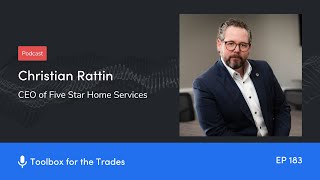
Christian Ratten, CEO of Five Star Home Services, built a $44M company where 40-60% of employees are in long-term recovery. He partners with Emerge Recovery & Trade Initiative to hire people transitioning from addiction, runs monthly gamified contests for staff, and donates 5% of revenue to nonprofits through his Profit on Purpose program.
Questions this video answers
$44 million
Over 15,000 Google reviews with an average rating of 4.8+
January of this year (episode recorded/published July 2024)
About 230–240 employees
5% of top-line revenue
Hello, contractors, and welcome to Toolbox for the Trades. My name is Jackie Aubel, and today I am chatting with Christian Ratten, the CEO of Five Star Home Services in Columbus, Ohio. Let's jump in. Christian Ratten, you are the CEO of Five Star Home Services in Columbus, Ohio. Today, we're going to talk about your incredible personal transformation. We're going to talk about second chance hiring, profit on purpose, and employee gamification. I'm so excited to get into it. Welcome to the show, Jackie.
Thank you so much for having me. It's truly an honor and a privilege to be here. I absolutely love the podcast and it's. Yeah, it's a real privilege.
Thank you so much for saying it. It's truly a privilege for me to talk to folks like you every day. I'm so lucky in the job that I have, and honestly, your story has got to be one of my recent favorites. So I can't wait to dig into it. But first, we're going to go right into an icebreaker, which I came up with myself. That's right, folks. I am now developing my own Icebreakers because I am so familiar with the icebreake, the art of icebreaking. So, Christian, your original life plan was to become the next Quentin Tarantino. And I would like to know, if you could watch one film for the first time again, what would it be and why?
So I. I love the icebreaker. I love that you came up with it. I want you to know, full transparency. I stole it and used it in an interview about 30 minutes ago. So just not to be too on the nose, but you kind of mentioned it. Quentin Tarantino, that. That was at a. He was making films at a time that I was just really into. That was a time when I was really launching into that side of myself. And Pulp Fiction was the film that kind of changed how I saw that art form. And so if I could go back and experience that for the first time again, I think that would be a pretty magical experience. So I would have to go with. I. I actually did think about this last night a lot because I was trying to pick the right one, but I kept coming back to. I have to just be authentic with myself. I'm not going to pick the art house movie that, you know, I'm just going to go with the one that I think is, like, really just authentic to myself.
Yeah, to that. I actually saw Kill Bill Volume 1 by accident in the theaters once. I was planning to go see a different movie, ran into some friends, and they're like, we're seeing Kill Bill. And I was like, what's that? I went into it blind, and I became obsessed. I'm with you on that. Is really, really talented filmmaker.
Yeah. So for 10 years of my life, I only watched movies blind. Like, I would. I would avoid trailers at all cost and only go in because I. I one time went into a movie and had seen a piece of the movie and then was watching, and the movie could have ended at any moment, but I was like, wait, I haven't seen that one part that was in the trailer. And so it ruined it for me. So from then that point, I would go into the movie theater, get my seat, wait for the trailer, start walk out, wait about, you know, seven or eight minutes, then go back in.
Oh, my goodness. Trailers are, like, my favorite thing. I love watching trailers. Sometimes I just watch trailers on YouTube. I'm just like, yep, yes. And I feel like. I feel like almost like a judge. Like, yes, no, yes, no. It's like a very fun experience for me. So I do not relate to that. But I will say going into movies blind can be a really wonderful experience if you don't know what you're expecting.
Yes.
I would love to make this entire episode about Quentin Tarantino filmmaking. I think you and I could take it to the full extent of this episode. But we're here to talk about your career in the trades. So tell me, how did you get into the trades?
Yeah, so I've only been in the trades for nine years, so it's. It's actually the. The shorter part of my career. I was forced into an early career when I was 18 years old as a result of having a daughter at a very young age who is now. Awesome blessing for me, but I actually got into the car industry and kind of worked my way through that and then got into real estate development a little bit and then moved to Columbus, Ohio, to be with my wife, the love of my life, and through that transition, ended up at a distributor and working for a distributor, calling on contractors, just trying to help them in their business. I had worked in and built a couple businesses, so it just seemed like a good fit. Always. After about six months, I knew that I wanted to be on the contractor side, but I said, you know, I'm going to give it a couple of years on the distributor side, kind of get the lay of the land there. My plan was to go a couple of years on the contractor side and then either buy a business or start a business. Probably buy a business. I had already had contractors offering Me to, to, you know, join them or partner with them. And, and then Five Star Home Services was one of, was actually wasn't even Five Star Home Services at the time, but they were one of my customers. And when they found out that I was thinking about leaving and going and joining another company, they asked me if I'd be interested in joining them. And so that was three years ago.
Incredible. So you started at. Not as, not the CEO level, I'm assuming. Right. You started at a different level. What was that?
So I was brought in as the Director of Business development, which was kind of, it was a broad enough term that I could basically go anywhere in the business that I wanted and kind of do anything that I wanted. And that's really what I did for the first year. I mean, my background is sales, but I have a passion for leadership as well. So I really just kind of went around, just talked to people for like a year and tried to figure out different things. I say that's all I did. We also onboarded with Service Titan, purchased a couple companies and added 130 employees. So it was a busy first year, but yeah, and then always the path was, I knew and the owners knew that this was the ultimate goal. It was just the timing. When was the timing going to be right? And it just worked out that in January of this year it made sense for our former CEO and owner and president of our board, Kit Morris stepped down and then I stepped into the CEO role.
Incredible. That's awesome. I'm really curious. So you were on the distributor side and you knew right away that you wanted to get on the contracting end. Why was that?
Well, I saw the opportunity. I mean, it's, it's such an opportunity. And I, I saw these people in these businesses and they had something that was just so amazing. And I, and a lot of them, I don't even think realized what they had. So many of the people that I would go talk to had this skill set of being able to diagnose or solve a problem for a homeowner. And that's not my skill set, but what I was able to do is come in and talk to them about their business and talk about unique and creative ways that we might be able to generate more leads or have happier employees or find, you know, better engagement with their customers. And so we found, I found this real synergy with them where it was like these conversations just would get rolling and we would just fire off and idea. You know, I love to create ideas. And so I found myself in a Very consultative role with them. And I just immediately saw an opportunity where I was like, if I could get my hands around one of these businesses, I think I could do something pretty special with it.
Very, very cool. All right, well, you guys are doing very well yourself. At Five Star Home Services you did 44 million last year, 2023, which is very impressive. Congrat. Congratulations. Thank you. And I know at Five Star Home Services you view your company as being held up by three pillars. And I would love it if you could tell us what those pillars are and which is most important.
Yeah, absolutely. So first, thank you. And I will tell you that the results of that 44 million is only as a result of the people that leave our office every day, get in a van and go out in the world. I mean those, those are the people that prop this company up, you know. But we do talk about the organization being held up by three pillars. And I think a lot of times in the trades and in any customer facing industry, the first pillar you would think of is the consumer. And I actually don't think of it that way. I actually think the employee is first. And what's this amazing thing happens? Whereas if we take care of our employees really well, then they go out in the world and they kind of just take care of the customer for us, you know, and that's evidenced by the fact that we have over 15,000 Google reviews that rate us 4.8 or higher, you know.
15,000?
Yeah.
Dang, that is, that is quite a thousand. That's a lot.
And they're only exponentially growing too, which is good. So we really like to celebrate those reviews. And so after our employees being that first, first pillar, they kind of take care of that second pillar, which is our customer base, which obviously super important. We would be nothing without our customers, but the reality is we'd be nothing without all three of these. The final pillar is one I think actually contractors often don't treat as well, which is their distributor partners. And I think sometimes that relation relationship can become adversarial. And it's not the way we like to go to market. We like to be partners. We like to look at it as a win win. We can't only be the ones winning. We need partners that are winning as well because we want that quality service. And for them to be able to service us with quality service, they have to be making money too. And so we try to honor that. Number one for us is taking care of our employees, putting them in a position where they love to come to work Every day we try to build a culture that fosters that and we try to give them something to shoot for beyond just making money for the sake of making money.
Yeah. And we're going to get into that a little bit more too, with profit on purpose. But I know that you have a gamification process for your employees. Can you tell me a little bit about that?
Sure, yeah. So it really started with just this idea I had. We were having kind of a slow start to a month and I wanted to get our managers more engaged. And so I came up with this idea to do a Tour de France style contest where every day it would be a sprint and then the ultimate win would be whoever won the most sprints, which is how the Tour de France works. And so about halfway through the month, we launched it. And it was based on simply beating every. So every manager every day has a daily goal that's tied to our larger goal. And then their percentage of that goal is based on their run rate over the last 90 days. Right. So the percentages adjust as different departments do better or worse. We simply said for the first 10 days of the competition, all you have to do is beat your goal by the highest percentage. And so for about 10 days that worked really well. But then what we saw is one department just started to outpace everybody else because there was, they had the lowest goal. And so I said, okay, in the Tour de France, you enter at one point the hill stage and that's usually the separator, right? And that's where literally you go into the French Alps and you just climb mountains on your bike for days on end. Right. We said, okay, we're going to enter the hill stage. So now not only do you have to beat your goal by the highest percentage, you also have to meet a minimum barrier to entry on membership conversion for non membered customers. And so you had to at least convert 15% of your customer non membered customers to become members and beat your goal. What happened was everybody became equal and the race got really tight the last 10 days. And the coolest part about this competition was that there was no financial win. Nobody was winning any money. The team that won one, T shirts, yellow T shirts with. We made a logo. Everything we do, we take to to the next level. So we had a five star themed Tour de France logo. We had a PowerPoint that had like a race track on it and every day we would post. And our managers, what we found is our managers are hyper competitive. You know, There's a reason 90% of the management team that works for us came out of a van. You know, these are people who didn't go to school for this. These are people who were good at their trade, they were probably good with the customer. And at some point they said, you know what, I want to do something more than just do this work. And so these people elevated themselves. What I found is they're very competitive. That that's why they got themselves out of that van and got themselves into that management position. And so when we put them against each other, it was just a really fun competition. And then their teams got into it and we celebrated with a breakfast at the end. And that kind of launched us into what is now a pretty much every month we have a competition.
Is it always Tour de France themed?
No, we have done multiple. So we've done a World Series of five Star, which is a poker themed competition. And then we've gamified at different levels. So we've gamified at the manager level, we've gamified at the front line employee level. We'd gamified at the all company level, which was our super bowl contest, which is my favorite contest because I named it.
So you actually. So different theme every month, but kind of similar process and similar challenging your managers to beat their goals by a certain percentage. And do you always have kind of that hill stage embedded in it too? So there's always kind of a le leveling of the playing field, so to speak.
We kind of leave it open to see where the competition is going. What's tricky with competition, what's tricky with gamification, is if you do it in, in too long of a run, if people get out of it quickly, they'll stop caring, you know, so you want everybody to be engaged all the time. So we like short sprint competitions, daily competitions that then stack to a month seem to work really well. And so we've tried it with, directly with our, our frontline workers, where we use like a chess rating system where every day they're trying to beat like three or four KPIs and they have a rating that bounces up and down. For one time we did it where they were competing against another technician, but they wouldn't know who it was. And then if you were to beat a technician whose rating had jumped and yours was down, you would gain a lot of points, they would lose a lot. So it was a really interesting thing. I have a business intelligence manager, Lucas De Leon, who is an absolute genius and creates all these crazy Excel files. For me, he's the owner of our Service Titan, because 99% of this comes directly out of our service Titan. And, you know, we are focused on the same things I would say probably all of the contractors listening to. We're focused on average ticket billable efficiency, net billable efficiency, truck overall truck value for the month. I mean, all the things, you know, that. That any other contractor is looking at. Membership conversion, accessory sales. Right. Flips to other verticals is a big one for us because we launched into H Vac, plumbing and electrical. Trying to educate our customer base. That we do all three trades is really important. No better person to educate than a person in the house. So we heavily incentivize our people. If you're in the home as an H VAC technician and you can get the customer to book an appointment with another vertical, that's a huge win for us. So we really give you a lot of points for that.
Awesome. Awesome. All right, that's so cool. How if you had to. If someone heard this and they're like, oh, I want to implement this at my company, what advice would you give to them?
Yeah, I would say start simple. The tour to five Star was not a very complicated thing. Yes. I had the marketing team generate a logo. Sure. But generally what it was, it was just tracking KPIs on a daily basis and getting it in front. One of the key elements that works really well for us is we have daily standup huddles with everybody in operations, and everybody huddles together. So it doesn't matter if you're in plumbing, H vac, electrical, doesn't matter. We all get on a call 15 minutes a day, and there are, at this point, anywhere between 35 and 45 people on that call. But this allows for is. Everybody's hearing the same message, Everybody's seeing the same results, and it gets everybody pointed in the right direction and in the same direction, you know, because what we found is, is, like, if I have two people go in this way, it just slows us way down. But if I can get everybody going in the same direction, man, we can really move, and we can really capture some business. Awesome.
Awesome. And I'm curious because you mentioned that you have acquired some businesses at five Star since you've joined. How has your general approach to employee experience supported your acquisitions?
Yeah, it's been. I mean, I will tell you this. Acquiring businesses is maybe the hardest thing to do. It's hard to mix cultures, and people are standoffish. When you start, I would say this. We've done it a Couple times. We've done it once, I think really well, and we've done it once. Not so good. And the reason I think we did it the first time, it worked really well, is we were committed and intentional. We were intentional with our communication. We were there all the time. We were messaging all the time. We were really leaning into what matters to us, and we brought them a lot of value quick. So, like, when we bought them, they were still paper invoices, and we flipped them to service Titan immediately, and we showed them the value when we got them the training. And so that was big. The one that we have not done as well. It's exactly that reason. It's in a space that's not as connected to our core business, so it's easy to kind of just let it operate on its own. But we've noticed that as a result of that, the employees at that company feel less connected to the home base. We've also allowed them to stay in their original location, which has kind of disconnected them from the corporate office, so to speak. I think that the reason that we have had success is because our employees are so engaged and they care so much about our mission and they are so welcoming that it's allowed us to jump those hurdles.
Yeah. Yeah. That's awesome. Yeah, I can imagine that melding cultures is definitely not something easy, especially if you are fostering a really competitive and playful environment. I don't know if playful is the right word. Would you say playful is the right word?
Yeah, I'd say. I mean, we've. We've definitely crossed the line of competitive on one or two occasions where we've. You know, anytime you start holding people accountable to a number, they're going to find the path of least resistance to get there. So it's. You have to. I tell my management team all the time, like, the number one thing they should be doing is inspecting what they expect, because if they're not watching it and they're not keeping an eye on it, all of a sudden, you know, we're starting to do things that maybe don't align with our number one core value, which is integrity. And we're. We always have to be able. I say every day, if you can't jump the integrity hurdle, then we're not doing it, you know, so. And sometimes that hurdle can get really high. So. But we have definitely had managers who, you know, they can't help. I don't blame them, and I love them for it. They care so much about their guys winning, about their department, winning about Their people winning that they're willing to just kind of take whatever they can to get across the finish line.
Yeah, you know what? Inspect what you expect. That I have not heard that on the show in a while. It's been quite a few episodes before I heard that. And I'm so happy that you brought it up, because inspecting what you expect is making sure that all of your team members are actually doing what you want them to do and in a process that aligns with the values of the company and the department as a whole. I really love what you're doing when it comes to focusing on your employees. And I just really want to say that I think it's a great way to. It's a great way to approach business because by investing in your employees, as you said, they are, in byproduct, going to take care of your customers because you're taking care of them. And how many employees are in your entire organization at this point?
So we are. I must say, it's probably 230 or 240.
That's significant. That's a significant amount of people. And like, getting them all to row in the same direction, you know, that just gets harder with every single headcount that you add. So I really. I want to commend you on what you're doing here because I think it's very cool. So another thing I wanted to talk to you about, Christian, is that you're incredibly, incredibly passionate about giving back. So tell me about prop. Profit on purpose.
Yeah. And another marketing thing where, you know, phonetically, it would probably make more sense for us to call it profit for purpose. But I believe that poof is not nearly as impactful as pop. So we go with profit on purpose. So profit on purpose is a really simple idea. And the idea is, is. Is that we seek profit with a purpose. Okay? We're not shy with talking about it at five star. Profit's not a dirty word. The difference is, and I think anybody listening to this is probably a for profit business and is probably out there seeking the same profit. In fact, even nonprofits seek profit. It's only the difference with what they do with it once they have it back. So the difference between us and all other, you know, we're not all other companies, but the majority of other companies is, rather than be beholden to a private equity firm or have a single point owner who's maybe taking the majority of the profit, what we choose to do with it is distribute it through nonprofits. So the commitment we've made is that we will give back 5% of our top line revenue to nonprofits that matter to us. And those nonprofits tend to operate in the recovery space because that happens to be something that we are very passionate about. But we work with a lot of nonprofits, and a lot of them are in recovery space or like in kind of ancillary spaces. But we also work with some, you know, that are outside of that, just based on things that have crossed our desk and we've had the fortune of being able to help. But that is profit on purpose.
In a nutshell, 5% of top line revenue, that's got a. That's got to feel a certain type of way when you're allocating those funds. Huh?
So as the person who's responsible for the P and L and for the bottom line. Yes. There are times where I'm like, why did I pick that number? Like, whose idea. Like, whose idea was this? But I'll tell you why I picked that number. Because you hear contractors all the time, and I follow all the same contractors. Everybody else follows. Right. And it's always, everyone puts that top number out. Nobody ever tells you what their EBITDA is. Right. Nobody's ever, like, putting on Facebook, like, hey, our net profit margin was this. Right. And I get that. But when you start talking about giving money away, if you're not being transparent, it can start to feel like maybe you're being disingenuous or using it to prop yourself up, and it's not doing it for the right reasons. So the reason I do it is to hold us accountable to making sure we actually give that money away. And because I want to be as transparent not only with our employees, but our customers and our community as we can, because this is a huge commitment for us, and I don't take it lightly.
Yeah. And you mentioned. So a lot of the nonprofits that you do donate to, they are in your local community.
Yeah, I would say all of them are.
Okay, awesome. And don't you also. Correct me if I'm wrong, but don't you also. Some of them, Some of the money goes to nonprofit. And then does some of it also go to direct customers who maybe are experiencing some financial hardship?
Yeah. So yes and no. Okay, yes, it does. But. But we try not to talk about it. I don't mind explaining it to you, because I actually think if people are interested in profit on purpose, this is a really important element of profit on purpose, which is that I will celebrate giving to nonprofits all day, every day. Okay. But we look at it as two buckets. We have the profit on purpose, nonprofit bucket, and then we have a hardship bucket. So the hardship bucket is like we run into. So it happened this week. We ran into a consumer, you know, foster care. Mom needed an air conditioner, can't afford it, so we just gave it to her. So the only thing is, is like, that money's allocated. It's just, we'll never put it on Facebook. It will never go out to the world. We're not going to talk about it. We'll talk about it internally with our internal customers, our employees, but we're not going to talk about it externally. Now the nonprofit giving, I tell the marketing team, you celebrate that all you want.
Yeah. Yeah. All right. Interesting. I'm glad you made that distinction. So I know that Second Chance hiring goes into play with all of this. So tell me a little bit about Second Chance hiring.
Yeah, I mean, second, y' all keep in mind that, like, we've stumbled into all this stuff. Like, none of this was really planned. Like, I'll tell you.
Well, you sound like it was so planned. You're like, you are so, like, you are. The way that you were describing your employee experience and now your nonprofit giving, you're like, this was my plan from the beginning and it was perfect. So I'm glad that you're normalizing. Like, no, I've totally stumbled into this.
Oh, my God. We've stumbled into everything. So, you know, both of our owners, two or two of our primary owners are, are in long term recovery. We have probably at this point like 40 to 60%. It's hard to track because we don't, like, ask people, but probably 40 to 60% of our employee base are in long term recovery. We have a lot of Second chance employees. And the way that came about was that because they were in the recovery space, they were operating in those circles. And then one day somebody came to them and was like, hey, I think I have a guy who might want to come to work for you. And the funniest thing is the story that gets told is the owner said, well, why would I ever hire somebody who did drugs? Meanwhile, he had just himself gotten clean from being in the same situation. We also. So we're a Christian based company. We don't shy away from it. We say, you don't have to be a Christian to work here. But, you know, it's not unlike unusual for us to like, pray in and out of meetings and stuff. And so he basically felt like he was spoken to by God to say, like, who are you to say that you're not gonna hire this person? I gave you a second chance. Who are you to not extend that second chance to somebody else? So that brought us our first ever Second chance employee. And then it just kind of went from there. And then, you know, what we found is, is that this is a huge untapped market of people who truly just need a second chance. And I'm not talking about, you know, violent felons or anything like that. I'm talking about people who either a, never had a chance. Right. Their upbringing put them in a position where, you know, they were in foster care or whatever. It's just a very difficult start to life. Or they made one wrong move, one wrong move in their life, and now they have that hanging over them. What we found is we give those people an opportunity. We teach them this trade a. It helps them walk out their recovery at a higher rate, because now they don't have to go back to the things they've always done. They have something that gives them pride, something they can go back and support their family with. And they become extremely sticky to us because we were the ones that gave them that chance.
Yeah. And the company that you or the nonprofit you partner with to do this is a merge recovery and trade initiative. Can you tell me a little bit about them?
Absolutely. So Emerge is our primary strategic partner on the nonprofit side. They were founded by one of our owners, actually, two of our owners, and. And another partner of theirs. They bought the. This old school that was a. It was a technical school. It was called the Greene County Career Center. And they had built a new Greene County Career center, and the old one went up for auction. And so they didn't mean to actually buy it. In fact, one of the owners was, like, told his wife, thinking she was going to say, absolutely not, and then she gave him the green light. He was like, oh, no. What did I just get into? What has transpired here over the last two years since they've purchased that building is really to build an ecosystem unlike any other we're seeing in the recovery space. Where they are. What Emerge provides is it provides all the standard recovery stuff you'd see at almost any treatment center, Right? So they're going to get their clinical services, they're going to get all the health services they need, and then even, you know, some of those things, like teaching people how to do their laundry, how to open a bank account, how to get their driver's license back, the legal things they have to jump through as they're Doing all that. And as they're coming through this program, which, you know, on average is 6 to 12 months. And this is not typically for first time people going into recovery. This is people who've tried recovery multiple times. Maybe they've been in prison or whatever is longer term. But as they're going through that process, at some point we enter a vocational phase. Okay. And what we do is we figure out what's something that these people might be good at. Have they had, you know, trades experience in the background in the past, which a lot of them have. And so what we do then is put them through a school. H vac, plumbing or electrical are the three right now, although auto mechanic is starting up very soon. And we're also looking at culinary elements as well. Yeah. Also eventually a digital marketing school. Yeah. So a lot of opportunities, but right now it's primarily in the trades. Hvc, plumbing, electrical. And then they go through another, you know, six month program there where they basically go through just like a trade school. But the cool thing is, is because we are a part of it, we get to decide a lot of the curriculum. And if again, if there's contractors listening, they probably know. You know, when you see people coming in from a trade school, sometimes you roll your eyes or you have this kind of feeling like, oh, they're going to expect to get paid at the top level. Even though probably they don't know as much as they think they know. Especially on residential. You know, trade schools don't do a great job of teaching that residential skill set, which it's so different fixing something when there's a homeowner standing right behind you, you know, and so we really combine this kind of combination of classroom, lab, and then we're able to put them out in the field with our technicians and give them real world practical application where they're able to tie everything together. So when they leave that program, they're pretty viable, able to get in a truck pretty quickly and actually start generating revenue.
All right, so hold on, I just need to recap this because I think this is so cool. So you. One of your main partners is Emerge Recovery and Trade Initiative. What they do is they take people who put them through recovery from drug and alcohol addiction, they help get them clean, they help them with all life admin tasks that maybe they were never taught or things were lost along the way. Especially a lot of people who suffer in this level can suffer from homelessness as well. And then at a certain level they get evaluated if they would be a good candidate for plumbing, H vac, electrical, if they are and they're interested, they go through this school, they learn all the technical and social skills, and now you have a brand new technician that has a whole new lease on life and can thank you for their second chance. I think this is absolutely amazing. And from what I know about recovery, which isn't a ton, but I do know quite a bit, giving someone that purpose, profit on purpose, can really, really make or break those first few years of recovery. And I just think this is such a wonderful, wonderful program, and I'm so happy that your team is doing it. And I know you also wanted to mention this on the show because you're trying to find other contractors out there who can take some of these people on because they're doing so much at Emerge. Right. You can't hire all these people. So can you tell me a little bit about that?
Yeah, so you're exactly right. Emerge is a new venture. It's only been around for about two and a half years, but we do have 50 men currently living in the program. We've already graduated. I want to say, like eight to 12 people have graduated from the program already. And when it's at full capacity, it will house over 150 people that will be going through that program. And so, you know, while I would love to think that Five Star will grow at a rate that will be able to employ every single person coming out, the reality is, is that that's not the case. And also, not everybody's a fit for our business. Some people are better on the commercial side, and some people are better in just in different trades. And other people, you know, they might not be from here. They might need to go back to wherever they're from. You know, they might have ended up here. Like you said, homelessness is a huge thing. Also, a lot of people end up in prison. And then the prison system can move you. So there's just a lot of pieces to that. So what we're looking for is strategic partners on our side where we can bring contractors in, we can bring them into that ecosystem, have them be a part of it, and we're even willing to help them understand if they've never employed a Second Chance employee. And if I could just take a.
Second to say, please, I want you to talk about this, okay?
If you, if you, if you currently employ more than 15 people and you don't think you're a Second Chance employer, it's only because you don't talk about it, because at some point you are employing Somebody who is either a going home and actively struggling with drug and alcohol addiction trying to not literally not pick up that, that substance that is providing them whatever it is, or they're going to a 12 step recovery modality or any one of the other millions of today any. There's millions of modalities in ways and we are very agnostic when it comes to that stuff. We believe you should have something in your life that's giving you some purpose, but you know, we stay pretty agnostic when it comes to that. So if you don't think you're a second chance employer at this point, I mean the reality is you are. And so, but what we're willing to do and really the only difference between five star everybody else, we just talk about it. You're just really open about it and, and it's worked out for us in some really amazing and powerful ways. But we're even willing to come alongside people and kind of help them with what does it look like to be a second chance employer? What does it look like to. So when you get that person in your, in your shop that first day, you know, what are you doing? Is there a different level of treatment for that person? You know, how do we make sure they're staying accountable to their long term recovery goals and how do you come alongside them to both get the most out of them from a work perspective? Because obviously at the end of the day they have to do the job, they have to do what you're expecting them to do. But then how do you also come alongside them just as a human being and help them get to where they need to get.
Yeah, I'm really happy you talked about that and 100% agree with you. If you've got over 15 employees, guess what? You are a second chance employer and you just don't know. You just don't know it. I really love your whole narrative around this because I think it's really, I think we're kind of coming. This is my personal opinion combined with my mental health experience. Right. For anyone who doesn't know, I got my master's degree so I can kind of talk about this, but I think we're kind of coming at an interesting point in our culture where people are getting a better understanding of why folks fall prey to addiction. And a lot of it has to do with the way you were raised, the way you were molded. There's actually, if anyone is interested in it, there's a very famous study that resulted in the ACEs questionnaire, which is a 10 question questionnaire that basically is yes or no questions. And it asks about certain things that were present in your childhood and based on the number of your response. So you get. For every yes you add, you get one point. The higher your ACE score, the more likely you are to have suicidal ideation, suicide attempts, have struggles with addiction or an end and other mental health issues. And some of the. Some of that stuff is so unpreventable and so not someone's fault. And I think it's just wonderful. You know, when I first started working in this industry, I've now been working at service time for almost seven years. I heard a lot of contractors talk about, you know, we background check all of our guys so the customer knows that they are in safe hands when someone comes to their house. And I do think there's a ton of merit to that. I understand that. But then I think about all of these wonderful men and women who have had struggles in their past, and I think about, well, what makes them not appropriate for that same kind of work? You know what I mean? So I think it's really important to have these conversations and to talk about how companies like yours are talking actively about this second chance employee or second. Second chance employment. So those are my thoughts, those are my opinions, those are my views on this topic. And I want to thank you for allowing me to talk about them today.
I mean, it's my favorite thing to talk about. It's profit on purpose is the reason that I work here. Second chance employment, it all kind of wraps up together. And I completely agree with you. You know, as an organization, you know, we're. We're large. The target on our back is big. We take that very seriously. We deal with the same challenges as any other contractor. We're not unique or special in that way, you know, but the reality is, is like, we can background check people and see a felony for a drug charge that was at a certain time in somebody's life. And you can learn a lot about a person based on how they react to being questioned about certain things like that. And at the end of the day, for me, what it comes down to is I was extended grace at some point in my life. Who am I to not extend grace to somebody else? And if you come in and you have the right heart and you show up every day and you match our core values, you know, some of our best employees are second chance, and they rise through the ranks. We have people at very high levels in our organization, and then when they started with us, we're literally just Coming out of treatment and it's. Listen, it's been a hard road, okay? We've, we've made a ton of mistakes. We've let people get into spots too quickly. We've, you know, become too involved. My HR team doesn't. Isn't always a huge fan of me, but, you know, we weather those storms and we're better off for it.
Amazing. You feel free to not to, to not answer this if you don't want to, but you have already kind of hinted at it, that you've had. You're a second chance employee, that you have a history that makes this issue near and dear to your heart. Do you want to expand upon that at all?
Yeah, I don't, I don't mind sharing my story. It's pretty open with it. So I'm the least likely person to ever be the CEO of a $44 million company. Ten years ago, I was homeless. Well, I guess a little more than 10 years ago I was homeless. Drug addict. I had the. I did a shuffle between heroin and meth. I would get on heroin and then to get off heroin, I'd get on method and then to get off the meth, I'd get back on the heroin as a. It was a horrible. I was always taught that it was like a two step process. So you, like, you get on meth, then you stop taking meth and that clears you of the heroin addiction. But I would only do step one, you know, which is I would forget about the second step of that process. And so, you know, through a crazy set of circumstances, I was put into a, well, not that crazy of a set of circumstances. I was brought to my knees by that disease and, and I was basically faced with no other option but to go to treatment. And so that's what I did. And it wasn't my first time at treatment and it was actually a long term vocational treatment that I was in for like a year. And through that process I was able to work through, you know, my modality for treat for recovery. And I've been able to walk that out long term now for 10 years. And I wouldn't be here if that hadn't happened. The, some of the, some of the things that make me good at what I do today are the experiences I had when I was at my lowest. God can use anything for good.
Thank you so much for sharing your story with my audience. I think a lot of folks will resonate with this. And you know, there's actually one other thing I want to mention. While we're still in this realm. A few episodes before this one, I can't say off the top of my head, I believe it's episode 174. We had MCAA and UA come on the podcast to talk about suicide in the trades. And I learned this sobering statistic that about 5,000 deaths in the construction industry a year are death by suicide, which is insane. And one of the issues that causes that is addiction. And in this line of work, you know, even though technology is getting some, is advancing at a rate that our physical bodies aren't being used as much in the trades as they once were. One injury can lead to you, can lead you down a painkiller path that leads you into drugs and, and your life can blow up. I think it's really important for people to recognize that no one wants. I don't think anyone wants. Has dreams of struggling with addiction or getting in some of the. The sticky situations that they've been. But I think if they have the desire to change their life and to do something different with it, then I think we owe it to them. Right? That's my opinion.
At least over 20 years ago, you know, I was just a normal person going through a difficult thing in my life, which was the, you know, I was being. I was separating from my first wife. She was the only person I had ever known. She was my high school sweetheart and we had a couple kids together. And, you know, we just grew apart over time. But, you know, through a crazy set of circumstances, I was presented with a painkiller, you know, nothing crazy, and it didn't seem so wild, you know, and, and I took it. And what I learned is very quickly, and I don't think I could have put this into words at the time, but what I learned very quickly is that, man, painkillers will mask physical or emotional pain.
Yep.
And it is amazing how quickly I was wrapped up by that. And that led me on a 15 year journey. I didn't wake up like in, when I was 18, 19 years old and think, man, when I'm like 30, I want to. I want to discover homelessness.
Like, yep.
You know, when I'm 34, I want to lose contact with my entire family. Like, that wasn't my plan, you know, but it was this thing that just took me there. And I have such a heart for people who have gone down that road. And because I know who I am and I've seen so many people recover. And when I met them there and then I see them a year, two, three years later, they're not the same people. And they're incredibly talented, incredibly beautiful, dynamic, intelligent, creative people. And I want to surround myself with people like that. And so we're fortunate, honestly, like, it is not a detriment to Five Star at all. In fact, it is the thing that props us up more than anything, because there's only two kinds of people that work at Five Star. There's second chance employee employees and people that aren't. But what we find is that even the people who aren't, it's very unlikely they don't have somebody in their life who doesn't need that second chance.
Yeah. Yeah. Well, I mean, especially if we go into, you know, the painkiller world, like everyone, everyone, I think, in the United States has someone by proxy who unfortunately has been completely decimated by this, I guess we call it a pandemic by this. By this disease. And so I think. And also, I mean, like, kind of going back to how you run your business and whatnot. These are all empathetic people that when they go and they work with your customers, they can be empathetic as well. So I just think. I think it's so cool. I know you've trademarked Profit on Purpose. I really hope that the folks who are listening today are inspired to learn a little bit about what you're doing, learn a little bit more about Second chance employment, because I'm very passionate about this myself. So thanks for sharing your story. Christian, I would love to know, as we're wrapping up today's show, what's next for Five Star Home Services? So you took the CEO mantle almost a half a year ago. And what's on the horizon?
Yeah, so we have a lot. We don't like to do just one thing, one thing at a time. We like to do a lot all at once. So I would say, you know, without. And. And a lot of it is honestly, like kind of. So we call it the Innovation Lab. So a lot of it's still living in the Innovation Lab, but we actually think we have some really cool, creative, unique things that we can bring to the trades. A lot of it in relation to gamification, which we talked about earlier, and bringing that to contractors in a way that they would be able to put into their business and actually see the benefits from. From that profit on Purpose. Expanding that mission and expanding the reach of profit on purpose. One of the goals for Profit on Purpose is to launch the Profit on Purpose Academy. That's why we trademarked it, so that we can. So a. You can't So I actually think I read a statistic that the average medium sized business in the United States does less than 4% EBITDA. So I think that a lot of business owners would love to give a lot of money away, but they don't have money left at the end of the year to give away. It's like, man, we did 5 million in revenue, but where did all the money go? You know? And it just kind of leaves. I mean, it just floats out of the business. Right. And so one of the things we'd like to do is help businesses first learn how to be profitable, right? How do you become operationally efficient? How do you make sure you have accurate accounting? And then once we've got you profitable. Now let's. Let's teach you how to align yourself with a nonprofit you can trust that's doing the things they say they're doing. The money's actually getting out there into the world and helping the people that you want to help doesn't have to be recovery. Whatever it is that you are passionate about, we want to come alongside. My ultimate dream for that is that we would actually be able to certify a business as profit on purpose certified. So as a consumer, I would be able to say, so when I do business with you, I know that some of that money is going to filter back out to my community in a way that I can trust.
Oh, that would be so cool. I would. When that happens, you got to come back on the show and you got to tell me all about it, because I am totally rooting for you. So I know you have a podcast that kind of brings this entire mission together. So. And I'm sure the folks who have been listening are interested to hear more from you. I know I am. So tell me a little bit about the podcast that you're running.
Yeah. So we did launch this year the Profit On Purpose podcast. And the purpose of that podcast is really simple. It's to align business owners with other business owners who are giving with a purpose through their businesses. And we. So we try to talk to executives or owners who lead with a purpose and who lead their companies that way. We've also, you know, sprinkled in some nonprofits, I think, put a light on how important it is that the business community supports the nonprofit community. You know, a lot of these nonprofits are reliant upon donations, and I think nobody better than a business that operates in the same community or even in the same space to provide that because they. They're doing great things and they Just need a little bit of help sometimes.
Yeah. And that's such a great way to get involved in your community. That's something that comes up on the show all the time, is getting involved, giving back to your community. And I can think of no better way than to support your nonprofits. I think that's such a wonderful way to flex that muscle and build relationships outside of your company, increase word of mouth referrals. I mean, I think it's, it's, it's a win, win on both sides, in my opinion. Buying equity with your employees. You're working for a purpose. You're getting your name out there. You're supporting a cause that means a lot to you. I encourage everyone to give on this show. Final question, Christian. And I have a feeling you'll have a pretty good answer for this. I want to know what are you listening to, reading, or watching right now? So give me any of the. Any of the media that you're consuming. What are you really into now?
Okay. So I've actually taken like, a short hiatus from, like, leadership books because I had gone on such a run, sure, that I needed a little bit of a break. So I, I listen to a lot of sports podcasts and I actually, what I find is that any, any content that I consume, I can turn it into something useful for my business or for, like, helping the people within my business. But I've actually been reading, like, a lot of historical non fiction, like a lot of just World War I, World War II, all the way back to, like, I just, I just finished a book on this, this British sailing journey around Cape Horn. And so, yeah, just really trying to free my mind up from. I needed a break from other people's, like, opinions on how to run our business. And I needed to get back to trusting my gut on how to do this. And so I, I needed a little bit of break from that.
Oh, yeah. So you choose to pick up the light, easy beach read of historical nonfiction about the great wars.
I feel like I've hit that point in my life where I'm like, in my mid-40s and I have to make a decision. It was either by a smoker or get really into World War I or World War II. And so.
No, it's true. It's true. I have a joke. I have a joke. I'm like, if you're a dad, if you're over 40, you gotta be into one of the world wars. It's just, it's. It's a law. It's a law at this point. So you're. You're adhering to the law.
I will say that I read. I read the Art of War by Sun Tzu once a quarter. It's the. It's the greatest. It's. It's like if you listen. So I listen on audible a lot, obviously. I'm sure a lot of people are consuming content that way, but you. If you put it on like three times speed, you can get through in like 42 minutes. It's so fast. And then I reread probably, at least I probably reread it like three times a year because I'm just. It's always kind of in my Q. But it's the Almanac of Naval Ravikant, which. Naval Ravikant is a really famous angel investor in Silicon Valley. And he. This. The book isn't by him, but it's. It's basically. They've taken like all the podcasts. He does these things called tweet storms with a, like, tweet a thousand times, and it's basically like a. No. Or like a. An essay in tweet form. And then like his, his speeches and his writings, and they kind of compiled into like, three chapters of like, wealth, spirituality and health. And so it's just a fantastic book that really centers me a lot of times.
Awesome. Thank you for the recommendations. Christian, it was great to chat with you today on Toolbox for the trades. Thank you so much for coming on.
Thank you, Jackie. Thanks for having me.
More from Bill



Capturing the 80%: How SmartAC’s Gen-2 Targets Non-Membership Homeowners | Podcast Ep. 296

Build better customer data with every booking in ServiceTitan | TAD Tune-Up Series

The Biggest Change for Roofers Coming From Other Roofing Software to #ServiceTitan?


