How to Build a Multi-Million-Dollar Business | Podcast Ep. 195 | Toolbox for the Trades
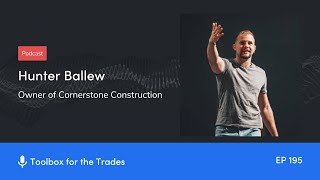
Hunter Ballew built Cornerstone Construction into an eight-figure business after leaving the fire department. He shares his systems: an Eight-Figure Checklist, a job-profitability spreadsheet, and a recruiting funnel that leads with negatives. He emphasizes daily number-checking and core values as keys to scaling in the trades.
Questions this video answers
Over 5,200 attendees.
Over $30 million annually.
Sold in 2021 for $48 million (deal with a public company).
First event held in August 2019.
About 80 events total.
Hello, contractors and welcome to Toolbox for the Trades. My name is Jackie Aubel and today I am chatting with Hunter Ballew, the founder of Cornerstone Construction, Roofcon and the Revolt Mastermind Group. We spoke about defining core values for your business, recruiting top talent and staying profitable while you build your business. I hope you enjoy our conversation as much as I did. Hunter Ballou, you are the founder and owner of many companies, including Cornerstone Construction, Rooftop Roofcon, which is a yearly conference that had over 5,200 attendees last year, and the Revolt Mastermind Group. Collectively, all of these Companies make over $30 million in revenue annually. Today you and I are going to be talking about building an eight figure business by establishing a good culture, staying profitable and mastering the recruitment process. Hunter, welcome to Toolbox for the Trades.
So excited to be here. I've been following Service Site for a while, know a lot of the folks over there. So excited to be on the show and talk through some of this stuff.
I know, I'm so happy we were able to make this work because I know that I think Service Titan had a bit of a presence at Roofcon last year. So I think this is, this is all good things happening. I wanna hit you with an icebreaker first. You know, sometimes I use icebreakers that you can just pull from the Internet. Sometimes I kind of create my own based on your story and that's what I did for today. You're now this entrepreneur with all of these different brands helping contractors, specifically roofing contractors all across the country. What's one lesson you learned in either your Marine firefighter or both of those careers? What's one lesson you learned there that helped you on your entrepreneurial journey?
A lot of lessons from the Marine Corps and the fire department. Funny enough, you know, me and my wife have had this conversation specifically with our son. We have a little boy that's going to be six in a couple of months. We have a little girl that just turned to this week and so talking about our little boy and she was asking me like, you know, if we were to gently guide him, not push him, but guide him in a direction, would I rather him be in the military or the fire department? Actually, most people would think that I'd say military, but I think fire department, you know, military is like, it's really a lot like another job. Like people watch the movies and like you assume you're in combat all the time for one like 90 of the roles in the military, you're not ever going to see combat anyways. And then for 90% of the time of your career. You're not going to be in compact if you're in one of those roles. So there's not like a ton of high pressure situations versus at the fire department. You're in high pressure situations almost every single day. You know, you're running a cardiac arrest, you're running a house fire where maybe someone's on side, you're going to a car wreck where there's three cars and you're having a triage and make a decision of who to treat first. And so for me, I credit a lot of my success to the fire department, actually, and being able to operate in high pressure situations when I was there. Because, because now, like I could tell you, I remember specifically when I really realized that was@roofcon 2022. We had Tim Tebow, John Maxwell, like a ton of big speakers that came out. And that year we had 3,400 people. We were, we were still come up. It was 3,400 people and people were like, you're so calm, like, oh my gosh, you would think you'd be stressed out running around. I'm like, yeah, it's just an event, you know, like stuff is gonna mess up and it sucks. Like I want the event to be better than anyone else wants it to be. So when stuff goes wrong, like I'm frustrated, don't get me wrong. That's the tough thing with running events versus having a roofing business or painting business or siding or gutters, whatever. Like when you're doing a contracting business, you get reps every day or every week. You know, if you're any decent sized company, like you're going to be doing a job a week versus our event. We get one rep a year. So if we mess up, we have to go back to the drawing board and say, okay, we failed our attendees, we failed our vendors in this way. Next year we have to be better. And so, you know, as I look back, I think just dealing with all the stuff I did at the fire department, it helped me handle the pressure and realize this game of business is not a life or death game. It ain't that big of a deal. When you hold a man as he dies and takes his last breath in front of his wife and she's bawling that, that, that's, you know, one of my tougher experiences in life versus, you know, I tell the story often like, like I've lost a million dollars on a single event. Did it suck? Was there a ton of self doubt? Do I still think about that? Yes, but it ain't life or death. It's just money. I'm going to figure it out. So handling pressure, I learned a lot of that from the Marine Corps and specifically the fire department. And then of course, on top of that, most people would say work, work ethic, discipline, those things as well.
Yeah. While you were talking and thank you for sharing that really touching moment that happened for you as a firefighter. I don't want to. I had a joke ready. So I just want to acknowledge that you said that first. But when you're producing these giant events like roofcon, like, I was just, I was thinking as you were talking, well, nothing's on fire, so we'll get through this.
Yeah, yeah, yeah. No, that's a good way to tie it in.
Yeah. So tell me, I want to know, how did you get into the trades? You had this trifecta of firefighter, Marine, very classic, you know, service oriented jobs. How did you get into the trades?
Yeah, so I'm from the south. You know, I'm in South Carolina. Born, raised and stay. A lot of people move in here, but I always like to say, born, raised and stayed. Don't plan on going anywhere other than that ranch I was telling you about before the show. I'd love to get a ranch out in Montana, but stay here long term. And so, you know, a little bit of experience, like I could build some stuff, I can do some stuff from growing up, but certainly was not an expert professional by any means. Didn't know anything about construction or roofing in terms of owning a business. And so while I was at the fire department, I just had this big goal of being a millionaire by 30. That's what I said all the time. I tell my mentors that, my friends that I'm going to be a millionaire by 30. That was my goal. And so, you know, you start doing the math. I've always been decent at math. And I'd get my check every two weeks from the fire department. It was $709. And you start saying, okay, it's not going to happen. I'm not going to make it to a million. So I started playing with the different business ideas and I ended up leaving the fire department, starting a marketing agency. And that marketing agency, just some of my first clients ended up being blue collar guys. And some reefers were involved with that. And I just realized really quickly, like as an example, one of my clients was a coffee shop in Atlanta. One of my clients was a roofer in Minnesota, in Minneapolis. And so for them to Pay my fee. I think at the time I was charging like 1500 bucks, 2000 bucks a month for my fee, my retainer. It's like, how many cups of coffee do I have to sell for this coffee shop for them to justify continue paying me? And another piece of that is it's really hard to track versus for this roofer. I can sell like 2, 3, 4, 5 jobs for him and he is crushing it. And we saw that Guy's revenue go from 2,3 million to 7 million in six, seven months. And so I just realized, okay, this is a pretty solid industry. I think I'm going to stick with this industry. And so we double down on roofing specifically and, and just construction. And it didn't take long. And I was like, you know what, let's do a case study. Let's start a company. So we started a company called Cornerstone Construction. It was my, my roofing company. And really the goal at the time, because I didn't know, like a million dollars in revenue is not $1 million in profit. So I thought million dollars was this big number. And so I wanted to get to a million dollars in revenue and use that as a case study. And so we did that in the first year with Cornerstone and then it grew 2 million, 5 million, continued on to eight figures. And you mentioned some numbers at the beginning of the show. It's continued to grow since then. We've sold a company, we bought companies. There's just been different stages along the way and we've enjoyed the ride. But that's kind of my, my journey into. I've heard people say, like, you don't find roofing, it finds you. So it kind of grabs you, pulls you in. But yeah, now at this point with Revol and Roofcon and all that, we do like, it's not just roofing, even Roofcon. Like, people hear roofing. This happened earlier. Like two hours before the show. Someone said the exact words were, obviously roofcon is a roofing conference. And I said, no. And it never has been. It's a leadership conference that has mostly roofers there. You could bring any business to roofcon and get a lot of value out of it. And in fact, like, from the beginning and every year since, we've given free tickets to people. So if you've never been and you want to come, you can go on the website right now. There's free tickets to come to Roofcon because we want people to be able to network and get to know each other and grow their businesses collectively. You've probably heard Chick Fil a says that too. They're like, hey, we're a leadership development company. We're not a chicken sandwich company. We develop leaders. And the chicken sandwich, that's just the vehicle, but it's not who we are.
Yeah. You know what I also was reminded of when you were talking. I had so many folks on this show say, I am actually in the marketing business. I just happen to do H Vac or I just happened to do plumbing. And I think it's so smart that you took on that marketing agency role and you got to see how different industries operated. And you were able to see, like, all right, how many cups of coffee do I have to sell for them to justify my $2,000 a month retainer? And you're seeing on the roofing side, like, oh, this is actually like a really great business model. So this is what I'm going to lean into. So I think it was actually very smart to do that agency model and kind of see, okay, what do businesses look like? And it's so funny that you wanted to do the case study and then you're like, well, I guess I'll just keep doing roofing and we'll. And you sunsetted the marketing agency, didn't you?
Yeah. Yeah. Because for me, it was like, for. For one, I just enjoyed the construction side of it more. Like, I still didn't know a ton about roofing or even learn a ton about. I just brought in the right people to help me grow the company. And for me, having people in house that I could grow with versus sitting behind a computer all day, I enjoyed that way more.
That's awesome. That's so cool. So that's actually part of what you do at roofcon, right? The leadership conference and at Revolt, which is your mastermind group. And you guys do mini events throughout the year. And you developed this thing called the eight Figure Checklist that you share with Vault members to help them grow their business. So tell me a bit about how you developed this process.
Yeah, so Eight Figure Checklist is a process that's just been put together. It's not like I sat down one day, I was like, okay, how can I build this checklist? It was like years of, okay, Cornerstone grew to eight figures and beyond eight figures, multiple eight figures. And, you know, we've helped. I don't even know how many companies we've helped at this point. And that. That's not a flex or pat on the back. It's just. I don't even know at this point because we've Run so many retreats, master classes, roofcon events. I do what's called Legacy days where I bring people in for a day at my office so they can see the setup of what it's like and talk to my team and interview them. And so we've just seen what works over the years and we put a process in place. It's just as simple as a checklist. And so we would go in and we work with either our REVOLT members or someone comes in for Legacy Day, or we have growth partnerships. We do. If we go work with them, you know, we'll pull up our project management tool and if, if they have one, and if they don't, we usually recommend signing up for a free version of Monday. And we'll go into Monday.com and we'll build out accountability for them exactly like we have it inside of all my businesses. We'll build out a workflow of. Here's how you do it. You set up the task, here's the updates, here's, here's how you set the deadline, here's the one owner for that task, here's the team to support them. And we'll go through and we'll add all that, the tasks they need to do over the next year and we'll prioritize it so they know which ones they need to get done in the next quarter. And so for us, just having something like that, that moves them closer to the eight figure mark if that's their goal. And I, I try to make it very clear, like eight figures doesn't have to be the goal for everybody. Some people I know, some great guys and Iowa and Colorado and all across the US that have been doing roofing for 30 years and they're happy at 5 million and netting 20%. And good for them. If they don't want any more stress than that, that's fine. But what you don't want to do is go in and build to 10 million and have 3% profit. I've been there. I know what that's like. The first year we broke 10 million and we grew pretty fast. It was because we were starting all these markets and reinvesting into the company. Now if you were to look at the business and do add backs and look at the ebitda. Ebitda, it would be much higher because we were starting the new markets and buying trucks and all the things. But you want to make sure that you keep profit in mind and don't just do it for vanity. Like you, you've probably heard that saying, vanity Sanity, like make sure that your business is profitable. Yeah. We built a checklist so people can go through, step by step, all the pieces. Who's the leader you need to become? We talked a little bit about the book I have coming out called Unlocking 8 figures that talks about exactly. This is basically like the checklist expanded big time so someone can go through it and not even have to pay me to consult them or come in or go to an event or anything. But it goes to who is the leader I have to be. What's the foundational pieces of the business? What are the operating systems I need in place? What do I need to know about finance? That's my weak point as a business owner. I freaking hate finance. As much as I love numbers, I hate looking at P Ls and balance sheets and all that stuff. I just want to run the business and do sales of marketing. So just all the pieces all the way through. What is the end game? A lot of people hear folks in the industry now talking about, exit your business. M and A. How much can I sell for? Yeah, a lot of people, they. They get scared by that. And I don't want to do that. I usually ask three questions. I say, you know, do you want to do it to exit, to have this big exit? If so, what's the number? Do you want to do it for cash flow, just to keep your cash for years to come, decades to come, or do you want to give it as a legacy business to your kids? It doesn't matter what the answer is. You should build your company in a way that tomorrow you could sell it if you needed to because it's irresponsible not. Not to what? What if you get cancer? What if your wife gets cancer? What if something happens and you need to sell the business to take care of her, take care of yourself? So it's irresponsible not to build it in a way where it's built to sell.
I want to. I want to plug in on that. And you just said so many great things. I had an episode. I believe it's. It's in the 50s or 60s. We're rapidly approaching episode 200, so you all have to scroll back a bit. But we had an episode where we talked about why it's so important to have a plan if that happens. A young owner came on, talked about how his father had unexpectedly passed away and he was running the business. And when he passed away, all of the things he knew in his mind about how certain things plugged into where. And like why we did this this certain way, that all left with them, and it left his family, unfortunately, with a lot of headaches that they had to untangle and kind of. It was tough to keep the business afloat during that time. So I actually think that's a really great mindset. Even if you don't plan to sell to private equity or you want to keep it private, what. Or whatever you want to do, that.
Is the most important piece. But even second to that, that I. That I tell folks when they come in for our masterclass, is you might just get an offer that you can't refuse. It might happen. You might have the right buyer that needs to be in that market that likes the systems and processes that you have, that needs them, because they know, hey, if I implement this in the other three businesses I own, it's going to skyrocket the value of those. I'm willing to overpay this guy. That's what happened to me when I sold cornerstone in 2021. It was a $48 million deal. That was before private equity came into the. Into the mix. That was a public company that came and pursued us, and so I had no interest in selling. They called me, and I said, no, I'm not interested. And a mentor of mine, he said, man, I think you should at least go hear these guys out. Like, if they're pursuing you, why not go negotiate, do the due diligence, learn the process. You know, you want to sell one day. And I said, you're right, I should. And we start talking numbers, and it's like, okay, maybe they are players. Then maybe we can be part of something bigger. So build your company so it's there if you get the opportunity.
Yeah. Oh, my gosh. 48 million. Congratulations. Totally burying the lead there. You mentioned that you kind of had humble beginnings. Can you just tell me what it was like for you to get that offer? And, like, this is how much we want to buy your company for. Like, did you just, like, pass out for five minutes? Like, did people have to throw water on you? Like, because that would have been my experience.
Not exactly. And I don't want to sound like big guy on the podcast. Like, it didn't. Of course I was. Of course I was excited. You know, like, for me, I grew up. I don't want to. I hate saying poor, because I wasn't like. Like, we had food. We're in a house. But, like, that. The roof was falling in. Funny enough, I'm in the roofing space now. Roof's falling in like mold on the ceilings. Ended up moving out to live with my grandparents. My parents were both drug addicts and. And both recovered now and good on them, but that's just part of the story. And so, like, for me, coming up through high school, it was just, like, constant embarrassment. It's a revolt. Like, the meaning of revolt is revolt against average. Because I hated seeing my parents settle for average. And not even average, below average. Like, I was embarrassed to go to school in our vehicle. And, yeah, so for me, that was the story is, how do I not live a life like this where I'm paycheck to paycheck and struggling to feed my kids and can't have a car, I don't have a car that hardly runs. Like, I didn't want that. So that was part of my story. And when that happened, funny enough, that was like, right when I turned 30 years old, I told you that I wanted to be a millionaire by 30, had already hit that. But this. This big deal comes, and I was at a retreat. I was at a revolt retreat. When I signed the paperwork, I walked out of my room, my team was out there, and I was like, I want to take this time to apologize to absolutely nobody because there's so many haters in the industry. And that's just like a funny saying of, like, all the haters that are talking crap about you all the time. And it was just like my moment of like, I freaking told you I was going to do it. You know, like, all the people who doubted me, all the guy you would think in the Marine Corps and the fire department, it's like, really this tight brotherhood. And it is to a degree, that's why I started to revolt, is because I missed that. And I wanted to provide a place for men to come together. And so you would think it's like that all the time, but it's not like there was a lot of jealousy there. There's a lot of people that told me I was stupid for leaving the fire department, that, oh, yeah, I need the. I need the check, I need the benefits, I need the insurance. I need this and that and the other. And so it was a real moment for me of just like, you did it, man. Like, you said you were going to do it and you did it. And then I actually remember being with someone, two people at a Waffle House right after that, and one of the guys was with me when I signed the deal, and he saw when I opened my council all the cash, and. And he was telling the story to another guy. Of, like, what I respect most of my hunters. He didn't change. He literally went right back to work. It's not like I was like, all right, babe, let's book the vacation. We're going to Mexico and spending six months. It was just right back to work. Let's. Let's do this retreat. Let's change lives. Let's go run rooftop. That's one of the things I'm. I'm more proud of is I hope that when I have the $100 million exit, that's what I'm chasing now. I hope that I don't change and that I can stay the same.
Well, I think if you're aware of it, that's not going to happen. But I truly hope you did take your wife on a vacation eventually.
We vacation all the time. But yeah, nothing, nothing changed from that specifically. Just like, for us. And some people may hate this on the podcast, but, you know, we don't do, like, birthday presents or anything like that. We don't really do gifts. It's just like if I want to get her something, I just get it for whenever I'm thinking about it or feeling it or so. So, yeah, just a little bit different of a lifestyle for us and thought process on that.
All right, so coming back to the eight figure checklist, and I'm loving the energy you're bringing. I'm. Thank you so much for telling us, like, the. Your origin story. And it's. This is very aligned with a lot of the folks that I love to highlight on the show. So I think people are really going to love what you have to say. So you help people define their core values at Revolt, and you actually prompt them with this question, what do you stand for? And when I heard that, I was like, oh, my God, that's such a big question. So how do people even begin to answer it? And tell me a bit about how it informs the structure of their business.
Yeah, so I mentioned that we do retreats, and we've done dozens and dozens over the last few years. I actually did my first event in August of 2019, and since then, just over five years at the time of this reporting, we've done about 80 events total, anywhere from like 30 people to 5,000 plus people. And when we do those retreats, they come in. The very first thing that we do, very first session we do is what do you stand for? And I literally started by just saying, okay, guys, we're going to start a session and I'm going to start with this question. What do you stand for. And I just sit there and I just look at them like it's a very awkward moment because none of these people know each other. This is contractors from all over the country that don't know each other. And so I have this big white post it. I don't know if you've seen those big post it, oversized post it notes and have a marker. And I'm, I'm just like, what do you stand for? Tell me. And usually someone will catch on. They'll say, integrity, honesty, communication value. And it'll start going. And then after about 10, it'll start to slow down. I'll say, we're not stopping until this page is filled up. And I can't really show you here on the video, but it's a, it's a big poster board, big square.
Yeah, it's like maybe like if you.
Were at a college football game and yeah, you were holding up one of the posters that you used in school. I mean, it's, it's big. And so I don't stop until we fill up the entire page. And they have a workbook to go through. And I'll tell them, okay, I want you to pick your top five, circle those and then put them down at the bottom. They have a spot where they can write their top five. And then I encourage them to pick three to five. They can pick more. But I usually say, hey, more than five is tough because you got to remember these things. Like they gotta be a part of who you are, embedded into who you are. And you gotta like ingrain these into your team too. They have to remember them. So you go pick an eight core values. It just gets tough to remember those and be able to spout them off. So we go through that session together and help them create those core values. And then depending on the size of the company they are, if they're married, if they're not married, like those things matter. Because if it's a single dude, that is a one man show, okay, he can establish them right there with us. But if there's someone that's married, I want him to go home and talk with his spouse. If they're involved with the business, if they have a team of six, I want them to get their team involved with those core values because it creates buy in from your team. Like if you have a sales manager or sales rep that's been with you for four months and he's your first sales rep and you help, you have him help you with the core values, he's going to be bought in, because he is now a part of the foundation of that company. So that, that is the first session that we start with is like, what do you stand for? Because everything else you do starts with this. And whatever you stand for as a man or a woman, a husband, a father, a mama, that is what you stand for in business too. They're not different things, they're correlated. And so that's really important to us. And we actually have a second exercise that we do called Embedded that is creating life laws, which are essentially core values. We call them life laws for kids, and it's doing that for your children. And so me and my wife did this a couple years ago. We created these life walls for our kids. This was before we even had our daughters healed. And ours are man of integrity, value people, purpose driven, positive attitude, and chase greatness. And so my son, like if you were to ask my son, he, he's five years old and at four years old, whatever he was when we came up with him, like we started right away, like if you went and asked him right now, he could shoot them up to you. If you ask him his six bricks, he can shoot them out to you. And so it's just pounding that into his head. And literally the name of the exercise is Embedded because I want to embed those life laws, those values into his DNA. So when he wants to quit early, when we're practicing ball, nobody, we chase greatness around here, you're going to do the extra rep. And so it's actually three stages that we do. And I don't want to take a ton of time on this, but one is life walls. So three to five life laws that you give them. Second is mantras, mantras that they repeat to themselves that will seed that lifelong. So I just told you one. One is one more rep. So chase greatness for us, that's one more rep. So if I say, hey buddy, you got to do 20 squats before we can watch this show, I usually say, hey, you got to do 10 pushups, 20 squats, 30 sit ups. And he'll never do 10, 20, 30. He'll always do 11, 21, 31. And then after mantras, it's actions. What are the actions that you take to see that? So for us, man of integrity, this is like one of the cutest things. My son, when we realized it was like pretty emotional for us. When we realized that he was getting it, it was like two months in, we were seeing him every day. Like I'm pounded into his head. I Would make him run up and down the stairs as he said one of them in a positive attitude because he couldn't remember. Positive. I would make him run up there. Maybe extreme for four years old, but it worked. Positive attitude, positive attitude, positive attitude. Back and forth up the stairs. And one day at work here, out in the shop, he came running up to my wife with a sticky note, and he said, mom, my life was my life laws. And she's like, what are you talking about? Like, thinking, did dad write down my life walls or something? And she said, what is this? Because it was blank. And he said, well, dad said, being a man of integrity is picking up trash when no one looks at four years old. And we were like, man, like, we got all emotionally, like, it's working. You know, you just got to keep after it and make sure he remembers those. So for me, it's like starting with your kids, doing it yourself, doing it with your team. Just pound in those values. Wow.
Yeah. Oh, my gosh. What a touching moment. Look, I picked. Oh, my gosh. That's so sweet. It sounds like you and your wife are very intentional about raising your children, which I think is commendable and just, like, intentional on how you're growing your business and coaching other people.
We try. Yeah. Not perfect. We try.
Oh, I really. You're not perfect parents. Okay. I don't. I'm. I'm very positive that perfect parents don't exist, But I'm always very happy to hear from parents who are being really intentional about how they're raising their kids. So good on you. Good on your wife. Let's move on to profitability, because it's key to a successful business. And you mentioned earlier, at one point you were 10 million, but at 3% profit. So what processes or systems do you recommend businesses adapt to track profitability and to stay profitable?
Yeah. One thing I know is I've had what I'm about to say. I've had this fill in so many times. And I know that members of Revolt and people that come to Roofton and people that follow me on Facebook and people that are part of our Facebook groups. We have multiple Facebook groups with 26,000 members. We have another with 33,000 members. I'll ask questions in there. And one of the things that people respond to the most is, where did all the money go? Like, I did 4 million in revenue this year, and I did a million last year. I made less money. I did $12 million in revenue this year, and I don't have anything to show for it where did the money go? And I know how frustrating that is because I've been there before. And so we created what I call the job profitability sheet. And it is just that it's a. It's a Google spreadsheet, which sounds crazy, basic and like, old school. And you're like, hunter, you don't have a CRM. I do have a CRM and it does have tracking. But I feel like with spreadsheets, if you build it out the right formulas, it is better visibility, in my opinion. We do that for lead tracking, too. For all of our leads that come in from every source. We track every single source. We track the sales rep, we track what the status is, just like the CRM does. Or we're able to attribute revenue to each of those leads and the lead sources and see exactly what the CAC is per. And so with the job probability sheet is similar to that. Who is the customer? Who's the sales rep? What was the commission on that? Is there a leader commission? If you have like a sales management leader that. That gets a commission on everyone, like, they get an override. That's part of it. What was the cost of goods sold, broken down into material and labor for the subcontractors? And if there was any extra stuff that you had, I had to go get an extra gallon of paint, or I had to get a extra piece of SID or gutters or gutter guards or an extra square of shingles, whatever it is, you're attributing all of that in there. And then if you're in an industry where there's insurance involved, okay, now you're looking at it and saying, all right, well, maybe I got some supplements I'm going to add on there. And then I had to pay the supplement company. It's all broken out, but very clean. It's not like all over the place. It's super clean. And it'll show you exactly what your gross profit is, exactly what your cost of goods sold is. And then from there you can say, okay, well, my overhead this month was X. I know I netted Y. And so it just makes it very clean. It simplifies the process. And you can look at it month over month. Like every. Every month, we create a new tab at the bottom. So we'll create a 2024 spreadsheet, and then it's January, February, March, April, May. And we have like a template spreadsheet we could share with people. We're happy to share with people so they can use this. It's in Those resources on the website, if they click the resources, it'll say, I think it says know your numbers. It's under that one.
Yeah. So it sounds like for you, like making sure that profitability is something that you're being mindful of, involves like pretty thorough review of what's happening on the day to day basis and really keeping track. And like noticing like, oh wow, we're really having our. So for example, this is the only example I can think of, but we're having to order new materials, so maybe we need to stock up our inventory a little bit more on this and that will save us money down the line because as you get bigger, as you do more jobs, there's things are just going to start falling through the cracks.
Yeah, there's so many things that you could add to that. Pre capping your job. So before the job gets built, making sure that you're still profitable, looking at rebates that you can get from your suppliers, negotiating on the front half, also negotiate on the back half with those rebates, bulk buying material and stocking some in house. So for like us, we have everything in house except for shingles because they're so heavy. Everything else, all the nails, the felt, the ice and water, the ridge, everything else is here and we're able to get it much cheaper. So that saves us and that allows us like of course in most cases we're able to be more profitable if we sell it, say margin. But in some cases it means getting skinny and we're able to get a little skinnier and win some bigger jobs if we need to and we feel like it's worth it. So really with knowing your numbers, like this is such a simple concept, like I'm not a super smart guy, but when this clicks for you and you realize I can reverse engineer my entire business, I can say I'm going to sell at X margin and I'm going to maintain X overhead, whatever that number is. Now just know like, yes, your overhead does fluctuate based off of your sales, but if you know you can stay consistent with your sales, then you say, hey, you know what? I know my gross profit is going to be 40% on average. If you say that you want a net 20%, you just have to run your business for 20%. Your overhead has to be 20% or less. And so you know exactly what you have to play with to hire people, to run marketing campaigns, yada, yada, yada.
Yeah, it's so interesting because again, like you're reflecting stuff I've Heard on the show before. And it's great because, you know, you saying example of your son, having him run up and down the stairs, repeating the positive attitude thing. You know, you have to hear that some of this stuff over and over and over again before it finally clicks. And when I first started the show, I would talk with people a lot about that hesitancy to actually engage with their numbers and engage with their KPIs. And then they talked about like there kind of was this like almost fear to do it. And but once they did it, now they're like obsessed and they're like, I have to get into it. So it's kind of like overcoming that fear and just really embracing something that you might not be familiar with and learning how to use it to your advantage.
The last tip I'd give on finance, while we're, while we're on that subject, this is the simplest thing in the world, but the hardest thing in the world. If you've ever been a part of a company that knocks doors and you've probably heard the saying, the hardest door to open is your truck door because you're afraid to open the truck door. You're afraid to get out and go knock the doors. Once you get going, it's not that hard. It's hard to open your truck door, get going in the morning. Well, with finance, it's very simple. It is every single day. Look at your numbers. That's it. That's in the book. That's in unlocking eight figures. I say it, that's like a little hack, a little pro tip. And to be honest with you, for years I avoided it and now I do it every single day. My client, ask girl, she sends me the numbers every single day. I see what it is. Cash on hand. What are the accounts payables in the next 30 days? Because I need to know if I, if I see there's a deficit, I know that we got to start driving sales. So I would encourage you to look at your numbers every single day. It sucks. Like, I know that, I know you're, I know that half the people listening to this right now, like, hey, no, I ain't doing that. I ain't doing it. I know it sucks. Just trust me, do it for a three month run. And just the visibility and the fact that it's top of mind is going to change your urgency inside the business to focus on revenue producing activities. You're going to stop worrying about the stuff that doesn't produce income and you're going to start worrying about the things that does produce income, that is calling people to collect money. They owe you money. Like one of the guys that's a growth partner with me, we stepped in to help him grow his business. He told me, like, man, I just really have a problem calling people to ask for that second check. And I'm like, okay, well, we're going to fix that right now. We're going to put it on your calendar every Tuesday and Thursday. We're going to block 30 minutes where you make those phone calls. And now there's no, oh, I forgot or I was busy. It is on your calendar. Blocked off. It's just a matter of discipline. You can have the pain of discipline or you can have the pain of regret. It's your choice. Do you want discipline or do you want regret?
Discipline or regret.
Wow.
Okay. You know, it's so great. Sometimes I talk to folks like you, and I don't even have a business, and I'm like, I can't wait to start looking at my financials every day. And I'm like, hold on, hold on, hold on. I look at my podcast numbers every day. There you go.
There we go.
So, Hunter, this has been a wonderful conversation. I want to make sure we talk about recruiting, because when I was doing some research on you, I heard your concept about the recruiting pipeline and how you kind of talk to candidates about the good, the bad, and the ugly of the job. So I would love for you to speak just about recruiting. That's a big hurdle for a lot of folks to overcome in the trades. And I want to hear a little bit more about your approach to it.
Man, I could do like an hour long podcast just on recruiting. I love recruiting. It's like one of my favorite things. So for us, from a very early stage in the business, I started building out a funnel, recruiting funnel, as I called it. And now a lot of people use recruiting funnels. A lot of people, like thousands of contractors, have used our personal funnel because I share it openly. It's on the website, 200 resources. People can look at it, see what it's all about and mimic it. But just to give you a quick breakdown of what ours looks like and how you can use the same thing to have success is we build a funnel for us. We use clickfunnels, because I've been using it since the marketing days and I've just kept the account. You can use lead pages, you can use a ton of simple little things. But we'll build a funnel out and the first video on the page is going to be a video that describes the job. It's all about the job, the position. It talks about the position. Usually this video is going to be like 10 to 15 minutes long. Really important here. The first half of the video, I'm talking about all the negative stuff, Anything that could be perceived as negative about that role, I'm talking about it. For example, let's talk about a sales role in Cornerstone Construction, the roofing company that I started in 2017. I talk about all the bad things that are. If you're afraid of heights, don't apply for this job. You don't want to climb a ladder, don't apply for this job. If you're not okay with 1099 straight commission, don't apply for this job. If you're not okay with knocking doors, don't apply with this job. All of the things that could be perceived as bad I'm telling them about up front because I want them to click off the video. I want them to exit out and never look at the post again because I don't want them to call or schedule an appointment and waste our time. And waste their time. Like I'm doing them a service. The second half of the video, if they've made it that far, I'm selling them the dream. I've documented all the points. I'm talking about the company, the service that we provide, the product that we provide, some of the testimonials people have given us, how we're involved with the community. I'm talking about the compensation structure and what they can do inside of our company, what others have done inside of our company. I'm selling them the dream and why they should want to be a part of our company and take that role. When they finish that video at the end, I'm going to say, hey, a couple more things I need you to finish. If you've made it this far, you're probably pretty interested. Next video below is going to be about the company. Then they're going to go to the next video that's a company video. And so we originally we had about a four minute video that's called the why Cornerstone Construction video. It was on this page. And it's also a video that we would send to every homeowner. Either before we went to the job or when we got there and we started our inspection, we would let them watch it. Now as of a month ago, we've updated it to a new video. That first one was like five years ago. Now it's a non minute video that goes even more in depth and it shows everything about the company, our processes. It talks about how far we've come, the credibility of the company. Basically the job of that video is to handle every objection a homeowner could have and make the sales reps job easy. And so we put that as the second video just to show them like, hey, this is who we are. This is how we interact in the community. Community. And this is who we are in terms of like trying to make your job easy. And so they'll see that we're serious about it. We're not just some truck in a truck that doesn't really give a dang. We're just trying to make money. That's not who we are. The next part after that is some testimonials from customers and testimonials from people on the team that are going to be like, hey, I've been here for six years, I love it. Best job I've ever had, yada, yada, yada. And then the last thing is going to be the actual application. And depending on the role, it can be pretty long. Name, number, email, all the basic things. I do like them to do a personality test. Some recruiters will tell you not to do that. I like it just because I have so much data from over the years of so many people applying that I know that like 80, 90% of our salespeople that do well are protagonists. I use the 16Personalities.com so you can check that out at 1616Personalities.com. It's free.
Myers Briggs too, right? That's like.
I think it is the same.
Yeah, it's the same thing. Yeah. Okay, sorry, continue.
I definitely recommend that one. It's free. Check it out. I've been using it for years. I'll also have them do depending on what role it is. Not for sales. I won't have them do this. But if it's a leadership role I'll have or management role, I'll have them do the rocket fuel test, which is visionary integrator. And if I'm looking for someone that's going to be like an admin or ops person, I want to make sure they're an integrator. I don't want them to be a visionary that comes with a million ideas. It doesn't know how to execute on anything. This is really important if you're looking for an ops person or an integrator inside of your business. And then there's some other questions around, like what's your current income? What's your income goal? What are your top three life goals. I want to know those things and learn about them so I can make sure that this is the right fit for them. And then the last thing that I always do is I check their Facebook profile link because I want to make sure they're not some crazy nut job that I don't want to work with. So I make them put their Facebook profile link to check them out and then they submit. Depending on the role that submit the application and we'll follow up with them. Or some roles will allow them to go and schedule a phone interview right there through Calendly. If they do that, we have someone on our team that takes the phone interview. If they like them over the phone, they'll bring them in for the final interview in person and we'll hire them from that point on. I'm going to add this because this is important in terms of recruiting, moving to training and retaining. We have a system we call six Figure Blueprint. Again, it's in the resources on the website. But Six Figure Blueprint is a training system we've built out for years to where we can bring people in off the street that have no experience in sales or roofing, construction, anything. We can teach them what they need to know to go make six figures in this industry. That's why it's called Six Figure Blueprint. So for us, it starts with an intro section, a welcome section that talks about the company, the common mission, the core values, all the things it moves to. Talking about scheduling your week for success, how to schedule your week for success. It goes to the basics of roofing. Like, hey, what is a roofing system? What is a shingle? What is the valley talking about? The parts of the roof. It goes to the CRM, any and everything you could imagine inside the CRM. We explain in video what we're trying to accomplish with this training. Some people say, and I get this, I've been the same guy because I was at the fire department fighting fire and doing these little things where people are like, oh, you need to follow the book. And the book's written by someone that's never been in firefight. I hated that stuff. So I'm not saying, I'm not saying you can completely replace in the field training. What I'm saying is there's a lot you can replace. Sitting in a truck, riding around with a guy for two weeks and then saying the same thing over and over when he's like, how do I do this outside of the CRM? How do. How do I add a Lead inside of service titan or change the estimate or Y. Why would you not just put it into a video? And that way when that person asks you over and over, you say, refer to six figure blueprint because it's in there. That's literally what I do. It got to the point where I'm sure people probably thought I was a jerk, but it's like, dude, I put hundreds of hours into building this out. You're going to take the time and watch it. Don't watch it just to get the little check mark and say, you're done. Watch it to understand. And so that's big for us all the way through sales process, lead generation for themselves. Everything that they need to know to make six figures, we put in this training program to make them successful so we can retain them long term.
You, I could tell you are very passionate about this topic and I commend you for doing all of that explanation in a very short time. I know some people listen to podcasts at like, double speed. I have a feeling they're going to, like, try to reduce the speed if they can. I love that in your process, your hiring process, you're just constantly giving the applicant the opportunity to like, disqualify themselves.
You.
You're constantly giving them the opportunity to be like, nope, not for me. No thanks. And I think it's so important as we combat this, like, hiring crisis in the trades. It's been around for years now, is like being upfront and honest about what this job is. And then once you get there, they're like, okay, I'm fine with all that. Now you can talk about all the great stuff. I think that's a really, really great method.
Have you heard of Dan Wright, recruiter?
No, I haven't.
They're out of, they're out of Tampa, but they, they run a recruiting agency. So, like, as we grow on, I still do the recruit funnel, but for some stuff I'll supplement. And I use an agency, which is Dan Wright, recruiter. And so they'll go recruit for you. And that's been great because it adds to the flow of applicants for us. And now we're getting to the point where we're like, maybe we bring someone in house. We started interviewing people to bring in house. And I think that at some point, depending on your growth track and what you want to accomplish, that you look at bringing someone in house to recruit as well.
Amazing. Actually, if you don't mind, I would love to circle back to something you mentioned. You talked about one of the reasons that you started revolt is because you missed the brotherhood you had in the Marines and in the fire department. Can you talk to me a little bit about why you think that is so important for men and women in the industry to have this, like, sense of brotherhood, of sisterhood, of siblinghood, so to speak? Like, why was this important for you to create?
For most entrepreneurs, you're on an island. Like, that's. That's what it is. You're on an island. Whether it's actually true or whether that's what's in your head. And there's a lot of imposter syndrome. There's a lot of doubt, there's a lot of shame. There's a lot of questioning yourself as an entrepreneur. I've been there. I'm still there all the time. Like, you have big wins, and then you look at the next level of people above you, and you're like, gosh, why am I not there yet? Like, what am I doing wrong? And so these games are constantly playing in your head. You're questioning yourself and start to get around another group of people that A can say, hey, you know what? I dealt with those same exact things. That's pretty reassuring. Like, it can't be explained on the podcast. Like, it really can't even be explained in person. What you experience at the retreats when you bring 30 men together or 30 women together. As of last year, we started doing the women's groups as well. My wife leads that. And so when you bring those people together that have had the same struggles, like, it's. It's so powerful. And, you know what's funny is usually it's not even. The conversations are not even about the business side. It's about the personal side of, I've been abused or I've had a miscarriage, or my partner stole a ton of money from me. Like, we're talking about real life stuff that we struggle with. My dad was a real jerk, and I. I deal with that throughout my entire life, and I'm trying to be a better dad, or I have this stepson that I don't know how to parent because he's rebellious. Like, it's real life stuff. And so to have people around you that have been through similar situations we created this year, this was, like, one of the best ideas I feel like I ever had. It was called a struggle sheet. And so we took, me and my team, we sat down together and we said, think of every struggle we've ever heard of at these 80 events we've done. And I Won't even say some on here because it gets pretty, like, dark. Some of the things that people have dealt with. And it's probably like 50 different things. Totally. And a lot of it is around addiction. Some of its personal stuff, family stuff, but we use those. And then, so my job at these retreats, we get people together. I just play matchmaker. I just play matchmaker. So there's two columns. So, like, as an example, if we're running a women's retreat, I help my wife run the first two women's retreat just to show her how we do it. And so I saw this play out, real life. Column one is, I've had a miscarriage, and I'm really struggling with it. Currently, I'm still dealing with it. I can't get past it. Column two is, I've overcome whatever that struggle is. And so it was like a 92% rate of people that had a struggle. There was someone at the same retreat. This is only a group of 30 people. There was someone else that had overcome it. And so our game is just playing matchmaker. How do we find someone in the group that can help this person overcome it? So it's really, like I said, it can't be explained, but it's beautiful to see people come together, support each other. And that's what I tell them every event that I do. It's not ever the Hunter Show. It's me putting people together. That's what I love doing, is bringing people together. And so that's what we try to do with Revolt, is create that community where people can feel not like they're by themselves. Because whatever you're dealing with as an entrepreneur, if you're still listening to this, I promise you that there are plenty of other people that have dealt with it too. You're even listening to me saying, nah, not me, man. Now, what I'm going through, I promise you there are and people that can help you, want to help you. Like, that's why God gives us those hardships. It's an opportunity for us to give back later on down the road. Wow.
Yeah, I love this. So I have a mental health background. I have a degree in therapy. And so I am absolutely loving everything that you're sharing here. I think it's really phenomenal when folks who are at this level of success, at this level of production, at this level of visibility, I think it's so important, important to connect them with like, like similar individuals who've overcome the same struggles. Because we love to talk about, like, work, life, balance, but the reality is, like, the things that happen to us, like, we take with us everywhere we go. And so it's really important to acknowledge them and address them. So I love that you combine this in your revolt group and all the really cool stuff that you do in supporting and building leaders. All right, tell me about the book you got coming out, and then we're gonna wrap this up. Tell me about your book, Hunter.
Yeah, yeah, I gave you a pretty good explanation earlier. It's basically the checklist expanded. So if you're like, I hate events, I don't want to go listen to this guy talk for two days. You don't have to do that. You can just read the book. I even send you one for free, so you only have to pay pay for it. But it's just an expanded checklist that I truly believe can change your business. My book, my first book, Make Account, was all about leadership and legacy. And I was kind of telling the revolt guys, we have, like, a group chat for all the members. I was telling them yesterday I was all hyped up because the book's headed to print right now. As of today, it's headed to print. We're trying to get it to recon 2024. And so first book, Bank Account, is all about changing lives. Second book is all about changing businesses. And someone asked and said, what's the third book? And I said, changing Kids Lives. I've actually already got it in progress. It's close to. It's a children's book, but, yeah, you can check out Unlocking eight Figures. Go to the website. We have all the resources there. Or you can be DM me on Facebook and I'm happy to get you one. We'll get it printed.
Amazing. And we're going to link all of these resources that Hunter mentioned in the show notes of this podcast, so feel free to check that out. Hunter Baloo, thank you so much for taking an hour out of your day and chatting with me. This was a wonderful conversation. I feel inspired, and I know our audience is feeling inspired too, so thank you so much.
More from Bill



Capturing the 80%: How SmartAC’s Gen-2 Targets Non-Membership Homeowners | Podcast Ep. 296

Build better customer data with every booking in ServiceTitan | TAD Tune-Up Series

The Biggest Change for Roofers Coming From Other Roofing Software to #ServiceTitan?


