Just Start AI: Future-Proofing Your Business with Artificial Intelligence | Podcast Ep. 271
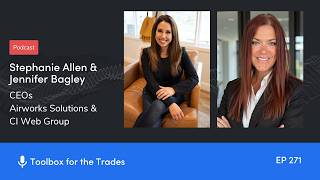
Stephanie Allen and Jennifer Bagley, CEOs who founded Just Start AI, show how contractors can use AI to future-proof their businesses. Airworks relaunched its website in August 2025 using AI agents for content and SEO, hitting 25% net profit by December with zero paid ads. They stress systemizing operations first, then automating, and adopting an AI-first mindset across the whole organization.
Chapters
Hello contractors and welcome to Toolbox for the Trades. My name is Jackie Aubel and I have a very special episode for you today. Today I am speaking with Stephanie Allen, the CEO of Airworks, and Jennifer Bagley, the CEO of CI Web Group. I spoke with them about the online community they started about a year ago called Just Start AI, an online community for contractors who are looking to adopt AI in their businesses. And trust me, after today's episode, You are gonna wanna do that. Please enjoy my incredibly informative and passionate discussion with both Stephanie and Jen. Jen Bagley, you are the CEO of CI Web Group, and Stephanie Allen, you are the CEO of Airworks Solutions. Together, the two of you are the co-founders of Just Start AI, an online community for home services and trade professionals looking to future-proof their business, stay competitive, and unlock the power of artificial intelligence. Today, the three of us are gonna be tackling a really big topic. We are gonna be talking about the real impact of AI in the trades and how Stephanie partnered with Jen to create AI-enabled processes for her business, and how the two of you guys are supporting other contractors implementing AI in their businesses. I think that is my record for the longest preamble I've ever done for the show, but I wanted to make sure I got both of your backgrounds straight. Welcome, welcome to the show. Welcome back, Stephanie. And so excited to have you, Jen.
Thank you for having us.
It sounds really official, all of that, that you put together.
Honestly, in my research that I'm able to do, like the two of you are doing some really incredible work and the Just Start AI community, oh my goodness, like the amount of trainings that you guys have released and the explainers on everything from like, what is an MCP? How do you build skills in Claude? Like, You guys, even though your content is trade-focused, it is helping me from a content marketing perspective do my job better. So thank you for just this selfless work that you're doing because it's having a real impact. And we're going to talk a little bit about that and how you've seen the difference for yourself at Airworks, Steph. But to kick things off, let's, you know, shake everything out and do an icebreaker. I would love to hear what your guys' favorite use of AI in your personal life is. Steph, why don't you go first?
You know, I'm still using it to help me meal prep and plan for the kiddos, and we have created these really cool bedtime stories together depending on the adventure that they've had that day or things they might have to be working on. We'll prompt it and it'll help guide us through that process. So even though that's rudimentary, it's super dumb chat, it is really something that helps bind us together. And that for me is what is so cool about AI is figuring out how to strengthen the human connection.
Yeah, yeah, that's so cool. So you're basically creating these little customized bedtime stories based on what your kids went through that day?
Yeah, or what they need to learn. So sometimes it's like, let's remind Lola how important truth is, right? And let's do that in story form. Or somebody's getting bullied and we're talking about their personal appearance and we don't really need to be doing those things. And so I can prompt ChatGPT and then we hear about it in a story and it, it feels like that lesson, is it coming from mom? And we build it together.
Love that you're using that. Jen, what about you? What's your favorite personal use of AI these days?
I have two. I use it to track and plan for all investments, real estate investments, stock investments, crypto investments, planning on when to sell, when to buy. But the one I love the most, I take my children and my grandchildren and I put them in the most ridiculous possible swimsuit on a counter, or I make my 5-month grandbaby walk across the floor and then do flips or whatever I can do to entertain the family. Quite frankly, Stephanie has seen these pictures at dinner.
You would be in good company with my father who has really leveraged AI. This is a retired New York City carpenter. Who is using AI to animate videos of my nephew. Um, so yeah, love to see that the grandparents getting on board with this technology.
So fun.
It's so fun.
No, and it's funny because Jen says that stuff, but Jen is also vibe coding these crazy solutions from her phone while at the golf course. Like she's able to use massive leverage because of her insight in AI and her background. So she brings a lot of that information in and then can literally talk to these agents that she's built, and then they go and do this work, and she gets to enjoy life and create massive impact for us. I am just— I'm trying to learn from her a lot in that space of how do I maximize both, right? Like, how do we live a really good life and get a lot of cool stuff done?
I love what you're saying because this relates really closely to what Abhishek Mathur said on the show recently, ServiceTitan's new CTPO. He said that he views AI as an accelerant, not necessarily a replacement. And from what I've learned in speaking to the two of you, that's very much how you view it as well. I'm gonna put a little pin on vibe coding 'cause I would like to come back to that. But, um, before we do, Steph, the folks at home who have listened to the show should know who you are. You are the CEO of Airworks in Ventura County. You've been on Toolbox for the Trades before. You're a giant service titan advocate and honestly just a trades advocate in general, and it's been awesome. Awesome watching your business grow. But for folks listening, you may not have know who Jen is. So Jen, I would love it if you could tell me a little bit about your background and how you got into the trades.
Yeah, absolutely. So prior to getting into marketing, I was a VP of global supply chain in the retail industry for multiple companies. So I spent a lot of time on ERP, CRM, global logistics, supply chain management, and so forth. Became a serial entrepreneur by the time I was 28. Got the nice little walk down the hallway out of corporate when I was recruiting my staff. So I learned all the good little 20-something lessons. From there, started, um, built, bought, sold multiple companies. And, you know, I think the interesting part was, is all of them surrounded the fact that the one area that I despised, which was sales and marketing— I was an ops girl, tech all the way. That's everything I've ever done has been operations and technology. And I had to force myself down the marketing and sales rabbit hole, which I despised. I got hired by Mitsubishi in 2008 to come do a keynote presentation. There was 250 contractors in the room. Jim Toklian, uh, and I were having a conversation. He was like, just ask them how many of them are investing in digital marketing. And I did. I was like, how many of you are investing in web and content and SEO? And in 2008, out of 250, you wanna guess how many people raised their hands?
3.
And those same 3 companies are the juggernauts, top 3 companies of all of Mitsubishi. So it was this moment of time when I walked the vendor floor and I was there just as a keynote, not for digital marketing at that time, had zero experience in the trades. As far as I was concerned, a duck quacks, walks across the street, you help the babies over the curb, like nothing, no clue about the trades. I have a handyman. That's as close as you get. A couple, one in each state. But yeah, this was, it was one of those moments that was, it was wild. Even the vendors that were there, I feel like we're repeating that same 2008 cycle right now because then it was a lot of Yellow Pages and ballot packs and mailers and print and more traditional advertising and mediums. And, you know, you have this small group of people that bought in and they were like, well, I use Google, so I might as well market on it. And we're kind of in that same space again, and history is repeating itself where as an entrepreneur we're saying, I use AI all the time. Awesome. Well, did you change your marketing strategy to get in front of people just like you also using AI? And they're like, huh, what you mean?
It's so interesting to hear Jen's story again and again, and I pick up different things along the way. And I know that from working with her, what's so different is that she designs the path with the end in mind. And so that's that strategy that she's brought to marketing.
So sometimes I'm like, Jen, I don't love the way this looks and feels.
She's like, but do you like how it performs? Yeah, I freaking do like how it performs. So why am I worried about those other parts? And like the performance that I have had when working with Jennifer, it's really changed my mindset from let's build, let's reverse engineer this, right? Let's figure out what the goal is. And then let's build it backwards. And that's what she's brought to marketing. It's not about what colors look good together for Jennifer. It's what colors are going to convert. Right? And so that's what we need as contractors is this conversion to results.
I am so happy you brought up 2008. I graduated high school in 2007. And I think at the end of my yearbook, I don't know if you guys remember that.
Thanks for that, Jackie. We both appreciate that.
Well, I did enter college in 2008, which historically not a great time to enter college, but at the end of my yearbook, there's literally a section, and I only know this because I saw my high school yearbook recently. It's like YouTube came out and I bring that up only to showcase like how much in less than 20 years technology has evolved. And in the 8+ years I've been at ServiceTitan, when I first joined, our whole thing was we needed to get contractors on the cloud. We need to get them into the CRM that's gonna turbocharge their business. And now I feel like with AI, we are at this whole different wave where we're trying to shepherd this change. And I really think the two of you are at the front of this for the trades. So, with that in mind, Steph, I wanna know how you first met Jen and what about her told you this was the person who was gonna help you implement AI at your business?
I first met Jen at, um, an E3 event, which was like women in the trades kind of coming together. And Jen sat on the edge of a bar stool, on the edge of a table, like not really in the group with the rest of us. Than telling us about AI is coming and we need to be thinking about changing the way that we are presenting to consumers, right? We're like, that woman over there, she's really smart, but we're not ready. And that's pretty much how it felt for a while. And that's still how I think a lot of contractors see us and what we're doing is like, I hear you, that's really smart, but I've been doing it this way for a long time and it's worked for me, so I'm going to keep doing it my way.
And that's why we started Just Start.
So in the middle, I figured out, like, Jennifer and I have been through some leadership training together. I was her husband's partner, and she ended up being in the same group with my husband. So I think the universe brought us together intentionally for a lot of this. I at first pushed against her, like, this is doomsday, I don't want to hear any of it, stop, stop scaring people. And then I started hearing it a little bit more and I thought, oh my gosh, this is the opportunity for us legacy businesses or small, medium-sized businesses to level the playing field. We have the opportunity to move fast here and change the trajectory of the game. With that, I started saying, hey Jen, like how do we attract more contractors to thinking like this? And that was the, the birth of Just Start. Because once you get started, you realize the possibility and then it just keeps opening up for you. And I would venture to say, as much as I consider Jen an expert, there's really no experts right now in AI because they're all rapidly learning as they go.
Mm-hmm.
Right? And so this is a compounding game. This is an exponential growth game. And the sooner you get started, the more you learn, And the more you can apply, the early adopters are gonna win.
When I hear people call me the expert, I live in a universe surrounded by actual experts, and I feel them like my AI engineers, my cousins. These are family members. These, they were trained by my father. Like these guys, uh, we just submitted a patent to be able to compress AI usage to reduce energy costs by up to 30% with the technology we've developed, which is really exciting. So I mean, the guys that are in our office and the rooms that I sit in, I sit in a space where I am constantly looking up acronyms, trying to figure it out, trying to test, trying to freaking test my skills as much as I can because there are experts, but they are few and far between and they're on a hit list for 7, 8 figures signing bonus and a 7 and 8 figure salary. So Hiring them is damn near impossible because they're being picked up like crazy. There's a lot of wannabes, there's a lot of pretends, but there are very, very few experts. They would have had to have been utilizing AI via ETL pipelines and so forth prior to the advent of ChatGPT. I think everyone thinks that ChatGPT is like the start of AI, but no, that's just when they decided they were going to give it to the human population and say, run people, run, play with this tool that is really safe and really scary at the same time.
Yeah, I, that is something that I've learned in my own research about how, no, this technology has been around for a bit. We just got access to it as the general human populace a few years ago. And I'm really happy we're having this conversation because I think what we're doing right now is demonstrating how it is still so new, even though technology has been around for a while. But when we were planning this interview, I was like, I feel like AI is the wild, wild west. And we're just every, all of us are just doing our best. To find resources and to figure out what we want to try and solve with it, and then execute and measure. And trying to do all that while also keeping your business afloat and growing your business the way you want to, like, that's a big tall ask. Stephanie, I would love to hear how you went from, get away from me, doomsday lady, I don't want to hear about AI, to no, like, okay, no, we actually have to do this. Like, just to kind of, how did you personally get over that hump?
Well, for Jen specifically, uh, human first. Once I figured out that the human I was connected to was very trustworthy, the risks and the guard went down. I've said yes to a lot of things that other contractors think are very scary, but I want to test them. I want to learn out loud. I want to use Airworks as a sandbox to what works and what doesn't work. And I can only do that if I link arms with the best out there. And the best out there for me, one, it's skill set obviously, but it's like, are they good humans? Jen and her team love first and then strategize.
Hmm.
So I knew that I would be held, um, especially after going through the experience with her husband and then, you know, my husband and her. I knew that they would always have our back. Jen would tell me like, hey Steph, this is ugly, you should get out, or it doesn't work, or whatever. Um, probably before I would figure it out. I think that that's just a really important lesson, is that you should surround yourself with people smarter than you and experts around you, but you have to make sure that they have your best interest at heart. And then I saw strategy. We jumped into a whole new digital marketing plan that everybody told me was freaking crazy. And to go backwards, like, I had interviewed Jen and CI Web Group years before, and she had explained the technology to me, which at the time is very different than what it is now, right? It was— it evolved. And I didn't go with them. I went with another company, and that other company created a beautiful website, and I still had very flat results. But it was standard. It was what everybody else was experiencing in the industry. And so because I had that experience, I thought, well, let's give it a try with Jen. I can always go backward. And that's kind of been my question with Jen along the way, is Okay, let's make this change. What happens if it doesn't work? And so she'll give me the risk-benefit analysis, and then I make a decision. Thank God I made the decision when I did. It was in May of 2025, and then 2025 was the hardest year I've ever had in business. And that was really hard on Jen too, because I'd call her and I'd say, like, I don't have the leads, I can't afford these things, like, this stuff can't happen. And she's like, we're doing everything we can, right? We're doing everything we can, and it's not an instant flip. A switch that flips. Build a newer product, I'm hearing, is getting like way faster. Jen, you know, we figured out it takes about 120 days for a massive move. At least it did on Webflow.
Well, yeah, I mean, even if you— so going back to the olden days, right, pre-AI, if you wanted to have a presence with content strategy, you were going to have to work this SEO tool for months before you would start seeing results. That's kind of the way it used to be, right? Correct me if I'm wrong. I was never an SEO expert, just know enough to be dangerous. And actually, I would love to stay on that, Steph, because you and I saw each other at Pantheon and you had told me, you were like, damn, this year is really kicking my butt, 2025. But this year with these processes in place, you're doing really well. So can you tell me a bit about the difference?
Let's give them the date. She launched on August 17th, 2025. I don't know my own child's birthday, but I know the day you launched and I will never forget, girl. My son's birthday is tattooed on my shoulder.
And then there was some time in November when we were like, it's, it's bad.
November 15th.
And then just in December, like all of a sudden I shot up like a hockey stick and the leads started coming, the pipe's full. You know, in that time we also broke down a lot of our operations in the business. So we went as lean as we could. I have an incredible integrator who wrapped her arms around almost every part of the business. I have zero paid ads happening. We have cut our marketing by over 50%. We cut all of our expenses by 35.9%. I'm posting 25% net profit. And I used to think when people would talk about anything above 10% that they were liars. Like, there was— I had never experienced a profit above 10%.
Okay, okay, hold on. So pause. So we launched this new web experience for Airworks on August 17th, 2025. November, we're panicking because we're like, what the hell is happening? But then December, you saw hockey stick growth, and now you're telling me you're having You have 25% profit and you are not paying any paid ad. You're not using any paid ads.
Zero paid ads. And it's not just Jennifer, right? Like Jennifer and CI helped me fill the top of my funnel, but because things were so bad in '25, everything got recreated. And a lot of that was exposure to the way Jennifer thinks. And so because I understand now building with the end in mind, and applying a lot of those concepts, I was able to change the structure of the way my business works. I take a lot of that for granted, you know, because I was just trying to survive. I was just trying to keep my head above water. But now I have a little bit more ability to look backward and think, wow, we did a lot of cool stuff, you know. And a lot of that came from survival mode.
Um, okay, let's talk about this. I want to hear about what you did, Jen. So We started with the end in mind. So I would love to hear your perspective the way you, I would love to hear you tell this. So when Steph was like, okay, let's work together. You were like, okay, we're going to optimize your web presence so you can get as many organic leads as possible. That's what it sounds like. Or you tell the story.
The way AI works and Google's always worked this way as well is the bot that is out there doing the homework for the human, right? A human goes to Google. And they do a search or a human goes to AI and they ask a long series of questions, prompts, questions, and queries, right? There's a little bot that's going to go out and do the homework. That bot has what's referred to as a crawl budget. So it has a specific amount of money it can spend to go try and find the answer for its customer. That's not your client. So if you think about this technically, the first move is how do we provide the answer based on the consumer's intent, what their issue is, with as small of a budget as possible. So what that means is budget, crawl budget, tokens, credits. Okay. So what that means is, is that the architecture of a website becomes priority number one. You need to be able to present the highest volume of architected content that is designed with human intent, EEAT, which is Google's requirements, NLP, natural language processing, we've got to make sure it passes the sniff test for humanization, right? It can't be spammy SEO content. So all of these things, but we have to deliver the content in a format that is fast and easy for it to crawl. So we've been moving through a sequence of technology applications. We've had to rent them before now. So Steph moved into the one that we had tested at that time that won as far as the lowest volume of code, highest volume of content. It's code to content ratio. That allowed us to be able to launch a website. It took us freaking forever to build them. These were like 6-month processes because I had to hire all new developers, all new tech, all new architecture, all— everything had to change, but we had to address the technology first. So that was the first thing we did, um, was upgrade her to Hydra, which drops the amount of code from 1,500 lines of code to 600. That was first. Upgrade her to Webflow. The second thing we did was basically rewrite 100% of her content minus her blog. And we rewrote it utilizing our agentic networks. So our agentic networks have the ability to analyze all your competition, analyze the SERPs, become an expert on the topic, be able to evaluate, uh, what we need to compete. So when people say, well, how much content should I have on a page? I don't know. Who are you trying to beat? Like, it became a math game. So nothing that Bob or Mary or Joe on my team could have ever done when we had a staff full of content writers. Impossible. So we started training all these little AI agents that all had a role. Some were, you know, architects, some were grammar, some were NLP, some were SEO, some were AEO, GEO, identifying what are the prompts, questions, and queries, what are the search terms, all of those things. And this little agentic network, um, essentially when she had it built, there was about 120 of them that were part of the process for each stage of the funnel. So top of funnel, middle of funnel, and bottom of funnel. Each different network. So we rewrote all of our content. And the next thing we have to compete on is speed based on user intent at the top and the middle of the funnel, which what are the prompts, questions, and queries people are going through during the awareness phase, during the decision-making phase, and so forth. So we built another set of AI agents that had the ability to analyze Stephanie's pillar pages, i.e., what do you want to sell? Where do you want to sell it? List of services. AC repair, service installation, maintenance, tune-up, financing, same thing, all of those lists, and be able to, uh, track how are consumers prompting related to those queries. So that set of agents gave us the ability to build out a, um, massive content distribution mechanism, which is essentially daily blogging based on prompts, questions, and queries in AI search engines. So we moved from blogging once a month. Or once every, I think it was, you had once a week or once every other week to blogging every single day, Monday through Friday, with the content being designed to be able to beat whoever we were trying to compete and win against. Sometimes multiple blogs. Yeah, sometimes 5 or 6. Sometimes Stephanie would call me and go, I want to sell, whatever it was, generators. And I'd be like, all right, let me tell the bots she wants to sell generators. And I'll be like, tell me about the generators.
How do they work?
Who needs them? Then we addressed her local. So we took, uh, her local marketing and said, if we're going to compete and win on the maps, then we need to publish more frequently than everyone else. So we started publishing daily, sometimes multiple times a day, content, pictures. She sends all— loads all the evergreen images in there. We publish it out. Then we were like, we need to get reviews. So not only are we going to automate the reviews process, but we're also going to have AI write the review for the consumer, which makes it easier to acquire the review, make it focused on the consumer intent. Then we did the same thing for our backlinking articles, press releases, to try and get our exposure. So we got Stephanie herself written in crazy magazines all over, online magazines, uh, as an entrepreneur, as a past attorney, just because we're building Stephanie as the author of these articles. So we need to build her credibility as an entrepreneur, as an attorney, as a CEO of her company, all of these things so that her brand authority score increases. So the articles we published related to the business became stronger, more heavily weighted, and we used her LinkedIn account to be able to do that.
We learned a lot along the way because those bots made some wild stuff up, dude.
Well, so that's real. I have to tell my guys right now, when I have guys, I'm like, listen, when my little AI says it needs images and you sit down while you're watching a football game and select them from your phone and send them, there is no human checking what you uploaded.
I just want to pause you for a second and tell you what I'm hearing. You essentially took Stephanie's website, you completely rebuilt it, rebuilt it based on this new world of how all of our search engines, especially Google, are changing with the introduction of LLMs. You have these agents that are crawling the web and figuring out what topics that Airworks has to comment on to start getting that organic traffic. You're publishing at least once a day, Monday through Friday, sometimes more than that. And my question was, are— do you have humans checking those blogs or no?
No.
Oh, absolutely not. No, we have QA agents, SEO agents, algorithm agents. The worst part of the whole process is image generation. Under all circumstances, we continue to try. I will say video— AI video generation and AI image generation is a total crapshoot. I'm not going to stop trying.
Where's the theme too, Jackie, is that a lot of this content isn't actually written for human consumption.
So say you have 3,000 words on the page. Each component is designed to be able to answer the prompt that a human is answering, not the full article, but it's pulling chunks of answers. So when you think about a blog post, it's not old school. It's like you are writing with the intent of the human who's reading it, but you're writing for that specific question, i.e., Heading 1, and you're writing for the answer. And the goal is to get that cited or mentioned on an AI engine because the average consumer, it's not like Google. When they go to AI, they prompt 3 to 10 times. So you have to have 3 to 10 times the impression volume before they click to anything. You have to have significantly more impressions and you have to deliver it on better architected technology.
But it's important for the contractor to understand that because if I go in and I just look at the blog, I'm like, we could really, like, this is what we're presenting. But that would go back to Jen saying, do you want it to be pretty or do you want it to work? What's the end goal here? I really had to develop my trust muscle. That's really important for us contractors to understand. We can no longer think that we can control every part. Of the business and have oversight in it. We have to decide who is the expert we're putting in that seat, and we have to give them autonomy to act in our interest. I think that that's one of the things— I'm maybe putting words into Jen's mouth, but that she would say about me, right? I'm here, I'm like, I trust you, go. I question because I'm like, hey, that picture of the naked lady, are we sure that that's what we want to use? And she's like, no, thanks for finding that, right? I We're working through it together. And I think more experts need to say that to people is like, hey, I'm trying this stuff with you. Be open and honest with me.
But don't freak out. Like, just send it over and let us write a script or retrain the bot or write a cron job or write an auditing agent or write— we need to— we're building on the fly. Like, now she's getting ready to move into our own operating system, which is Hydra, that reduces the code from 600 lines to less than 100. Deliver straight content so freaking fast. Oh, fastest website you've ever seen.
And it's beautiful.
I don't know if I would have got there if she didn't pressure me on the design piece like that. When I was pinpointing all of the things that were critical, that was at the top because Steph, that was her thing. But inside of this engine, we've been able to solve for all of these other problems, which are the quality of the content, the tone, the brand, the messaging, and so forth. So now behind the system we didn't have before. Imagine being a contractor and how they onboard onto a company. Normally they onboard and they're like, you're the expert, you figure it out. I'm like, it's your business. You tell me what the heck, what do you stand for? What do you want? We could never get that information. Now we have like a 50-minute process for building a strategic plan, identifying what your strategy is, all of the onboarding information. And we won't take on a client unless they spend the hour filling it out, and that data now becomes the intelligence engine that sits behind all of the content that's generated. So now, not only does it know all of the quirks and promises and brand voice and all the intricacies of Stephanie and her business and her, her, but in addition to that, now the AI has the ability to analyze the market and understand landmarks. Events. There's a rodeo in Houston. They call this freeway the inner loop or clutch city. So now we're to the point where our AI can get into these really, really fine details. It's just, it's the process of trying something and then hopefully working with someone that is continuing and getting this feedback loop. I couldn't ask for a better client than Steph.
I don't think that you should get into a partnership with anyone if you can't serve them and they serve you. Like Jen and I make each other better.
Right?
A way that she thinks saved my business. I don't think I've ever, like, put all of that together. And then the way that I think helped her change the way that she's doing a business. When we build together, we're stronger. When we build our businesses together, it creates synergistic results. So you can't just look within, like, what's my part? How can I contribute to you? How do we build to win together? That's another thing is like some of Jen's clients early on, the old clients would call me and they're like, how are you getting those results and I'm not? And I said, well, what are you doing? Listen, what part are you doing to win? Because you can't just show up and expect these results, right? Jen would challenge me to crazy stuff all the time. I had to do videos for a month, like these 1-minute videos that I'm posting. Um, I had like just crazy Miss, but it was participate. Jen's thing is show up, suit up, and participate. If you do that, you'll get results, right?
Yeah.
And so I would say that to the people that would call me and they would ask these questions, should I work with Jen? Like, well, are you prepared to suit up and participate? Because if you're not doing that part, then she's wasting her time on you. And that's not fair either because we all wanna get better together. You have to be part of that. And if you're not out there getting reviews, if you're not out there collecting the evergreen content. I have challenges with my team that they have to submit these photos and they win events and gift cards or raffles. Or, you know, last month it was two teams against each other and the losers making breakfast at the all-company. Like, there were cultural things that I do to collect content.
The content that you still need that can't be generated by an AI, right?
Or the content that our AI is going to harass her like an ex you kind of wish you didn't have, saying, I only have 21 days of content left. I need content too. It's gonna bug them.
I've created the folders where we share stuff. And so you have to create the system that's going to serve you. This year my word is systems because I'm like—
and I freaking hate systems.
Like, I hate the idea of having a dinner party for boundaries, right?
Yeah, Jen says my brain is like a dinner party all the time.
But she's helped me realize that those systems, I get to go fast. Yeah, so I'm systemizing things to, to win. And just wait, like 2026 is just the start of where we're going.
And when she systematizes, it puts her in a position to then automate with AI. You cannot automate something that is broken.
Data?
No. Process? No.
People?
No. You cannot. Like, it's— she's focused on the thing that matters, which is that infrastructure piece. And what that will do for her? Truncate time so she can accelerate rapidly as new tech becomes available.
So this morning we have our internal people that are upset because my sales tech is not doing the scoping form the way they're supposed to, right? I'm like, why are we creating all this friction for the human that's selling? What is the least amount that they have to do to keep moving? So they drew the house photo. Like, we have years and years of experience on the material, the ductwork, how we want it laid out, etc. I could take that picture I took the annoying conversation that the team was having. I put that into ChatGPT. I said, give me a list of materials and how do I coordinate this job? I shipped that to Bridget 'cause I didn't have more time to build it. And I said, pick Kevin's brain and tell him exactly how we want this built. 'Cause ChatGPT told me we want a 4-inch duct to go to the bathroom. We don't use 4-inch duct. We don't think it's big enough. You, they need register sizes. Like tell me the inputs that have to happen. I no longer need a human to tell me. How to build that house drawing because we're gonna train a bot to do it.
I wouldn't hire a single person on my team if they don't touch AI under any circumstances. And I would make them show me, not tell me, show me how you're using AI before I even had. And if the contracting industry doesn't start making that a requirement at every level, they're gonna be in big trouble. Like that has to be required at every, you, from the leader all the way through the entire organization. That's got, it's gotta be in your job descriptions. It's gotta be on your website. We have to transition to that. I know it's not that way right now. We must transition to that. I cannot express that enough.
I can't use Gemini, a gem, for this ducks thing cuz we're Google Workspace. You would only use Claude Skills?
Only Claude Skills.
Yeah.
This is me texting in real time cuz I just, I'm directly asking you which one should I use.
Okay. I'm gonna, I'm gonna take control back of my interview.
I'm so sorry.
But I, but I did not stop you because I did love that. Like that partnership just demonstrated in real time was really fascinating to see. And I want you both to know that I'm learning from you two speaking. I just wanna kind of summarize what happened and like really lay this out as plain and simple for our audience who tend to be owner operators of contracting businesses. Several years ago, ChatGPT came into the world and we were like, oh, this is cute. It is completely disrupting. The internet as we know it. Jen has identified ways to make your website so that it is optimized for AI. Stephanie is being her guinea pig/collaborator/partner in crime to test this out and to make it happen. But another thing, Steph, that you brought up that I really love is this idea of if I don't have my systems, my operations in place, I can't inject AI into my business if I'm working with broken systems. And this is like a drum I've been beating on this podcast for years now. Everyone who comes in and says the only way you can scale is if you have your operations and your systems in place. So someone's listening to this, they're like, okay, message received, I gotta do this.
Yeah.
Where do I start?
One of the first things I did was I created— this was 6, 8, 10 months ago, which is like years in AI, right? I created a Google Gen for the CSR team that with basically they could ask any question and it would give them a Stephanie response. That way we were helping give them a tool how to do it in text, how to do an email, and how to, what answer we're giving over the phone to create some uniformity in response and to be able to take humans that might have soft skill but not technical skill and give them, you know, feed that to them easily. And so I think it's very easy for operators to create these resource centers for their team coming from their brain?
So number one, you need to get enrolled in juststartai.io right now. And you need to be hella curious and incredibly focused on implementing the right things in the right order at the right time. If you do this, you will accelerate faster. Period. Exclamation point. Period. Put yourself in a position where you get comfortable being uncomfortable. And you start learning what AI is and what it is not, how to be safe and how to be aggressive at the same time. Education first. Like, that's, that's why it's not just automation. No, be very, yes, be very careful. Conversational AI, AI agents, agentic, MCP, autonomous. You need to know those 5 terms and what the difference is of those, and you need to be able to call BS on anything. And, and get the, whoever you're working with that's talking about AI better understand those 5 things or run. That's first. So you don't take a ton, ton of tail whippings learning the hard way. Number 2, as an owner, you need to create a declaration that I will invest in becoming more AI enabled. Number 3, you need to start at the beginning of the supply chain and work backwards. You have to run 2 things at the same time. So 1, at the beginning of the supply chain, That is marketing and conversions. Those are the first two places to implement AI right now because money, revenue, cash creates opportunity to solve other problems. You need lead volume. You need to bring your marketing and advertising costs down, your marketing results up. That is first and foremost. While that's being built, you need to be focusing on brass tacks fundamentals, data, systems, processes, people. And those things have to happen. And you are going to have to buckle up, buttercup. And you are going to have to be firm. I stole that term from Stephanie. It's so much nicer than my version was before that. You are going to have to be firm with your team and sit down and say, I know I'm not comfortable with AI. I'm not an expert at it. I'm committed to learning. I'm part of this organization and I need every single person in here. If you want to be part of this team, I'm going to need you to commit to utilizing it because those who utilize AI operate at 100 times, 1,000 times, or 1,000,000 times the rate of those who don't. And anybody that doesn't will become non-hireable in any role. Otherwise, train your kids on how to make jam and whittle wood and buy a farm.
If that's not the pull quote for this, for the, the start of this episode, I don't know what my producer's thinking.
Um, I say AI is your superhero cape.
Right?
But the superhero has to show up.
And if you're uneducated, it can also be the death of everything you've ever built. One wrong instruction from someone from this stage that tells you to launch OpenClaw on a Mac Mini and give it access to your entire life, your ServiceTitan account, your API keys, your Google authorization, your Google Workspace, and it can literally demolish everything while you sleep.
I don't make a move without asking Jen or the Just Start community about it. It's interesting 'cause I will go forward fast, but I confirm first. There's so much stuff that I send Jen and she looks, stay away, not safe, don't go there. If you don't know how to test security, find somebody that does because I haven't, knock on wood, had to go backwards because of stupid mistakes because I ask these questions. And if I didn't have a resource like Jen and Just Start, I would have made some really bad choices.
I want to normalize that because there are so many tools popping up. AI is the hot button issue for everyone, for all businesses. And I'm really happy you— I know it is kind of doom and gloom, but I am happy you brought this up, Jen, because the security component with AI is— there are some significant risks and folks need to be educated so they don't make any detrimental mistakes.
It's also part of the reason that the big guys are moving slower than you would expect. And so I'm working very closely with ServiceTitan and helping them in a lot of their AI initiatives, but they are very concerned about security. And a lot of these third-party tack-on tools don't think like that. Like, it's a kid out of college, maybe, that, uh, is like, on Saturday, log in with your Google authorization and give me access to everything.
Right.
Scary. So you know who you're trusting when you're moving forward with these solutions.
If they don't know what Dockerization is, containerization, hardening, if they don't, if that stuff isn't part of their conversation, run. If they said they built this on Saturday, run. If you can't find the people on their Our Team page actually on LinkedIn and they're not real, run. If they have less than 10 visitors to their website, run. If they've— this is their fifth business and they learned how to lovable a site together and pretend like they have an app, run.
Lovable is also a good one. Like, marketing companies are selling these lovable sites that are not callable.
Yes, that is— that's a really good— actually, you should put that in your headlines. That's called an SPA. So everyone's gonna have to— I hate that you have to learn this, but you have to learn what an SPA is, which is a single-page application, uncrawlable by any AI or Google, built with AI. But uncrawlable. Need to understand what server-side rendered is. You need to understand what client-side rendered is. There are 5 acronyms, which another podcast, that will tell you, do you have a website that can be crawled by any AI? So it might be beautiful, but Steph will tell you, I get messages from people telling me that they're gonna go build their own cuz they learned how on Claude or whatever. They built their own website, they launched it, and they immediately shut off the phones. Their entire website deindexed from Google, all phone calls shut off, all traffic shut off, and they made a gorgeous website on a weekend.
Jen, we're going to do that. We're going to— we'll do our Just Start. Please come join us over there. We'll give you all of these, um, words, the things that you need to know. We'll explain it all. You can ask questions. So come find us there in Just Start AI. It's a labor of love for both of us. It's neither one of our business, right? We're doing it because we want to shed light. For the trades industry in this space, and we want to move everyone together towards this next era.
And I will just double down on that. Ever since Steph first told me about Just Start AI, like, a few months ago, I have been on it. And guys, like, really, like, it is a labor of love, and I'm so happy I got the opportunity to amplify what you're doing there. Thank you. Because I think it really is very cool, and I'm so happy that there's folks like you helping us navigate this wild, wild west. And just thank you both so much for your time. We've been going— this is going to be a longer episode. We could go forever. So, if anybody wants to hear more from Jen and Steph about AI, I'm sure you probably do, you can reach out to jackie@servicetitan.com. That goes to me and let me know what you'd like to hear. But definitely check out the show notes of this pod and go to Just Start AI. Jen and Steph, I can't thank you enough. Thank you so much for sharing your insight today.
Thank you.
[MUSIC] [MUSIC]
More from Bill



Capturing the 80%: How SmartAC’s Gen-2 Targets Non-Membership Homeowners | Podcast Ep. 296

Build better customer data with every booking in ServiceTitan | TAD Tune-Up Series

The Biggest Change for Roofers Coming From Other Roofing Software to #ServiceTitan?


