Maximizing Your EBITDA for a Private Equity Partnership | Podcast Ep 243
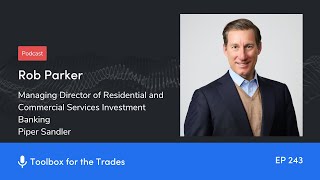
Rob Parker from Piper Sandler explains how trades businesses can prepare for private equity partnerships. ServiceTitan and other platforms made PE firms notice the sector, and the best deals have strong management teams, clean financial reporting, and systems like ERP software in place. A1 Garage's sale took about six months and required careful planning around employee incentives and communication.
Hello, contractors, and welcome to Toolbox for the Trades. My name is Jackie Aubel, and today I'm chatting with Rob Parker from Piper Sandler, and we are talking about private equity, we are talking about ebitda, we are talking about acquisitions, all of that good stuff. I hope you guys love this conversation as much as I did. Rob Parker, you are the managing director of Residential and Commercial Services Investment Banking at Piper Sandler. Today you and I are going to be talking about tips for partnering with private equity and the tech you need to maximize ebitda. Welcome to the Toolbox for the Trades podcast.
Thanks, Jackie.
So glad to be here and I am so happy. Thank you for joining me in person at Burbank. You are headquartered yourself personally in Detroit. So I really appreciate you making the trip out here. It's always so great to have people in person. So thank you for making the trip. I really appreciate it.
Love it. It's nice and cool here compared to Detroit the last couple of weeks.
That's one thing I wanted to ask you before the. Before the recording started. It has to be humid there, right?
Very humid, yeah. Incredibly humid. I took my two boys to the Detroit Tiger baseball game on Sunday. It was an afternoon game and it was at least 100 degrees.
It was.
It was brutal. But they won, so it was good.
Well, at least you got that. That was the consolation prize.
That's right.
So, Rob, I want to start with an icebreaker so the audience can get to know you a little bit better.
Okay.
I want to know, if you were a professional wrestler, what would your intro song be?
Oh, wow. I've not often been confused for a professional wrestler, I'll have to admit. So I haven't given that a lot of thought. I guess I would have to say Thunderstruck by acdc. It's good selection, it's up tempo, it's fast paced. I think it would strike fear into the hearts of my wrestling competitors who probably wouldn't have had much fear before that.
So for folks who aren't familiar, can you tell us a little bit about Piper Sandler?
Yeah, sure. Piper Sandler is an investment banking firm. We're headquartered in Minneapolis. We're publicly traded, and so we do all sorts of services and products along the investment banking spectrum. So mergers and acquisitions, IPOs, debt financing. We have a huge equity research group. Service Titan is a public company that we cover and we helped take public last year, so that was great. And we have a huge public finance business, so we help raise municipal bonds for public entities. Really, Really a typical Full service investment bank.
Amazing. Thank you for taking Service Titan public as an employee. I thank you so much. Appreciate it.
Yeah, for sure.
Very, very cool. So, yes, you have been working in and adjacent to the trades then for quite some time. Can you tell me a little bit about how you came to Piper Sandler?
My career started back in the late 90s in New York. I was on Wall street right out of business school. I was there for a number of years. I came out here to Los Angeles actually. The firm I was with, which is called Donaldson, Lufkin and Jenret, had a big LA office. I came and joined those, those guys was there for, for a number of years and then eventually I'm from Detroit, my wife is from Detroit. We wanted to move back home there, so moved back to Detroit, joined a small investment banking firm there called Campbell and Company. And our work was mainly with heavy metal, heavy industry, automotive industry, manufacturing. Because that is really what was in Detroit.
Yeah, of course.
And in the Midwest where our business was. Being a Detroit native and being someone who spent a lot of my career working with kind of blue collar in the manufacturing context, but very much blue collar, hard working those kinds of businesses. I was comfortable and familiar with the blue collar world. Eventually we were owned by Comerica bank. Comerica took TARP money in 2009 and wanted to shut down our small investment bank. So in early 2010, one of my colleagues and I had no choice but to start our own firm and literally did, right at my kitchen table. We built it up brick by brick and In January of 2019 we were acquired. So I've been an entrepreneur before. I know what it's like to start something and be nervous and not sleep well for a long time because you don't know if you'll make it or not. In 2019, we were acquired by a firm called Cowan. We served there for five years and then ultimately got recruited over to Piper. And our business at Piper really focuses on that blue collar, trades oriented, residential, commercial services world.
Great. I'm glad you made the specification that you were an entrepreneur before because like I told you when we first spoke, this is a show for service entrepreneurs talking about the trials and tribulations of being an entrepreneur and what it takes. There can be a really great reward, but there's also a real tremendous risk.
And.
And if I got my timeline right, it sounds like you started yours around 2010.
Exactly, yeah.
What was that like post 2007, 2008 recession? What was that like?
In many ways, Detroit was ground zero for that. I Mean, in our town, the idea that General Motors had gone bankrupt was, Was mind boggling. And we were not totally out of it yet in 2010. And it was. I mean, it was scary. I mean, it was definitely nerve wracking. You know, I had, at that time, I had, I had my. Our first daughter. You know, we had bills to pay. And it was, I mean, it was a little nerve wracking, but that can be motivating. You know, I was definitely motivated to go get it. Right. And we clipped coupons and we cut every cost that we could and. And we kind of rolled up our sleeves and got to work. And it took a little while, it took a couple of years because as you said, we were coming out of that, the great financial crisis. And it took time. But when I look back on it now, it was actually a really fortuitous time because the Federal Reserve had pumped so much money into the system to get us out of Bear Stearns and Lehman Brothers and these major financial institutions that really shook the financial system. It ended up being a really good time. A lot of the money they pumped into the financial system ended up going into the private equity world, which is where I really had focused my business. And so once the ball got rolling, we got into 2011 and 2012, it became a really good time to. To own a boutique investment bank.
Yeah. That's so interesting what you just said about how it was a really scary time. Just the vibe around, but it turned out to be a fortuitous time. You know what it's making me think of? It's making me think of COVID with the trades.
Yeah.
Because, you know, in 2020, Covid happened. No one knew what the hell they were doing. All of our businesses at Service Titan, they had to figure out a way to continue servicing all these that were being used more than ever before. And it was like this rush. And from my perspective, I'm curious if you agree with this, but from my perspective, that is really, I think when pe, not that it hadn't already been in the trades atmosphere before, but where PE really locked into the residential and commercial services and was like, ooh, this is a great investment, no question.
Yeah, that's two things. There have been two catalysts that have led to all the interest from private equity in the trades. Number one is, was Covid. Everyone was at home. They were stressing their systems more than normal because they just really never left their homes. And they were noticing things. Noticing things like, oh, my roof seems to be leaking or wow, there's. I'VE got all kinds of pests, termites and bugs and you ghost in my.
House and my ductwork. What is it?
Yeah, I better get someone to check it out. Yeah. So people were just paying attention more to it. So Covid was catalyst number one. I would say this if I weren't here with you, but I would also say the advent of Service Titan. What Service Titan did is it allowed businesses to scale across multiple geographies and manage a very local, very hands on service business remotely. It allowed the CEO and the management team, the owners of those of those companies, to know the data and understand what's happening across their business and go acquire different businesses and plug them into Service Titan and actually have a much larger enterprise. So I think those are really the two catalysts that drove, that really drove our world.
So much of building a successful business has to do with luck, but not luck. You know, you can't control, you can't control those outside forces. You can't control a pandemic, you can't control a giant financial crisis. But what you can control is, is how you run your business, how you show up for your customers. And I will say, even though I am an employee of Service Titan, I was very proud in 2020 to be working for a brand that was really firing on all cylinders when circumstances like that strike it really if you're a business that does well by your customers, that works hard, you can really take charge of those opportunities. So I think like when it comes to entrepreneurship, it is, you've got to put in that hard work. You've got to put in the hours, you've got to be plugged in and dedicated and ready to go. So when opportunities this come, you can really take full advantage of them.
Oh, totally. Right. And there's never a perfect time. There just, there's never a perfect time. These, these things don't come with how to manuals. You just have to be willing to take the risk and roll up your sleeves and just go do it.
Yeah. So we talked a little bit about, you know, the, what I recognize as a podcaster for service for service companies. Right. I really saw PE taking a focus on the trades in 2020. 2021. Right now we're recording this August 2025 where what do you think is similar? What do you think is different about where we were three, four years ago?
There's a few things that are market oriented. So the interest rate environment is far higher today than it was back then. Technology has advanced a lot since, since those days. It's you know, we sold a company and H vac business, H vac and plumbing company at the end of 2020 and that company was on Service Titan. And when the private equity firm that bought the company announced they bought it, in their press release they referred to it as a tech enabled home services company.
Oh, interesting.
And being tech enabled meant they were on Service Titan. That's it. Today that's table stakes. I mean that's assumed. There are far more products, products that Service Titan offers and other products that are out there. There are AI driven products that help with things like call center. There are virtual ride around products out there that help, that help sales managers coach their sales teams better. There are visual learning tools out there. So I've had clients in the past that will give their new hires virtual reality goggles and run them through virtual training sessions using, using virtual reality goggles. And so I think technology has changed a lot and it's changed the way these businesses. You know, private equity has entered the world more, it's gotten more sophisticated and leads are more expensive on Google and places like that. So you have to just be more efficient. You've got to operate better. And I think the technology solutions that have been introduced to the trades have quadrupled in that period of time.
Yeah, it has been so fascinating to see the tech boom in the blue collar workforce. My dad's a carpenter by trade, so I grew up seeing blue collar work being done. And just in the eight years that I've been at Service Titan seeing, you know, when we first, when I first joined it was trying to convince contractors why they shouldn't be using pen and paper anymore. And right now we're talking about 20, we're in 2025 and it's, we're talking about VR training and AI powered solutions. When I first started this podcast I a lot of the times when I would approach someone to be a guest, they'd be like, what's a podcast? And I'm like, a podcast is. And so it's really been, it's kind of almost like whiplash, I can imagine for some of these owner operators. Do you feel like that's the case like in the last like decade, the last eight to 10 years, it's been like, oh my gosh, this industry has been impacted so much by technology.
So it starts with Service Titan is sort of the ERP CRM that they will use as sort of the foundation. Next is a, is just a financial reporting tool. A lot of smaller companies will use something like QuickBooks. We've I've even seen way back in the old days, clients that literally used Excel. But having a much more formalized accounting system, financial reporting system is critical. On top of that, a lot of our clients go beyond and we'll have a business intelligence tool like Domo or Power Bi tools like that, which take all the financial data and operating data from operating data from service titan financial data from the financial product and they'll take all that and create metrics, create dashboards, make it super easy for executives, C suite managers to know exactly what's happening in real time in their company. So we'll see that some of the virtual learning tools, the digitized learning systems, we see those, the virtual ride around tools, there's a couple of those out there. Those are very popular and very common. And as I said before, there are a lot of AI tools coming out now for things like call center for things like route optimization. So like in the pest world or the lawn care world, where being sort of dense in terms of where your route and being as efficient, you can route wise so you're hitting as many lawns as you can in one day or even like a pool cleaning business, same kind of thing. There's AI generated route optimization tools, there's satellite technology. So like in the roofing world, they'll use satellite technology to measure hyper accurate measurement of a roof and then they'll use that hyper accurate measurement to give a more accurate quote, number one. But then number two, do things like overlay different kinds of here's a slate roof, here's a cedar roof, here's a shingle roof. And it makes it much more impactful at the point of sale to show a homeowner on an iPad. Here's how this roof would look. Here's how this roof and it's literally overlaid on your own existing home. And not only is it more accurate, but it helps you sell better.
Yeah, a thousand percent. If I am in the market for a new roof and I've got several people coming over to estimates and somebody gives me like a really nice like mock up of digital mock up of what my roof is going to look like. Yeah, 10 out of 10. I'm going to go with that guy.
Imagine comparing that to someone who does chicken scratch handwriting and they give that to you three days later, it's, you can't really compete.
I'm really curious about the business intelligence component of it. So taking this data from your financial institution, your financial vendor of choice, QuickBooks, Intact, whatever, and then your operating data from service titan what are you seeing with some of your clients that. What are some of these insights they get from business intelligence software that is really helping them move forward?
Yeah, so they can. They can measure all kinds of things. They can measure how many leads they got in a particular day. What was the source of that lead? Was it a tech generated lead? Was it a lead that came in from Google? Was it a lead that came in from a particular phone number? So one phone number is on the website, another phone number's on the back of the truck that's driving around town. Maybe one's on a billboard somewhere. So you can measure how many leads and where they came from. You can measure things like how of all the leads that came in, how many did you actually get to? That's your booking rate. So how many leads did you actually get to? Of the ones you got to, how many did you convert? What was the average ticket? When you did convert, how long did it take you to do the work? So all these different kinds of things that exist in the systems come out. And you can customize whatever dashboard you want. So whichever of those metrics you think drives your business, you can have that immediately on your dashboard or literally on your phone. So you can see real time in any given minute, any given hour, where you are across whatever is important to you and your business.
Interesting. So I want to kind of go into a little bit more about the specific work that Piper Sandler does. What does the actual relationship look like with you and service entrepreneurs right now?
Yeah, so there's a few things we do. So the most common thing today is we help service entrepreneurs or owners of home services companies. We help them sell, we help them find the next owner. So the current owner could be an entrepreneur, could be a family, it could be a private equity firm already. We will help them. It's our job to know who is the right universe of potential buyers. Who are they? What motivates them, what will appeal to them? Where will they see value? Where will they see risk? Emphasize the value part, be prepared to position the risk part and do all of it in a very upfront, candid way. It's our job to know that. I've got a colleague, Eric Van Dam, he's kind of my partner in crime. In this world, we attack it together. We live in Detroit, we're blue collar people. We always have been. I was an entrepreneur. I started a company literally at my own kitchen table. So I can relate to these owners. We can really speak their language. So that's one thing we do is we help owners sell. We also help buyers buy. So when a private equity firm is looking at entering a sector or they're trying, they're chasing a deal that really want to own it, they'll hire us to help them with due diligence, help them think through where once we buy it, how are we going to create value? Like what are the best ways to create value in this business? So we'll help on the buy side, we do really two more key things. One is we will help buyers finance the deal. It's always, virtually always the case for a private equity buyer to use debt to help fund the purchase. Some portion of the purchase price is going to be funded with debt. We will help them do that. We have a very active debt capital markets team and that debt team will help private equity firms or other buyers find the debt, the best possible terms, best possible price. And that's a long process and it allows the buyer to focus on how am I going to create value? And we go focus on how are we going to get the best terms on the debt. So we can do that. And then the last thing is we do initial public offerings IPOs like Service Titan, we were part of the syndicate that helped Service Titan go public. There will be a day where some of these trades companies are going to be so big that the only option they will have, there will be no single pool of capital big enough to acquire them on their own. They'll have to go to the public, the public markets. And so we do IPOs, we're preparing for that day and we, we offer that. And that's something that I think eventually will be pretty important in our world.
How exciting is that?
Very exciting. I mean, I think in the public markets we'll be very receptive to these, to these kinds of these trades companies. I mean they have thousands and thousands and thousands of customers. They don't rely on any one customer. The demand is pretty urgent. You know, pest control companies, it's one thing to have mosquitoes, but if the kind of pests you have are like disease carrying scorpions or they're disease carrying, it's really not an option. So the nature of the demand is very non discretionary. The margin profile is good. And as we've discussed earlier, technology exists to make these businesses really efficient and really, really good. And so there's, I think the public markets will be very receptive.
How that is so fascinating. I am, I'm 35. I graduated high school in 2007. Right before the financial crisis. I was still like I want to get into tech because that seems like such an interesting frontier and it's so fascinating that I have, in my professional, adult career, have seen the passion, like the business opportunity kind of go back to this like blue collar, like core essential services market. Because at the end of the day, especially with, you know, people have opinions about this. But if climate is changing, you know, you live in Vegas, you live in Phoenix, you live somewhere that's really hot, your AC is broken, you're not. That is not a. Oh, I'll get to it one day. That is an immediate need. Like when your toilet, if you only have two toilets and you have a family of five and one of them is busted, it is an immediate need to get that fixed. These are businesses that will always be in business. Like there is no. At least in my brain, I can't think of any way where they wouldn't be in business.
Oh, totally. I mean, so like in my firm, Piper, I'm on this, this key leaders committee and we've been thinking a lot about AI and how that can affect our business.
Yeah, I think one should.
The effect could be profound, honestly. But in the trades, AI and these other technologies are really a complement. They're not something that's going to replace. So there are, there are definitely tools out there. There's remote monitoring sensors and things that can alert you before a problem begins, but they don't fix remotely. You need someone to go out there and actually do it and inspect these things and clean the ductwork and spray for pests. And these are things where technology is a compliment. Technology is not going to be a replacement. I think there are other white collar sectors where there could be some. There could be some replacement going on, but I think way less so in the trades.
Isn't that wild? I'm just even thinking about in the five years that we've been doing this podcast, you know, a big topic that always comes up is the hiring crisis, the labor shortage and the trades. And it's going to be, I think, really interesting to see in the next five, 10 years as we probably will see a trades company get so big it enters the public market. Doesn't ipo how that is going to shift the perspective of what it means to be a blue collar worker when it means to go to trade school. I think it's going to be really good for it, to be honest.
Yeah, I think so too. As it really enters the more kind of the broader public sphere and people are paying even more attention to it. I think it is going to, and there's already talk of this in Washington D.C. there's talk of vocational schools and trade schools and you know, the, the earnings, the earnings power in the trades are very, very good.
Oh yeah.
And it's something you have to have and going to getting advanced degrees and things isn't for everybody. It's been maybe over encouraged for a long time. Yeah. I think vocational school and actually having a skill is becoming more, more common now.
I 100% agree with you. All right, so I want to talk a little bit about. Thank you for giving the bare bones description of what Piper Sandler does. So you're talking about helping owners find buyers and helping buyers find businesses to purchase. Right. So let's go for the owner's perspective first. So I think I've asked most PE representatives on this show, but let's just make sure everyone knows what it is. Can you define EBITDA for me?
Yeah. Well, so it's an acronym for Earnings before interest, Tax, Depreciation and Amortization. And it became more common back in the 80s. So it's been around now for 40 plus years. And it's really a proxy for cash flow. And that's where it came from. And it kind of harkens back. You know, here in this town, there was someone named Michael Milken who was famous for the creating what, what we would call high yield bonds, what in those days they called junk bonds. But really what's commonly used to finance leverage buyouts. EBITDA was considered a proxy for cash flow. So if you think about it, depreciation and amortization, those are, those are accounting metrics. They aren't actual cash flow deductions from the business. Now in businesses that have a lot of capital expenditure requirements, like when I first moved home to Detroit, a lot of the big manufacturers that I worked with in those days, they have to take their earnings and go buy new machines to keep growing. But trades, businesses don't necessarily have to do that. If you're leasing your vehicles and leasing your equipment, your capital requirements can be quite low. So EBITDA is really a great proxy for the true earnings power of the company.
Got it. And so my understanding in my time doing the show is that if you're looking to partner with private equity, or if you're looking for a buyer in general, doesn't even have to be a private equity buyer. You want to maximize your ebitda.
You want to maximize. Yes, that, that is the single metric that, that people use to, to hinge their valuation off of. Yeah. Now, there's all kinds of other things that go into it. So how much are you growing your revenue? What is your gross margin? So after cost of goods sold, and then ultimately, what's your EBITDA margin? Is it 5% of your revenue or is it 4. 35% of your revenue? So all those things play into it, but it's that EBITDA number that they will ascribe a multiple to to determine the valuation.
Got it. So I imagine that when owners approach you or when you approach owners about potentially buying, one of your objectives is to figure out what their EBITDA is and figure out what they're doing to maximize it.
Yeah, it is. I mean, it's, it's, it's all those things. It's. You have to know, I do need to know what the EBITDA is. So let's say you have an EBITDA of 10 to get your valuation. Are we going to multiply that $10 million EBITDA by a 5 multiple, a 10 multiple, or a 20 multiple? That is a pretty broad range. All those other things go into that. But yes, ultimately it is the EBITDA that they'll ascribe a multiple to.
Got it. So I would love to hear if you can get as specific as you can about maybe a recent trades business that you've partnered with to successfully sell. They approached you or you approach them and they're in the stages of, we're getting ready to buy, we're getting ready to sell. What does that process look like? And you can use a specific example or talk in generalizations.
Yeah, sure. I mean, one of the, one of the ones I like to talk about is a company called A1 Garage.
Oh, yeah, Tommy Mellows.
Tommy Mello. Yeah, exactly. So Tommy Mello was the. With the owner of A1 Garage. A1 Garage is, is based in. In Phoenix, Arizona. Tommy started the business, true entrepreneur, built it up and was ready to take it to the next level. And knew that while what they were building was impressive and they'd done a good job to that point, finding a really sophisticated private equity investor that would come in and really help him take it to the next level. He knew he could get it there and he knew he could take it beyond there, but he would make far less mistakes if he brought in a partner who's done it several times before. So he hired my colleague Eric and I, we were, his team, hired us in that preparation process. Tommy ran, ran a very good business. And I would say when it came to operational things like Training, training technicians, hiring technicians, retaining those technicians, being as effective as possible at the point of sale. So whether that's a sales script, whether that's using an iPad, whether that's simplifying the options for the homeowner, all those kinds of things, they were great when it came to the. The other business attributes. They were like, we see a lot, like a lot of entrepreneur owned businesses. Not as much time had been spent on those. He had just hired a new president and that president was putting a lot of those things in place. But things like being audited, things like producing monthly financial results within five days of the month, closing, all these kind of basics. Tommy was very good, one of the early adopters of Service Titan. In fact, I think he is the one that took you away from just H Vac.
Oh, he did. Yes, he did.
And he was a little insistent, as I recall. He was rejected once, but he got it done. So he was a very big adopter of Service Titan. But there were other tools that he wasn't using. All of Servicetight and there were other tools that he could use. And as a continuous learner, he learned fast. But these are some of the things that we did in the preparation process. We brought probably a good 10 or so of the most likely groups in to kind of meet him, spend a little time with him before we really launched the process. Really as much for him to get a feel for the kinds of questions he's going to be asked. You know, what matters to an entrepreneur like Tommy might be a little bit different than what matters to a private equity investor from Park Avenue.
Yeah.
And so exposing him to a little bit of that was what we kind of did initially and then launched the deal. And, you know, the machine that he had built resonated well with the private equity community. And ultimately a firm from New York called Cortech was the investor that Tommy chose. And Tommy's still a very meaningful owner of A one. He didn't cash out and walk away. He truly was looking for a partner. And he still owns a very significant portion of A one today. And that's been a very successful partnership.
What was the timeline of that of when you first started working with Tommy? To him, to him choosing a partner.
The whole process is about six months from beginning to end. Eric and I spoke to Tommy just about every day. Tommy or his president, a guy named Dan Miller, we spoke just about every single day for six months. And that's one of the things, the cool things about what I do that I like is you end up Becoming friends with your clients. I mean you speak to them so often.
Yeah.
That you end up just developing a great relationship. The first couple of months are preparation. So we're getting all of our materials together, we're getting organized. We're laying things out in a way that allows these different potential buyers to really do their diligence and understand we're getting organized for all that. And then it's about four months of introducing the business to different groups, letting them do their diligence, responding to questions and then ultimately negotiating all the legal documents.
I'm always curious about what you do if you're in Tommy's position. When you know you're pursuing this pathway and you've got a really sprawling, successful operation. When do you start telling the employees, the team members about hey, this process is happening because especially if you guys are flying into Phoenix, Arizona, you know, they see you and Eric and they're like who are those guys? What are they working on? Huh? What's going on? So I'm, I'm really curious how owners would prep their team for this type of partnership. This really impactful change that's going to come to the business usually for good. It's meaning a good thing. But I would love to hear your thoughts on that.
We had a client one time that said please don't wear a suit and tie to the, to my business. Someone's either going to think there's a funeral or, or they'll know I'm selling the company. So I just don't dress down, dress comfortable. So we often dress in a way where we look non threatening. We try not to stand out too much. So I think in my view the best time to tell the employees is when you have something to tell them and it can be a little unnerving. There is a perception that really again goes back to the 80s and maybe was really emphasized when Mitt Romney was running for president years ago, got painted as in such a negative way and private equity was painted in a, in a light where all they're going to do is come and close things down and fire a bunch of people. The Cortech A1 story is much more like the typical deal we see where they're investing in a company because they, they like it, they like the team, they like the people. If anything they want to grow it more, they want to invest in it so it goes to the next level. They would way rather earn their return not by selling off assets and firing people to pay down debt. They would way more prefer to earn their Return by tripling the earnings, by growing it over a period of five years. But that's not well understood. What most people think about private equity is they're going to come in and my job is at risk.
Yeah.
And so it can be a little bit unsettling and change in general can be a little unsettling as it is. So I think the best time to do it is when you have something to say. So when you begin the process and there's legitimate interest, that's probably the best time to do it. It's good to make people, you know, people are the people who work for you, particularly in trades, businesses where I spend my time. Those people, their assets, I mean, they're valuable. They have a lot to do with why the company is valuable. So you should treat them like partners and treat them like adults and let them know that this is something we're considering. And the idea is I'm bringing on a partner to help us all grow and do better and get to the next level. That's probably the best time to do it. I wouldn't necessarily do it right out of the gate because it could be that you decide not to do something or it could be nothing happens at all and then you, you unnerved people for, for no reason. But once the process is underway and it feels like, yeah, there's good interest here, that's probably the right time.
Are you finding that companies that are pursuing this path, I've heard of rumors of giving incentive plans to top managers in their company. So they're trying to unlock wealth opportunities for their teammates as well. Are you seeing that more often?
Yeah, definitely. We, it's, it's typical for kind of the key managers, people involved in the process at a minimum to get a deal bonus because it is, it's a burden on them. So those people who have been part of the process, who have been burdened, who had this second job on top of their day job, there's definitely a bonus for them. And then it's also common for long term employees or employees who may maybe weren't part of due diligence in the sale, but who are important to the company to get bonuses too. I've seen a pretty wide spectrum of that.
That's great. It's great to hear. Now Tommy is an example of residential, right? Residential service and replacement.
Yes.
What does this look like? How does this differ when the company is primarily a commercial services department or new construction or any of that kind of stuff?
Yeah, yeah. So there's some important differences in the commercial world. So the commercial world tends to be more complex. These are larger systems. They are in environments like hospitals or data centers or schools that are very critical infrastructure. So they really, they need to be a much more sophisticated, much more complex, oftentimes much larger system. So the skill set needed to replace a basic air conditioning unit at my house versus an air conditioning unit at a hospital is just very different. They tend to be inspected and maintained much more regularly. And in some cases, in the case of like a hospital, it's a regulatory requirement like a generator. And these things are maintained and inspected. So those are some key differences. Also, the commercial customer tends to be a little more sophisticated, a little more process driven when selecting their trades partner. A homeowner might be a little more emotionally driven. Whoever can do it the fastest, who can fix it's 100 degrees outside, I need it fixed as fast as possible, or I trust the person that came into my home and took their shoes off. There are all sorts of little techniques or little base little things, little differences that can cause a homeowner to make a decision. A commercial purchaser tends to be much more focused on price benefit versus some of these other emotional things we see in the resi world.
Are you finding private equity players? Are they doing both residential and commercial? Are you finding they're kind of sticking in their own lane?
Yeah, there's. Yeah. Oftentimes a firm will have investments in one or the other or both because the, the work is basically, is basically similar. And if you understand, let's say, you know, lawn care, landscaping in a residential environment, you can figure out how to do that same kind of work for corporate headquarters and for malls and for things like that. So the work is similar. So you already understand a lot of the important metrics and a lot of the important drivers. It's just a little, you know, the end markets are a little bit different, so there's some nuance, but it's not so, so starkly different.
Interesting. Sticking again to the owners, owner, operators who are looking to sell, looking to partner. What is something that I should have asked you, Rob, that I have not, because you. I don't know what I don't know. Our listeners don't know what they don't know. But you're, you're in this system day in and day out. What are you finding is the most surprising thing that owners come across when they begin this process or what should they really consider before they undertake this?
I mentioned that company we sold at the end of 2020 that had ServiceTitan and therefore because of that, consider themselves tech enabled. These sectors are so valued that really if you had any scale at all, there was great interest. Today there are a lot of private, there's a lot of private equity backed companies across, across home services, a lot of them. So it's gotten way more sophisticated. You can't just simply be a lawn care company or a pool maintenance company, or an H vac player or roofing player. You actually have to have a developed C suite. So you need a real management team. It can't just be the entrepreneur who kind of does everything. You're the one who's in charge of sales. You're the one who's in charge of being the visionary and setting the strategic direction. You're the one that reviews the numbers. You're the one you need to have a well developed management team, a CEO, a cfo, someone who's a market head of marketing who can help drive leads, someone who's ahead of sales, who can help you convert better once you generate those leads, a COO to kind of keep the trains running on time, make sure operationally everything is in order. All these things have to be in place. Not necessarily five years ago, but definitely today. The threshold for being ready to go to the next level is way higher than it used to be. I would say technology is part of that too. You have to have a financial system, you have to have some kind of an erp. Again, service titan is one we see most often in our world. Doesn't have to be that, but you have to have a sophisticated erp and then you have to begin thinking about some of these next level, you know, visual learning, using a disc profile to help assess who you want to bring into your organization. Being sophisticated and ready to go to the next level is way more scrutinized today than ever before. That's one. Those are a couple of things. The other thing that I think about and you said, how do you prepare for this? I think what I would say is kind of going back on something we touched on. People are so afraid of private equity and partnering with that community. They want to be partners, they want to collaborate. They're expecting that an entrepreneur is going to not take 100% of their chips off the table. It's okay to take some. Yeah, of course, you know, you started this thing in your garage, you know, 20 years ago, you're allowed to reap that reward. But they want to see you put a meaningful piece back in. I mean, they want to hear you say, I can't Think of any other investment I like better than this one. Now, it's okay to say I want to be diversified, but it's also okay to say I want this to still be the single largest piece of my net worth. And I want to partner with you because together we can take this thing three times beyond where I could take it on my own. So approach it as if these people want to be your partner and they want to grow this with you, not that they're like an adversary who wants to go fire all your people. It's not like that.
Interesting. Okay, so I just want to call out some things here. One, the threshold for partnering with private equity is higher than it was three or four years ago. Totally makes sense because now that a lot of players have entered the space, the first big boom kind of happened. Now their expectations are a little bit higher, which makes sense. And I feel like a lot of service dying customers. A lot of the customers I've had on the show, they're, they're, they're there, they're. Yeah, I. More than ever before, I'm having people come on the show and talking about how integral their management team is. They're like all that stuff, right?
Yeah.
Going into it and making sure that you're approaching a private equity partnership as that, as a partnership. One other thing you mentioned, you talked about COO and head of marketing, I think also a cto probably.
Totally. Yeah.
Is really important because certain service titan. I'm an employee. I'll be the first one to tell you. It's a massive, massive CRM. I mean, we do so much and our pro products do so much. I think it's really important to have someone in charge of that technology adoption and usability, making sure you're getting your ROI out of it.
You're right. There are new applications coming out every day.
Yeah.
Having someone who can assess them.
Yeah.
And determine which ones will help us be just a little bit better is. Is important.
Where do you think that true owner operator owned businesses in the trades are going to survive with the influx of private equity? Do you think there always will be a balance or do you think there's going to be essentially a mass takeover?
Well, the world has gotten more competitive. The bar has been raised. And I think there could be some that if they're not willing to continuously learn and continuously innovate, they could have share taken from them. Definitely. And sometimes those would be the ones that tap out and decide, I'll just sell, I'll let them come in and frankly, take a Lot of headaches off my plate. It's hard for me to keep my technicians busy in the non busy season. And so therefore I lose them. Now I'll have, I'll have someone, a much bigger player who knows how to do these kinds of things and sell more member agreements and we do all our kind of inspections and stuff in the non busy season. Maybe it solves a problem. And so I could see some of that. But yeah, I do. I think if you're not a continuous learner and you're not innovating all the time, you could ultimately have a problem.
You know, Tommy Mill's been on this podcast a couple times before. He's so big now, he's so famous. But he has said that before on the shows that I've done with him, where if you're not innovating, you're failing. If you're not struggling, if you're not working to get better, you're actively failing. And one thing I always really appreciated about Tommy is that he, whenever I spoke to him about his team, he always took it very personally that he's in charge of the employment, gainful employment of hundreds of team members who feed thousands of mouths. He's like. And so I take that on as like a, as a personal responsibility that I'm doing right by them. And I think that mindset, that having that servant mindset as an owner, operator, the head of a company can really benefit you in that way.
Oh yeah, for sure. I totally agree. Back when the firm that my partner and I started years ago, my wife and I would go have dinner with friends and in Detroit, people don't totally know what I do. It's not common where we don't know what I do. No.
Yeah, like what you do a podcast for a business?
Yeah. People say, what do you do exactly? Finance. I'd always say, no, I'm in the, I'm in the talent development business. It's all about the people that work at our firm and how do we find good ones and how do we keep the good ones that we have. You know, they don't grow on trees in Detroit. It's not like New York City or San Francisco. We, it was really, really critical and just that mindset. And Tommy talks about it all the time. He's another good example that can inspire a business owner to be a continuous learner and to continuously innovate and evolve. Because all these people are depending on you, which is why you need a good team, so that as the CEO, owner and you can actually Be that visionary and you can actually be out there thinking about what's next and what's around the corner. And you have a CEO and all these other people to help manage the.
Day to day to implement. Yeah, exactly. Rob, you are, I don't know if anyone's ever told you this. You explain what you do very well and you explain the ecosystem that you operate in very, very well. I could genuinely, like, talk to you for. I'm like, I'm thinking of all these other questions I would love to talk to you about. So if you'd love to come back on, I'd love to have you.
Love to.
Is there any final words you want to impart with our listeners? If they want to find you, if there's anything they want to reach out, I'm sure you, you know, they may want to get in contact with you if there's anything you want to share there.
Yeah, for sure. So first of all, I would just say thank you to you, Jackie. You've been great to work with. I've enjoyed this. This has been really fun. You do a great job on these podcasts. So thank you for having me. It's an honor to be here. If anyone wants to reach out to me, email is a great way. It's very easy. Rob Parker, which is P A R K E R at P S C COM.
Perfect. And Rob with 1B.
One, one B.
Okay, great. And any final words that you'd like to say with to our audience?
I would just like to say it's what I do is fun and I like working with entrepreneurs. I like to work even. Even the private equity folks who are focused on the trades. I relate well to that group. I relate well to that community. These are all people from the people on Wall street itself to people out in the rest of the country, like where I live, who are helping homeowners every day with these basic problems that are so important to their daily life. It's really fulfilling and rewarding and I've really enjoyed being part of it.
Awesome. So cool. Rob, thank you so much, much for being a guest on Toolbox for the trades.
Thank you.
More from Bill



Capturing the 80%: How SmartAC’s Gen-2 Targets Non-Membership Homeowners | Podcast Ep. 296

Build better customer data with every booking in ServiceTitan | TAD Tune-Up Series

The Biggest Change for Roofers Coming From Other Roofing Software to #ServiceTitan?


