Swipe, Tap, Done: Optimizing Payments for Your Contracting Business | Podcast Ep. 50
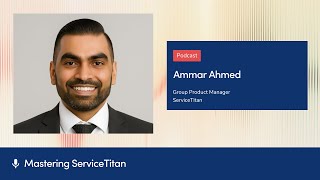
Amar Ahmed, who spent 21 years in payments, explains why contractors should push customers to pay in person instead of over the phone. Card-present transactions cost less and have lower fraud risk. ServiceTitan's new features include Tap to Pay, Pay by Bank, and QR checkout.
You pay through your phone, you listen to music through your phone, you can watch movies through your phone. That's the big evolutionary shift that's occurred within payments, and it's only going to get more innovative.
Welcome to Mastering Service Titan, where you get expert advice from power users. I'm your host, Josh Liu, and today I'm joined by Amar Ahmed, the group product manager here at ServiceTitan. And we are diving into all things payments in service. DY and Amar, welcome to the show.
Appreciate it. Josh, great to be here.
Awesome. Yeah. Excited to dive in. But before we get started, I wanted to ask how you got into this field of payments technology. It's such a niche area, and what is it about payments that fascinates you so much?
So I have been in the payments industry for about 21 years now. It was not my first choice when I was like, you know, getting into the. Into corporate America. Actually, corporate America was actually not my first choice. Studying to be a medical doctor. And while I was in school, I was working for this subprime credit card issuing company. As I was working there, I was like, wow, this is cool. Like you, not the subprime part, but it like, right, what our company, but really around the fact that like, you know, you can swipe a card and, and like me as a user, I have no idea how complex the back end pieces, the complexity of the money movement is occurring and then all of the other ancillary impacts like your credit reports, right? So if you don't pay on time, there's a credit bureau impact, et cetera. So that got me really, like, interested and I started just diving deeper into like, learning more about, like, payments. Needless to say, I pivoted from my career choice and never looked back and have been in the, the payments industry now, like I said, for the past 21 years.
Wow, 21 years. Zooming out, like, just looking at those two decades, what has changed in the payments world and how has that evolved to where we are today?
Oh, wow. It has changed drastically in the last, like, I would say even the last, like 10 years has changed drastically. Right? So I mean, think about it. Early 2000s, right? IPhone came out in what, 2007. So before that it was basically cash or check, right? And then you had credit cards from a swipe perspective. Since then, we've had evolutions of payments in digital wallets, right? So PayPal wallet, Google wallet, Samsung Wallet, Apple Wallet. Then you had the evolution of Apple Pay, Google Pay. You had evolutions of tap to pay on an, with a card has an NFC on a, on a card reader, like a terminal. Now to the point where we're at where your mobile device is an actual payment acceptance terminal. I recall kind of watching the, the Steve Jobs biography and at the end of the movie, he tells his daughter, he said, one day I'm going to put the music in your phone. And it's amazing that his vision was just to do that. But how? Now everything from a smartphone perspective, you do everything in your phone. So you pay through your phone, you listen to music through your phone, you can watch movies through your phone. That's the big evolutionary shift that's occurred within payments and it's only going to get more innovative.
Wow. And looking at service time, how is service time starting to adapt to some of these changes?
You know, when I started at ServiceTitan, I had a little bit of knowledge in the trades industry. I come from like a fintech background. One of the things that I realized is within the trades industry, we don't necessarily get the love that we need from a, from a payments perspective. Right. Everything goes to like your bigger fintech companies. Right. But at the end of the day, the core value that I think Serviceitan has is we need to do what's best for our customers. And I think Serviceitan has changed and adapted those changes by really focusing on newer technologies and newer payment methods. So for example, we have launched tap to pay. There are some payment service providers, not software companies. I'm talking about actual processors who still don't have tap to pay available. They're still building it. So the fact that a software company has enabled it for their customers is massive. It kind of just drives home the point that we are trying to build more, faster, seamless embedded payment solutions to, number one, speed up the checkout process, but also help tenants and contractors and techs get paid faster and increase revenue overall.
Got it. Yeah, I was actually going to dive into that a little bit in terms of, you know, someone's listening and payments, I feel like maybe can be an afterthought sometimes for people and for. Or for contractors or really businesses in general, what are the main, like value areas that payments and getting payments.
Right.
Brings to. To a business?
Yeah, you know, payments often because it just works so seamlessly, you kind of almost like forget about it. Right. And a lot of times it's. It's looked at as a commodity. So when you kind of like look kind of take a step back and look into the mindset of a tenant or a tech. Right. They're there to like Basically perform a job. Sometimes it's a service or sometimes it's an emergency they don't want to think about. Potentially how do I get paid? Is this the right channel for me to accept payments? Is this check going to bounce if I take this cash, I put it in my pocket, let's say my pockets are too big and my cash falls out while I'm, while I'm getting on my truck. Like all these different things, you don't want to necessarily think about that. So from a perspective of, you know, how technicians, tenants should be thinking about payments in general is what is the most seamless way for us to kind of come, get in, get out, get paid faster. And I think that's the value proposition of service and payments that we really offer is because we offer these, all of these digital channels of payments, you basically get paid faster. And we also help you reduce the, the NSFs, right? The non sufficient funds that you get with checks where, you know, somebody writes a check, you go back, you try to go cash that check or deposit that check, next thing you know, oh, it bounced because the person who wrote the tech forgot that they wrote you a check. Right. And they took out the money from the account. That's kind of where service payments can really help businesses evolve and really help them in also reducing their overall operating costs.
Right? Yeah, I mean, accepting payments is something, you know, every business has to do. It's like the core of the business where you got to make money. So it seems like there's one aspect where it's like making sure that transaction takes place, like just fulfilling that transaction. And what you mentioned about speed, then there seems to be another value of like you have to take payments. But there's probably a strategy around it in terms of optimizing your costs or maybe like security or like I, I don't know what that area is called, but can you talk a little bit about some of those benefits too?
Yeah, absolutely. So I think optimizing costs is that every business tries to do, right? It's like we're in a constant battle to like optimize cost. Here's the way I look at it when I start thinking about payments in general. So there's two types of scenarios in digital payments. I'll touch on that, I won't touch on cash and, and chatter. In digital payments, there's something called card present and card not present. And what that basically means is from a network like your visa, your MasterCard, your Amex, right, when you have a card present transaction, it is to the networks considered to be more secure because the cardholder is there, you know, they have the physical card in hand or with tap to pay, they have their phone in hand, right. With their face ID to unlock. You tend to have a lower interchange cost. Interchange for anybody who does not know is just basically the cost of processing a transaction. So it's what the, basically the networks, the banks, right, they all basically have a, have a piece of the transaction. What card not present transactions do is there's a little bit higher fraud associated with card not card not present transactions, right? So the networks basically charge a little bit of a higher interchange rate. So like for example, if somebody was to like just peek over while you were making a payment, either take a picture of your card or just memorize your card number and your expiration date and your CVV code, they can just go online at home and just type in that number and then transact, right? So that's kind of where the fraud vector increases. So that's why the cost of hardener presence is a little bit higher. So when tenants and technicians like are looking at optimizing payments, we always recommend card present first. And the reason we recommend that is because number one, with card present with any card transactions, you know immediately that, that that credit card has a balance to actually make the payment. So you basically get paid faster. You have authorized instant authorization and then you also save money. From an interchange perspective, we do offer obviously card not present solutions which are safe, secure and reliable. So let's say the customer is like, oh, I don't have a credit card on me, I'll have to go find it, blah, blah, then you can send them a payment link, they can go into our customer portal and then they can either check out through an ACH transaction which is like a bank where they enter their bank account information manually. Credit card where they can enter their credit card information. Or we also have pay by bank, which is an instant connection to their bank account. Instead of manually entering their routing and account information, they basically enter their username and passwords of their bank and connect their bank account, which also offers balance checks so that you can check a balance and make sure they actually have the funds to reduce NSFs.
Ah, got it. Okay. So it seems like best practice is try to as much as possible have a card present transaction type. And that could mean they're swiping the card, they're tapping it, or you mentioned via the payment link and the customer entering it through the customer portal. All of that counts as card present, no?
So card Present is only when you're actually have a reader and you're just tapping and swiping and inserting it. Or, or if you have a tap to pay and you're basically accepting a payment from a tap to pay. Those are all card present payment links and keyed in. So if a technician is, has their app and they're keying in the card number, those are all considered card not present. Got it. So our recommendation is when you have a, when you look at your payment mix, try to have your payment mix leaning more towards card present transactions than card not present. And that will actually have a significant impact on, on your overall optimization of interchange costs. Okay.
Makes sense for contractors out there listening if they want to increase their card present. Do you have any best practices or recommendations like how can, how can they ensure that technicians are taking that card present rate more often than not?
So you know, some of that comes through obviously tenant training, right? So from technicians to like say, hey, we know that like the mindset. So the mindset is like, you know, pay consumer, you decide how you want to pay and what we've seen in the industry and just in general, right. When you look at the market as the older demographic transacts, they're more aligned to paying by check because they think that that's safer. So it might be safer from their perspective, but it's actually less safe from a tenant perspective because they could bounce. The best way that I've seen that occur from just a, from a technician perspective is, is if you as a technician were to say, hey, would you like to pay by card or debit? If you actually trigger the first option as being credit or debit or card. Right. We've seen significant from a behavioral psychology perspective that people tend to hold on to what the technician said first and assume that that's the preferred method that they want to accept the payment with. But when you do cash or check and then put credit as last, immediately they say, oh, I can pay you by cash or check. So it's the first choice is what consumers actually think believe that that's your preference. So you want to change the preference model from a language perspective in order to drive more card present transactions.
That is such a good tip. And any contractors out there training your technicians to lead with the credit or debit option first, however you want to word it, just to show that that's your preferred option and then you'll get paid faster, it'll be safer. Now how about those in the back of their head thinking like, oh, but with With a credit card or a debit card, I have to, you know, pay that fee versus a check or cash. Maybe it's less secure, but hey, I get to keep all that money myself. How do they work around that fee and how should they think about that?
Well, so before I answer that question, I think, I think that's a common misconception. So when you actually look at the data, the Federal Reserve did a study of 20, 24 and 70% of transactions are basically credit and debit. And then the next majority is like mobile payments. So you're talking about like cash app Venmo, you know, and then mobile transactions. We're talking about actual physical mobile transactions like tap to pay, which amounted to, I think like 23% of that 100% gap. So it's increasing pretty significantly. And more and more people are moving more towards mobile transactions than they are towards, like physical card. It's just easier, right? You always have your phone on. You may not always have your wallet or your purse on you. The second piece is, even though checks are considered like, hey, I get to keep all of that, all that money, you have to understand that the, the actual ACH network that's built in the United States, it's very small, slow and outdated. Let's say you get a check on a Saturday, you go do a job on a Saturday, you get that check. Banks are closed on Sunday, so you really can't do anything about it on Sunday. Even if you, you know, do an ocr, you're not going to be able to get anything done. So Sunday is gone, Monday comes around, bank receives that. Now it takes almost three to four business days approximately to clear that check. So now that money that you were supposed to receive on Saturday is now you're running onto the next week, Thursday or Friday. Right Now, God forbid, if that check bounces now you have to go fight and figure out how do I get another check from the customer. So now you have to now go reach out to your customer and say, hey, that check bounce and it didn't clear. And then the bank actually charges you a fee for the bounce check.
Oh, wow.
Yeah, so there's a bounce check fee. So we've kind of like done a, like in like study on the industry, just in the Czech industry. And it takes about, almost like 20 to 30 days to resolve a one balance check issue. And it could cost up to $75 in fees and processing costs to process the check. Wow.
Wow. Okay. Yeah. I'm so glad that you're clearing up this misconception because, yeah, at a surface level, it seems, oh, my gosh, cash is king. Right. Like, let's just take the ca of the check. But even I'm thinking now in the back of my head, like, if they lose one check out of like a hundred checks, oh my gosh, it's just like all that pain and the money and maybe it's slipping through the cracks and not collecting. So, yeah, it seems like there's also. I don't know what to call that a risk or like a security aspect to it.
Yeah, 100%. And. And then there's also like, fake checks. Right. People can. People can create fake checks. I live in Atlanta, Georgia. I think, like last year there was like a. A group found that was making fake checks. Wow. And they were actually processing, like, transactions with it. So I always tend to say digital is safer because, you know, you have protection as a business with digital payments, whereas checking cash, like, you know, technicians are driving around all day, they have a check in their pocket or wherever. Like, what happens if it just falls out? You know, so it's, it's not just thinking about it from the lens of like, am I going to save money? But also what happens for the customer that I am trying to retain to use me again and again if I go to them and be like, oh, you need to give me another check because I lost it or I dropped some cash or etc. Etc. Right. I think it's really important to really understand the value of digital payments, which, you know, as. As a payments industry Expert, I am 100% bought in all the digital payment models.
Yeah, let's talk about a little something like a strategy I've seen often, you know, you go to like, convenience store and they say, hey, you know, you gotta. There's a surcharge. Like, I'm gonna charge you a little bit extra, like 3% or whatever percentage if you use a card, because they're trying to save a little money on that fee. How should contractors think about techniques or tactics like that in their business?
Great question. We get this question a lot about surcharging. Surcharging seems easy. You basically just add a fee and, you know, the customer either pays it or, or they basically don't pay it and you give them an alternative payment method. Right. So I'll kind of tackle this question in a, in a few lenses. The first one is going to be more on the regulatory setup side of the house. From that perspective with surcharging. Surcharging is pretty much still like Illegal in like four states within the United States. And then a lot of other states have heavily regular regulations around this, like New York, California. They basically have like, yeah, you could do surcharging, but you have to be like, really careful. In addition to that, you can only surcharge up to 3%. Cancer charge more than 3%. That's a Visa, MasterCard, Discover cap. So if your interchange is higher than 3%, you still end up paying the difference. Thirdly, you can't surcharge on debit cards. So if a customer comes in and uses the debit card as a credit and you charge them a surcharge, you're in violation. Oh, wow. Okay. So fourthly, if you do a surcharge, you have to have signage, messaging, everything upfront before they pay. So you as a tenant have to take on that burden to basically tell the customer, hey, just to let you know, if you have a car, if you go to a convenience store, you always see a little sign that says, we will charge whatever fee for any transactions like, you know, below or above certain dollar amount if you use a credit card. That's part of the surcharging rules and requirements. So if you're a technician going to someone's house, are you going to be carrying like, I don't know if you're going to be carrying around a sign that says, hey, we're going to charge you, because you can't get to the payment screen and then say, oh, there will be a surcharge. You have to tell them before.
Oh, wow, okay.
So you can't.
Even if it's on the payment screen somehow or the invoice somehow, it has to be before that.
You, if you could tell them on the invoice before you start the payment process. Okay, that's, that's fine. Right. So that they can make the decision of how they want to basically pay. You don't want to get to the payment screen and say, hey, by the way, you're going to pay by card. It's going to be a 3% surcharge.
Gotcha.
Right. So those are just a few things that I just laid out about surcharging, which kind of like is, I understand, it's like an industry trend that, you know, you want to optimize on the interchange cost. Those are some of the gaps. Secondly, consumer sentiment on surcharging is net negative. Consumers don't like surcharging. It is one of those situations where you can basically surcharge and say, hey, okay, if you don't Want to pay by credit card, you can pay by like ach, right? So you have to offer them a non surcharge payment method and they may not want to, they may say I don't want to pay by ach, I don't want to pay by cash or check either. I wanted to pay my credit card because I have a rewards card and I want to earn points because you're charging me a $500 invoice. Right. And that's. Consumers are thinking about it from that perspective in that lens. Right. So in some scenarios that also is like the thing that tenants have to think about, right? That's the legal component and the customer experience component from it. From a search engine perspective. Now how do you still reduce your processing cost without necessarily surcharging? We have this amazing tool called price book. So with the price book is all of the prices of the services that you offer and the products and services that you have. The, what you can do. There is, there is a functionality within a price book product where you can actually add a 3% fee to any card transactions. When you basically go to a customer's house and you say, hey, it's a thousand dollars invoice, right. Basically you could just show them if they're paying by card, the thousand plus 3%. But if they're like, oh, is there any sort of like discounts to this? And then you as a technician can see like, oh well if you pay by ACH or pay by bank, we can knock off 3%. So then with your ACH and ACH has a lower cost of acceptance from a payment perspective, you still keep your like thousand minus the smaller reduction from ACH, but you don't lose that 3, 3% from a credit card transaction. So the price book is a very powerful tool and I do like whenever I talk to tenants who and who are basically saying like how do I, you know, pass on the fees in order to initially like not have the regulatory burden, which a lot of it is on the, the tenant side. This is an easy way to reduce your overall cost while improving your, you know, your bottom line revenue.
That makes sense. So let me make sure I got this right. So within the price book, rather than surcharging where there's a lot of regulatory risk, the consumer sentiment, like they don't like it either. So it seems like pretty much bad all around. You're taking on risk as a business and giving the customer worse experience. So rather than surcharging, are you saying to go into your price book and mark up your price book by say 3% and offer a slightly higher price to make up for those fees. But then offering a discount if customers want to pay via other options.
Yeah, so that's exactly what I'm saying. So, you know, definitely, if that's, if that's the route you want to go, I would much rather do that. Right. To a consumer. When you go to a consumer, they're like, can you give me a discount to win the sale? You can say yes if you pay by ACH or a payment link. So you can pay online. With pay by bank or ACH, we'll give you a 3% discount. So the conversation changes between the tech and the consumer of, oh, you're giving me a discount versus oh, you're penalizing me for using a credit card. Right.
That is, that seems like such a better experience for the consumer. And it also seems like this makes sense. Like, you know, every business incurs costs, various costs across the business and they bake those costs into the price and that's how they, you know, make a profit. And so it makes sense, I think, to be like, hey, this is a cost that we incur. Maybe we didn't calculate it in this way before we were eating it, but hey, we want to pass it on or be more profitable. And so to run those calculations and take care of yourself as a business, I think is totally reasonable. So how about, you know, you're leading a lot of the innovations and tech in terms of how serviceign does payments here in the future. I'm pretty excited to hear about, you know, what's new and out lately that people may not know about and then what's on the roadmap.
So something that we've, we've been trying to push that has been recently released is our Tap to Pay functionality. So that's basically no more card readers. No more like trying to figure out if I charge my card reader, oh, I forgot it in the truck or I forgot it at home. Everybody. Nobody forgets their cell phone nowadays, right? So your technician's cell phone basically becomes a card reader. So we have that capability now available. So Tap to pay is I highly urge if you would like to learn more, contact your sales rep or your csm. We also have pay by bank available. So that's the ability to do balance checks and have a consumer connect their bank account. Very powerful tool. Right. Than traditional ACH where you don't know if the transaction is going to go through. We're also making some like more modernization from a experience perspective. So One of the things that we're working on is we're doing a QR code at checkout. So currently the experience of sending a payment link is as a tech, you have to go in, send a payment link, make sure the phone number is valid or the email address is valid. Right? Fat finger it. Or if it's incorrect, you have to get that and you have to like start typing in the new one, then send it, then wait till the customer either gets the text message or the email. Then that customer has then click on the link, then they land in the payment page. That's a lot. That's a lot of steps. So what we're doing is whenever technician clicks payment link, we'll help them generate a QR code. The consumer just scans the QR code and then immediately gets directed into the payment page. No more waiting, no more trying to figure out if I have the right email address, all that stuff. So we're working on that as an experience. We're also working on the roadmap to enable Apple Pay and Google Pay within our customer portal. So you can consumers want to pay by Apple Pay and Google Pay to check out faster. That's also currently on our, on our roadmap. One big thing that I know that a lot of tenants have been asking for is the ability to collect deposits within the estimates. One of our kind of phase one or phase zero that we're working on is the ability to collect a deposit using the customer portal. So it's a seamless flow right now the text basically when the consumer selects the confirms the estimate. They have to go back into the job, go to collect payment, then collect the payment manually. What we're doing is we're building in the payment collection and the calculation of the deposit within the estimates flow. So once they hit the estimate, it'll auto calculate whatever the deposit that you have set. Present the payment screen to say, hey, $10,000 invoice for this estimate, we want to collect 50% deposit. You immediately get shown a $5,000 deposit payment. You do that within customer portal. So you send the link and then the consumer basically pays it. And no more trying to figure out, hey, how do I collect the payment now for the deposit? So those are just some of the things that we're working on. And then some other minor UI U exchanges we're working on something called a dynamic checkout. So we talked a little bit earlier about how do you get the tech to do more card present. So one of the things that we're working on is like we're also working on like reordering and also pre selecting some of the dropdown options. Basically, if you have a card on file, we should always show that as a first option. So tech goes, oh, you have a card on file, you want to pay with that. So I think those type of little enhancements are going to help drive the movement towards more digital payment methods.
Very cool. Wow, there's a lot to be excited for in this world. The two at the top that you mentioned that are available now, the newest things, I think Pay by Bank and Tap to Pay sound really interesting and exciting. Can you share a little bit more about exactly what Tap to Pay is, how it works and then same for Pay by Bank.
So the way Tap to Pay works is any mobile device that has NFC technology capability, you probably see on your card, you see like the little like know, semicircle, semicircles that are on your card. Oh, right, yes, yeah, yeah.
So it's like a sideways WI FI logo, almost.
Sideways WI FI logo, yeah. Basically if you have that on your card, that's an NFC enabled card. So same thing. The devices who accept those Tap to Pay transactions have to be NFC enabled. So there's many Android devices like Samsung tablets or et cetera that have NFC enabled and you can actually take the payment on your iPad. So a customer can basically take their card or if they have an Apple wallet, right, they can tap onto that Android tablet and transaction is done. So it's very important that if you're purchasing any sort of like Android devices, it's important to like make sure that they're NFC enabled in order to use Tab to pay. Apple on the other hand, does not have any NFC capability on any of their iPads. The problem is when you have an iPad and you want to collect a payment from Tap to Pay, you basically can't do it right on the iPad. You would have to ultimately go into your phone and log in and then find the invoice and then basically enable the payment. But that seems like a deterrent to using Tap to Pay. What we are building right now is, and it's actually releasing in our upcoming release is once you, once the technician hits Tap to Pay on an iPad, QR code pops up. Tech scans their phone. If they have the mobile app and they've already logged in, it immediately loads the payment page for them on their phone. You hit Tap to Pay and then the customer comes in and taps transactions. Done. You also don't get logged out of your, of your session from your iPad. So we we basically keep the concurrent sessions open. Right now what would happen is you would basically open up your phone if you don't have that QR code feature and then if you log in, it'll log you out of your iPad.
Oh, okay, I see. Interesting. So now you can, you will be able to do Tap to pay even if you're on an iPad and it's via this QR code and this link.
Yeah. So in about a few weeks in August, we, we will have that capability to not only do this multi device transition. So if you like to have an iPad and then an Android phone, you could do that. Right. But if you have an iPad and an iPhone for that QR code, you'll be able to do that multi device transition. In addition to that, we're also launching the sessions as well concurrently. So that way you can actually have multiple sessions open at the same time so you don't get logged out.
Awesome. That is so cool to hear. So yeah, if you want to learn more about Tap to Pay, we'll include a link in the description of this episode and then you can also of course reach out to your CSM and we'll get you connected to someone on our team and then Pay by bank. How exactly does that work? If someone's interested in using that, how does that work for their business?
So Pay by bank ultimately is, like I said, it's an instant like connection to a consumer's bank account. It does not work on a card present scenario. So it is a payment link option. Basically you contact your CSM and you say, hey, I'm interested in pay my bank. And then they'll, it's. They'll basically just set you up. It's fairly easy of a setup and all it is, it becomes an, it becomes another payment method on the payment screen that the consumer sees. They basically click it. If you want to see a demo, we can also show a demo of how that works, but basically click it and then the consumer goes through some steps to link their bank account. And now when they link their bank account, that bank account is also stored as a stored payment method. So the next time you want to take a payment, the consumer doesn't have to reenter their bank account information again.
Got it. Is that like an account and routing number situation or how does that work?
Correct. So instead of you manually entering your routing number and account number, having to remember what that is, I still don't on my own. You basically because you remember your username and password more than you remember your banking routing number. And account number information. So all it is, it basically it connects to your bank account. Right. It does not necessarily like, share like, it does not have access to like your. Your personal, like checking account, et cetera, et cetera. All it is, is it's basically the banks are allowing our service to basically connect to the consumer's account. It auto populates and then the consumer can also select if they have multiple accounts. They can select which one they want to add to their profile as well. Right. So instead of individually adding it with the manual flow, you can add multiple at the same time. And then as they're checking out, they can select which one they want to essentially choose.
Okay, that makes sense. Wow. If there's a theme to this episode, I feel like optionality and like meeting homeowners where they're at is like a big theme across all the different things that we talked about today. And yeah, it's really cool to hear and dive into a world where I just hadn't thought about this too much previously. And I think likewise a lot of businesses a bit of an afterthought. And so I appreciate you coming on and just diving into the details about how this, how all this works and then just providing awareness on all the different options that we can meet customers, where they're at. So, yeah, I appreciate you coming on. And do you have any closing thoughts for our customers out there listening?
If you have any questions regarding service side and payments, if you're stuck, if you have like, hey, you know, what is tap to pay? I want to learn a little bit more. What is this QR code? What is like pay by bank? Right? Please don't hesitate to reach out to us. Our commitment is to serve you guys first and make sure that whatever we do, we it's to ensure that it's the for the success and benefit of our tenants.
Amazing. Yeah. Thank you so much, Amar. And we will catch you all on the next episode.
Awesome. Thank you guys.
More from Bill



Capturing the 80%: How SmartAC’s Gen-2 Targets Non-Membership Homeowners | Podcast Ep. 296

Build better customer data with every booking in ServiceTitan | TAD Tune-Up Series

The Biggest Change for Roofers Coming From Other Roofing Software to #ServiceTitan?


