Teaching Techs to Problem Solve | Podcast Ep. 93 | Toolbox for the Trades
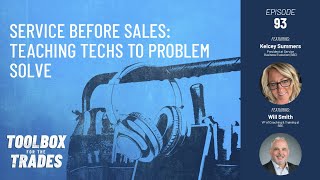
Kelsey Summers and Will Smith of Service Business Evolution teach HVAC technicians to diagnose problems and close sales themselves, cutting out separate salespeople. Techs using their system earn six figures, with some producing $800k to $1.5M in sales yearly. One client, Russell's, scaled to $19M revenue with 25% net profit.
Kelsey Summers and Will Smith, you both work at Service Business Evolution, AKA sbe. Kelsey, you are the president and Will, you are the vice president of coaching and training. Today we are going to talk about how to make a six figure salary as a technician. And I am so excited to dive into this topic. But before we do, I'm going to start this podcast the way I do every single one, which is how did you get into the trades? And Kelsey, you can start first.
Sounds good. First of all, thanks for having us. We're really excited to be here. I would say for me, it was more of a by accident, but definitely it's my purpose. So out of college, worked in cardiology, which is kind of, you know, completely random from what we do in medical stress testing and nuclear stress testing. Had my first or my only son, kids 22 years ago and was lucky enough to stay home. But I'm also a workaholic. So by accident started to get into a little bit of sales and marketing, and that's where it really was just a matter of a really good referral network and being in the right place in the right time. And someone introduced me to one of the largest, actually today, the largest plumbing and H vac company in Phoenix, who had a side business helping contractors grow their businesses through an advertising co op, kind of like an Angie's List, which I'm sure you're very familiar with. It was basically a local Angie's List and was mentored. My first major mentor in the business, who again, ran a very successful business. And it was six years into that venture that I was introduced to his biggest competitor in town, George Brazil Air conditioning and heating. And I probably wouldn't have made that change except for there was something very different about the leader that I met there, Jim Probst, who's been my. My biggest mentor in my entire career. And for the first time, I saw something different in a leader versus a manager, if that makes sense. And there was something very special he was doing with his business and I wanted to be a part of it. And so I went from working with 150 contractors in an advertising co op sense, loving to help contractors grow. I mean, absolutely thrived in that. But then really being a part of something where I could lead and manage an organization. And then. You'll learn a little bit more about SBE in a minute here. But that turned into their side business at the time they started a consulting business. So I went from being a sales manager in George Brazil to basically being the general manager for Service business Evolution and that happened where I actually did both hats for about three or four months, turned into a full time job very quickly. Will came on board about the same time. And that's really my story about the industry. But I've absolutely loved it and it's exactly where I was born to be.
So I love that. And I, I always ask this question because I love answers that, that start off with, well, I was working as a. In cardiology or anything that has nothing to do with the trades. Right. And how we all find ourselves here. The trade is such a rich environment full of awesome people. So welcome. We're very happy to have you or not welcome. But it's great that you're here. Will, I would love to ask you the same question. How did you get into the trades and eventually find your way into sbe?
It was also by accident, big time. I got into sales at 20 because I always had million dollar ideas, or at least what I thought were million dollar ideas. And I knew that in order to sell my ideas, I'd have to learn how to sales. So I got into sales and over the course of my 20s, became really good at sales training, sales management and that kind of thing. And I'm hanging out with a buddy of mine at church after services. His name was Ronnie Lewis. He was the national accounts executive for Trane. And I was telling him that all my friends were going to a recruiting company and making a lot of money. And Ronnie said, will, why don't you just come down to Trane and get a real job? So on Monday, walked me into the DSO manager's office, Frank Garcia, and said, hey Frank, give this kid a job. He's going to sell a lot of boxes for you. So Frank hired me. So at Trane at that time, for your listeners, they would know Barry Burnett from bdr. They had just gotten off of Ron Smith's dominant market. Steve Howard from the ACT Group, Joe Cunningham from Success Track Network. We were doing a lot of training and my job as a territory manager was to take that training out and help contractors. So for 12 years that's what I did. And I really loved it and got good at it. So in 13, I went and started my own sales training coaching business. It was about the same time that SBE had started theirs. And I knew Jim and George Brazile and Corey Holman from being the sales leader for Trane in Arizona the last four years for my career at Trane. So Jim saw me on LinkedIn, saw what I was doing, called me up and then I had lunch with him and Kelsey, and the rest is history.
That's awesome. I know Joe Cunningham. He is fantastic. And I actually love that you both have the connection to George Brazile, which we'll get into in a moment, because I think when I first started at Service Titan, their testimonial was the very first one that I saw. So this is kind of coming full circle for me, and I absolutely love it. So, Kelsey, why don't you tell us a little bit about what service business evolution is, AKA sbe. What is it and how did it start?
Sure. Well, it's a coaching and training organization. It was born out of George Brazil air conditioning and heating, which I will specify is different from plumbing, and that's who actually was a Service Titan member. And so they have completely different owners, which is a much longer story. But George basically sold the H Vac side of his business before he died, and he sold it to Jim and Dave Probst. And so they had started a different company in 2006, took one acquisition in 2009, which was the George Brazil air conditioning and heating name at that time. And SBE was really born a few years later in 2013. And it really. It was born because Dave Probst, one of the three owners, Corey Holman, Jim Probst, and Dave Probst are the three owners of George Brazil. Dave retired out of that business because basically other leaders grew themselves up in that business and essentially, essentially replaced him. But he wasn't ready to retire. He said, I want to give back to the community. I want to help other contractors figure out how we went from 0 to 30 million at George Brazil in 10 years. In their first 10 years, they actually had two back to back years of growth of 10 million a year. So they had a lot. They made a lot of mistakes. They had to operationally be very sound, but they were. They did something really special with customer service and positive reinforcement, management style. And he said, you know what? I want to help other contractors shortcut what took us 10 years. Right. So there's a lot of lessons to be learned, and you can learn them a lot quicker when you have the right standard operating procedures and the right coaching and training. And very early on, George Brazile became a training organization more than a sales organization. And Jim would tell us that he really believed in it. So, you know, Dave really had something special that he wanted to help, you know, other contractors grow. And we were in a very unique position where George Brazile has always believed in the distribution channel. They had a very strong partnership with York And Johnson Controls. And so that's really, you know, even somebody that worked for Johnson Controls at the time helped name our company. And the reason they named it Service Business Evolution is because unlike other training in our industry or most other training in our industry, we are constantly evolving and changing. I mean, from one month to the next, not just one year to the next. And so somebody at JCI actually helped him name it because he knew that's George was still constantly evolved and changed their business. And that's what SBE would do too. So, so basically we never started. We didn't even start marketing SBE until a month ago, honestly, because of those partnerships, because we had a strong partnership with Johnson Controls and we're able just to grow it that way. But really it started out just helping contractors. Within three months they had 50. And it's grown to. I mean, we've now coached and trained over a thousand contractors across the United States and Canada.
That's awesome. And don't you have about 22 employees across the country?
We do. Mainly Arizona, Florida and North Carolina is where our employees are located. And we are 100% virtual at this point.
That's pretty impressive, having to do no marketing on your end whatsoever. I want to say that I wrote down positive reinforcement training because I want to circle back to that. But before I do, I really want to get to kind of the meat of today's discussion, which is really about how SBE works with the technician. And Will, I was wondering if you could clarify from what we talked about when we first met. You know, you believe that text shouldn't turn over leads to a salesperson, which when you first told me that, I was like, come again? So I would love it if you could kind of explain that and tell us how come you think that's the best way to do it.
Well, it's something that Jim and Corey and Dave figured out between 2010 and 2012. The toward the end of 2010, I don't know if you remember this, but there was a massive influx of proactive customers who were trying to get the fifteen hundred dollar tax credit. And the efficiencies were changing. And at that time, GEORGE Brazil had 20 salespeople and 20 technicians. But by 2012 those had kind of disappeared. And it didn't matter how much money you spent, you couldn't generate enough proactive leads to support or they couldn't 20 sales guys anymore, but they could support service techs. In fact, by 2012 they had 65. So in that two year period, it was a Dramatic shift from a massively. A heavy, proactive market to a heavy, reactive market. And so the discovery was there's two types of customers. There's proactive customers and reactive customers. So if you don't mind, Jackie, if we could talk about this. When you think of a proactive customer, what time of year do proactive customers buy equipment?
I'm not a homeowner, so I might get this wrong, but I'm assuming whenever they feel they have to.
Yeah. And typically it's in the off season.
Yeah.
Because they want to get it done before the heat of the summer. They don't want to wait for a breakdown, and they want to get a good deal on it. So if you were going to get a good deal on an air conditioner and you wanted to get the best price, how would you go about doing that?
I would probably shop around. I would probably, you know, invite a couple technicians to my home and, you know, have them evaluate my current system and tell me what kind of options they had.
That's exactly right. That's what they do. So in our world, the contractors, I'm sure if you talk to them, they're inviting three to five salespeople into their home. And when three to five salespeople start competing with each other, the homeowner is now in a powerful position to negotiate. And as a result, they end up paying about 30% less for the equipment when they buy it. Oh, by the way, when the salesperson comes to their home, scale of 1 to 10, 10 being. I absolutely trust salespeople, I would let them watch my house over the weekend or I don't trust salespeople at all. I don't even want the guy in my front yard. How did. What would. How would you scale the trust that most people have for salespeople?
Oh, my goodness, Will. I mean, you're going into my noggin right here. I'm a very empathetic person. I like to think the best of a salesperson, but overwhelmingly do not trust them. And whenever someone says, I'm in sales, I'm like, oh, what are you going to try and convince me to do? I will let you know that most personality tests, though, say that I'm a good fit for a salesperson, which I think is very wrong. That's my opinion. So I will. Short answer to your question. Not that trustworthy.
Yeah. Most people don't.
To be low.
Yeah. Yeah. Well. And they earned it. Right. I mean, there's a lot of salespeople that are trying to convince people, and it's not good sales methodology. They're not using the best of what we know about how to be salespeople. They're just trying to get people's money. And as a result, people don't really trust salespeople, and that's a challenge. So on the reactive side, though, when somebody's being reactive and they've got to have somebody come out to their house, it's the middle of summer, they're in crisis mode, it's hot, the unit's broke, and now somebody's got to come to their house and it's an emergency and they want it fixed right now. If the technician goes out there and provides 100% customer satisfaction, which means they listen to them, they take care of them, and they fix their problem immediately, those people, scale of 1 to 10, where's the trust with the technician? Is it high or low?
I would say it's pretty high. Especially if they're solving the problem, it's much higher.
So, matter of fact, they may not even trust them completely, but they want to because they're in a difficult situation. So now here you have a customer who trusts the person that they're talking to, or at least wants to. And now they've got to replace their equipment because it's just dead. Now you've got two options. Either that technician can then go ahead and take care of them, which means they're going to go ahead and give them an option so they can buy a new system. Odds are pretty good. If they do that, they're not going to shop around. They're going to pay full price. Because technicians don't negotiate. They're like, take it or leave it. This is what it is. People buy it. So as a result, the tickets are much higher. When the technician makes the sale, the customer is happy because they're talking to somebody that they trust. What happens when the technician says, well, okay, I can't actually sell you new equipment. I've got to give you to the sales guy.
I have to invite another person into my home. I have to find some more availability in my schedule to make sure I can let them in. I gotta learn another person's name. Geez, that sounds too difficult.
Yeah. And so about 65, 85% of the time, the sales guy will come out, close the deal, it's not a problem. But 30, 40% of the time, those people go shopping. And so if you've been cultivating this customer's love and attention for years through maintenance, and now their system's broke and you just Sent them shopping, and that's a problem. So there's multi facets to this idea, but one of them is the average technician is only making 25 bucks an hour. That's a $50,000 a year job. And if all he's doing is service repairs, he's pretty much stuck at 50 grand. Unless he gets a raise or works longer hours, he might get up to 60. And our feeling is these guys are working hard and they deserve to make a good living, a six figure living. And since the customer wants to deal with them anyway, why wouldn't we let the technician actually go ahead and do the replacement at that time? And when they do that, you can have technicians selling 800 million, 1.5 million. We've got lots of them. And when a guy's selling that much service and replacement, he can earn easily. 120, 150 easily.
Got it. All right.
Why wouldn't we, why wouldn't we want.
To do that too? It's about doing it the right way with the best customer service. So we teach them how to provide customer service, capture them through maintenance agreements, we do happy calls, and we teach our, all of our contractors how to do that. Because, I mean, you know, at George Brazil, I remember letting go a tech that brought in 3 million a year and it's because he would just swing for the fences and sell everybody everything all the time versus knowing what they need in the moment. So it's definitely about providing the best customer service so that you never lose that customer. When they're ready to buy, they're going to buy from you. And that's what it's about. In the, in the techs love it because it's not really selling. You're just providing customer service. That's all it is.
Oh, interesting. So we talk about selling a lot on this podcast. We've talked about the importance of comfort advisor roles of doing those technician turned over leads. And of course, we've also talked about, you know, training your technicians to sell and being able to build options. That's one of Service Titan's core functionalities. That's one of our biggest offers. Right within our price book. You're able to build out those options. But I like the way that you are forming it a bit because you're really relying on the technician's expertise. You're shortening that window from when someone first calls a service company for an issue to when that issue is solved. Because by not bringing in an extra person, you're not elongating that process right and you're also telling the technician, like, you're good at your job. You know what's best. We're going to give you the tools you need in order to provide the best customer service. So I'm really excited to talk to you guys just for that alone, because I love the idea of turning the technicians into empowering them, really. Not really turning them into salespeople, but empowering them to really use their skills. So, Kelsey, I would love to know, like, what results have your clients seen? I'm guessing they're good, considering you haven't had to advertise up until a month ago. I would love to know, like, you know, what are your contractors seeing when they adopt this methodology?
Well, just like several of your podcasts, I've listened, I've listened to. With other trainers in the business, it's no different. Where these are not business people, normally they're previous techs starting businesses and whatever. I think we shine there where we help them figure out how to run a profitable business. Double the revenues year over year, some of them, but it's about the profitability. Many of them don't understand pricing and where pricing comes in. That's just one example. So I would say the results for our customers really shine in. Not only higher revenues, but much higher net profits. And I think where we focus is really on helping these owners create lives they can enjoy. So it's about, you know, you know, and we'll talk a little bit more about how we do it. He may even get into the three phases, but it really is about helping that owner structure a company so that he's working on it and not necessarily in it, in the truck. And really, we talked about the techs, right? So it's not only. And the stories I love. And we'll share some of them, I'm sure, today. But it's about being able to spend time with their kids, time with their grandkids, go on vacations, pay off their homes. But for us, it gets all the way down into technicians. I mean, we celebrate technicians, comfort consultants, plumbers and electricians once a year, every single year. We just had our annual conference. And when you see so many people who. And these are just to Will's point, they're used to making $50,000 a year, and now they're making 150, up to 300,000 a year, doing it the right way, having fun. And we've created this community where they're bragging to each other, patting each other on the back, you know, supporting each other, building each other up and you're building a career. It's not, you know, it's not just a vocation. It's not just a, you know, hey, I'm going to support my family. It's. I'm going to take my family to Disneyland and I'm going to pay cash, you know, and it's. It's just really changing lives, and that's what it's about. So I would say that's. We have hundreds of case studies. Many of them are even listed on our website. You can see videos of it and that kind of thing. But there's definitely some really fun and unique stories. But the results, I mean, we track and measure everything. We have an app that does that so we know what the revenues are. You know, we get into their P&Ls and we understand what the profits are, and that's what's going to make a difference. They have to be making money and they have to be having fun doing it and building a culture. Really. Again, the positive reinforcement management style, that's also where many people fail. Many owners fail. They always say they have trouble hiring. No, you don't. You have trouble keeping people because you probably suck sometimes as good leaders, you know? You know, it's. It will has that. That sign behind him. The beatings will continue until morale improves. I mean, we joke about it, but that. That's what the industry is, right? So for us, the results are creating cultures and creating, you know, money in the bank for these owners and the ability for them to hand it down, sell it, whatever they're gonna do, and enjoy it along the way.
Got it. I mean, and I guess if an owner is also able to work on the business instead of in the business, have more of a life, those beatings will most likely, you know, diminish by nature, even if you don't try to do them, which you should actively be trying to build a better culture. We talk about that on the podcast all the time. Really do. It's like. And I'm not trying to make this podcast about service tech, like service culture, but it just. Every single person I have on the show is like, it is so important.
So I'm glad you, Jackie. Everything we do is about culture. In fact, we just alluded to the. I mean, Kelsey almost had to speak to. We do this in an ethical way. I was just at a training in Minnesota a couple weeks ago, and after spending the whole day teaching our method, one of the guys in the audience, all day long, he'd been talking about, he'd been to everybody's training. I mean, if you can imagine anybody in our industry that does training for technicians and salespeople, he mentioned those guys names. And so he was watching me the whole day to wait for me to say something that was not ethical. And at the end of the day, he was like, man, I totally want to sign up with you guys. I totally want to do it, because I did not see one thing that was not ethical. And so the reality is that we teach the technicians to solve problems, to communicate about problems, to get the customers involved and whether or not they want to solve the problems. It's a very ethical way to do things. But the number one concern that I hear people say is, well, I don't believe in selling technicians, which is ironic because everybody in the industry tells the technician, you need to put five or 10 things on a list and make the customer say no, because you'll sell at least two of them. Which is silly, because what happens is the service manager is now looking at invoices and saying, how come you're not putting things on the list? And then the technician has to say, sometimes tearfully, I don't want to be a salesman. Because what happens is every time that technician makes the big list and says, here, here's five, ten things that I want you to buy, the customer says to the technician, will, every time you come out here, you're trying to sell me something. And so the technician's forced to say things like, I don't want to be a salesman. But when you teach the tech how to. How to present things to the customer in a way that allows the customer to say, you know what? I have a problem that I want to solve, and I'd love to give you my money to solve it. It's no longer the technician selling something. It's the technician just getting involved in the customer's situation and having a conversation. It's not about offering things. It's about talking to people about problems they already know they have. I know the unit is noisy outside of my house. I know my office doesn't cool off. I know my utility bills are rising. I know that my filter gets clogged up way too fast because there's a ridiculous amount of dirt in my home. I Homeowners are perfectly aware of the problems they have. And if the technician just treats them with respect and gets them involved in talking about the problems that are obvious, most homeowners will say, I'd really like to solve that problem, so it's perfectly ethical.
I love that Clarification you made there. And I want to just paraphrase because I think there's some nuance that could get lost, and I want to really hammer it home. So in what you just said, you're saying there's basically two types of trainings within our industry. One of them is make sure that your technician goes through a whole list or creates a list, and they at least have five items that they're upselling on every visit. So it's kind of a check and done thing. And when you look at that, at first blush, you're like, all right. So that ensures that the technicians are doing their job and also looking for opportunities. But in the sbe way, it sounds like you're really encouraging technicians to have conversations with homeowners and talk about, hey, so what else is going on in the home unit in regards to your heating and air conditioning system, in regards to your plumbing? Like, do you hear your. Whenever my neighbor takes a shower, it sounds like I'm in Splash Mountain. So, like, what are some things that are happening in your. In your life, and how can we talk about making it better? That's something you're interested in. So that kind of sounds like the difference that you were trying to highlight. Am I on the right track?
Yeah, you're very, very, very close.
Tell me where I'm at.
It is very well. What we would say, for example, is I was talking to a contractor in South Florida, and they had three of their technicians in, and. And the accessories and UV lights came up. And I asked him, so do you guys sell any UV lights? And they were like, nope, we don't sell them. I'm like, well, you live in South Florida. It's humid. It's inside. The duct system is cold, it's wet. I'm sure things start to grow. They go, oh, yeah. And. And I go, so did. Did people just don't buy UV lights there? And they go, no. About half the homes we go in, they have UV lights, and you don't sell any. And they go, we don't know how. How to get into the conversation. So I taught them how to get into the conversation. And I call this. It's my trademark. If I ever write a book, it'll be trademarked. I call it the Smell My finger presentation. This is how it works. So if I go to the unit and I take the door off inside the unit, there could be something growing in there. So, Jackie, what I would say is, take your hand and wipe it across whatever is there, and then it's Usually a cloth. Show it to the homeowner. Hey, Jay, smell my clothes. Well, you never say that. It's just a joke. But, Jackie, look what I found. If you're a homeowner and I just showed you this thing I just wiped out of the unit, you're a homeowner. You see that stuff on my hand? What would your reaction be? What would you say?
I would be like, oh, my goodness, I'm breathing that in what is growing in my body, because I'm growing that in that kind of stuff.
Yeah. Most people. After doing this for several years, most people say, oh, my God, that's disgusting. And so what we teach the technician to say is, yeah, yeah, it is. And it's very common. We see this all the time. And then shut up. What would the homeowner then say?
Well, if it's so common, what do other homeowners do about it?
That's exactly what they say. Almost 100% of the time. They go, what do you do about it? And then we teach them to say, well, some people are really concerned about it and wants to clean it out and get rid of it. And some people figure, I've lived here 20 years and I'm not dead yet. Just leave it alone. Now. What's the customer going to say?
The customer is going to say, well, I kind of want you to clean it. That sounds like a much better option.
Okay. They have the choice. They could say, you know, I ain't dead yet. Leave it alone. Or they could say, I think I want to do something about it. And if they say, I want to do something about it, this is what we teach them to say. Do you want to do that today?
Got it.
Do you feel like I'm selling you anything?
No, not really. I feel like you're just educating me on how. Well, what's so interesting about this is, with the UV light example especially is, you know, it's thinking about the kind of objects. Objects. The kind of products that your company offers and kind of reverse engineering a bit. All right, I got UV lights. Why do UV lights exist? To make sure that all this gross stuff doesn't grow in my. In my ducks. Right. That's the right way to use it.
Right.
So there's. I Sometimes I try and speak technician, and people look at me like, what are you doing, ladies? Stick to podcasting. And so you're kind of reverse engineering and figuring out, like, okay, what would be the common problem? That would be, what problem would a homeowner be having that would make it appropriate for me to even talk about this product in any way.
Exactly. You know, the real problem is, because I come from manufacturing, is the manufacturer is the one in charge of most training. So what does the manufacturer want to talk about? Features and benefits of their product. But that's not what people buy. They buy solutions to problems they have. In our system, we almost never need to even get into the actual product itself. People aren't buying the product, they're buying a solved problem.
Yep, exactly.
So it doesn't really matter the detail of the product. What matters is, is what you're going to do going to solve my problem. And technicians love doing it. They can, by the way. People, we, we change out complete duct systems using smell my finger presentation. Because, because you show them what a 20 year old duct system, what does the inside of that look like? It's gross, Jackie. It's disgusting. And people don't know it. And then they see it, they're like, oh my God, that's disgusting. Yes, this all the time. Well, what do you do? Well, some people replace their entire duct system. Some people just clean it out, some people leave it alone. I think I want you to replace the entire duct system. People will spend four or five thousand dollars with a, for a brand new duct system just because they're really not happy about the fact that the inside of their system is so gross. And it doesn't take. We didn't convince them to do it, we just showed them the problem. Do they see the problem, do they want to solve the problem and do they want to solve the problem now? And that works much better than making a list of crap that you're trying to convince people to buy and explaining the features and benefits of a product. It just doesn't work. And the proof is there. Now here's the other thing. You empower a technician to now learn these skills of communicating like a professional, using high level sales acumen and really discussing problems in a way that makes you never look or sound like a salesman. Because that's really the gift of a professional salesman is they never look like a salesman. They never give you the impression that you can't trust them. So now you've got this empowered technician. So let me tell you one of my favorite stories. We had a guy, I just saw him this week, he was in Phoenix for training and he grew up in the trade with his dad. And about 25, 30 years ago, he bought the business from his dad. His dad had never made money. He had to fund his dad's retirement. And then for the next 25 years, he went about the business of not making any money. And in 2013, he had. By that point, he'd never broke 1.8 million. And in 2013, he did about 1.4. He. And he did it with less than $8,000 net profit. And then he met us, and within six months he hit $2 million with a 15% net. And then 12 months later, he had $3 million with a 15% net. And you say, well, how in the world did he do that? Well, he had five technicians and he what? And he was the sales guy. And what was happening is he was the bottleneck. And he was, he's like, my technicians can't sell. I'm the only salesman. But then he would leads come in and sometimes they would wait until he never got there and then he would lose them. He was the total bottleneck in the business and he hadn't empowered his technicians. All he did was put his guys through our system, taught them how to do what they do, and got out of the way and his business exploded. So why in the world would this guy hold on to this old ideology of how the business is supposed to run? It was killing him. And, and today he's on track to hit $5 million and make lots of money. One of his guys was. He's the first podcast that we did our plug. The trusted technician Ricky is a 1.6 million dollar technician that we changed his life and Ricky's.
Now isn't Rick wakeboarding like once or.
Twice a week now? It's.
That's the honor.
Yeah.
Yeah.
That's amazing. That's awesome. Well, speaking of, like, inheriting old systems and just kind of doing stuff until you know, you know how to really do it, there's a couple things that came to mind. One, like classic kind of marketing to sales pipeline, right? Speed to lead. If this guy is getting leads and he's the bottleneck and they're dying on his desk before he has a chance to actually go out there, that is just. You're just hemorrhaging money, essentially. But like we stated before, there are a lot of companies out there that really don't encourage turning their techs into selling technicians, but instead opt for the comfort advisor path. And Kelsey, I was wondering if you could tell me, like, especially to the folks listening now who are like, I really like it that my techs turn over all of their leads to our sales department. You know, it works. My comfort advisors work. What would, why would they change their process? Like, what's your Opinion.
Well I would say when, let's just say they come into our program. Right. We don't have them change overnight because whatever's working for you is working for you. That's fine. They don't do it until they believe in it. And normally it's usually they baby step their way in and they let one tech at a time, some of them even will hire a brand new tech and train that person and no one else on the team because it spreads like wildfire what's working. And it is that company's job to bring leads for comfort consultants. It is your job to market and bring leads and make your phone ring for the proactive customer. So for us it's really about until that tech is seasoned enough to understand how to have the right conversations they should be turning over leads. And Russell's is a story that you know that will maybe sharing with you here in a bit but they're one I can think of where I think will. They waited almost two years of being in our program. Yeah.
Before they even want to hear another cool story. Jackie. They came, they, they came to Phoenix. They 8 million dollar company. Buddy and Mark came out and they'd been stuck and they'd been to all of them, I'm not going to name names but they'd been to all of them and they were stuck. And so as they were talking Kelsey was in the room with Jim and Dave and Corey, the, the other three owners of our business. And they started whispering to each other and in Mark and Buddy we're like waiting to hear what they were whispering and, and then Jim comes over. I think it was Jim, you can correct me if I'm wrong. And Jim goes you guys have a 12 million dollar business, you just don't know it yet. And I end up being the coach for Russell's. And I was talking to Mark, I'm like why, what made you choose us? Why did you come with us? And he goes you're the only consulting company that ever told us we had a 12 million dollar company. We just didn't know it yet. And so the first year what happened was he did, he took one technician and that one technician alone crushed his install department. So the second year they spent building out install because they didn't have the install capacity to support the sales growth. So the third year these just started taking off and they started adding technicians. So I don't know if it's been five or six years now but last year they ended the year about 19 million with a 25% holy cow.
A 25% net of 19.
They're structured.
This is their seventh year.
That's right. And they're structured. They're targeting $50 million. They're on their way. And these guys, smart and talented. And so this goes back to culture and mindset. And that's really what this all boils down to, is we don't believe the technicians should sell and they shouldn't turn. We don't believe that. What we believe is what is the data telling us? Is this technician, is he best suited to turn the lead over, or is he best suited to close it himself? What does the customer really want? What is the data telling us? We've got companies that have been with us several years that still don't allow their technicians to sell. We don't care. We don't want to change their business. We want them to look at the data and make decisions based on the data and not emotions. And sometimes that system works just fine for them. And here's the thing. If you've got three to five salespeople, those are sometimes family members, you don't want to just dry them out and not give them leads and that. There's a lot of emotion in there. So we're okay with that. I mean, keep those guys on. But really, if you could figure out a way to generate enough marketed leads for them, that would be the ideal and allow those technicians to go capture customers. Because again, at our heart, we're like, you know what? Every time you turn a lead over you, you're potentially sending your customer shopping. And I mean, if you want to create leads for all your competition, I mean, that's, that's okay.
We've seen $8 million companies. That $6 million is coming from four or five techs. I mean, think about that operationally, right? I mean, what's the industry average for a service truck, do you think? Or do you. Do you know from. From.
Oh, my goodness, I have no idea. And four and a half years of service time, I don't even know where to guess.
So what is it today?
It's. It's 150 to. It's 150 to 300.
Our top. Last year, our top 100 were 957,000 out of their trucks each. Right? Doing it the right way. That's insane, right? So it's possible to build a very profitable business with fewer people. I mean, that's what we're about, is not adding more resources, not adding more people. Let us help you with what you have today. All the Way down to the call center. I mean, we start there. You know, what is the CSR dispatcher's job, for instance? So there's just. We touch all aspects. It's not just tax. We touch every aspect of that business.
Amazing. That's a pretty big leap and a pretty great endorsement for your business. If the average service Truck brings in 150 to 200 and you guys have customers with trucks that are pulling in almost a million a year, that's, you know, that's a little dust off your shoulder moment right there. And also great for my next great little piece of trivia for my next podcast recording. You guys are hitting so much stuff, and we're kind of. I'm taking this conversation in so many different directions, but I really want to make sure we get into goal setting because we've alluded to it a bit. I mean, Kelsey, you mentioned positive reinforcement training. You've mentioned that when this training gets implemented, it kind of catches like, wildfire. Like, people start doing it, the more they see their fellow people. Technicians succeed with it. I'm assuming they want to learn it. So, you know, tell me a little bit about goal setting for technicians and how you think that you do it totally different than anyone else in the industry. And, Kelsey, you can take this one and then Will, you can add on. Just because you've been talking a lot. Well, and I want to give you a break.
Well, I think one of the ways, if you think about, you know, a service manager, let's just say they have a budget for the years. Let's just say that their budget is 2 million. Right. They normally take. Okay, I've got this many texts, this many. This many salespeople, or we're talking service manager. So really would be the text for that person. They back revenue into that truck for each person, and then they go to their text and they say, okay, I need you to do 350,000 on your truck this year. Go. That's normally the way that it goes. Right? And then every week they're like, why haven't you done this? Why haven't you done that? So we look at it very different. Corey started. Started this, and this is kind of what led it. This is exactly what led into our app and the development of it is we make it about. And Corey started this, you know, with, you know, what do you want to do personally in life? Like, what is your goal in life? Right? My goal is to. I want to pay off my house in whatever year. I want to take my family to Disneyland. You know, so it's like, okay, so you know, how much money do you make today? How much money do you want to make? So it's about how much do you want to make a year is where we start, right? And then we can back that into truck revenue by knowing what is their average ticket, how many calls do they normally generate? What's the average amount of calls a technician generates in a business? And I gotta tell you, we have many companies come in and they don't know that number. We help them with that too. But it's just figuring out what is it, what is your treat that truck like it's your business. You'd have to run this many calls if all you did was sell this many more maintenance agreements. This is what you would make. Does that make sense? Right?
It's easy.
It doesn't even have to be about the systems. That just becomes cake later, right? So it's about having them look at that and say, okay, I want to do that. And then meeting with them regularly, whether it's every other week, whether it's once a month, taking them to breakfast, getting to know who they are personally. And you're motivating them to treat that truck like it's their business. Well, Corey took that a step further and basically said, you know what? He, you know, he was doing calorie counter one day and he said, I want my text there. He had it in a book on paper, and they would come into training and they would leave their book in the car in the truck. And so he was like, I want it to be in the palm of their hands. I want them to be motivated every day and see where are they to their goal. It's not the company's goal. And by the way, if, you know, Anna George, Brazil, if she added up her budget and then she adds up all of the goals that the techs and the comfort consultants also did for themselves. It's always more. The personal goals are always more than what her goal is because they want to reach new levels every year. So anyway, Corey started working with us as far as developing that app and really figuring out a way to track and measure every call every time and have that be back itself into goals, into the app where they can see where they are today versus where they're going to be for the month versus where for the year they can see what they sold. They can see how far they are. And it might be, you know, hey, two o' clock on a Friday, which is normally, you know, beer time or whatever. And they might Be. You know what? I'm $300 from my goal. I'm gonna take another call. Because they want to reach a new level. So it's about making it personal to them, not just about what I need you to do. And then continue that. Beatings will continue until you do it right. You're going to get much more productivity out of a guy or a woman that, you know has an amazing goal. That's their personal one. They want to reach new, new levels. So I'll let. Will you have anything else to elaborate on that with our goal setting?
No. I love what you said. I could give. I could tell you some stories, but I'm totally with you.
I want some stories, though. I want to give them to me.
So I'm coaching this guy in San Marcos, Texas, and he had three technicians. Two of his best technicians quit, and his. His third technician. He doesn't like that guy. And I'm like, well, he's the only guy we got, so what are we going to do to help him? He's like, if you. If we. I don't want to talk about coaching that guy. If you can't help me replace these two technicians, we got nothing to talk about. I'm like, well, okay, how much of the two guys that just left, what were they on track to make? And they were both on track to make. One was 80, one was 90. I'm like, well, what does your ad say? Well, my ad says family business, whatever. You know, top pay, top benefits. I'm like, what's a terrible ad? Write this ad. If you're not making over $80,000, call me. So he created a flyer. He went around all the parts houses, and this guy showed up named Edgar. Edgar had been a dishwasher in Florida that moved to South Texas to live with mom and dad with his wife and young baby to go to refrigeration school to become a technician. Edgar saw the ad and answered the ad. A year later, Edgar did a million dollars. And he's sitting at my table because it's my contractor. So it's the big awards ceremony in Phoenix, and Kelsey's up on stage telling Edgar's story about how he's washing dishes. And he went to trade school, and now he went through the company's reliable down in San Marcos. He went through Reliable. And I look over, and there's just tears streaming down Edgar's face. He was so proud of himself. This is a guy that is completely changed within 18 months. He went from washing dishes, which I've done by the way it's a very difficult minimum wage job to. Now he's got a career, a profession, and he'll never, ever make less than 100,000 again, ever. That's what we're in the business of doing. We believe that the technicians in this world deserve to make a good living. When owners come to us and say, my guys left for $2 an hour, we call BS. You know what? If you had guys making six figures, they would be knocking on your door, lining up, wanting to come work for you. Are you creating the opportunities? So positive reinforcement, management style. This is our definition of that. We believe our workers get out of bed every day wanting to do a good job. If they fail, it's due to leadership. It's leadership's job to remove the obstacles that caused them to fail. And we use the accountability process to accomplish this. So the accountability process. I found this from the Harvard Business Reviews. The right way to hold people accountable. Step one is you set clear goals, sit down with them, how much money to make? Are you going to buy a house for your mom? Are you going to take your kids to Disneyland? You want to get a ring for your engagement? What is your goal and how much money do you need? And step two is how can I support you and make sure that you accomplish that goal? Step three is track and measure. That's what the app and dashboard does so we can do. Step four, meet on a regular basis to review progress toward goals and positively reinforce all of your successes and celebrate all of your wins. And if you're failing, it's okay. That's my fault. It's my job to identify what's causing you to fail. So let's go back to step one, two, three, and four. Is that still a good goal? What's causing you to fail? And help them fix the problem and just invest in your people. Positive reinforcement is about the leadership taking responsibility for the lack of success. Too many of these guys say, what's the lazy millennials? No, it's not. They're the hardest working people I've ever met.
You have your amazing dashboards with Service Titan, and we're so excited that within the year we're going to be pulling in that API so that we can use that with our app. And so our customers are so, so excited about that. But what I would say is sometimes they're not using the data the right way. So, you know, you've got these goals, you've got them motivated, and then all of a sudden, we populate all that on a dashboard and we teach them to look at that information, bring your guys in and coach them from it. And it's not about saying, okay, see, you're, you're at 300, you know, average ticket here, and Caleb's at 400. What's going on? What are you doing? Why aren't you, why aren't you like, Caleb? No, it's about showing them the data, too. They see. They can see them compared to everybody else. You don't need to point it out. It's about, you know what, you're 500, an average ticket here. Let's go look at these jobs. You're 150 over anybody else that you work with. Like, what are you doing? Let's go look what you're doing. Right? Let's focus on that. Then. Let's, you know, then that coach is going to go and take that with the other employees in the business and teach them some of those secrets, too. But it's not about, you know, find, you know, they'll see what they do wrong and, you know, what you have to train them on. You know, if they know that they're the lowest in duct cleaning in the company, they're going to see it on this dashboard, they're going to see it in the numbers, right? So it's not about beating people down. It's about lifting them up, focusing on their strengths, and having them feel like they're part of your business. I mean, how many owners spend time with techs that valuable time coaching? And ultimately that's our goal, is to train them to do that.
I love that. And I just love that you encourage tying back their personal goals to the professional goals. Chris Hunter talks about that a lot. He's talked about it several times on this podcast. Jamie D. Domenico came on this podcast a while back and talked about how he likes to manage by walking around. Not very, not very efficient, but just really engaging and talking to people. I 100% agree with you guys. I think that's the best way to do it. And I think you really, in today's episode, we really got a lot of ideas as to how leaders can start thinking about one, building technicians that sell and, like, giving technicians like, you guys, like, you guys are really smart and you know what you're doing and you deserve to be making six figures. And it's totally possible. I'm going to start wrapping up, but I'm going to say it with a little asterisk that we did not even scratch the surface on some of the stuff. I wanted to talk to you Guys, about today, so I hope you'll come back. I'm going to end the episode with some icebreaker questions that I would love to get your answers for. So, Kelsey, you can take this one first. If you could go back in time and give yourself one piece of advice early on in your career, what would it be?
I would say it's surrounding myself with the right people, meaning mentors. I learned later in my career to seek out people who I really aspire to be like and start inviting them to lunch and networking with them. And I've given that advice to younger people that I've met in the last probably five or 10 years. And it's been game changing for them. It's like, learn from the best that's out there. And I told them, go so far as to offer to offer your time for free, to follow them for a week, to work for their business, to, you know, gain the secrets that they've learned so that you can shortcut some of the things and really start networking with people who are other aspiring leaders.
That's great, Will. Same question.
You know, I was just now starting to think about it, and looking back on my life, I feel like all the major events in my life have just fallen in my lap. It's like I didn't actually have to will any of them into existence. Jim Probst called me to come join sbe. My buddy at church dragged me in to train to get a job there. All the major events just kind of happened without, outside of my control. And so as I was reflecting on, I'm thinking, well, I wouldn't want to change that, because it seems like, you know, it's the hand of God himself, so. But what I would change if I could go back, I would tell myself, the most important thing that you will ever do is to be kind to other people and be respectful to other people and cultivate those relationships. Because my biggest downfall in my life has been, you know, I came up in the 90s. It was okay to yell and cuss at people, and I got yelled and cussed at a lot. And I carried that through my life up until I met Jim. Jim is the one that changed my view of how to treat people with kindness and respect. And it's not about the beatings. It's about loving people.
All right, here's the fun question. If you had to choose a song to be the soundtrack of your life, what would it be? Will, you can take this one first.
You know, I thought about this question. I can't come up with one that I'm gonna, like, be proud of. You know, I just can't think of one. But the true answer, Jackie, is the theme song for Rocky, and I don't even know what the song is called, but dun dun dun dun dun dun dun? That's the way I feel whenever I break through a challenge, Whenever I overcome dramatic odds and I know that I'm fighting against it. That's the music I hear in my head.
I laughed when I saw this. I think I play this song probably at least two or three times a week. You know, just asking Alexa. Hopefully she won't talk to me right now, but to. To play this song when something happens called the climb by Miley Cyrus, of all people, because I'm not like, I don't have her album, but I love that song. And we all, you know, we fall off. And really, it's about wanting, you know, to be a leader that other people want to follow, to help climb to the top and to reach your goals and. And there's times where I question, you know, why am I doing this? I'm having a bad day or whatever it is. It's like you got to remind yourself there's. There's a reason you're doing this. You know, other people are following you. You. You're responsible for helping them reach their goals, too, and keep going.
That's a great answer. Will and Kelsey from Service Business Evolution, thank you so much for being guests on Toolbox for the trades. I love chatting with you, and I'm sure our audience love to you. I hope you can come back on again soon.
Thanks, Jackie.
More from Bill



Capturing the 80%: How SmartAC’s Gen-2 Targets Non-Membership Homeowners | Podcast Ep. 296

Build better customer data with every booking in ServiceTitan | TAD Tune-Up Series

The Biggest Change for Roofers Coming From Other Roofing Software to #ServiceTitan?


