The HVAC Revolution: Data-Driven Support for the Trades | Podcast Ep. 206 | Toolbox for the Trades
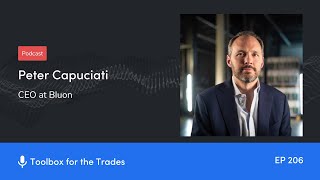
Jackie Aubel and Peter Cappucciati, CEO of Bluon, discuss how the company evolved from refrigerant R&D into an AI-powered HVAC support system. Bluon trained its AI on 150,000 recorded tech-support calls and now helps contractors troubleshoot faster and improve technician productivity.
Questions this video answers
2011
About 150,000 calls over a 4.5-year period
Approximately 500,000 hours of content
About 15 people pre-marketplace; grew to nearly 200 during the marketplace strategy; later reduced to about 60 employees
By 2020
Hello, contractors, and welcome to Toolbox for the Trades. My name is Jackie Aubel, and today I spoke with the CEO of Bluan, Peter Cappucciati. As a trained physicist, Peter didn't plan to become CEO of a company that powers the most powerful H vac database of all time. But the story of how he got there is a great one. I hope you enjoy our conversation as much as I did. Peter Capucciotti, you are the CEO at Bluon, and today we're going to be talking about the power of data and pivot your business when you uncover a need. Welcome to Toolbox for the Trades.
Great. Thanks for having me. Really appreciate it. Looking forward to this conversation.
I am looking forward to this conversation too, my friend. We're going to kick it off with an icebreaker, which is my favorite icebreaker these days. What song, if any, would be the soundtrack of your life, Peter?
I have to go with something like, you know, White Rabbit or Comfortably Numb, maybe Bohemian Rhapsody. You know, all those songs talk about, you know, the world being not quite what you think it is. I'm like a physicist and seeker, and so the world is way stranger than you could ever imagine. Those tend to be the most representative of my life story, which is definitely a little bit odd and bizarre. But, yeah, I love those songs also.
Wonderful answer, and thank you so much for dropping the physicist factoid right away. You are actually, I believe, the very first applied physicist I have had on Toolbox for the Trades. And people listening right now are probably like, why is this guy on here, Jackie? So for folks who may not be aware, although some people probably are, can you tell them what is blue?
Yeah, well, built on, you know, it's got a crazy evolution story, which we will save for later in the discussion. But at the end of the day, what it really is is technical data and technical subtruc. It's an incomprehensible delay. Friction in the workplace. And technicians are always going up against this problem. Always. And so all of a sudden, they had this, like. And there it is. You know, it was like God came down and gave them their. Their information. What we were freaked out by was that no one had done it before. It just seemed like, wait a minute. This is fundamental content that you can't not have. Like, you can't move forward without it. So it was really a huge revelation of how broken the H Vac industry is in so many ways. Right? Technically speaking, there's been a lot of. Lot of innovation on the business side, but man, because even. Even the OEMs and the distributors did not have this data, which is mind blowing. Right. Like they make equipment, like where is the data? So anyways, it was been a very slow realization of how fragmented and disorganized the industry is in a whole to provide this technical data to the folks working on this equipment.
Yeah. So you set out to develop this new refrigerant, follow your physics streams again. Sometimes my mom listens to this show and she's probably cack because I need you to know I passed high school physics by the skin of my teeth. It is not my subject whatsoever. So bad at it. So I applaud you for being smart in that regard. So you set out again to follow your physics dreams. You uncovered this need. You obviously had to quickly pivot. And you know, on this show we really talk about folks's journey in their careers that happen to be in the trades. Right. So I would love to know if you could tell me a bit about when did you identify that? Like, hey, this is. I think we actually have to pivot this business. I think we actually have to change what it is we're doing and change it in such a fundamental way. You went from a chemical R and D company to essentially a database and AI solution at this point. So yeah. How did you realize it and like how did you get started in making those changes?
I mean, I think generally speaking I don't see risk. I just go forward. Probably a bad trade to have in some ways. So that's number one. Number two is we had two covailing factors happening. We had the EPA becoming more and more difficult to work with, like to the point of insanity. And we had this obvious need for what we were providing that we didn't know how to monetize. Right. So we were like, we have this giant community consuming this data, you know, with the number one app by far, not even close the number one usage by far. But we weren't making a dime on it. It was just there for technicians to use for accessing the data. The real risk was, okay, we know we have this demand. We know these folks need it. Let's lean into it. We'll figure out the monetization of it. Luckily we had very good capital partners who are willing to explore this risk with us and this clear demand. The need was obvious. Like, it wasn't like we had to think about the need. The question was, could you monetize it? In that regard, we had to pivot twice. Because initially our goal was to keep the techs free. That was our goal. Like let's keep this data in the hands of the technicians without cost. That was our like mission statement. And we spent a lot of money and a lot of years trying to make that happen. Just can't do it. It's not possible. And so we didn't want to do an advertising market because we didn't think techs would hate ads. Right. So that would be a. You just lose all your street cred. The initial plan from 2020 to 2023 or early 23 was to monetize it on the backs of a marketplace. So we would connect all these techs to their distributors and have them use our data to find the right part and then buy it and take a take rate on that purchase. We had it all set up and we had like half the market on the platform. But technicians are very instant gratification required and the system required the counter staff to be timely in their receiving of these orders and getting back. And they were not. And they were all over the map. And distributors, you know, counter staff range from good to terrible and everywhere in between. And so there was a kind of a backlash to that. So we had to figure out, okay, well that's not going to work. We can clearly see that. So how do we, how do we monetize this? And that's where we really struck our stride in figuring out how to work with partners like Service Titan in integrating our data into that, their platform, where it's used and needed most. Which is in that field, service platform or for distributors in their EE Commerce or ERP platforms. And so the business has really gone through two fundamental pivots. First, the data and support is the key. How do you monetize it? The second, oh, let's monetize it in this more direct way into these larger organizations that need this data to support their users. But both of the pivots were tough and you had to had the stomach for it to get through them. But you know, getting through it the second time, the light is very bright at the end of the tunnel now, which is good.
That's awesome. I mean, you already hinted at at the begin, beginning of your answer that you're not very risk averse. I guess. Congratulations. Maybe, I don't know, maybe, maybe. Congratulations. How did you deal with your team? Right, because this probably I'm, I imagine that just all of these pivots, you probably had to, you know, sunset some departments that you probably didn't want to sunset. You had to, you know, convince people on a different mission. How did this all translate with you as the helm of the ship, reorganizing the team. And the reason I'm asking this is because I know for a fact there's owner operators of service companies listening right now who are going through serious change management challenges in their organizations. I'd love to hear how you did it.
The most important thing is transparency, right? To make sure the team is very aware of what you're seeing and what you're doing, which I could probably be better at. But I try to keep that front and center because they've got to know what you're seeing. You're in the front of the, you know, tip of the spear, so to speak, and you're, you're getting all this feedback. Understanding what's going on and communicating that effectively is the key. You know, luckily, the core, ever since we started to grow as a company, the core underlying mission, like the bottom of the mission, has been the same, which is, you know, support the trade, support technicians, support contractors in what they do in a way that makes them more productive, more efficient, more profitable. That's always been the same. But how we do that, how we monetize our own service has changed. Obviously, the first pivot is a different animal, but we were a much smaller company. We were, you know, we were like 15 people before that pivot, right. So that was a kind of a different chapter. Then we grew like crazy. We went to almost 200 when we were in the marketplace strategy. Then we've gotten down to like 60 in this new world. So you're right, there's been a lot of modifications, a lot of unpleasant rifts, which are the worst thing in the world. That's the hardest thing in the world, I would say, as being a leader is doing that. It's just the worst. You become so connected to these people. It's just gut wrenching. But you have to do it right, otherwise you're doing them a disservice because you're going to put them in a hole too. Stick to your guns, see the solution, believe it, intend on it. If you can't see it, you're going in the wrong direction. To me, it's like once it crystallizes in your vision, then it tends to happen. But if it's not clear, then that can be a little bit challenging. And once it's clear, then you can share that clarity with your team and just march forward with confidence. The key is confidence, right? If your team sees you being confident, they're going to be confident. If you're not confident, they're going to feel that. So I'd say clarity and confidence as part of the guiding principle.
Yeah, I mean I can see it just in your face and the way you talked about it. Having to small company, giant company, have to go down to maybe like a medium sized company and having to make really tough decisions that affect people's lives. What has this all taught you? Like what's the biggest lesson that you've learned in terms of resiliency in business?
Trust your gut and don't wait for the numbers. Right. So, you know, a lot of times I would have known certain things had to be changed maybe four or five months before we did it because you're letting your emotions of trying to figure out a way to keep these people guide you. At least I was. And so that was a bad idea. And so I think if we had made those moves quicker, we would have accelerated the path and you know, gotten to the goal faster. But it's tough, right? If you're a human, it's hard to not want to preserve that. But I think, you know, once you feel it, you know it, it's not going to change. Right. We all know that, you know, guts don't ever go away. They just get stronger with the analytics that come in after the fact. So I think that's number one is don't wait for the circumstance to be necessary. Do it when you know it's got to happen, even though that's not quite there yet. And you're going to save yourself a ton of heartache and get to the goal line a lot faster.
Yeah. So one of my questions I also wanted to ask you is like, what would you tell yourself? So 2011 you guys started. When did you pivot to focusing on the database?
Pretty much in. By 2020, we had still the refrigerant business, but it was a very small part of the company. Most of our effort was on the software side and the database. But again we had this marketplace idea that was, that took a lot of our resources, but it was all based on the, on the database and the support. When we realized it was just database and support as our, that's our thing then that was like about 18 months ago, you know, when that became. And it should have been 24 months ago, but it was 18 months ago to my earlier point. Since that moment it's been very clear and things have just lined up, you know, in a much more effective way and, and great feedback. But I would say in general, besides acting quicker, spend less money, I would say would be my advice to My younger self. Because, you know, in 2021 and 2022, as your company also knows, raising money was really easy, right? Just like snap your fingers and the venture capital guys are throwing money at you, you know. But that world changed dramatically right at the end of 2020, 2022, early 23. I mean, it went from a fountain to like a drip. And if you weren't ready to be able to react to that, and if we had been more frugal, we would add a bigger war chest and we had more flexibility. Luckily we got through it. But it would have been a lot more sleeping would have happened if we had done that and maybe a lot less stress. But I'd say that would be the main thing. Trust your gut and maybe be a little bit more frugal, you know, when the money's easy to get.
Yeah, I mean, I think. Excellent, excellent answer. I'm very curious about this, so I think people are curious about it too. You don't have to get into details, but like, how expensive is it really to maintain a database of this size? So 20 million unique H VAC units out there in the world right now. A lot of them can take similar parts, a lot of them can use similar materials. What does it take on your end to maintain this type of data?
It's a bit overwhelming, I think. You have to, you have to break it up into components and you've got to get. We call them the unicorns. These individuals, they have H vac knowledge, they understand a lexicon, they understand the technology, they understand the equipment. But they're also very computer database savvy, which is a small subset of people. And because you can't just put engineers on this project, they will fail because it's such a unique landscape of what works and what doesn't. And you need to have people that are genuinely interested in the solutions. So that being aside, you really have to build systems that let your database cascade itself. If that's a word, it's a three way connection. It's a model part, meaning if I have a part that's compatible with this part, it's only compatible with that part in that model. So it's not just these parts work for these parts, this part works for that part in that model. Luckily, I have really smart partners that are able to build database systems that allow us to navigate this data. I mean, for example, we talk to some of the biggest aftermarket manufacturers, the biggest in the world, and you would think this data would be part of their mission because it's kind of fundamental. They all gave up on it. Like, they tried doing this. They quit, you know, like three or four or five years ago because it's just. It's that hard. But we were just naive enough, a little bit smart enough out of the industry and don't take no for an answer kind of approach. Once you built it, then maintaining it is not easy, but it's not nearly as hard as building it right. We're adding hundreds of thousands of new data sets a month, and we're, you know, cascading all that into. Because you have all these new. This new equipment and new parts, then you got to cascade that down into the historical archives of where and where they work. And that just requires having a really good infrastructure that can allow that cascading to happen. Without that, you're screwed. So I'd say maintaining it difficult, building it really difficult. But luckily we're past that part.
You mentioned now the word naive a couple times, and I want to touch on it because I actually think there is some magic sauce to naivety about actually getting things done and being successful at something. You know, sometimes you hear people say, like, I just didn't really have a plan. I just kind of went with it. And sometimes I think that there is some magic to that. And it seems like that certainly worked for you guys at Blue on anything else you want to add in regards to that concept?
Yeah, I think it's huge because if you know too much about what you're going into, your doubt gene kicks in, and then you're in like, a position of, well, that just seems way too hard. We can't do that. But if you're a bit naive about it and you come from outside the industry, like, of course we can do that. Let's do it right. And then step by step by step by step by step by step, you get there. You go through challenges, hurdles, you know, you tackle it, but you're not. You're not overwhelmed by a sense of doom that you can't do it because of the. The task has already been processed in your head as being too big to handle. So if you're a little bit naive and don't think that, then you can tackle anything right now, if some people are able to, you know, shut that doubt off and if they know about it, still drive through it, I find that difficult. I'd rather be a little bit naive, but know I'm capable and know the team can get it done, because that's exactly right. We talked to all these other groups that have tried this. And they've all said the same thing. I was too big. You can't do it. Like just. It's not possible. But if you don't know that and you're, you're, you know, you've got enough gumption to tackle it, you can just keep going one step at a time. You just keep building, building, building. You finally get there.
What was your reaction when you first found out that some of like the biggest H vac manufacturers had tried to accomplish this and just quit?
Luckily, at that point in time, we were already enough. Yeah. That we already knew we could do it. We weren't done, but we knew we could do it. Was more, more evidence of the value of it. Because, you know, then we're like, okay, we. When we finish this, we're going to be the only game in town. There's no other data set. Right. It's proprietary. Really can't be replicated. Very difficult. It takes only 10 years. So we're sitting on this gold mine of data that we can monetize in a variety of ways. There's a giant wall of barrier to entry because of exactly that. Not to mention the difficulty, but also the assumed difficulty of it is our moat, you know, around our business, which becomes empowering as you get that feedback.
Yeah. I have to tell you, if I had gotten that, I probably would have gone like, oh, crap, I probably did something wrong. It's probably broken. So I admire, like, I love the way that you were able to reframe that into like, oh, this is actually a really good thing. And this is just proof that we're going in the right direction. I really think Blue On Story is like such a fascinating one. So I love that you're kind of getting into the nitty gritty here with me. We haven't talked about the support component of Blu on at all. So you've got this database that is incredibly robust. You also started. Now you have AI support chat. Can you tell me kind of how that has evolved over the years?
That actually is probably a cooler story. So we had, from 2020 to last year, we had about 35, 37 of the most gifted mechanics. We call them technicians, all with 30 years experience. Just salt of the earth geniuses. Right? They can solve any problem. Like, these guys are magical. And they were also just really gifted at de escalating and walking people through problems. They really genuinely wanted to help these people. So it's like this real gifted humans and we all, we used to sit around weekly and just be like, how do we get this wisdom out of your head into some system that we can scale because you guys are not cheap and there's not that many of you, right? So we wanted me to support a giant industry. So how do we do that? We were lucky enough that we were recording every single one of these calls. So it was 150,000 tech support calls over a four and a half year period. About like a half a million hours of content. Right? Just a staggering amount of information. And my genius partner, Adam, this is before AI was even a thing, like two and a half years ago, was already into AI, before even, even no one knew the word. And he came up with this idea that he was going to, you know, take these transcriptions, turn them into unique problem solution sets of the conversation. It could be like 12, each conversation, 5, 10, 10. And then he would use that to create a proprietary large language model to create what's called a rag retrieval augmentation system to pull the data out in an AI system. And he did it without telling anybody, by the way. So no one knew he was working on this project by himself from six to midnight every night for like six months. Then he comes to me one day and he's like, hey, let me show you something. And he showed me the first version and I was just like, what? You know, that is the most incredible thing I ever saw. And the coolest thing about it was that the AI cursed like a drunken sailor because it was based on the actual conversations. So it was ass bombs. It was very political. It was hysterical, actually.
This is hilarious. Continue.
Yeah, and so, but we actually, we've, we've actually gotten rid of that. Some guys want to have it back, but with, you know, we've tone it.
You have like a. Maybe you have like a pro version. There was like, yeah, you know how you can like change Siri's voice or whatever? Maybe you can, I don't know, maybe it's an option. Continue.
You're onto that. Yeah, that's exactly what we're trying to do. Because it is, it is amazing to hear it in their own voice. So we were able to accidentally extract the Wisdom out of 35 of the best mechanics in the industry over a four and a half year period of time. Because, you know, they love to talk and they'll talk about anything in depth, but they'll never write it down ever. Like under no circumalty of death. I'm not gonna write it down, but they will converse at will. And we were able to grab all that wisdom and thanks to AI and large language models. Now we have this remarkable system that can answer the most nuanced question you can throw at it. You can ask it things that you never believe it would know, like just crazy nuance about a certain system and it'll be like, oh yeah, you do this, this, this, this reach around, grab that wire, you know, just like it's amazing. So we are really sitting on a gold mine and a gift to the industry that can scale this knowledge and let green new techs have access to it. And also it fits the Gen Z world. They don't want to go to a six month class. Right. They don't like to memorize, they want to index and know where to find the answer. And so this is exactly that. Right? If you don't ask the question, you get the right answer.
Awesome, awesome, awesome story. All right, my big question for you right now is, are, do you guys have any interest in doing this for like plumbing or electrical or you know, a bunch of other industries? Is that the next place where Blue on is going to.
That question comes up on a weekly basis as of right now, no. Just because two things. A, it is a large road to get that data, like a staggeringly large road. And it's not that it's not as valuable in electrical and plumbing because H Vac is so nuanced and so fragmented like you have in H Vac literally a part that has 300 aliases. It's the same part, it has 300 other part numbers that are the same part that's common. Right. So that's a cluster like that's impossible to navigate. So the value we bring to the table is just much higher. In H Vac you could definitely do it in plumbing, electrical. It'd be a big road and not that big of a payday because the payoff would not be as big. Your value you're creating, isn't that as large? So possibly. But right now there's so much opportunity with these two assets within the larger H Vac industry that we're just heads down, you know, trying to get it operational in as many places as possible.
Amazing. I feel like we already know the answer to this question, but I want to give you the opportunity to really say it in your own words. Tell me why owners, operators of H Vac companies would want access to BlueOn's database and AI support chat.
In a nutshell, it's the solution to this guilt labor shortage. Right? You've got a decreasing number of professional technicians and the ones that are replacing them are Far less qualified. And the training apparatus, the mentor apparatus, the ride along tradition is gone, right? So these technicians are just thrown into the van like have at it, right? And they have no clue, right? And so we're able to provide that feedback that lets technicians be technicians and lets contractors be contractors. And you know, if you talk to most service managers now, they're going to tell you in the season, 90% or more of their day is putting out fires with helping tech solve problems. We get rid of that, it's gone, right? And now you can focus on your business, focus on growing your business, focus on actually making your business more productive, becoming a real manager instead of a fireman. And I think that's the core issue. If you want to focus on growing your business and create a system that lets your text be techs and be good techs at that, then we are an unbelievably benefit to your productivity. And then on the other side of the equation, as the market shifts to a repair versus replace mindset which is coming with all these, there's so many tailwinds that technicians have to become technicians again. They become salesmen for the last 10 years. They gotta fix stuff. And a lot of them don't necessarily have that skill set or not that strong of a skill set. We provide that, that skill set as a plugin basically into that tech's brain that makes them all of a sudden capable in ways they wouldn't have been before without bothering the service manager every day.
Amazing. Awesome. Awesome. Peter, is there anything else I could have asked you to make this a better interview? You killed it.
One thing I would say, just because we are talking to the Service Titan audience is we are just so excited to get this data and support into your workflow, right? So you don't have to have a blue on platform and a Service Titan platform. It's all in one place. And all this is accessible in your day to day, whether it's your tickets, your workflow, your support, your assets, whatever it's going to be. That data is just there. And that's really exciting to be able to bring that because everybody wants that. Like, you know, half our customers are Service Titan customers. Like can you just get this stuff inside there please? So that's requested on a daily basis. So we're excited to get it done.
Yes, we are too. And so I'll put information in the show notes of this for any Service Titan customers who already get started with Luan in their Service Titan instance. All these have updates for you as to when you can expect that we'll also link out to Blueon for our non service Titan customers. But our valued listeners who want to get to know Blu on Peter. This was such a fun conversation and I also have to say you've got total scientist energy and I really enjoyed it on this show. It was really, really fun. So thanks so much for giving me some of your time and sharing your story with us.
Awesome. Totally appreciate it. Thanks a lot.
More from Bill



Capturing the 80%: How SmartAC’s Gen-2 Targets Non-Membership Homeowners | Podcast Ep. 296

Build better customer data with every booking in ServiceTitan | TAD Tune-Up Series

The Biggest Change for Roofers Coming From Other Roofing Software to #ServiceTitan?


