Tips to Improve Your Sales Performance | Podcast Ep. 197 | Toolbox for the Trades
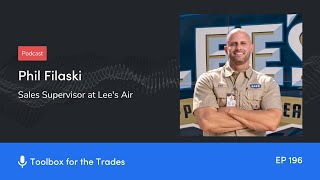
Phil Folaski, sales supervisor at Lee's Air in Fresno, closed over $15M this year with a 58% close rate. He walks through his sales approach for tune-ups: build rapport, handle objections early, offer options, sit in silence. He also coaches by example and advises ServiceTitan on SalesPro, a tool for recorded in-field coaching.
Questions this video answers
Over $15 million.
Approximately 58%.
Approximately $26,000.
About 10 months.
Luis Rojas (reported over $6 million this year; $750,000 'flips' last year).
Hello, contractors, and welcome to Toolbox for the Trades. My name is Jackie Aubel, and today I am chatting with Phil Folaski, the sales supervisor of Le's Air in Fresno, California. This year alone, Phil has closed over $15 million in sales. He joins us to talk about his sales process, coaching his team to sell more, and how he contributed to Service Titan's newest product, SalesPro. Enjoy foreign, you are the sales supervisor at Lehre. Today you and I are going to be talking about how to become a multi million dollar sales guy and how to teach others to do the same thing. Welcome to Toolbox for the Trades.
Well, thank you for having me.
I am so excited to have you. We're going to get all into your history, how you got into the trades and your sales knowledge. But before we do, I'm going to hit you with an icebreaker. And I would love to know, if you had an extra hour in the day, what would you do with it?
I would definitely just spend time with my fiance.
Oh, that's great. What's your fiance's name?
Her name is Marjorie.
Margie. And so we were talking before off air that you were splitting your time between Vegas and Fresno, where you're at with Lise now. Is. Is she in Vegas or is she in Fresno with you?
She's in Vegas, so we have a house out there. So she's definitely helping me out with the kids.
All right, Phil, I would love to know, how did you get into the trades? I know before you got into H vac you were also in other trades too, like woodworking. So why don't you tell me the story how you got into the trades?
Okay. So when I was in high school, I took, you know, wood class. When I got out of high school, I was doing a little bit of woodwork, and it really wasn't for me. I think I had a kickback on one of the stalls. I'm like, oh, man, this is like, kind of, kind of freaky. So then I got into sales right away, so, because, you know, I was looking, how can I make a lot of money at 19 years old? And everything kept leading to sales. And it was kind of rough because I was young, you know, so I did okay with that, but it just kind of got exhausting after a few years. So my brother worked at a company in Las Vegas doing sheet metal. And he's like, well, what? You can just come work for me. He was the manager there. So I just started doing sheet metal, like completely from the bottom. So I had myself and my Two brothers, all in the same shop doing sheet metal. And then I just evolved from there. So I started doing startups and then warranty work, and then I got into, like, running COD calls, and they're like, hey, you know you can sell. I'm like, oh, perfect. I know how to sell. So I kind of fell on the place, and I just worked really hard ever since.
Awesome. And so your parents. Are your parents in the industry at all, or is this something you and your brothers just fell into?
We kind of just fell into it.
Okay.
So my mom, I think she worked for this company a long time ago. She worked for the water district in Vegas, but she worked at this company, and she got my brother a job there when he was 16, and he's still working at the same place, and he's 45 now.
Oh, wow. Well, there you go. And you started in woodworking when you were 19. You told me you're 41 now not to, you know, share your age with the whole podcast audience, even though I just did. So you came over from Vegas to Lee's because you needed to support them in sales. Can you tell me a little bit about that journey and how you got to lease today?
Yeah. So I was friends with Tom Howard. We actually live in the same neighborhood. So, yeah, we just. We always talked and kept in touch, and he. He gave me an opportunity to come out here. So we just figured out the logistics. I came out here, ran a few calls just to test it out, because I'm not from Fresno. I don't know anything about Fresno. So, like, my first day here was the middle of October, so it's kind of the slow season. They gave me, like, four calls to run as a. As a technician, and I sold all the calls, every call that I went to. And then the next day, I believe, kind of early. I ran three calls that day and sold two of them. And I'm like, okay, I think this place is going to work out just fine. So went back to Vegas, worked a little bit out there, took a vacation, and then the rest is history. So.
Nice. Well, from what I know about Vegas heat and Fresno heat, probably more or less the same type of concerns for homeowners in both of those areas, right?
It is. It's just a little cooler here in the morning and nighttime.
Yeah.
Yeah, we don't have the constant heat. Like, we don't wake up to 100 degrees out here. Yeah, that's. If we did, it'd be a little bit better. It'd be even better out here.
Yeah. Totally. Well, so that was a year ago that you came on board?
It was about 10 months ago, yep.
Okay. Wow. So you sent over a screenshot to myself and Sarah Gerardo, who's on the service side team, who helped organize our interview today. And it looks like in this year alone in Fresno, an area you've never lived in before, you did over 15 million in sales. You've got a 58% close rate, and your average sale is approximately $26,000. What is your secret, my friend?
I don't really have any secrets. I've been doing this for a long time. So it really just comes down to I always consider myself the hardest worker. So I don't think anybody's ever going to outwork me. And most people who know me will probably agree to that. And then, you know, I'm. I've just been doing it so long, it's kind of like just natural to me. Now here's a good analogy I use. So, like, if you go to quarterback camp and you learn how to throw a football, like we all know how to throw a football, but some people just throw it better. So I just threw it better. And then of course, I. Very conditioned to success. So I go to sleep early, I wake up early. I don't drink, I don't smoke. So my whole life revolves around being the best possible.
Okay. You might be the most humble salesperson I've ever had on this show. I'm just gonna say, normally when I have people talking about sales and sales secrets, they just like, they'll go a mile a minute and they always share fantastic advice. But. But you're just like, yeah, I just happen to be really good. And this is pretty sweet.
I mean, I'm sure we can go on and on, but it really comes down to hard, hard work and professionalism. That's. I think that's the secret to sell. So. And working every day, you know, like, I'm not afraid to work every day, so no.
So weekends included, all that stuff?
Oh, yeah.
Okay. So I'm curious. So you mentioned you don't drink, you don't smoke, you've got a very good sleep hygiene, it sounds like. Is that something that came to you also naturally, or is that something that you learned about as you were growing in your career?
So I started getting really into working out. And I had young daughters at the time, so the only time I could work out was before work. So I had to get on the schedule to get up at 4:30 every morning and go to the gym before work. Because I never knew when I was going to get off. And when I did get off, I couldn't just ignore my kids. So that's how that happened.
Okay, so the demands of being a parent and then the wants to keeping yourself healthy, you just figured out how to do that?
Absolutely. Yep.
And what about the no smoking, no drinking? You just were like, well, if I'm doing all this, I'm not going to do that either, kind of.
So, yeah, I used to have fun, obviously, you know, but yeah, just hangovers and work just was always more important to me. I always felt like I could be the best. So I always had that belief in myself. That's my biggest motivating factor. So. And I know I can't come in hungover. I have to be conditioned for success all the time. And that means if I had to go somewhere at 7 o' clock to do a call, or if I had to wake up a little early, I want to make sure that it's never a problem for me to say, oh, I'm leaving now.
Yeah. Yeah. All right, cool. Simple, but very effective, for sure. Where did this confidence and becoming, knowing that you could be the best of the best, where did that come from? Is it something that was instilled at you at an early age, or is that something that you absorbed through watching other people that you admire do the same thing?
I wasn't born with that, that's for sure. So it definitely came over time. So I was always naturally good at it. Like, kind of like the football analogy. I could always throw the ball, you know, like, I could always sell. But, you know, I was behind someone for like a decade, you know, and I just kind of got comfortable being number two for so long. I'm like, yeah, there's a lot of pressure to perform all year. And, you know, especially in the slow seasons, you know, it's really hard to stay motivated. So I was kind of cool at that. And then, you know, one thing turned into another and they decided that I was the best fit for that, being number one. And now it's when I was like, okay, like, there's no time off. Like, there's no. I don't feel like doing this today. There's none of that anymore. And, you know, I have a very good fiance too, and she's very motivating to me as well, so. So she expects a lot from me. And I have a really good friend named Katherine Howard. I'm sure you know her. Like, they expect a lot from me. And, you know, I don't want to let them down either. So.
Yeah, so it's having folks around you who hold you to a high standard that's been able to keep you motivated and keep you going 100%. I haven't met Katherine Howard yet, but I have heard her name several times, and she's definitely on my short list to come on this podcast. So I'm going to hopefully do that soon.
I'll enjoy it.
Oh, I cannot wait. I'm also just so fascinated when I talk to people who have this really strong work ethic like you do. I'm always fascinated to learn a little bit about their process and how they develop. Developed that because I think we ebb and flow. Right. I used to be an early morning workout person myself, and in the last, like, six months or so, that's kind of died off. So it's always helpful for me to hear other people's perspectives and see how they persevered through difficult times.
Yeah, I mean, you have a mental battle, right? That's. That's our biggest. The biggest block in the road. Right. I mean, we had to get over our. Our own insecurities and own doubts and everything, so. And it just takes a lot of time. So I think once you put in effort and you fail and you fail, you kind of like, it's not worth it or this is way too much work for the little bit I get out of it. And then you go back at it again, and then it starts working, and then that's when the confidence really starts coming. Like you feel an obligation, really like, to. To do this and be the best.
That's awesome. So as sales supervisor, you actually were doing this call for anyone who's watching the YouTube. Phil is in his van, so he just got off closing a sale this morning. So you do your own sales, but do you coach other people at least to help them close more?
100%, that's. So I came here as a technician initially to start selling, to help boost sales. But eventually, over time, I restructured the H VAC department. Catherine Howard and I did, and we started building teams. So, like, I have a couple of guys under me that go to the calls now, and they set them up for me to go out. And now we have six guys, six sales supervisors here, and we all have two to three guys underneath us, so we can give them a lot of attention, a lot of coaching, and it close a lot more deals that way.
Okay, got it. So do you come in as a closer, essentially?
Yeah, I do now. Yeah, I come in as a Closer. I. I still will run calls with people when they're struggling because, you know, it's a. It's a difficult time of the year, so mentality is absolutely the most important thing right now. I'll go in and be like, hey, I'm gonna run two calls with you today, or I'm gonna run one call with you. And if I sell one of these calls, you guys know it's possible. So I've always led by example. I had a deal last week. You know, I'm out here running tune ups. I'm like, let me just take the call. Come with me. And I always just happen to sell. And if I'm a technician or a sales supervisor, closing the deals. So I still. I still heavily involved. I had my best guy here. His name is Luis Rojas. He was. He did $750,000 in flips last year, and he's over. He's over 6 million this year with me. Yeah. So he's had three, seven figure months. He's a really good guy, and we hit it off, and he. He just commits his life to what we're trying to do here.
Oh, my goodness. So $750,000 in one year, and this year, pacing for 6 million.
He's over 6 million already.
Over 6 million already. Oh, my goodness.
Yeah.
So, like. Okay, so I'm going to try and get into your science here. It's interesting because as I'm talking to you, as I've said, I've had other sales experts come on the show, and sometimes they'll present me with a methodology, like a very specific way that they. They go through the sales process to support closing more deals. But for you, you're kind of giving me vibes of, like. You're kind of giving me vibes of, like, Jeff Bridges and the Big Lebowski. Like, this is just your vibe. Like, this is just how you are. So I'm gonna do my best to try and get into your mind and figure out how you do this. So for Louise, like, what was it like? What were some of those things you did for him in terms of coaching that really helped him? Just, like, turn it up to 100.
Okay. So there definitely is a method behind the madness, for sure. I can get into that how the psychology of how I sell.
Yeah, sure.
Slowly came up with it. So when I got to Lee's, after I started showing everybody I could sell, I had a meeting with everybody, all the text, and I'm like, hey, you know, my name's Phil Felaski. This is what I do. I want to make you guys very successful. I want to make you guys a lot of money. And I want to show you guys how to sell on tune ups because that's where the real money's at, right? We can all sell when it's hot and cold. I had a few people asking me questions. Some of them were asking questions with the wrong intentions, kind of like, well, how do you do that? Like, you're just going to get in trouble. So those kind of people put me off a little bit. But he was asking me the right questions with the right intentions. Like, well, so, well, how do you sell them? Like, how do you build urgency? And. Oh, that's a good question. Well, why should they buy now? And then he would answer the questions. And so it was just like a perfect mindset. I dedicated all my time to him at first, and then we started evolving with other guys after that. So he took on. So he ran a call that day and I called him like, hey, how's it, how's it looking over there? He's like, I don't really know. I think I'm gonna go for a coil clean. I'm like, well, I'm looking at the pictures now. Did you tell him about this, this and that? He's like, no, I didn't. I'm like, well, tell them what's going on and, you know, see how they're reacting to it. And then let them know I can come out there and put a second pair of eyes on it. And he just listened to everything I said, didn't ask any question. He's never asked me once what's, what's in it for me? And he just took to everything I was saying with no questions asked. So he just trusted me to make him a lot of money. And he's, you know, he's probably made like, as a flipping tech, $300,000 a share, something like that.
Yeah. You know, every once in a while I get an episode like this where I seriously consider my personal career path. But that's not what this episode is about. This is about you, Phil. So let's go into the methodology of your madness. So these are things I've heard before. I've heard, you know, this importance of creating urgency, the importance of looking for opportunities when you're looking at an older unit and learning about the family, their needs, or the homeowner, their needs, whatnot. So tell me a little bit about your methodology.
So I definitely, if my technicians or if I'm running as a technician, we're gonna go to the door initially with our tools. We're there to do a tune up. Let's just talk tune ups, right? Cause anybody can sell on a no cool and a no heat. So, you know, you go there, you talk to them a little bit like, oh, hey, how's everything working? They're going to tell you everything's working fine, right? That's a normal thing. Okay, well good, because we're here to clean it and make it even better. And then you ask to come in and take a, take a look at the thermostat and filter. But you're also looking at other things too, like, okay, well what kind of pictures do they have on the wall? And. And then I would ask, I start handling objections as soon as I go in, like, so how long you lived in Fresno for? Or why are you out here? And they'll start talking about their family and their wife or their kids. So I know later on in the cell I'm going to have to deal with this objection like, oh, I need to talk to my son or I need to talk to my wife. So I started handling that right away. So I know what direction to sell. So then I'll go, let's say it's on the roof. I'm like, okay, great. I'm going to go ahead and get started on this. Do you mind if I just walk back in or you want me to knock? Okay, yeah, you can just walk back in. Okay, great. So I'm eliminating any kind of awkwardness and I'll go on the roof. And usually they're older units, so there's going to be some challenges with it. So halfway through the call, I'll go down there and change the filter and I'll let them know, hey, I found a couple challenges with your system. Something you're going to want to take care of. This is what's going on with it. And then they're going to say something like, well, what does that entail? Or how much does that cost? So now I'm already getting them involved. I'm not telling them after the call. I'm giving them time to think because everybody needs to think no matter what anybody says they need a thing. So I'm like, well, you know, I still have a little bit of work to do. I'm going to go back on the roof and then once I'm finished, I'll go over a few options with you and you can tell me which way you want to go. I won't do the full tuna before I Go down. So I'll be looking through the other systems and maybe there's something else wrong, maybe there's not. I don't know. I'll say, well, this is what I found. You also have this going on, so you're going to want to take care of this. And once they're engaged in that and they're asking me the right questions, they're usually already texting their wife if they're not there, or texting their husband if they're not there. They're texting their kids. So now we're getting people involved without being in an awkward situation at the end. So then I'll, I'll go talk about the units and what they, what they do. No price, right? We're there to give them options. So I'll go over the pricing. I mean, I'll go over the systems. Hey, we have the inverter units. This is what they do. We have the middle of the road units. I don't say middle of the road, I say two stage. And then we have our basic units. They're kind of like on and off, similar to what you're used to, you know, and by then they. I almost never sell regular units. Like, I just sold a inverter unit right now on a tune up in the end of September. So then I'll write down pricing for them. I'll physically write things down. Of course, I have my service tying an iPad with me. This way I don't have to go back and forth and I'm just spitting out numbers like, hey, it's 32,000 for this, it's 27,000 for this. So then they'll typically look at it and they're going to stare at it for a while. And I feel if we do a good job handling objections and giving them time to think throughout the call, I hear a lot of yeses at the end, like, very smoothly, of course we're gonna still hear I need to think about or I need to talk about it afterwards. That's the most common thing we're gonna hear. The answer to that is, of course we definitely want to talk about it. Then I'll just say, okay, I'll give you time to talk about it and I'll just step away and leave. But I'm not leaving the house. I'll just sit there and, you know, just kind of keep talking. And they eventually, well, not always, but they eventually say, you know what? Let's just do it.
Yeah, well, I mean, of course they want to talk about it because even the prices. You just said $27,000, $32,000. That's giant chunk of money. And so, you know, when you're coming in, people are like, hey, Phil's coming in for a tune up. And now he's telling me I've got all these things wrong with my. My unit. And now he's giving me options for how we can fix this in the future. I heard a lot in your description of, like, kind of going through. This is. You're really just. Well, one thing you said is, I'm there to give them options. I'm not there necessarily to sell them. I'm there to discuss with them. Hey, this is what's going on. This is. These are some other options for you that can, you know, improve your quality of life, the quality of life in your home. And you just kind of stay there until they tell you, hey, scram.
I don't get up when they say, I need to think about it. I just sit there. In fact, some of the sales training I had with my guys, I'm like, hey, why don't you come in this morning? I want to talk to you all one on ones. I'm like, we're going to stare at each other very uncomfortably right now, not say anything. Cause this is what it takes to be really good at it. So I'll bring them in and I'll just. We'll just stare at each other. You know, I'm gonna get used to this.
Yeah. Yeah. Actually, you know, it's. I. You don't know this, but I. But I've talked about it on the show before. I got my master's in therapy a year ago now, and it really helped me master the art of sitting uncomfortably in silence. It really helped me because as someone. I'm someone who talks a mile a minute, obviously, my job as a podcast host.
But.
But it's. Sometimes you can get so much gold out of someone. And I think that applies not just to a sales or therapy relationship, to a friendship, to a partnership, to a work relationship. If you just sit there silently and wait for someone, for the other person to fill the void. Because sometimes when you're in a rush to fill up the space with words, you unintentionally cut someone off right before they're about to say something powerful.
Yeah. And they're thinking, right? They're thinking. They're processing. So sometimes I'll stare at the paper. I can just see for, like, three or four minutes, like, and I can just tell their thinking. I'll just let them Think. And sometimes people don't want to give you anything during the call. They just won't say much. And if you just sit there, they don't tell you no or to leave. They're going to start eventually trying to fill the void of silence. And that's when they start talking. And then you can start helping them get a new unit or get repairs, whatever the case may be.
Awesome. So you mentioned objections. I would love to know what are your most common objections and how do you circumvent them? So you mentioned I gotta talk to my spouse. And you mentioned I need to think about this. Anything else?
So the think about it is absolutely the biggest one. So if they really need to think about it, you'll know. If they're really interested, then you definitely give them time to think about it. That doesn't mean leave, of course. That just means give them some time to think about. Like, I just bought a couple of things with my fiance and the salesperson was with us. I'm like, hey, can you give us a couple of minutes? Like, I just need a couple minutes to be alone and discuss it without hearing what you have to say in the middle of our conversation. So I've always done that for people. Can you email it to me? That's a pretty popular one too. Can you email it to me? That one's really simple, you know, you just say, I'm here now, this is what I do and I can answer any question better than any email or anything you look online. They might as well take advantage of it while I'm here and just be quiet and let them talk about it. But typically when they're spinning out emails or I need to talk to my husband and wife, you kind of messed up. That's really how I feel about sales, you know, because if they didn't talk to their husband and wife and you didn't know that they had one, you know you really messed up along the way.
Yeah, you should have found that out earlier on because like you said, you should already be conditioning them throughout the tune up process. So they're already texting or on the phone with their spouse or kids or whoever while you're still working on the unit. Like, oh, hey, this guy's here and he's saying that, you know, we might need to replace our unit. What are you thinking exactly? Yeah, yeah. So tell me a little bit more about the email thing because that's something I would do. I'm not a homeowner yet. This is my biggest joke here on Toolbox for the trades, live in Los Angeles. So I'm not yet a homeowner. One day, though, this is something I could see myself doing. I'm single, live by myself. Technician comes to the home, tells me, hey, your unit is like, it's not doing great. Here are some options. They're all in, you know, say the. They're over $10,000 each. And I'm like, oh, crap. I did not budget to spend $10,000. I would want to say, hey, Phil, this has been great. So helpful. Thank you. Can you please email this to me so I can just, like, do my own research and figure out what it is I want to do? And then so you say, hey, I'm here now. This is the time to do it. But, like, what else? Like, what would. What are some other things that would. That would make me want to keep you there and really go with you instead of shopping around for other options, that kind of stuff?
Okay, so you're probably politely asking me to leave, but you're not asking me to leave. I don't have anything written up. Like, everything's coming out of my mouth. I have my service tied in front of me. Like, nothing's built in my iPad, I have a few things written down. So if you say, email me that, I can definitely email you. And I'm going to email you, but I'm going to sit there. I'm going to tell you what I initially said. I'm going to sit there, and I'm going to start building the estimates, and I'm going to wait for you to keep talking to me, and you're probably going to start talking about something or I may even bring up something, too. Oh, how did you end up in L. A? You know, something along those lines. But I am going to leave myself room to stay there. So I'm not going to have anything filled out. I just always have an excuse to keep staying at the table. And that's another thing, too. Like, before I forget, I'm sure everybody knows this, but if they don't let you in the house and you're not sitting down with them at a couch or table, your chances of selling it are probably, like, 1%. So you want to sit down with them and get to that point.
Yeah, because I feel like if you do that, then you're kind of breaking the barrier of, like, I'm a technician to. Now I'm a professional.
Yeah, absolutely. And that's my biggest thing, too. I always. When I was talking with Sarah, who's been an insane amount of help, Gerardo. Yeah, she was. She was asking me things like that, too, so it's interesting, you know, especially. Especially the email.
Yeah. Yeah, for sure. All right. I think I've gotten some pretty good tips from you, from your. Your sales experience. I would love to know if you could tell me a time where you closed a particularly challenging sale and what were the key factors that led to your success? There were.
I thought for sure there was no way I was going to sell this thing. Like, I was 100. Sure. So one of my guys that flips to me, he's really good, too. I should probably mention him. His name is Luis Estrado. He was going through a really bad spot where, like, he wasn't closing anything. He was just getting desperate and getting me out, setting up, like, just horrible lead. So I go to this call. The lady doesn't even know why I'm there. He's just so desperate for a sell. And then. So we started talking about, hey, you know, we're probably going to have to get this thing repaired or replaced. Why would I ever replace this thing? It's working. Like, this thing was just set up so poorly. And, like, she wouldn't get off her couch. You're just kind of screaming, like, from there. And I was. Anyways, what helped me sell was my patience, for sure. So anyways, I'm like, okay, no, I. I get it. We know it's working now. We're trying to let you know that the writing's on the wall, and we're trying to take care of it before that. And then, well, I'm not doing anything without my son and this and this and that. And like I said, it's working, so there's no way I'm going to replace it. And these are very understandable things. Right. Like, I understand where they're coming from. It's working. She didn't know why I was even there, really. Like, he didn't set up the call. He was just so desperate. I really just let her vent. I just sit there and let them vent and get it all out of the system. Usually they feel a little remorse because maybe they got too aggressive with you.
Sure.
Eventually. Eventually they calm down, and then they listen to you. So then you just walk them through it, and then their anger starts to become in, like, real, real objections. Like, well, why would I do it now? Now they're going to finally sit there and listen to you. And that was the only time, I think I sold something where I didn't sit down. I was standing up the whole time because I thought for sure she wasn't going to buy. But I'm just sitting there and going through all of her anger, I guess that you would call it, and all of her objections and. Yeah. And then eventually say, you know what? The truth is, I don't need to talk to my kid anyways. So this is making sense and we don't need to get him involved. Let's just go ahead and get this done. I'm like, okay, did that just really happen? Like, all right, sounds good to me. Which is good because it made my guy, Luis Estrada and gain on the confidence again. So that's when we started doing much better after that. So.
Yeah. Well, okay. Also another parallel between sales and therapy. Just let them talk. Just let them. I mean some. So many times people, people just want to be heard. So I think that was a really smart move on your part. And as a quick follow up question, you know, one of the things I want to talk to you about is how you do you stay motivated, especially after experiencing rejection or like a slow period. And it sounds like for Luis in this example, he just needed to break the streak. Are you similar in that way or do you have a different methodology or have you never not closed a deal in the last several years? So you can't relate to this question whatsoever.
No, I definitely. That was the biggest hurdle. Right. So like I was always pretty good. But when things got really hard, especially when you're coming off the easy part of the year, like summer where like shooting fish in a barrel. Yeah. And you have to go to this part of the year where it's 80s and 90s and no one's using their air and it's not really heating. Like it's very hard to stay motivated because you get a lot of rejection. You get a lot of people that just don't really care at the end of the year. So yeah, I used to check out actually, like I'm going to be straightforward with you. I would just stop trying, go on long vacations, sometimes a month, you know. But once I had the responsibility of being the number one guy. That's when actually I started praying a lot. Like give me the courage to ask people for units. Give me the courage to treat every day like it's the middle of summer. Don't let me be afraid. Those are, that's what I asked for, you know, kind of like affirmations, you know, and, and then of course I'm. I'm really motivated by the people around me. Once again, I know I Keep going back to that. So I have a wonderful fiance and I have Catherine. Like, I have just really good people around me that believe in me. So I. I just. It doesn't bother me anymore. I'm just super conditioned for every part of the. Every week, every day, every month. I don't. I don't give myself a choice anymore. So I get my butt kicked a lot, just so you know, all the time.
So, again, I appreciate the humility. And you must send this interview to your fiance when it airs so she can just hear how much you loved on her on this episode. I am obsessed with it. So we talked a little bit about how you make other people great selling technicians. Right. You've given examples of two of your guys right now, I think, both named Luis. One who, like, was like a sponge and who just absorbed everything you had to say. This other guy, Luis, was just really struggling, and you finally helped him kind of overcome this hurdle. What are some other things that you do as a supervisor that really help you create excellent selling technicians?
I have training with them. First and foremost, I'm looking for mentality. I always go back to that. This may sound kind of harsh. I don't waste time with certain people. Like, so if I'm gonna pour gasoline on the fire, I want it to get the most out of it. So for me to spend a lot, especially with all my knowledge and everything I know and. And being successful and making this money, I. I don't want to put my effort into something with a bad roi. So, yeah, I look for people with potential and with the mindset that they. They want it. That's a lot of training. It's a lot of patience. I actually have all my cell supervisors too, not just technicians that I basically manage that whole department. I just spend a lot of time with them. I keep them updated and I tell them what I do. So I really, once again, lead by example with.
I. I agree there's a thought of, like, I don't put energy where it's not. Where it's not going to be received. Right. I see what you're trying to say, and I know you kind of prefaced it with this is going to sound harsh, but I do agree with you, I think. I mean, I've heard this on this show countless times. Again, I don't care if this person's never seen, never turned a wrench in their life. If they've got good personality and are willing to learn. I'd much rather work with them than with someone who's got 20 years of experience, but is a curmudgeon and doesn't want to be told how to, how to do their job. Right. So we've been chatting for a bit. I think I got a good sense of how you approach sales and how you coach it in others. And here's the part where we tell all of our wonderful listeners that there was a bit of an ulterior motive with you coming on this show. So for anyone who attended Service Titans user conference Pantheon last last week, which is when this episode will air, we unveiled a brand new pro product called Sales Pro. And you were one of the biggest people from the trades who kind of influenced this here. Tell me a little bit about how you've been working with SalesPro and how you're doing this to make sales coaching more streamlined and efficient for service to end customers everywhere.
Okay, so I think the biggest thing that I try to get out of this is to let people know that you don't have to be a salesman to sell. So if you follow the process, a very simple process, because every time I close with people, they're like, that's it, that's it, that's it. So if you just follow the process, you don't have to be a salesperson. You can be a professional helping people. So I want to let everybody know that you can sell a lot and be comfortable doing it. I took sales classes before. Like I went to one by Mark Atherstone. It must have been like 15 years ago. And it's, it was very, very salesy, like uncomfortable. And if you're uncomfortable trying to sell something, not going to work out. So just over time I found a way to just not be uncomfortable while I do it. So I think if we start with how I do things, you can feel comfortable and start developing your own little processes along the way. But these basic principles of how we run a call will make everybody sell a lot more. A lot more.
So what Sales Pro is as I understand it, is it's essentially sales coaching in your pocket. So the technician on site gets is recording their interaction with the homeowner and instead of you doing ride alongs which are limited to obviously like a one to one ratio, you can only do so many ride alongs a day. This allows you to get all of this information at once. Like hey, how did all of my guys do or my girls do today? And where were there opportunities for them to improve? And they can leverage Sales Pro themselves to see areas for where they can improve. And then you as a supervisor can see, oh hey you're actually like, you're not finding out about, you know, who's living in the home and you know, the family situation or whether or not the person you're talking to has a spouse. And like, that's something you really have to focus on. So basically, you're getting a lot of data every day from your sales guys and girls and you're able to give them more specific and consistent coaching that just doing one to one ride alongs isn't allowing you to do.
Oh, yeah, it's much more efficient. Right. Because if you tell them to say the same thing as you, they may say the same thing as you, but maybe they started talking right after it. So you can go through these calls and you can share with everybody. Makes it a lot more efficient.
And I also thought too, I was just introduced to this product literally, I think like five business days ago, if you're training me and you're on a ride along with me, me as Jackie the salesperson, I'm going to behave a lot differently if Phil is with me than if I'm just out there on my own. Uh, like maybe when Phil's with me, like, oh, yeah, I'm remembering Phil always does this. Phil always does this. So my ride along may be actually better because you're with me. It may be worse when you're with me because I'm nervous that you're there. And so this sounds like sales pro gives you just a lot more data about what the everyday of your current salesforce looks like.
Yeah, the realistic version. Yeah. When you're riding with somebody, they. They would get nervous. Right? Like, I try to make my guys not feel nervous at all, though. Like, I joke around like, like a friend with them. It's going to help out a lot. We can go over why is luis Rojas doing $6 million or seven figure months running the same calls as you, and you're making 50,000amonth in sales, you know, because everybody wants to know what's the secret sauce? Right. So, yeah, it's perfect.
Awesome. All right, Phil, well, thank you so much for pulling off on the side of the road to chat with me today. Is there anything we should have talked about that we didn't get a chance to? As it pertains to your incredible sales career and what you're doing with the FOL over at Lee's, you know, there's.
No substitute for hard work. So I know you. Everybody wants to say, oh, we're smarter, we're smarter. Yeah, you have to work smart. But you got to work hard. Like, you have to work hard. And, you know, the more you work, the more you make. And you're never going to be an ultra successful human if you're working 40 hours a week.
There you go. Right from Phil Flasky, the multimillion dollar sales guy over at Lee's. Phil, thank you so much for being a guest on Toolbox for the trades. I so appreciate you coming on with me today.
My pleasure. It was nice to meet you, too.
More from Bill



Capturing the 80%: How SmartAC’s Gen-2 Targets Non-Membership Homeowners | Podcast Ep. 296

Build better customer data with every booking in ServiceTitan | TAD Tune-Up Series

The Biggest Change for Roofers Coming From Other Roofing Software to #ServiceTitan?


