Transforming Raw Data into Actionable Business Strategy | Podcast Ep. 274 | Toolbox for the Trades
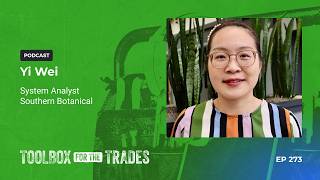
Yi Wei moved from construction estimator to systems analyst at Southern Botanical and now uses Aspire to track operations. Her team runs monthly health checks, standardized estimates and tickets, gate checks, and site audits. Equipment inspections on TVs got participation to 96% and turned raw data into forecasting and proactive fixes.
Chapters
Hello and welcome to Toolbox for the Trades. My name is Amanda Salvatore, and today I spoke with Yi Wei, the systems analyst at Southern Botanical. Yi has a unique take on the role. She describes Aspire as the circulatory system of Southern Botanical, with herself serving as the cardiologist. She makes sure the heart of the operation is healthy and every team member has the oxygen they need to execute. We dive into how to find the root causes of problems upstream before they become disasters downstream, and how a simple site audit initiative transformed their internal communication. I hope you enjoy this conversation as much as I did. E-way, you are the systems analyst at Southern Botanical, and today we're gonna be talking about the heartbeat of operations, transforming data into strategy. Welcome to the show.
Thank you, Amanda. I'm so glad to meet with you and then talk about how we utilize Aspire at Southern Botanical and then share our struggles and then what we learned from the past 3 years being partner with Aspire. It's definitely an honor to talk facing all the industrial peers.
Thank you so much for saying that. I really am excited for our listeners to hear what you have to say because I think you're utilizing Aspire in a very unique way. Before we get into how you guys are innovating, I would love to ask you your icebreaker, which we always ask here on Toolbox for the Trades. What is a hobby or passion you have that would surprise people who only know you from landscape?
My hobby is running and then being outdoor. I sprint the triathlon when I was first year at Southern Botanical and then keep this passion. So I'm always like a coordinate outdoor event every year. This year is going to be a 5K, 10K run at a lake close to our office. And then we have been growing continuously over the past 4 years since we start doing this event, outdoor bounding event. So this year we're hitting 30 team members joining.
That is so cool. I admire any runners. It is like the one thing I never want to do, so I really admire anybody who really finds a passion for it. I love that, and I know that you have a passion for the outdoors, and that's how you found yourself in landscape a little bit. But how about you tell our listeners how you found yourself in this industry?
I love drawing, do design work. So when I trying to select my major at college, I choose landscape architect, which can— I can do design work and also be outdoor in the field.
So how did you find yourself at Southern Botanical? I know you've been there for 5 years now. I would love to hear how you started there because you have a new role.
So I was first hired as construction senior estimator, and then run our construction division for a whole 9 years. And then our leadership decided to completely turn off our construction division and then focus on our maintenance business. That's also the time that we're going to switch from a construction-tailed software to Aspire. Obviously, my position was gone. So leadership saw my value as an accountant, so I was invited joining the implementation team. It's about a 10-people team. It took us about 3 months to complete the implementation process, and then we went to live January 2023. So at that moment, we feel there is a need to have full-time people to become a bridge between Aspire and then Southern Botanical. So I just step in and then create my own role with the help of our leaders. First, I'm the Aspire specialist, the title was. And then we bring more other integrated software like Innova, Azuga to combine all the different software. So it become a system analysis.
Incredible. What a journey. So you came into Southern Botanical and you were dealing with all of this construction, the construction side of things. Once that was sunsetted, they admired you so much they wanted you to stay with this company, and they found a place for you with this implementation team while you're adopting Aspire. And now here you are as the system analysis. Now with this new role, you have a really cool perspective on how you view it. Can Can you tell our listeners a little bit about that?
Yes, that's a quote from my, our previous CFO. He mentioned that Aspire is almost like our circulation, it's like a circulatory system. And he mentioned on my performance review that he is the best cardiologist.
I think that is so much fun. You're the cardiologist. The heartbeat of this company. Aspire is pumping the blood and getting all of the data, all of the information to all of the different facets of your business. And you're making sure that everything is running smoothly and everyone's getting what they need.
Yes, we think like Aspire is not just a software, it's how information flows through the business. Everywhere.
So you're seen as this cardiologist and you are here to keep that system healthy and you're looking at all this data and all of this information that you're getting from Aspire. You frequently have these health checks, which you say are protecting margins. What do these checks look like and what are you keeping your eye on?
Margin as a business is a big vital signs, but that coming from a lot of different places. You have labor, material. We spend a lot of time working with our accounting team very hardly. Also like doing monthly close check review, over-under review, work tickets review. We have about 30 metrics, about 17 of them are regarding to work tickets and then 7 regarding to opportunities. So we check our operation management and sales management, every aspect in Aspire and billing also. This is a monthly close aligned with our Aspire close. So we do checklist and the follow-ups monthly. What I have to admit that we're doing very good job on monthly checklist. This is very awesome. But we just realized that we are not doing a very good job on our annual check. So we are fixing right now.
And this is something you are doing throughout the organization, looking at this data, the tickets, at the opportunities that you have to improve your processes, and you're learning that from the data. Typically, companies will look at the data at the end of the year and see where they can have improvements, but you are instead trying to forecast what's coming. How do you get ahead of an issue?
We actually recently had this, like, a big issue with one of our division has a lot of warranty cost. We get a lot of frustration and intention from both operation and then accounting side. Why so many warranties? We figure out that it's a lot of tickets get complete inaccurately, or like a material, the dates put into inaccurate dates. So instead of looking at a warranty at about a monthly frequency, we're right now looking at a warranty as a daily basis. If there is any warranty fit into that dashboard on Aspire, and then people will go check in, is that true warranty or it's just inaccurate operation?
So while you are trying to look at this data, you see something happening, alarm bells are ringing, what are some ways that you are solving these problems and course correcting the issues?
The first way is like we are trying to do standardizations for our process. Purchasing is one piece, and then how we handle tickets is another big piece. We focus on ticket management a lot. That this is all from downstream side. We want to make sure that operation is correct. But on the other hand, and we spend a lot of money to do our, like, money and efforts and the time to train our salespeople too. The upstream, well, which from estimate, very beginning, like how to create a contact, how to create a property, create a correct estimate. This is a lot coming from, like, business developers. Our business developers, like, natural, they are living, like, in a very high speed. Mood of pace of the work. And then they're taking a lot of bids maybe at once. We see that a lot. People will go rush and then tap into wrong service line in the estimate, and then it ends up in the billing that your revenue goes to another bucket. Like for example, you are in a commercial division and then some of a partial your revenue goes to residential. At the very last time, we find that at the billing part, like when we do accounting review, But the upstream is happening from a business developer, how that estimate was created, very upstream. That is the cause of that issues. We have sales training very frequently. We just finished our whole camp in about 2 weeks ago. We train a lot of our front, like business developers. That piece is very important and inspired to affect all the downstream issues. So training is, is one. We also have a green standard trainings every month for the whole company, and then we just spend a lot of time do trainings and then SOPs, trying to make it standardized across multiple branches, multiple divisions.
I would love to know what you would advise to any owner or operator who feels like this sort of thing keeps happening to them. How do they designate a role like yours? To someone in the organization?
That's a great question. We are also doing that right now. We are adding a lot of gate check, like a second check. Same thing, like you, uh, if a nurse is trying to put you on a medicine, they will bring another nurse to verify that you are using the correct medicine. So for example, one gate check is once the business developer mark, uh, like opportunity in one status before they are trying to schedule to purchase, we add a gate check for the branch managers or the branch manager administrators to verify that on the tickets, like your opportunity start time, end time, on the tickets, sit in the correct branch division, on the revenue match, like your ticket's revenue match with what's your proposal price. Adding a great gate check after any job gets, gets win.
Yeah, double-checking your work works in school, it works in business, it works in real life. I think that is amazing. Do you have any other examples that happen within your organization where you were able to really track an issue and forecast so that you were able to get ahead?
The warranty issue is one example that we have been experienced. I'm just sitting in this analysis role, so I'm still working a little bit behind on the data analysis. We're doing— we're still like finding issues and then trying to fix it right now. So we are slowly, slowly doing like forecasting.
You're taking the time learning what to be looking for, seeing the trends in the data. What do we need to do to get ahead of this? And get those problems solved before it becomes an issue. But first, you really need to be able to dive into that data. Yeah, that's right.
And that's the goal of this— my new role is to do more like a forecasting. And then after we become more mature, we know more about Aspire and our operations, we'll be able to do like proactive steps.
If someone was looking to fill a role like yours within their own business, what are qualities that they should look for in their team?
I think that person in this role needs to be really focused on like a— you are like a support. Treat yourself as a support team member and then try to reach out proactively to team members. People may feel shy to come in to see, ask questions. I regularly check in with team members. Do you have to be a very proactive person? Like to reach out, good at communication too. And then one thing I'm afraid is like public speaking, but I'm also training myself to grow so that I can one day— I haven't been presenting at our Green Standard training. That's one of my target of this year. But you have a heart to serve, to support, and then to reach out to anyone. You have a passion to learn everything. Aspire release new functions, notes, every like a few months. So you have to keep up. I like enjoying learning, adapting the differences every day. I would say not every day, but it's a lot of new features and a new implementation. You are not— you have to adapt the changes and then love learning new things.
Your advice would be look for someone in the organization who is interested in helping, who has great communication skills as well as an appetite for learning new things. And maybe public speaking might not be the thing, but learning that, getting more comfortable— there is so much to be said, especially for when it's keeping up with change. Technology is constantly changing, constantly innovating. There are new tools to help you, and being excited by that is something to look out for because that's a huge part of the job.
Yes, you have to embrace technology and then new like AI tools. Like we invite— or we also using ChatGPT too and then pay for that. So you have to embrace all that and then keep up with all the fast-changing technologies to embrace it and then really enjoy learning it with a very open mind and then qualifications in a role that between like a traditional construction industry and then a software company. You want to become the bridge of between. You have to have those, uh, characters. Yes, I feel like embrace.
You are the bridge between Aspire and this organization. You are making sure that there is a clear connection and a healthy connection. You are also innovating within Aspire, which I really admire when it comes to site audits. There is this initiative that you started earlier this year, and I know companies don't often view site audits the same way as you guys are. So please tell our listeners how you are working with those audits and utilizing them.
Yes, we launched our site audits initiative early last year, so it's been about a year, and then we set a goal of 20,000 by end of 2025. At first it was just a number, but over time it became something much bigger. Site audit turned into a structured field conversation with celebrating wins, documenting improving areas and then talking about safety. So when we end up hitting the 20,000 mark in middle of December last year, and then with Aspire production team and the leadership came to visit us, we are very proud to know that we are in the top 2 companies as a total complete side order in 2025. So we are top 2, we are very proud of that. But honestly, what we are proud of is not just how many we complete in the site audit. It's just that everyone that was aligned— crew leaders, managers, operations— it become a leadership tool, not just a metric.
Most people use these audits to upsell, but you're using them to also communicate and make sure everyone is following through on these processes as well. Why do you think this is so successful?
So comparing, like, a lot of company, you do annual performance review. So site audit, it's a tool we utilize that into our production team internally. So it's kind of like a weekly performance review, weekly safety checklist, just weekly celebration your wins. So it's become a very successful structured conversation in the field. Annual review is one year. But if it's happened weekly and then document in Aspire, and then you set a score, you look at your score weekly, you have so many data, you have trained to see what's the improvement, whether you have been doing very good, and then what's the field that you need to work on. And then we are also seeing that site audit, like visually make our truck looks cleaner, shinier. We do like a truck cleanup previously, 1 month. But right now with this site audits conversations, it's more cleaner, organized on the trucks. And then that brings our operation success.
There is something to be said to kind of take small bite-size pieces while you're out cleaning your truck, as opposed to once a month maybe doing a deep clean and having to do that and that taking hours. Instead, they're having the opportunity to say, "Ah, I'll just clean it up really quick." I'm sure that they also feel more prepared as well going into a job, which sets you up for success right off the bat.
Yes, I would want to add one more to that side audit. So it becomes like a two-way communication. A manager is going to see, "I'm going to grade you at 3 out of 5. You just meet an expectation, but there is still room that you can improve." And then he will ask the crew leader, "Are you agree with my grading? Is that you agree with that?" So it's immediately feedback, constructive feedback, and then you get everyone on the same page aligned with the documentation with a great, like, all agreed score. Side artist, it's about a score. So we analyze scores too.
It seems like that's really the core at what you're doing at Southern Botanical is keep open lines of communication. I know sometimes when you standardize a process, it could feel a little rigid. How do you keep flexible when you're trying to nail down a process?
That is a great question. When we're trying to standardize a process, we get a lot of pushbacks at first. I encourage all the people who having any feedback, immediately like communicate it and then get it to us who like trying to implement in the process. We are very open. We tried it out at a small group, like at a small branches or divisions. We collect feedbacks and then we revise it, expand it, and apply to different groups as a large scale. So we are not doing SOP and from leadership from the top. Leader groups and then trying to do that at one time, implement, ready to go, no changes. As a leadership group, we hear all the feedbacks. For example, like we just do it like putting a tree staking kits into templates. There is about 8 lines. So a lot of people dislike the 8 lines because they are not using them all the time. They have to maybe using one and then they have to delete 7. They have to do deletions one by one. So they hate it. Our Vice President and I saying that we need to think about another way. So we change immediately to create another service line and then put all the kids under another service group. So if they don't need it, they can delete all the group. So first, we have to be not great at first. We need to welcome all the feedbacks.
It goes back to this open line of communication that you have, but also being able to hear and truly understand your employees and their needs. This feeds into company culture, morale. When an employee feels seen, when they feel heard, when they become a part of the process, they are going to do better work for you because they know they have the support. And that is what you're doing at Southern Botanical.
Yes. So that's on my calendar. I have a regular calendar occurring events to reach out to different people. We have like a task force leadership for people. I regularly join the meetings with them. I'll just reach out, hey, any recommendations? Anything bother you recently? Is there anything that I can support for you? Or it's just weekly, like weekly, monthly check for managers. I'll checking, hey, it's your team. Do you have anyone that is suffering right now, need extra support from me? So it's a regular check with different, different positions.
That's also a great way of keeping those lines open, healthy, keep checking in on those arteries, those ventricles as a cardiologist for Southern Botanical. That is really wonderful to hear. I love when companies really consider what is going on in the field and what is happening with their technicians on the ground every day.
Yes. Like, my work is a lot of checking, checking Aspire system, and then also checking our team members because we know that we value everyone in Southern Botanical. When we make a business decision, we know we're not like a trying to get rid of our employees. We provide positions, we provide opportunities to move around if you are talented on other aspects. We have a very professional recruiting team here too. There's a lot of awesome good stories about my team members, from like, from a purchasing role going to an account manager role, and then right now he gets promoted to a maintenance operation manager. So it's just a lot of good story happening here. We have open communications in every department. It's not just a company growth, it's also personal career growth. I really enjoy our culture here.
I was gonna say, it sounds like if you have people who are interested in going from one position to the next and have those opportunities for them, that you're going to have a happy employee and people who are invested in the company. And it sounds that you have done exactly that you're hiring good people and you're able to invest in them.
Yes, exactly. And then our, like, a recruiting team is also regularly checking in too to see if you are interested and you have any idea. I can help you with your career growth. I can help you make a plan. So it's, it's a whole company teamwork.
Honestly, you can't ask for anything better. Yi, this has been a wonderful conversation. I love how you're using Aspire and how you're communicating with your team and looking at this system. Before we go, do you have any final thoughts you would want to share with our listeners?
One thing that I really want to encourage for utilizing is the equipment module in Aspire, which is you can do equipment inspections. We started the last, uh, summer, and then at the very beginning, we are hitting about 72% of participation rate. It's not horrible, but it's not a reliable number. We want— ideally you want 100% crew leaders is doing equipment safety inspections before they leave the yard to go to other properties. So I really encourage that. Right now with the visibility, we put TV screens for every crews this week, how many site audits you have been done, because you have crews working 4 days, 5 days, but on the TV, it's It's showing that this crew, 4 site, like 4 inspection did that has been complete this week. We have Aspire, is a good tool, and then the visibility is better than just the pressure or enforcement. The visibility make it more effective to make it happen, make it work as in the field. When the crews see that numbers, how many he finished this week, it brings that awareness too. It's a good tool of visibility and also the equipment module in Aspire. So I'm very glad last week we hit 96%.
That's an incredible improvement. That's wild. That's all from just making sure that your team has visibility on the numbers.
Uh, it's already set up as a, uh, saved Aspire in the— as a list. So it's running on the TV. It's automatically running on the TV, and then they can see it.
Once again, Keeping those open lines of communication and making sure your team understands where they are, where they want to be, and also their value within the organization. Amazing work. Yiwei, thank you so much for coming on Toolbox for the Trades. What a great conversation.
It's my honor. Thank you so much.
More from Bill



Capturing the 80%: How SmartAC’s Gen-2 Targets Non-Membership Homeowners | Podcast Ep. 296

Build better customer data with every booking in ServiceTitan | TAD Tune-Up Series

The Biggest Change for Roofers Coming From Other Roofing Software to #ServiceTitan?


