Why Conduit Tech Is a Game Changer for HVAC Design | Podcast Ep. 72 | Mastering ServiceTitan
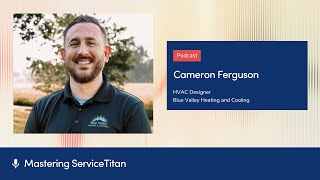
Cameron Ferguson at Blue Valley Heating & Cooling uses Conduit Tech's LiDAR scanner to show homeowners 3D models and exact BTU needs during sales visits, replacing generic bids with interactive design sessions. The tool integrates with ServiceTitan for automatic handoffs and field-office alignment. He won a job over two competitors by scanning live in front of the homeowner.
Chapters
I'm just scanning a room like this, right? Boom. And in real time, just like self-driving cars do when they're scanning roads, this is the LiDAR right on the iPad Pro. It's amazing. And it's creating these lines. The visual impact of that alone, for most of my clients, they tell me is that was the moment they realized that I care a lot about what I do.
Welcome to Mastering ServiceTitan, where you get expert advice from power users. I'm your host, Josh Lew, and today I'm joined by Cameron Ferguson, the HVAC designer at Blue Valley Heating and Cooling. Cameron, welcome to the show.
Thanks for having me. Appreciate it.
Yeah, I immediately reached out to you after we did our webinar on this topic of conduit tech, and I'm super excited to have you on to dive even deeper into what conduit tech is, why people use it, and then we'll spend a lot of the time today talking about how to set it up and all your advice there. But first, I guess for people who haven't heard, what is Conduit Tech?
Yeah, Conduit Tech has been, uh, for me, I'll try not to be as dramatic as I always talk about it, but for me, it's been a complete game changer. For me, it has been what I've decided to focus, I would say, 100% of my time on in this HVAC field. For me, it's a decision support tool. So when I'm going into homes, I'm always trying to stand out and look different, and that's well and good. But also for me, I— my huge desire here is to make sure I'm doing a good job and doing the right job and the right work and not overcharging for, uh, for, for services. I want to protect homeowners. And so this is like a layer of protection for homeowners. And I'm sure you and I, Josh, will get into ways that I'm able to implement that, but this is a layer of protection It's an incredible software that anybody can pick up and learn quicker than any other, any other software I've ever tried. It's got to be one of the most intuitive ones as well.
Can you paint a little bit of a picture of what life was like before Conduit Tech and what it's like now in terms of your process when you walk into the home?
Beforehand, a few years back when I first started being residential sales only, I was going up into, uh, what I call the price war. So you have a homeowner who goes on Google, they don't really know anybody around, so the first place they go is to Google and they'll get 3 bids and all 3 bids, all 3 companies that come out and provide bids are all likely gonna be the same. A lot of companies do like-for-like systems, which is, you know, what's already there. They're just gonna get what's path of least resistance option going in is like, we know this is gonna work. They won't call us back. And for a lot of businesses, that's kind of what they're striving for. That's their business model. For us at Blue Valley, and for me, we're going to spend the extra time and we're going to scan the home. We are going to take in these considerations of how much heat is this home losing, and are there problem areas, for instance, above your garage? And if there are, here's software that I'm able to use right now and show you and measure it in real time and tell us exactly what size is needed for this space. Once I understood all of that, I started to just immediately just walk that walk. I was no longer saying, oh yeah, you know, you should really do a Manual J, you should do a heat load calculation, or I did it, and not showing them the why. That has been the huge transition for me. Once I understood that, the power of that, is I'm no longer in this price war. I'm not replacing a box with a box that looks like it, that's just newer. I am asking questions to figure out where the problems are in the home, and I'm also asking questions for clarity on myself because I want to make sure that I'm serving the homeowners right. So this has been just a great pathway. The software has been for me to just protect more homeowners.
Gotcha. And for those who have just no clue exactly how it works, can you share a little bit about what those features are within Conduit Tech that help you with that?
Some of the really cool features right out of the gate, it only takes you a few minutes to get set up with the account, especially when you merge it with ServiceTitan and they talk to each other. That just makes our job so much easier in the field and in the back office, right? So you walk into the home, you greet them. Of course, that's what I do. Sit down and I set the expectation this is going to be a design visit and I'm asking them questions like, "you know, how many fireplaces do you have?" And I'm showing them the screen as we're doing it. So we are literally designing their system. That's an interchangeable word a lot of times in HVAC, but HVAC design, typically that's more, if we tune into that, it's the heat load calculations and beyond. But we, I'm putting this in the customer's hands, essentially, like they're with me filling out their home. They know the home. After we establish that, it only takes a few minutes. I bring the homeowner with me and we go walk around the house. We start maybe in the room that we're in and I show them what I'm doing. I'm holding an iPad and I'm just going to grab one here so I can show. So I have an iPad, Conduit loaded up. I'm just scanning a room like this, right? Boom. And in real time, just like self-driving cars do when they're scanning roads, this is the LiDAR right on the iPad Pro. It's amazing. And it's creating these lines. The visual impact of that alone, for most of my clients, they tell me is that was the moment they realized that I care a lot about what I do. If they only saw, like, they don't see all the extra stuff, but if they're catching that much on the front end within 15 to 20 minutes of being there, it's no longer a price war. You are in a lane of your own, essentially. And that's been really, really great for me and our company. Wow.
Yeah, that sounds like a huge differentiator. I've never seen someone come to our house before and scan the entire room and have— be that thorough and detailed. And so you do that with every room in the house? You scan every single room to just kind of have a calculation for the entire home? Is that how that works?
I do. I, I do. And we scan the home, and, you know, typically we're so self-taught to— we want to be quick and super efficient, which is all great things, but when we're talking about people's investment and their money, especially with the cost of living these days, want to make sure that their dollar reaches as far as possible. And this tool has taught me to slow down, and it's so counterintuitive to what we know, but when you slow down, you miss less things. And when you slow down, you're measuring things and you're intentional when you're measuring things. And when I say embody this design side of HVAC, you— it's hard not to embody it once you've seen the magic of it work and homeowners buying into what you're telling them, and it's backed by this ACCA-approved rating as well. The software is. So it's the real deal.
So once you're done scanning the entire home, what's the next step with the homeowner?
So the next step with the homeowner is immediately I review my results with them. And when I review my results with them, that does a couple of things. It allows the opportunity for them to actually see BTUs in their home, visualize it in some way or another, because when we're talking to people, And we're discussing gas furnaces or heat pumps or anything, we're always talking about transferring and generating heat. Now we can show them what this BTU acronym means, British Thermal Unit. That is powerful in itself. People are longing for this tangibility aspect, especially when they are being proposed anywhere from the mid-teens to the mid-twenties for a project. It really uncovers a lot more discussion and it does also automatically start talking about, hey, we're talking about increasing our comfort level in the home. Homeowners will start to think outside the box with me and start thinking about indoor air quality improvements as well in the home. And that's just more revenue potential. You're opening up the opportunity because you're slowing down and having these discussions, and you're able to take care of problem rooms up, up above the garage. You're able to let homeowners know that they don't have to live this way in this house and be standing in front of the thermostat all the time. You have the data to prove that. So I— it's a big discussion with the homeowner, but I also don't want to go too deep in the weeds with homeowners. I kind of will give them an out along the way. I'll check in with them multiple times, and if I, if I get the sense that it's a little bit too much, no problem. The visualization from Conduit Tech with some of the sales visualizations that they have and templates, PDFs that explain it, PDFs that you can just put It's right within the app that you can show them the importance of LiDAR technology. So that's also something that I'm doing. I'm showing them this software is, you know, in a really easily digestible PDF that Conduit Tech has uploaded. So all of that is part of immediately after scanning. And then once we have this big discussion and we're fine-tuning down to one pathway, that's what I'm trying to do. I'm not trying to overwhelm homeowners by multiple options and Now I'm able to find all these new problems. I'm trying to find an ultimate solution for them. And Conduit Tech has been the way that I've been able to do that by showing the data with it. So.
That makes sense. Most of the listeners of this podcast are using ServiceTitan, always trying to improve their usage with ServiceTitan. How does the Conduit Tech integration work with ServiceTitan?
The Conduit Tech and ServiceTitan integration is incredibly smooth. So you can immediately upload the PDF. Right from Conduit Tech onto the ServiceTitan platform, which everyone in your office, your installers included, now have access to your entire report. Because within this report, Conduit Tech has another cool feature. I know I keep saying there's so many cool features, but literally this one's really cool because this one protects your margins because it's called the install handoff. And this is a— it's not too much information. It's not more than an installer would need. We don't get lost in all the numbers. They don't need all that, but they do need pictures, pictures that I have written on and drawn on and locations. That's been a very powerful thing. So the installers show up day of install happy. It's incredible when you walk into the office and you see them saying, "I wish I had a Cam job today." That is a really cool feeling to have when you're in a sales role because it's usually the opposite. It's the sales team and the install team. And salespeople, you know, most of the time they have egos and egos that push them very far in their career, but these egos don't align very well with the installers who are doing the hard work. If you care about protecting not only your reputation internally, but your money and your income, you're gonna have to have some handoff procedures in place and Conduit Tech lines it all out for you where it's super easy to do and intuitive with ServiceTitan, or it just transfers right over to it. If taking information from one device and putting it on another is a pain in, in somebody's rear end, it doesn't have to be. There's tools in place that are already integrated between these two to make it seamless for you.
That's amazing. Uh, I want to dive into some of the gritty details when it comes to setup and any advice with setup and especially your journey, you know, starting from without Conduit Tech to now, like having mastered it so well. Like if a new customer signs up for Conduit Tech, what does the first few days and setup look like?
So the first few days, just like any software, most likely for people, it's going to have growing pains and the growing pains are normal. And me personally, when I am going through growing pains, I'm looking at it with a glass half full perspective because I know that I'm going to be learning if there's challenges. I'm learning along the way. And so it is normal to, to feel like you're kind of just lost. But just because you feel lost when you first have it in your hands, everyone's felt lost when they first have new tech in their hands. The first time I used AI, first time I used a smart device, anything, you're like, what am I doing? Well, if you can use a smartphone and everybody does, Conduit Tech is extremely easy to use. I mean, it's using an iPhone or an Android is way more complex. So you just have to be patient with it and understand you're not going to be blowing through calls as fast. You're going to be forced to, even if you don't feel like it's a great idea for you, you're going to be forced to slow down. So you have to be open-minded for change. That's the constant always. And, you know, especially in our career, for us salespeople, there's change almost weekly for us. So you have to be open to it. You have to let it reinforce the good habits. Rather than replace an entire experience. So if you have a way of doing heat load calculations, which has been more rule of thumb, not that that's totally wrong, there's still a lot of validity. That's why rule of thumbs are a thing. But if we are targeting more efficient installations and less warranty callbacks, the sooner you can embody this process along what you're doing, and then at some point you might feel the desire to just go full on board with Conduit tech, like everyone I've ever talked to, which is a lot of people at this point. You just have to be patient with it and yourself, ask questions, be hungry and motivated to learn. And this tool is for everybody that has that heart that, you know, it works best when it's used to support how people already think and not force a new one overnight.
Yeah. You mentioned, you know, some of those growing pains. What were some of the lessons you learned throughout onboarding? Any like mistakes made or frustrations that people should watch out for?
Some of the mistakes that I made early on was I was doing a lot of work and the homeowner wasn't seeing it. This is an idea that one of my sales mentors, Larrin, he has taught me. He taught me this idea that if you're doing anything and the homeowner's not seeing it, it could potentially— most of the time is a waste of time and is not valuable to what you're doing. That's why I love Conduit Tech versus other software where you're literally just sitting. You could do it anywhere. You don't have to be in front of the homeowner and they don't see the value. They just— you just tell them a number and they're like, okay, cool. Yeah, I don't have no idea what that means. So with Conduit Tech, you are forced to literally do it in front of the homeowner, and that is a good force. You have the opportunity to build value that your competition, they're not doing it. So wow.
Yeah, I can totally see how this changes the entire homeowner experience. It reminds me of right out of high school, I started working in sales selling Cutco. You know, the kitchen knives?
I do. Yeah.
So I did that for like 5 years, and I, I remember they used to always tell us, don't sit across from your customer and like you're talking at them, but you kind of want to be like talking with them and looking at something together. It kind of reminds me of that. Seems like you're really involving them through your whole process right away. You're not like talking at them, but you're working together with them in like a it just feels a lot more collaborative. I don't know if that's the right word.
You're right. That's what I'm aiming to achieve. That's my ideal outcome is an interactive visit from the start to finish. I want it to feel like they are designing what they want in this home. I provide the information and then the data and the options, and I narrow down the options down to about one, maybe two. That would be the argument between electrification or dual fuel. And there's great arguments to be had for both fuel sources. What I'm seeing currently in today's electrification movement right now, which I love— I have plenty of books on electrification and I'm a heat pump nerd, I'm an advocate of it— but if you're not properly sizing these systems, you are potentially creating a lot more stress on the grid. And so if we are oversizing equipment, and not taking in these considerations of not only heat load calculations that Conduit Deck provides, but also airflow assumptions and airflow actual— what happens in the real world— that's going to be a huge problem. If we have a home with ductwork that can't support this large heat pump, 5-ton heat pump that's made for a really big house, if the ductwork can't support it, it's going to be just drinking right out of a fire hose the energy use. And that's not what heat pumps are designed for. So when you're designing a system with the homeowner, they feel involved, they see it all, they're feeling it. If people don't— everyone has heard this most likely, but people don't remember what you say, they remember how you make them feel. That is the truth when it comes to conduit tech. You're making people feel good and comfortable. Wow.
Yeah, I bet they feel super reassured when you're seeing how— when they're seeing this whole process. When it comes to change management, have you— like, people on the team, were there— was there any pushback? And any advice you have for helping to roll this across? You know, change is always difficult for some folks depending what the new thing is. So any, any lessons there?
Yeah, I like it to be— my framing is very humanized, very human-centered when I'm talking to people about it. Of course, I, I tell them that, hey, you know, change always brings hesitation. The framing matters more than the training ultimately, like how I can frame it to them or somebody is with special words, of course. There's a great, a great book. It's Exactly What to Say by Phil M. Jones. And he has these, these words that are really, really impactful and powerful. And one of them is, would you be open-minded? And that alone, when you're communicating not only to homeowners but internally to technicians or anybody who doesn't, isn't embodying this design life yet, I hope they will. You just need to emphasize that this tool is there to support And it's not an oversight tool. Like, people— hopefully organizations aren't capturing this tool and using it as some type of threatening thing, because that's not— you're losing the whole point. This is to protect the homeowners and to protect the margins. That is what it all comes down to. And you're able to sleep a little bit better at night too, because, you know, you didn't oversize a system and, you know, now their $20,000 investment doesn't work at all. Like, that has just made my work-life balance Amazing alone. So thank you, Shelby from Conduit Tech for that. Thank you.
Shout out to Shelby.
So many shout outs, but you know, I have to.
Were there any frustrations from the team early on and how did you all handle those?
Yeah, some of the frustrations that I noticed was how time-consuming, you know, to loop it back to the time-consuming piece, that could be a little frustrating, but that is easily you can work through that within just a few site visits. I highly recommend people that do try Conduit Tech— you definitely got to try it, you're going to love it. So once you do try it, do it at your own house first. Don't do it in front of the customer first. That's what I can recommend to you, because you might know everything about heat pumps, you might be 3 times smarter than me, maybe 100 times smarter than me, but if you are fumbling with tech in front of homeowners, especially people from my generation, millennials, we're like, whoa, okay. It's a little weird. So we're— remember, we're trying to— there's trust building that we're trying to accomplish with this. And so do it at your house first, learn all the ins and outs. There's incredible training videos as well. And the staff from Conduit Tech, at a drop of a hat, you just say you would like some training, they will book you however much time you need. And I've done that plenty of times along the way, and it's only helped me to get to where I'm at at the pace and acceleration I have too.
Cameron, do you have a like favorite customer moment or story as it relates to using Conduit Tech? What I'm trying to get at is, was there like an aha moment for you where you realized the impact?
Yeah, there was. And this story is an incredible story for me and my confidence level in not only the, the tech, but my idea of the importance of going all in on this idea of design forward. I went to a home late on a Friday. This is all true. About an hour and 30 minutes away from where I live. We were slow and I'm like, I'm going to go, you know, I could really use this right now. So I went out, I show up, there's already two companies on site. I see two trucks in front. I'm like, okay, a little interesting, but it's happened to me one time before and it just, you know, it was a little weird. So I walk in, both of the companies, both of the other salespeople were there inside. One was checking the furnace, one was talking to the homeowner. And I walk in and I don't change anything that I've learned along the way where I walk in and I set the tone of the call, even though there's other salespeople there from other companies. I still go in and I ask to sit down with them and I sit down with the homeowner and I open up Conduit Tech, right? And I'm like, hey, I'm just gonna ask you some preliminary questions. The house is this old. My software is already telling me that. How many fireplaces? Cool. So, you know, I know we have a lot going on in this house right now, a lot of moving pieces. But if I could just get your attention for just a few minutes, you know, during this, other sales guys were like, his phone's ringing. It was crazy. It was like out of a movie. And I'm just trying to get— give me 60 seconds. Just— I just want to get to where I can show him what I'm doing, the scan. And I had never had this aha moment before, but I'm like, you know what? Instead of going in with a bad mood, a bad idea and assumptions, I'm going to go in and try this idea I've had. And so I said, hey, you know, Mr. Jones, just walk with me real quick. My whole experience here I'm trying to set with you today is going to be a lot different than what they're going to be offering you. Not that I'm right, they're wrong, or anything like that, but let me just show you what I can do. And so I pulled up my tablet, and the first line that hits the edge where two walls meet in his living room, he sees it, and I'm looking at him and his eyes are already— his eyebrows are already kind of going up. And then I look back and I scan a little bit more, and it shows another LiDAR scan at the ceiling, um, in the wall. And I could see his eyebrows going a little bit higher. All of a sudden, I swipe the 3D model on the screen, and it's doing a 360, and he's like, whoa. He's like, that is cool. What is this? And so I start telling him what this is and how passionate I am about making sure the money he's going to spend, because he's going to spend money one way or another. Obviously, someone is going to be going home with, with a deal. I said, I'm making sure everything that I'm offering you is in line with what the home can actually support and what the ductwork can support. This is the most important thing, Mr. Homeowner. And he's like, you know what, let me walk with you a little bit further. So we start walking down the hall, we're looking at other rooms, and he's seeing this in real time. A floor plan in a 3D model format being created. And I'm, of course, strategically sales guy here. I am doing these swipes for these impact moments, and it works. It's insane. It got to the point where he's like, okay, I understand. I understand. And he's like, I'm just going to let you be. So I continue scanning the home. I go back to where I set all my stuff up in the living room at the table. And he's like, yeah, so, you know, I told all the other guys just to, email me their bids. You know, I said, thank you guys. Um, just email me and pretty much sent the other two companies away and sat down with me. And at that point I was building this in real time, this idea of designing an appointment. That was the very first kickoff point for me was I designed, I showed him that I'm designing. Then I showed him the design room by room identification. Like here's bedroom 1, 2, 3 primary. Bathroom. He's like, man, he's like, I had a flooring job happen about a year ago. I would have loved to just been able to take this floor plan and emailed it to 3 different companies and not have these guys come out over. I'm like, I get it. And that was another cool thing, was this floor plan, I'm sending it to the homeowners as well. So they're getting a floor plan, a 3D model, actual data that's backed by ACCA. All of these components, and now we're deciding, hey, these are the numbers we need to hit with the heat load calculation. Here are the pieces of equipment that I recommend you do. One of the options that he chose was an LG Max Performance heat pump system that, you know, I don't know what the other guys were offering, but we were then able to take care of his primary bedroom upstairs that was always hot and cold. None of the other people had even discussed problem areas in the home, nor let alone a plan on how to attack that aggressively, because now's the time to do it. So that was the huge aha moment for me, was he actually sent other companies away, and that was not my intention. I am not a guy who's coming in and, and trying to be disparaging to other people. I don't want to be disparaging to other companies or anybody at all. We all have our own way to do it, but the reality of this entire experience was unlike anything he had. Wow.
So after that call, what's going on in your head when you're walking back to the truck or driving home?
Like, I'm always practicing Stoic philosophy. So on the outside, I had my poker face, but on the inside, I was doing backflips. You know, I was like, there's something here. I did it. I did it. I'm not crazy as much as I thought maybe. I'm not. I'm not, you know. And that was the most empowering moment for me. It is pivotal as well in terms of my confidence level and knowing that I belong. And this idea belongs in this market in Colorado.
Okay. Tough question. Is there— Sure. Are there certain companies where Conduit Tech is not really best suited for them? Like, could you see some kinds of HVAC companies, maybe the way they run their business is not suited for Conduit Tech, or would you recommend this for really any HVAC company?
That's such a cool question because at first thought, me being a competitive person naturally, and, you know, a lot of us are in sales, I'm like, the people that are speed to lead and don't care about replacing things with the right-sized equipment and they just want to get one box in, one box out as fast as possible. At first thought, I'll admit, I was like, I don't know if that's for them. But you know what? That's not my philosophy. My philosophy here is conduit tech should be in every salesperson, project manager, Comfort Advisor's hands, because this is a tool that can shift this entire industry. And what I mean by shift the entire industry— yeah, it's such a big thing. I know it's crazy to think in these big terms, but if we are not designing systems to the home's needs properly, like I mentioned before, fire hose of energy coming out, we're wasting energy. The acceleration to a cleaner energy future is going to be a lot slower. Because we don't need to use as much electricity to heat our homes. And, you know, a 20-minute design, 30-minute design session using Conduit Tech is going to help us get to the next step. So I think it is for everybody because the entire industry should be wanting to do it the right way, I feel, and protecting homeowners. That's why— this is why we're in it. We're here to help people, right? We can't lose sight of that. We cannot lose sight of the reason why we're in the trades. We're here to help. At least I know I am, and the people I work with are, and 99% of the people I've come across are as well. This is what helps our trade, especially in protecting our trade and our reputation.
Wow. You've got an awesome mentality. It is infectious. Uh, just, just hearing you talk. Yeah, I know before we started recording, we were talking about stoicism and, and all that. And yeah, I can see where a lot of this mindset really serves you well in this industry. Um, as a leader, I do want to mention, I know you haven't launched your podcast just yet, but maybe we can give a little teaser about what's to come in the future of your work there.
Thank you, Josh. I appreciate that. So we're going to be rolling out a trade podcast, and we're going to be highlighting tradespeople, not only HVAC people. It's going to be electricians, plumbers, executives, perhaps. If you guys want to come on, hey, we'll learn. I would love to learn anything from anybody. But this podcast channel is not only going to be for to highlight people's stories and what they're going through, and it's not to highlight people like Oh, he's a general manager. He's this top exec. Like, wow. Like, they get their flowers. I want people that are in the trenches as well. I want the installers. I want people that they have mindset that I align with as well, and they're here to help people. So it's called The Balanced Podcast, and it's going to be homeowner education. It's going to be highlighting tradespeople as well. It's going to start with local people that I work with at Blue Valley Heating and Cooling in Longmont. Shameless plug. And then also, you know, I would love to see, just see where it goes. I love to have just experts in their field on, but I, I feel like people in the trades, you know, the blue-collar workers, they work so hard, and a lot of times it gets unrecognized at the more lower to mid levels. So I would really like to highlight them because I'm of the mindset that you can learn something from everybody. And just because there's a new maintenance tech that just started We don't know what that person's background is, and the next thing that you hear out of their mouth could be profound and it could have a massive impact. And that's what you see today is a reflection of that along the way for me and who I've talked to and who I've wanted to be in the same room with.
Beautiful. I'm honored to get to be a part of your, your first guest podcast appearance, and I'm excited to see where you take it. Please feel free to reach out to anyone who's been on this podcast before and let 'em know, hey, I heard you on Master of Service Design. Would you be interested to come on? Yeah, I've had some amazing guests here, so please feel free to reach out to any of those folks and let them know I sent you. Um, anything else that we missed today that, that we wanted to add or close out with?
My last talking points that it's like my mission, right? It's something that I've developed, if you could believe it, without the help of AI. This was right out of me. And so this shows how much purpose and how much this means to me is I This takes me a lot longer by myself without the help of AI these days, but it really feels authentic to me. And what I would like to share here about all of everything that I talked about is, you know, my passion is about designing systems that work well together so homeowners stay comfortable and the grid stays stable. I mentioned that a couple times. If we're going to be accelerating a cleaner energy future, we— it all starts at the front-end design. So, a properly designed system, it does eliminate overspending and excessive energy use on oversized systems that carry a higher price tag. So when you have a higher, a larger unit, it does carry a bigger price tag. If you design it right on the beginning and you realize you don't need a 5-ton system, you actually need a 3-ton system, you're saving the homeowner money. It's amazing. It's the right thing to do. And then the last piece that I would like to just— I would like to say here is the transition to a cleaner energy future should be accessible to all homeowners, and how they choose to live sustainably starts with thoughtful design as the blueprint.
Wow, what an honorable mission. I'm so glad you shared that. It's the first time I've heard someone talk about that, and, uh, it goes so deep, and it's like way bigger than I ever pictured before. So yeah, I appreciate you coming on and sharing that.
Thank you so much for the opportunity and for the time. And if people would like to learn more, talk, I'm a great advocate for conduit tech. Please reach out to me on Instagram @cameronferg, The Balance Podcast on Spotify and Apple.
Awesome. And we'll link those in the description if you want to connect with Cameron. So thank you so much for coming on and we'll see you all on the next episode.
More from Bill



Capturing the 80%: How SmartAC’s Gen-2 Targets Non-Membership Homeowners | Podcast Ep. 296

Build better customer data with every booking in ServiceTitan | TAD Tune-Up Series

The Biggest Change for Roofers Coming From Other Roofing Software to #ServiceTitan?


