Why Field-First Tech is the Future of Construction | Podcast Ep 226 | Toolbox for the Trades
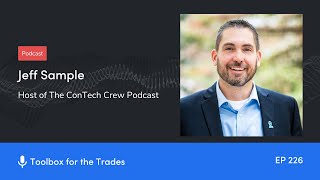
Jackie Aubel talks with Jeff Sample about why construction tech needs to start with field workers, not office managers. Jeff, who worked in both IT and construction, explains how better communication between tech companies and job sites could solve adoption problems and actually improve how projects run.
Hello contractors and welcome to Toolbox for the Trades. My name is Jackie Aubel and today I am chatting with Jeff Sample, the host of the Contact Crew podcast. Jeff and I spoke about his mission to bridge the gap between technology and the construction industry. This was such an entertaining and eye opening conversation. I hope you enjoy it as much as I did. Jeff Sample, you are the host of the Contact Creation podcast. Today you and I are going to be talking about the challenges the construction industry faces in adopting technology and how to solve for it. Jeff, welcome to the show.
Jackie, thanks so much for having me. I'm. I'm excited to be on the other side of the podcast experience. It's always fun when you get to sit in the, in the hot seat almost and just talk a little bit. I don't have to worry about questions and moving the conversation along. So I'm excited. I'll sit back, relax and let you run the show and I'll just answer.
Sounds like a plan. Okay, so icebreaker time. This is one of my favorite ones that I've written especially for you. You're really into jam bands, which I think is so much fun. Tell me about the best jam band sesh you've seen live and what makes it so great.
This is going to age me. It's like 2002 at the Fillmore Auditorium here in Denver, Colorado. And it was the recently late pass Phil Lesh. He had a band that he started after the Dead called Fill In Friends. And I'm sitting up front because nobody really knew they were out yet. And Warren Haynes is playing guitar for him and this young blonde hair kid, long blonde hair kid, walks up and I'm standing looking at him like he barely looks like he's like 15 years old. Turns out it was an 18 year old Derek Trucks who walked up to the front of the stage and starts kicking into this famous song called the Eleven by the Grateful Dead. And if you know it, it's like a really hard one. And he steps out in front of those famous people and takes over engine. Just jams for like 30 minutes on the song and we were just like. And he couldn't even order beer at that point because he was only 18.
So who is this? I'm sorry, I do not know much about the jam band culture.
So Derek Trucks is the nephew of Butch Trucks from the Allman Brothers and he's famous for it, like 14, playing with the almonds. And then he started his own band called the Derek Trucks Band. But then he married Susan Tedeschi. So the Tedeschi Trucks band is Derek Trucks his band. And if you haven't heard them and you're into the jam band scene or just into really good music, they are awesome.
Okay, that's so, so cool. Let's pivot out of music world. Even though I think you and I could probably stay here for a really long time. Before you worked for a masonry contractor, you worked in IT architecture. So I want to hear how that past experience helped you first realize the technological challenges facing the construction industry today.
So it was a mixed experience. So I got my, my start in IT in the ski resource business, where they would teach you anything. And I had the luck of learning a little bit of everything and then growing into, you know, really building and designing large infrastructures. And in doing so, you get to see every business, right? You get to see every part. You get to work with the, the accounting folks, you get to work with the HR folks, you get to work with, you know, whatever it is you might be doing in ski resorts. You know, we're scanning badges and, you know, scanning tickets and running restaurants and running hotels. So you get a feel for what everybody's perspective and needs are. So you have this, like, great view. So coming into construction, I thought, okay, this is, this is going to be easy, right? This is a pretty contained environment. We're work done and we're going to go. And then you find out that you're wrong inherently, when you're building something new, there's no infrastructure there, there's no connectivity there. And I'll be Honest, this was 10 years ago now. There's not a lot of quality solutions. The solutions were, in my opinion, built for the back office and were thrust upon and creating more work for the field. And at that time, there was nobody really bridging the gap yet into making life easier for the field, which ultimately became my philosophy. Like, if it's not helping the field, if it's not making us safer, more efficient, and focused on the work, it's not worth doing. So that was sort of the start of it all. And where I was wrong. I mean, I was wrong about that for a considerable amount of time until I really got to work with the teams in the field at the masonry contractor that were starting to tell me the truth about, oh, well, we got to drive back to the office to pick up this or pick up that, and then I got to fill these timesheets out. And the best they were doing is taking pictures of them. And, you know, there was all sorts of errors, and it was just it was a mess. It really opened my eyes to the opportunity as well.
Yeah, that's so interesting. So this was 10 years ago. You had come from the ski resort industry and you found that the technology available there was far more advanced than contractors that were literally building infrastructure across the country.
Yeah, it was far more advanced. We were using RFID technology to track people, to get people through gates, automatic gates for access controls, lots of different automations that were built. And we were moving, you know, a lot of our infrastructure into the cloud and, and doing, you know, purchasing tickets online, those kinds of things, those self service kinds of things that, you know, we were building and then also being involved in each of those other areas like a real estate or. And you know, you started to see. I saw a matterport before I ever saw it here in construction and never put the two together for a while longer until I realized, oh wait, that's that thing we were using back then, that's now over here.
So it must have felt like you stepped into a time machine kind of when you made that industry transition.
Yeah, yeah. There's a famous story about a year in where I was about to go and really luckily met a couple of the true early pioneer innovators that were like, no, no, no, no, don't leave. Like, let us introduce you to all these things that are coming and see what you think about that. And that was a segue into joining what was the Contact Trio at the time that when they brought me on board two years, so it's three years into my journey, they brought me on board full time and called it the Content Crew. So that's when the name of that show changed and when I got my sort of start in our world of.
A podcast host, well, perfect transition. I told you not to put on your hosting hat, but you did it naturally. Tell us about the podcast, the Contact Crew. What inspired the beginning of it? It sounds like you weren't a part of starting it, but you joined it later on, is that right?
Yeah, so early early. I mean, I was one of the 20th guests on the show, one of the earliest guests on the show. And the idea was James Benham founded it with Rob McKinney and Josh Bone early on. And they kind of made up this like software development from James's perspective. Rob came from the safety and innovation side. Like he was doing things in Atlanta, Georgia around safety technology. And then Josh Bone was a huge BIM proponent and doing a lot of BIM work. So they had those three areas covered. What they realized was all that's great, but if you don't have good it, none of that stuff works right. If you don't have connectivity, I don't care how good the application is, it's not going to work for you. So they founded the show to bring on and educate the industry around the technology that was available and start to spread it. You know, James was quite frankly designing a product for the industry and he realized there wasn't an appetite because they didn't know. They moved along, met me and then said, oh, wait a minute, we're missing this IT infrastructure piece. And so I came in to round out the group and that's what we figured out is we went to a lot of construction companies and realized that their IT teams, they were pretty homegrown. Just the job coster who could do it, had an aptitude for it, or the BIM or VDC person that built gaming machines at home. That's not true IT architecture. That's not thinking at enterprise scale. That's not the ability to budget and, you know, create cybersecurity and also, you know, implement good backup and redundant systems. Like, they don't, they don't have that. And it's a true skill that you need. So bringing me in kind of rounded out the team, but also helped me get into the industry. Like, if we're going to go through this transformation, these are some of the key components that you're going to need in that process.
It sounds like the Contact Crew was established to educate the industry as a whole as to this is what is possible. Now, you said 10 years ago that you first joined the industry, so we're looking at 2015. This is what's possible in the year 2015, 2016. Get on board because you're wasting time, energy and effort just not implementing this kind of stuff.
Yeah, it was get on the bus and realize, but it was also, and you're absolutely right, like the coolest part about, and the reason I really wanted to join those three was there was other things in their lives they were doing, but at the center of it was educating an industry they fell in love with and really helping be great stewards. We had rules around the way that we operated. Like we all had day jobs and things we needed to do. But when we were on the crew, when we were on stage, we were there to entertain and educate people on the possibilities. If one of those possibilities was something we were doing, that's great. But ultimately it was about pulling the whole industry that we loved forward and had fallen in love with forward and that's probably something else I should have said early is the other thing I didn't realize when I got into the masonry world was just how talented and wonderful the people who do the work in our industry are and just how critical they are to everything we do. Doing what we did at the masonry contractor, we came across a lot of other trades and learned about them and just saw, you know, we. We had guys putting unit mason work in that would bring sculptures and show you these little sculptures they made and stuff. They're true craftspeople. And that opened my mind to like, oh, wow. Like, we don't get to enjoy the spaces and places around us without these people. And we're severely underserving them, so we need to bring that service to them. And so that was, you know, really the impetus behind the crew and sort of what has become now, like just part of me. It's what I care about and what I want to do.
Amazing. I mean, this is so this runs really parallel to kind of service titan start. I'm not sure how familiar you are with our founder story, and apologies to folks listening who have heard it now a dozen times, but our founders are in Bahe. Their fathers worked in the trades, came to America, Armenian immigrants, and they worked their butts off to put their kids through really great school. R and Vahe both specialized in computer engineering, computer science. They met at a ski trip between various Armenian students, like in California colleges. And they found this connection they had. And they're like, you know what? Before we go off and we work for the Googles, the Facebooks, these big tech giants in the world, why don't we take a summer and build some technology for our dads? Because their industry is completely underserved. Fast forward to we're now a public company.
So.
And that I think all of service titan. And one of the reasons why I'm still part of it, I've been a part of the team for now eight years, is because we're fueled by that desire to enhance and change the industry and unlock all of the opportunity we see there. And it's rooted in a deep, deep respect for the people that actually do the work, the craftsmen and women of the trades.
Yeah, it's not worth doing if it's not really impacting them. And, you know, on the show, I've had time on time again, been able to interview founders and gotten to see them, you know, go through the process and see who's been successful and who hasn't. And those who are tied truly to the Problems that exist through family or self experience are the most powerful because honestly they're solving a problem, they know the problem exists. And you know, so many people, so much technology, especially back when we started this thing was like we used to say this, it's a solution looking for a problem, that's a bad way to go about building things, right? You gotta start with the problem.
100% agree, Jeff. Before I worked for Service Titan I worked for like a handful of tech startups that don't exist anymore. And when I look at Service Titan compared to them I'm like, oh, that was just technology, that was just tech for tech's sake. That wasn't actually doing anything meaningful. Versus Service Titan is making a giant splash in an industry, a giant industry. I'm curious, as Contact Crew has grown and expanded, are you guys still doing a lot of that education component or do you feel like the industry has shifted a bit?
There's a shift for sure, so we're still educating. But it's, it's kind of funny. A lot of those early flash in the pan technologies looking for to solve a problem have come full circle and are starting to really figure that out. Right? That is part of the process too is like I don't want to deter anybody from thinking technology is awesome and new technologies aren't incredible, but trying to make them commercial scale and go after it. You know, there's a couple of times when we were sitting there looking at, you know, I'll go back to the blockchain days because there was so much hype around it and people going like, oh, we're going to do this, we're going to do that. And it's like blockchain doesn't solve the fact that we don't all want to work together and we don't trust each other. Like you can't fix trust with blockchain from a willingness to do it perspective. Now come full circle, we're seeing new say collaborative project delivery platform type work and okay, there's maybe a chance to use some of these things. So but it has shifted in. It was about educating what was possible and what was out there. And it's turned to how do you find now that there's so many of them right? Back then there wasn't as many but they were growing fast and it's switched to now. Like how do you find the right one for you? How do you go about this transformation and innovation or evolution? I like to call it an evolution because as I've learned the construction industry more like transformation is sort of a little bit misleading, right? Because maybe you transform from project to project, but you, you know, it's an evolution as a company, it's an evolution as an industry as we grow and the, the solutions mature, but also what we do, right. So there was this early on, we found this problem or middle of the road, we found this problem where it was like we were selling software to people. Because I, I, you know, moved into the software side of things for a while. We're selling the software to people and they were getting mad that, you know, it didn't work. And it turned out it's not that it didn't work, it's that you don't have the problem. And that's when we realized, listen, you've got to start with your problems. What are the things that keep you up every night? Or what are the things that are bothering you and your business? And come to the table with that idea. Because if you come to me and you sit across from me and you say, these are my problems, and I go, hey, I don't have that solution. We can be done. We can be at no. And no is just as acceptable as yes. And in fact, getting there really, really quickly helps both of us, Right. It doesn't. It keeps me from, on the software side from spending time chasing you when it's not something that you need.
Yeah.
And vice versa. If you don't need it, I probably have somebody I can tell you that has it. You know, I can be sitting across from you and say, listen, you don't need this software. You need service titan. Go talk to them and they have the solution to your problem. Because I, my product is solely built for gcs, let's say. Great. You know, I worked for project management software for trade contractors. General contractor sat across from me. I'm like, you do this, this, this. No. You don't self perform? No. Okay. Let me tell you about these other softwares you should probably go talk to. That's one of the skills that we learned and have shifted to in the crew, in taking the practitioners and really talking to them about the way they go about identifying their problems. And that's been a great process to watch people, you know, teach them about, you know, process mapping. I mean, that nobody loves that. It takes forever.
It does.
Time consuming.
I'm literally in the process of doing that right now with my team because my team's slightly grown and I'm like, oh, I gotta go back to our processes. There's some holes I gotta fix. Oh, what A task I love to procrastinate.
Sorry. Yeah, and you gotta, you gotta process map it. And when, once you process map it, then you can figure out where technology can take you through the steps. The other key about process mapping is understanding not just what every step is, but what the goal of every step is, because that is the opportunity for technology to jump steps because it fulfills those needs along the way. That's another problem we saw in construction. It was like, oh, well, I do this and I hand it to this person and they hand it to this person and, and there was this belief that all those steps were required. Well, they were required because you were doing it with paper forms or you were doing it in an Excel spreadsheet and every hand needed to touch it. Ultimately, okay, I'm doing my time card and my time needs to be entered in such a way that not only do I get paid, but I know the work that I'm doing and I can project present, completes, let's say, through a system of connection. That doesn't mean I have to hand it to Jackie and Jackie has to type it into the percent completes and how far we are and oh, by the way, then get it over to payroll. We can do those steps in one, but we have to know them. That's the difference is we have to know them and we have to trust that it does those things. Right. That's the other problem is software, early on in construction especially lost a lot of trust because it didn't deliver on the promises. I always say, this construction has an elephant's memory. Oh, no, I tried that 10 years ago and I ain't doing it again. And you're like, oh, okay, we've come a long way, right? So it has changed. And I'll be honest, a lot of the technology that was unavailable or too futuristic is now starting to be here and starting to come back around and solve true problems. And that's, that's a unique path for the industry to see and to open up to because they're going to bump up against things that were absolute failures originally that are now possible.
Yeah, yeah. That's so interesting. You want to bridge the gap between technology providers and construction professionals. You already mentioned that construction professionals have the memory of an elephant and, and they remember bad first tries with technology maybe 10 years ago. That makes them hesitant to embrace technology now. Are there any other challenges that you've observed in this relationship besides general mistrust?
Yeah, there's a couple of different things that are going on over time here. Mainly the one is, you know, identifying the things that you need and then understanding that the software can do it. So one of the early on ones that we taught folks, and I still teach them today, is it's a show me, don't tell me. So when you do a process map and you understand the requirements you have for any type of software, you sit down with your people who are showing you it and you're asking them if it does it and they say it does it, then you ask them to show you. Because if it's 12 clicks to do what you're asking and right now it's not that slow, it's not a good answer. So it's a show me, don't tell me, show me how these things work. Show me how my workflows are going to go. Show me how this is going to experience that opens up both sides. And I think software has gotten to the point too where they've realized that they have a much more sophisticated user on the other side. And that's the other sort of growth and side effect that I've been fascinated with for the last 18 months. So for the last 18 months I've had the opportunity to work with the mechanical, electrical and plumbing industry.
Mep. Yeah.
Mcaa.
Mca, yeah, yeah.
Nika Smacna. And for the MEP Innovation Conference around some data that we got about beginning of 18 months ago about the people in the room at the MEP Innovation Conference and that they had now represented about 60% were leaders, know they had higher ranking titles than when these shows had first started. And we wanted to understand what that meant. And what we found is so many of these contractors are growing at such rapid rates and those people who were, say BIM and VDC who were a construction technologist are now, by the way, I want to change that construction technologist to an operational technologist. It's a much better term for them and gives them an operational route. Just a little self plug there. We helped invent that title and I want to change it. Oh yeah, but to grow into CIOs and CTOs to understand that growth and what both roles mean. And the headaches that were created in the process were eye opening so that the data came in and what was nice is they asked me to go do the qualitative part. Right. The quantitative part came in and they asked me to go do the qualitative part. So I got to interview and attend all these different sessions with people and sit down with them and get their take on it and really map out all of the headaches that existed in that growth process so that we can educate the, the next group coming up so maybe they can avoid some of those headaches and some of that turmoil and then honestly like educate the industry on what CIOs and CTOs do and how construction companies, contractors can. And I think this spreads across any of the verticals in our world, can utilize and respect that those trades.
So just to clarify, from me, from working with all of these different industries, you were noticing that over time there was a significantly higher amount of CIOs CTOs joining these conferences than previously?
Yeah, yep. They were VPs of IT or VPs of innovation or CIOs or directors of. And they had originally been, you know, bim, VDC manager or now they were, you know, raising up into the CIO ranks or CTO ranks and it was. What does that mean?
Yeah, yeah, I think I've actually seen that on the service titan side. I've always been in a fairly customer facing, industry facing role and we have a annual user conference pantheon and I've been to every single one of them. And it's really interesting to me because I am, I've witnessed the same thing. I'm seeing more people that don't necessarily come from the trades. Maybe they have a connection to it in some way, but they are much more corporate or business focused or they're coming in and they're mapping these career paths that we've seen in other professions and they're kind of coming to the trades for the first time. My opinion is part of that is because we've seen a giant influx of private equity in the space, especially in the residential space. And then also people are really starting to see that a lot of these industries are very good business models at their core. So, so you have aspiring entrepreneurs that are embracing the trades more than they ever have before. And I think that's part of it. What do you think?
Well, yeah, I mean if you look at uncertainty and you look at industries that have been changing, the tech industry seen a lot of layoffs, seen a lot of problems over time, seen a lot of instability that it hadn't before and the trades have grown, the construction industry is growing. Our need for infrastructure, our need for modern healthcare facilities, for water treatment plants, for everything, power distribution, for data center boom. Like it's a booming industry and it's an industry that can, that you can make good money working in. And it's also because of all that VC influx into the software side of things. And you know, some of that private equity into the trades themselves. People are looking at us and going, oh, wait a minute, I can go have a, have a job there. But that's, that's part of the interesting part of what we learned was what does it take for those contractors to shift their mindset and for those IT&CT people or operational technology people? And that was one of the bigger problems we found is I was hearing this like, well, they won't listen to me. They won't listen to me. They're not doing the things. And I'm like, well, what are you telling them? And they're like, well, we go in and we talk about, you know, virtual reality and bim, and. And I'm like, they don't want to hear about that. That's not. You can't, you can't go into the CEO, into the leadership office and start talking about the technology itself. CEOs and CEOs have businesses to run. They have operational issues. They do not want to hear about your freaking glasses or your robot or, you know, your next whiz bang cool thing. And what you don't realize, you do. And this is where operational technology people and IT people do the same thing, just a little differently. They come in and they talk about how many threats were under and my data deduplicated backups and my redundancy systems and the CEO, just like they would with the glasses and the bim, go, please don't ever let that person come in here and waste my time again. You now report to the cfo, the office of. No, we won't talk to you again and stay out of here. And by the way, cfo, keep them on budget and keep them out of here because we have adult things that we need to do over here. Running businesses and getting jobs delivered when ultimately that's really a bad thing. Because it is a business opportunity to apply technology to do better. It's just what we had to, what we learned we had to do was teach two things. We had to teach IT and operational technology how to speak business. It's a critical component in the process of them coming up through the ranks. And it's something that we just don't do in construction because we don't think about it as a skill set that we need, but it is one. It's critical not only to keep those wonderful people on both sides. I have a value for those people that come up as CIOs and those value that come up as CTOs. Very different. Right? Just a quick. Your CIOs your IT people, they keep the plumbing running, right? They keep your infrastructure, your cybersecurity, your data is flowing. Everybody has access to it. Your phones work, your computers work, Everything gets done. Everybody has access to the things they need to do. That's extremely unique and important operational technology. They understand how your fabrication systems work, how your modeling systems work, your coordination systems, all of these different pieces, your field applications, et cetera. They are great at those things. Those are just as important. You can have a cto, but they better have somebody in IT that is like an IT director, that that's their discipline, or vice versa. You can have a CEO that can have an operational technologist underneath them that understands those things. But ultimately, as they come up, they need to learn to speak business. They need to take the tools that they're talking about and not focus on the tools, but focus on the business.
Outcomes, focus on the solution, focus on the problem those tools are helping to solve and what it's going to look like.
Hey, listen, I have teams on site. I have material that's delayed and they're not getting it. And my crews are waiting around. I'm deploying people onto job sites and I'm trade stacking. And these scheduling tools are going to help me better schedule that, better handle the risks, understand where we're at. I'm deploying people and they're driving around like crazy. Hey, this tool is going to help understand and work efficiently and get to the right place at the right time to work on the right thing and have the right materials with you. Great. That means my teams, my project teams, my service teams, can be more effective and efficient and waste less time. Great. I'm in. Talk to me about. Don't tell me about the bits and bytes, just tell me about those outcomes. But on the flip side, we noticed that there was another problem in this process. Is that leadership. Originally in construction, we kept everything really close to the chest. Like, really tight to the chest. We didn't share things we don't share.
Not a lot of collaboration with competitors, Nothing like that.
Not even. Yeah, with competitors, but also internally. Oh, right, like that. I don't want to share how this job went versus that job. Because if I share that information, you might be able to figure out how much I'm paying that project manager or that foreman or that super. And we were that tight. And they had to realize over time that the world had shifted and we needed to share data, share that information, because the more they shared it to their teams, the more their teams could effectively understand it and use it to solve problems. They could look at those jobs and look at the profit margins and figure out why were we profitable on this one and where versus this other job where we weren't. What were the differences? What are the things we can learn? I was on stage at MEP Innovations and I had a representative from a cio, a CTO and a. And a business leader. And he said that was the hardest thing for him over time was to realize how much more. Every time he thought he was sharing enough, he realized he needed to share more. And it was just counterintuitive to the way we'd been raised. He'd been raised in the industry itself and it was a big challenge and that was something we didn't see coming.
Well, you know what's interesting? You were talking about this process mapping to like that, that contractors, that commercial and construction contractors should do to figure out where their problems are and figure out what kind of solution they need. Right. How are you going to effectively process map if you're not communicating transparently with all the different departments in your team?
And that's what it was. Joseph Lanzell from Pointer Construction, he was the one who, he just said, listen, the more I gave them, the better off I was. And the, and the better the solutions I was getting were. And the more. And the more pointed and the more decisions that was. The other thing is that once you process that data, you can make really informed decisions on what you want to do and how you want to do it as a business, not, not just as a construction business, but as a business in general. The more data you have, the more visibility and transparency, the better decisions you can make.
I want to sum up all this stuff that you're saying a bit because you're really sharing some awesome insight and I can tell how passionate you are about this. On one side of things, you've got kind of like the technological nerds, right, who are geeking out on the bits and pieces of the technology. They're not really focusing on how the technology solves problems. And when those technological nerds come to the cfo, to the C suite, they're getting NOS because they're not speaking the language of the. The C suite, of the business operators. Right? So that's a takeaway for technology that wants to serve construction. You gotta start with the problems and solutions first. On the other side of things, in the industry itself, you're helping them realize that sharing is caring, essentially. And then in order for them to grow and find solutions and streamline their businesses they have to be a lot more transparent in their departments than they ever were before. Because if they're going to successfully adopt technology, they need to understand their workflow from end to end. And by cutting people off at certain stages, you're never going to get that whole picture.
And you took it further earlier, Jackie and I will agree with you there. Then you need to take that and you need to turn around and realize that sharing that with the industry is actually going to help you. We call that coopetition. It's where, you know, mechanical fabrication facilities are really known for allowing other people to come in and look at how they're fabricating. And underneath all of that, what I realized was, look, if we don't share those things and raise everybody up, the rising tide lifts all ships. You're still going to have mechanicals out there or electricals out there that are going to stick big, build things, that are going to do things the old way, that are going to undercut you, that are going to hold us back. So ultimately, by sharing, you're actually improving your own expectations. So you don't have to sit across from a GC and explain that you're going to fabricate. You're going to sit across from the GC and tell them how you're going to fabricate and what you're going to fabricate and how they're going to adjust what they're doing to help you fabricate, or vice versa. The GCs are going to sit across and go, wait, you're going to stick, build? We don't do that anymore. Everything's going to be coordinated. Everything's going to be modeled ahead of time. Not everything, but the critical components are going to be modeled ahead of time. And, oh, by the way, you now have asset owners who care so much about the future and managing those assets into the future. Right. 20% of the cost of a building is in construction. 80% is in its operation. And if you think inefficiencies in what we do affect us, inefficiencies in our technological processes and our ability to hand over assets kills them. I just had a chance to sit with a whole bunch of owners about this and a particular group of owners that are exacerbated by the problems that we created by not doing what we're supposed to do and handing over things correctly. And by the way, here's a little secret. They're willing to pay more because, remember, 20 to 80, they see the 80%, they see the efficiencies. Those maintenance people, the facilities management People that handle those maintenance contracts with you, if you can provide them with the digital assets and the ability to show up and know what you're doing, where and when and where things are, that's such a value add to them and efficiency to them that it is going to not only help you with win service contracts, it's going to help you win construction contracts. It's going to help your business become more cyclical, more balanced. It and it provides a better product and that's what they want.
Yeah, we're going to start wrapping up soon, but before we do, I want to kind of pivot back to something you said at the top of our conversation, which is kind of when technology first hit the construction space, or at least when you first entered the construction space and you were seeing what was available, you saw a lot of technology that really served the back office and didn't really serve the people in the field. The service titan side of things. We're aiming to provide a solution that helps all areas of the business, from project managers, billing departments, and the crew actually doing the work. How can technology providers make sure that they're providing that solution?
Well, it is always begin with the end in mind. All of our work in construction is based on work getting put in place. Most of us do not get paid. Yeah, there's little parts where design work, etc. Get paid there. But we get paid on delivering an asset once it is installed. If, you know, a framer puts in framing and the framing's up, then they can build the gc, the GC can build the owner, and everybody can get paid in the end. That's where the efficiencies need to be. And anytime you're discussing any technology, like I talked about scheduling, scheduling is critical to the ability to have the right crew, the right material at the right time in an efficient and effective manner. That creates a flow to the job site of what work getting put in place. So you have to connect even when it comes to safety. Right, Safety. On any given job site, if a job site is shut down for a safety incident, that creates an impact on the schedule, which is time is money. Yes, we want to keep those workers safe and we have to have cultures of safety. That is true. But I'll be honest, we didn't start doing that until things like EMR happened, where you got dinged financially for it. So if you can take that safety and communicate how it helps you be productive, how it keeps people working, if you can talk about any solution that gives somebody access to information, see this was the thing. When I got onto the job site, I realized how many times somebody up on a ladder had to get off that ladder, had to go back to the trailer to get the information to come back to go up the ladder and do those things, that is a failure. The people on the ladder should have the information that they need. Maybe not while they're standing on the ladder, but before they go up, they better know what it is they have. They have the materials. If they're on the scaffolding and they're all the way up, 20 floors up, and they've got to figure out where the materials are because they're missing something. That whole crew shutting down. And as each crew shuts down, people behind them stack up. So if you're designing software, no matter where it is, and people go, oh, Jeff, you can't do that. Yes, you can. If you're talking all the way back about modeling and you're modeling and designing, and you start to put in constructability and start to put in phasing. And a good friend of mine said, you're building a time machine, right? To go into the future, to find the problems, come back to today where you have time and design to say, okay, no, we can't sequence it that way. We're gonna sequence it this way, and that's gonna make us more efficient in the field. Again, connect everything you're doing up front to how it's putting work in place and how we're moving the industry forward, keeping people safer, more efficient, because we got less and less of them. Even if it's, hey, this experienced electrician who's been doing this for 20 years is about to walk out the door with everything in their mind. If it is about capturing that information, whether it's around how you fix a piece of equipment and tips and tricks that can then live on in the system for others to learn, right? I talk about this all the time. If you're coming out to work on a chiller, and you know the chiller needs to be kicked in the bottom left and smacked in the top right, which is a joke, that's not how it works. But being the person who can't actually fix that stuff, but if it's literally, these are the things that we see go wrong. And here's, hey, when this happens, look at this. If that's documented, a new person coming out has a leg up. If you just talk about how your system does those things, you've connected it to moving the industry forward by making it more efficient. Efficiency is not always I can put more work in place. It's that I have access to the information I need when I need it. And that access is financial information as well. A lot of people are in this business to make money, right? But it is not, I think why the, the industry exists and why so many people give so much to it. But it is certainly the fuel. And you better know I saw this at the Construction Financial Management association cfma years ago. 60 to 70% of all contractors that go bankrupt, trade contractors are profitable at the time they do. It's a cash flow issue. So if the field technology is not connecting to the financial technology and you don't have the visibility over your cash flow, that's just as important because people got to get paid.
Jeff, this has been such a fun conversation. I would be very surprised if you don't get a little, I mean I'm sure Contact Crew has a very solid listenership, but I would not be surprised if you guys get a little bump when this episode comes out, man. Because you are, you're super passionate about this and I'm so happy you agreed to be onto a box of the trades. Is there anything we should have talked about that we didn't get a chance to.
Well, we got this far and we didn't talk about that two letter word that's out there that everybody cares about. And I'm not even going to talk about that. What I am going to say is we are at an inflection point in this industry as these new innovations in technology hit us. Don't chase the shiny object. The shiny object is that two letter word. I'm not going to say that two letter acronym I'm not going to use. Today I want to talk to you about data. Your data structure, your ability to use modern tools. Excel is great for visualization. It is not your estimating system. It is not a database. You need to get into connected tools across your organization and prepare your data for the ability to then leverage these new technologies and accelerants that are hitting us right now in the industry. They are real, but they aren't where the focus should be. I've heard it over and over. Oh, what's my strategy going to be for that? That's like asking what my strategy for a hammer is going to be. My hammer is going to hit a nail and it'll go into the, to the wood. If I hit a window, it's going to go through it and break it. Right. It's all about what you need to do as a business. Do you have your data in order so that you can use it to advance whatever it is you want to do as a business?
I'll just say that acronym is AI Right?
You got it.
Jeff. This has been such a great conversation. You got my mind percolating and I don't even own a construction business so I know that our listeners are going to appreciate this. Who, who you know fit that bill. Thank you so much. This was a great conversation.
Thank you Jackie for having me. Listen, if it did connect with you guys, you can connect with me on LinkedIn. I'm very active there and love to hear more and check out the content crew. You know we love this. We love other podcasters growing. We do believe it's a rising tide lifts all ships. So hey, who knows, maybe someday you'll see Jackie on our show.
I would love that. Thanks so much Jeff.
Thank you Jackie.
More from Bill



Capturing the 80%: How SmartAC’s Gen-2 Targets Non-Membership Homeowners | Podcast Ep. 296

Build better customer data with every booking in ServiceTitan | TAD Tune-Up Series

The Biggest Change for Roofers Coming From Other Roofing Software to #ServiceTitan?


