131 Designer Fund: The First Design Centric VC Firm | Ben Blumenrose, Co-Founder & Managing Partner
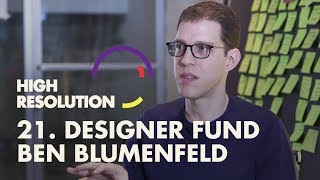
Ben Blumenrose, co-founder of Designer Fund, talks about his path from early design work through Facebook to launching the first VC firm focused on design-centric startups. He explains why design matters in tech and what drove him to build a fund that invests in founders who lead with design.
Series I'm thrilled to have you on.
Excited to be on.
So we're going to focus today on Designer Fund, which is a venture fund built around.
And the moment where design all of a sudden became a thing is I used to on the Mac, I used to modify software all the time. And as a 13 year old I'd go and res, edit and start modifying the way the software looked. And I thought that was the coolest thing. And then I used to be on BBS's and talking to folks and as a 13 year old there was an ad agency that reached out to me. They had no idea how old I was. They just saw that I was modding these games and they said, hey, we have this client they want to modify this game to. The client was Zima, if you remember that clear alcoholic beverage. So yeah, they're reaching out to a 13 year old, asking them to modify a game to be Zema centric. It was Asteroids and they wanted it to have like a six pack as the big asteroid. A single bottle.
Dear God. Dear God.
Bottle cap. Right. And all done in 3D. I used to do a lot of little like 3D experiments and they said we don't have much of a budget. We have five grand. We can pay five grand as a 13 year old in whatever it was 1990. 1990 or that was an. That was basically retirement money.
Yeah. That's $50,000 in today's dollars.
Yeah. With inflation today, it's 1.8 million. Right. So someone paying 1.8 million to do these graphics. And that was the moment for me where I was like, oh my God, this is like a thing. This is like a thing I can make money on. Computer art is a thing I can make money on. And I got obsessed with it, went to study design at UCLA when it had all the. I've had every kind of design role you can imagine. I'm freelanced as a designer. I've worked in house at design agencies. I've, you know, I've done it all really. So when I talk to designers, it's like whatever stage of their career, I'm like, I have been there, I have done what you're doing, so I can speak to it. But really the experience that opened my eyes to the power of design and scale is Facebook. So in the summer of 2006, I get a call from a and I was starting my own company at the time with a friend that actually became a very big company called Magento Commerce. So I was starting that with a friend of mine. And I got team and they were social network. And all I knew about this social network was that we had two interns. And every time I would turn my head, they would be on the site. I'm just like, hey, stop going on that site. Like, do your work. Right? And I was just so intrigued. I was like, so curious, like, what is the deal with this company? And so I went to visit Facebook when it was. When I first visited, it must have been about a hundred people, maybe three, four designers and whatever, 20, 25 engineers. And when I went up there, I said to myself, there is a. And I told them this. I said, There is a 0.0001% chance of me joining. It's so abysmally low because I lived in LA at the time. And I just said, there's no way I'm joining your company. It's so low. But I'm just kind of curious to meet you all. And I know people use this thing. So they said, oh, yeah, we'll take that. And so they flew me up and I just drank. It was a weekend where I didn't even realize it was an interview. And I flew back down to LA after that weekend. I just said, oh, okay. This is where everyone who's really good, like amazing engineers, people who want to change the world, like, this is. This is what, Silicon Valley. Like, I didn't really know anything about Silicon Valley, any of that stuff. So that was the thing that opened my eyes to all of a sudden, like, this idea of product design, design at scale, design, design, making, changing the world, like all the stuff that I had dreamed of. All of a sudden it was actually getting manifested here. And so that was the. The experience that really just like, you know, kind of changed my life trajectory. I got to meet amazing people, work alongside all these amazing people. And basically we started designer fund. And my plan was to stay there 15, 20 years. Like, I was like this. I remember in 2010, I sat there and I looked around the office with so much. Like, we were just. The company was doing well, the people were amazing. And I remember there was a day I just sat there and I looked around, I said, this is it. Like, I won't ever look for work again. Like, as long as I keep doing what I'm doing, I don't need to find, like, I'm done. And it was such a crazy feeling to feel like I'm done with this, like, rat race of finding jobs. I no longer need to look for new jobs, like, because I found the last job I will ever want. And it was amazing. It was the most content I felt. I have not felt that content with work since then. Like a designer funded so hard.
You had a peak moment, like a decade or more ago at this point.
In terms of just like feeling like this is it and there's nothing more I need. That was it. And then. And then basically a couple years later is when the cracks started to show up, which is just like so many people started reaching, you know, Facebook success created this giant magnifying glass from the people that work there, and people started reaching out for help on design. And it really opened my eyes to how absent design was in venture. These companies were getting started without. Without designers anywhere in sight. And like, oh, my God, this is a big problem because these are all the healthcare companies that are building the software in the hospital. It's like all the stuff that we use, designers are absent. So there's a whole city getting built and architects are nowhere to be found. And I just thought, am I going to be okay? You know, and that was 2011, 2012. And I just thought to myself, in 2022, which we're now here, I literally thought, in 10 years, if I look back on this moment, will I feel good about staying at Facebook for another 10 years, 10 years, knowing that this is what's happening outside these walls? And I just kind of sat with that for a few weeks and I said, no, like, I. I'm not going to feel good about this. And I need to do something about this broader ecosystem. I need to start thinking about, you know, what. What's happening outside the castle, if you will. And at first I didn't. I thought it would be a side project. I didn't think I would actually, like, do it full time. But then it's like all of a sudden, nights and weekends started being filled up with this thing. And, and that's the. That's one of the pieces of advice I always tell young designers is like. Or actually people, any, anywhere, like, what are you spending your nights and weekends on? And is there a way for you to make that your job? Because that's, you know, that's the stuff that you're really into, right? If you're spending your nights and, you know, Saturdays and Sundays on something. And so is there a way for that to be your job? And so at Facebook, I had never had anything that wasn't Facebook be my nights and weekends thing. And around 2011 is when all of a sudden, nights and weekends were designer fund time. And I thought to myself, what does this mean? Like, why, why am I not thinking about the next version of, you know, Facebook photo or like the next version of Facebook profile or what we could do? You know, why, like, why was I thinking about this? And I just realized, like, because if. If we didn't do this thing, if we didn't do designer fun, like, it didn't feel like there were any. There was anyone else that would do it. It kind of felt like that kind of thing. So that was why I left the. The sweet, lovely, cushiony job there.
The blue walls or. No, these are the spray painted walls. The spray painted barreled walls.
And by the way, I remember when Enrique and I were starting designer fund and one of our friends was letting us squat in the back of their office for free, surrounded by their likes in storage container. So it's like there's paper towel storage and toilet paper and cereal and whatever. And that's where I watch like the Facebook IPO on streaming. Yeah. So it's like, you know, you're looking around, you're like, okay.
More from Ben
Early Facebook Employee: How Getting Criticized by Zuckerberg Shaped His Career
Ben Blumenrose - How designers can be successful startup founders (Dive Club Ep. 71)
#21: Designer Fund's Ben Blumenfeld on how designers can become successful founders