EP004 - Football, Mindset, and Red Cards - Ben Nunn
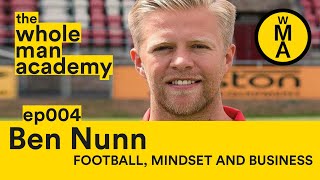
This is a YouTube video titled "EP004 - Football, Mindset, and Red Cards - Ben Nunn" created on April 21, 2020. It features a conversational podcast episode hosted by Anthony Astbury with guest Ben Nunn and Samantha. The discussion covers topics including managing multiple businesses during uncertain times, the importance of mental health and personal grooming for men, Ben's professional football career, fitness routines, personal development, and the growth of their men's grooming brand Benny's. The conversation is informal and motivational, focusing on mindset, planning, and resilience.
So, Ben, welcome to episode four of the whole Man Academy podcast. I had to think about what number it was because we've done so many. And how are you today?
Yeah, very well considering. Yeah, surreal times. But just trying to. With everything I'm sure we'll go through in detail, but just trying to plan as best we can for everything, everything we've got going on, businesses and just our personal life. Just trying to plan for the next three months and maybe longer for us as best we can.
And I guess for all of us it's the unknown. We've spoken in the previous podcast about uncertainty. It's not like we're saying in three months or whatever this is going to be over. So I guess for all of us with different businesses, what have you're trying to, you know, keep various plates spinning at the moment.
Yeah. So with the property business, we've just gone through of our portfolio of stuff that we've got currently tenanted, we've gone through the numbers, the ins and outs of absolutely everything so that we know what our breakeven figure is, how much we need to earn per month to cover everything. If no one pays our rent, what do we do? We've emailed mortgage companies, we've emailed the letting agents to be proactive and say, can you let us know as soon as any tenants contact you? And that sort of process of thinking the worst of everything so that, okay, if no one pays, if we have got to pay all the mortgages, if we have got to pay all the bills, we have, tenants do move out, how much is that figure? What do we need to do?
How long can we last for?
So that sort of thinking process is what we're doing with everything with property and with Benny's and with our personal life.
Yeah. I guess what that shows, at least for all of us, we know that, you know, this is probably the most important time of anyone's life to stay calm.
Yeah.
Because when you have got all these different things to sort out, I mean, in a way, for, let's say when I was an employee, in a way, it's easy for you because you either get sent home and you're being paid X percentage of a salary and in theory you haven't got anything else on that side to worry about. But if you've got your own business and, or you're self employed and you employ people and you've got online stuff, it's a new world altogether.
Yeah, definitely. I mean, I've got a lot of friends that are self employed that They've been hit already. Chaps that work in barbers, they're shut. People that own gyms had to shut the gyms some. We're lucky in respects that we've got different. We've got Benny's, we've got property, I've got football, and we've got different revenues coming in or potentially coming in. But for some people that have literally just got the one income stream, self employed, they're literally stopped. So for us, we're lucky in respect that we've got multiple, I say multiple avenues. But there is a chance that Benny's could not sell anything, we could not get any rent and football stops and then we are at square one. So it's now, like you say, such a crucial time to stay calm. And that's what we're trying to do as best we can is say stay positive, but plan for the worst. So we are planning. I know I said three months, but we're planning for the foreseeable that, okay, how long can we last? Whether that's three months, six months, 12 months. But also not, not just as a time now for first things first is protect ourselves. How can we protect ourselves as best we can? But also, like what you guys doing with the podcast is right. How can we, one, help people. Two, if no one's buying anything, how can we create content and stuff that people are gonna. Stuff that might help, stuff that my people might enjoy, Stuff that if you can get an engagement and following behind you in this time and try and do that, that when things do go best, come for the better, that you have increased your following at the very least. Yes. So that, that's, that's sort of our mindset at the moment.
It's a lot to consider. Well, let's, let's get started with the first part of it, which was the, the reason we actually became in contact was, I mean, through the whole Man Academy, through one of your friends and one of my friends. So for those that don't know, you've supported the whole Man Academy, firstly by coming on to some of the events and you've always given the guys who speak at our, some of the Benny's products, which we really appreciate. So why, for you, why did you get involved with the whole Man Academy? What was it about it that kind of, you know, spoke to you?
So the biggest thing for us, obviously was it sort of happened at the same time. So I had a friend of mine that committed suicide through mental health and I'd met him two weeks before he committed suicide and you wouldn't have known. You knew he had some problems, but nothing. You would never have known that he would have gone to the lengths he did. And at that time it was just, I'd heard about you guys, let's say through a mutual friend and it just sort of sat right that we need, like with our Benny's products we can help people, men mainly for either having a shave, doing their hair in some way. Our products can help people day to day. So the message that now we're trying to get across and why I'm so passionate about working with you guys is that that feeling of when you get your hair cut, no matter what you say, unless they've done a terrible job, unless you come out of a, usually you come out of a barbers a little bit taller than when you walked in.
Really sharp.
Yeah, you do, you just feel a little bit better about yourself. Your hair's done, you had a shave, beard, trim, whatever it was. You just, no matter what happens, you do generally feel a bit better about yourself. So what we've tried to do is over the past year or so is try and get that message across that even just a simple shave at the start of every day or doing your hair can make you leave the house. Just that little bit more confident about yourself, that little bit more you feel like you can go out and achieve something or do something, or you'll say hello to someone when you normally wouldn't have done because you feel ashamed about your appearance or you just don't feel right that our products can potentially have that, even if it takes a month or it takes six months, or it takes a hundred shaves or whatever, for some brief moment at some time, our products can help someone. Then that's the mess you want to get across. And with you guys have the same sort of moral compass of what you're trying to do and how you're trying to help people just fit so well with how we are as a brand and how we feel about men's health, men's mental health and just day to day life of being a man and the stresses and struggles that you go through, it just resonates so well with us, which is I say why I've always wanted to do things with you guys and we'll continue to do so for as long as we can.
Well, that touches on especially that, you know, what seems simple about again maybe doing your hair being, you know, having either trimming your beard or shaving before you go out. You know, some of that speaks back to when we had David Gandhi at our event and we spoke through, you know, strength through style and aligned with. We always say about a morning routine, you know how important it is for it doesn't matter if you're a footballer, a businessman, you know, whatever job you're doing, if you know, if you're working in the city that know we're not saying it's the, it's the answer to all your problems is looking good. But what we're saying is for the majority of guys, we all know that either putting a suit on or you know, taking care of your appearance hopefully makes you feel, you know, makes you feel better. And we've used the word sharp a bit as you have your haircut and you come out and you know, you feel a bit, kind of feel a bit better when you leave. And how if we can touch on morning routine, I mean we'll come on to the football in a minute but do you think for yourself that has helped you and do you have a particular morning routine?
Yep. So we have a morning and weekly routine. So for example, Sunday evening we plan the week, try and plan it almost to the minute of what you're doing, what time you get up, what time you have breakfast, you do a workout, what time you read, how long you read for, you do your emails at a certain time. So there's, I can't remember the name, there's a navy general or a navy sergeant that was said about the first thing you should do when you get up is make your bed because it's, no one can take that away from you. You achieve something in your day, even if it's a simple task of just making your bed, that, that is something to get you off on a good foot. So if you can achieve little wins in the morning before you start in that first hour that you, you read for half hour, you write your goals, you set out your tasks for the day, you have your breakfast, you do some exercise. In that first hour and a half that you're up, you could achieve seven or eight things that make no difference over the course of a day or a week, over the course of a month, six months and a year. If you read every day, you do exercise, Even if it's 10 press ups a day, you do that every day consecutively. You just, it gets into a routine, but it might get a bit boring and mundane. But if you consecutively do that, you consecutively read inspirational books, books that help you with your mental health, books that help you with your business, it will help you no End and that's something that has been a big help for us is having a structure to your week, your day. Otherwise you just float through the day and you feel like you haven't accomplished anything, you haven't done anything. And that's when you start to think, I didn't do anything today. And you straight away go, what did I do today? Whereas if you have that list like we do on a Sunday of all your businesses, so what do I need to do for Benny's, what do I.
Need to do for property?
What have I got on football wise, what have I got on personal wise? All my meetings, I plan everything out so that one, it's not chaos and two, that you actually write, okay, I need to do that, I need to prepare for that. And you're constantly focused and achieving things, even if it's little things like print off documents to sign, like something that simple. But I've ticked it off, I've done it. And that's just a little thing in your brain will say, I've achieved something and done something.
So how'd you keep track of it, Ben? Kind of how do you, let's say on a Sunday night we're sitting down, do you write it out or do you do it on email or on an app?
I use Google Calendar for my diary. I've got a handwritten diary for notes and when I'm going to meetings and out day to day and then on pages I break I've got to do list that is broken down into businesses and then it's subsided into. So for example, Benny's will be to do list for UK to do list for EU for property it will be to do list for each property company, each site and then that will be broken down and I put everything unbold and then stuff that's urgent I put in bold and so that I know, right. And then I, I'll work for, on that Sunday I work through, right, what are the top things of each individual section that I need that need to get done or that are going to earn me money or not lose me money and then, right, okay. They're the first things that I do on a Monday. Get through them and then sort of filter out throughout the rest of the week. Try and stick to property in the morning, Benny's in the afternoon. But that's something that I need to improve on is not letting stuff distract. Especially at the moment where a lot of things are important. You need to try and even be more strict that like, okay, I know dealing with an import From Benny's is important or dealing with an order is important. But I have to get these mortgages sorted. So try and so it's trying to.
Yeah, you know, if people aren't even sure, you know. Also you've had to maintain, you know, elite physical health to be able to play football. So how have you are we're going to come on to the actual playing football? But for you, how do you find the time to put in the fitness side as well? Is it that you go out at the moment? No one's going to the gym. But let's pretend that the world is back to two weeks ago when it was mildly normal. How did you manage to fit in the fitness as well as it sounds like you've got a shitload of stuff that you're trying to deal with as well.
Yeah. So up till last year I was playing full time, which was Monday, Tuesday, Thursday, Friday, Saturday. With a lot of times in the National League it was games. So we'd have Tranmere away, Barrow away on a Tuesday night and you'd be leaving all day. And so it's just that was really hard and that's why I took the drop down to part time football is because it was just taking up so much time and I physically did not have the time to do everything. But again that comes back to the planning of Google. I'll put in what I know what time I leave for training on a Tuesday, Thursday, I know what game I've got. If I've got an away game then I know I need to leave earlier.
So I can only do a certain.
Amount Saturday morning and it's just all planning what we do. So I work training Tuesday, Thursday evenings. Sometimes the games are Tuesday evenings, but throughout the day and this is something again I can be better on. But I try and do, Even if it's 25 push ups in the morning or 25 sit ups or something, I'm doing a thing at the moment. I've done it every day for the last probably 10, 12 days. Is the bring Sally up, bring Sally down, push up challenge.
Yeah. How you finding it?
So I've hit a barrier for the last three days. I got to one minute 30 and I can't pass it. Whether it's just a mental block or I don't know, but even that it's not a full gym routine, but it's something we've done, me and my partner Samantha, we've done a couple of runs early morning, just 10 minute runs when no one's about, just to get out the house and do something. So there is time and there's so much that I've taken screenshots this morning of like what we're doing, creating more social content. There's so many, where so many gyms have closed. A lot of forward thinking people are creating so much gym content of home workout programs natural where you're lifting your own body weight like workouts and things like that. There's so much stuff out there that you can do. Like we've got a two steps lead into our kitchen. Like that in itself. I can do an upper body, an upper chest and a lower chest just by doing that.
No excuse is there for not, I mean the big thing at the moment in the last day or two, I mean recording this on, on Monday when we assume the country is or should about to be going to lockdown and a lot of people saying oh I have to get outside because I have to do exercise. And you're like that's not good enough excuse to be going out at the moment because there's about 500 billion videos online if you're doing any fitness.
Yeah.
So we've got a couple of friends that are PTs and they've created HIIT programs for indoor so you can have a meter square space that is all you need and you can do a full on our HIIT program and get more of an exercise than you would by running outside for three miles.
Yeah, it's a bit like saying let you know when you finish the hours HIIT training and it's not been enough for you, then I'll let you go outside and you know, then I'll give you permission to go out for a run. So if we're going into football as it were. When did you start playing football professionally?
So I've played football since I was 4, 5 years old. I've been playing for professional clubs since I was seven, eight years old, training two, three times a week, then went full time at 16 and I was full time till I was about 20. I had a couple of years where I was part time and then we went back into full time for the last four years and then yeah, dropped down at the end of last season.
Now how was it for you? Because I know there's, there's such a huge difference between the, you know, if you're, if you're a top Premier League club and you're earning a huge, you know, hundreds and hundreds of thousands a week to obviously dropping down one league or two leagues. So were you always confident that you could Continue to play as a professional footballer or have any times where you thought, I'm not sure about this.
Well, there's. Throughout my 90% of my career, it was all I wanted to do was just play football, There was nothing else. I was so adamant that that is what I wanted to do. And I didn't really understand then. Like I didn't read, I didn't listen to audiobooks, I didn't do anything, I didn't set myself goals. There was no structure, just I want to be a footballer and that is it. I'm not going to do anything. Yeah, I practiced as much as I could, but there was no. If I knew now what I knew as far as like how you structure a business, how you plan, how can I improve, how can I, what am I not good at? What am I good at? If I would had that knowledge in football, I would have done things different. It might have gone on further, I don't know.
But I think it would just be that you might have started a business earlier.
Yeah, that's the thing is I started the business when I was 25, 26, and straight away that changed my thought process sort of straight away is that I can earn. Football doesn't last forever. I'm gonna get to a stage. And I was speaking to people at the time that were coming out of the game at sort of 33, 34, 35, had no career, had no qualifications, had no experience, had no other form of income and was saying how hard it is and you need to like prepare yourself. And so when we started the businesses, it started off as I'll be able to do both, it's fine. I still love football and it just over time has gradually swung the other way where you realize that especially at the level that I was at, it'd be different. Maybe if you're at a premiership level and you know that you've got a free four year contract or you've got money saved from the amount of money you've earned, but a lower league level, it's very much contract to contract and they only usually offer one year, two year deals and that in itself is not secure enough for like to live to have a family. And it's like long term lack of certainty. Yeah, and that was getting to that. So you get to February, March, April, and if your contract was up, you could have a mortgage and all your bills going out and you could find out in two weeks time that actually they're not offering you new deal, you haven't got a club and you're like, well, how am I going to pay for everything? And it was like that for 95% of the football population that it is almost year to year and you do need. I felt that I started, I think I started early compared to most that I didn't want to leave that to chance. Each year and especially now in situations like this, I think if I didn't have what I have. There's a lot of people out there that are solely dependent upon their football income that you really don't know. Even at the best of times. There's a lot of clubs that go into administration, have money problems. It's not usually renowned, other than the Premiership and elite, that clubs are run effectively enough to.
I guess we've also seen that, you know, it's no guarantee of financial security just because you're a Premier League player. I know, I've read about it where some players. It just means that you've got probably a bigger house, a faster car, more expensive holidays. And then suddenly when it comes to it all ends and you're maybe in your 30s or you're young and you get injured. It is that thing of what else do you go and do to earn anything like that kind of money also doing something you love?
Yeah. The short answer is there isn't much that you can go to that earns you that sort of money, especially in a transition of such a short period of time to get yourself back up to that level. And that's unfortunately, I don't know the full. How much the FA are involved in the younger generation of coming through and how much they actually help people. But the knowledge that I know now and that some people do, if I could share that with the football world, some people might not choose to use it, some people might already know it. But if you. If people know that, right, okay, it's not going to last forever. You might want to have a five million pound house and £30,000 worth a month, going out on cars, holidays and everything else. But actually if you just set aside, even from when you start, you set aside 10% of that or a percentage of that into property or into shares or into a business or something, that you don't have to be your fault, your sole focus, but just chip away and save and put away to know that, okay, you live a certain lifestyle, great, but you want to know that come 34, 35 or if you get injured at any time or the club go into administration or whatever reason, you at least have something there to fall back on. That's Gonna at least help you, I guess.
So what worked like on them? It's funny, we've got, we, we put on Instagram also that we were speaking to you today and asked if people wanted to ask questions. So I've got a couple of good questions for you as well. But what was it like on. On match day to. You know, we spoke to some people who would, you know, obviously naturally maybe feel nerves. But were you always pretty relaxed on a match day and did it depend on if it was home or away?
Sometimes. So a lot of the time you have the belly like pre game nerves. You can be relaxed but you still get that little nervous feeling of like you're about to kick off and you're excited and then you have some games. Especially when you play like at the bigger grounds and you playing sort of for me like a big crowd, like five, six, seven, 8,000 people was like a good crowd. Like there's no better feeling than playing in front. Like you just, your adrenaline just takes over and it's such a good feeling. But as far you sort of again, you put into a bit of a pattern, a routine of what you're doing. You eat a certain pasta the night before, have a certain scrambled egg in the morning. You just have your routine of what you do.
Would the club tell you what you should or shouldn't eat or would they guide you or kind of lead you to make your own decision?
Throughout most of my career you get given like diet plans of what you. Not exactly what you should eat, but just a rule of thumb of what you should eat. And you sort of know where it gets embedded into you. From quite a young age we, where I played when I was younger, they were very good on what you eat, you sleep, how you should prepare. So that got embedded at quite a young age that.
Right.
You don't go out obviously night before or 48 hours before a game. What type of foods? Lots of carbs, pastas, which I'm sure dietary things have changed over the last couple of years, but that's been my routine. That's what I have.
And.
Yeah, that worked for me for having. And when you have away games a lot of times you stay in hotels the night before and like you get food put on for you. So you have. Everyone will know, like footballer will know you have like dry chicken, dry pasta, broccoli. What else do you have? Dry chicken, pasta, baked beans, scrambled egg. And it's all in one meal. Like you never normally have that meal one. So yeah, so the club put on certain Things and they give you like say, dietary requirements, fitness requirements you can.
Do from home, and bits and pieces.
So they generally do look after you in that respect.
Well, let's ask you one of the questions which was. One of them was actually kind of, as you said, about what was your pre game meal, which I guess you've kind of answered. But also it was one of the questions was, what's the. Or who's the best player you've ever played against?
Best player.
So for me, I play right back. And what's his name? Can't think of his name. There was a. Matt Jarvis was a left winger for West Ham, played him in a pre season friendly and I've never ever had such a hard afternoon in all my life. I remember the centre half next to me said, right, he's left footed, show him inside. So I showed him inside and he crossed it with his right like, unbelievable cross. And he was like, oh, maybe he's right footed, show him down the line.
So I showed him that wrong. He beat me down the line, crossed it.
I was like, he was just so sharp. Over 5, 10 yards, he was just so sharp.
So what would you. Now, how many, how many years ago was that?
Seven, eight years ago?
So if you were speaking to a young footballer now, who was going to face that situation, what would. Knowing what you know now, what advice would there be? Would it just be to drop off and try? And what would you say?
So I was, I was never like the quickest. I had a little bit of pace, but never usually the quickest. So I remember we played Arsenal in a friendly and we had who's our Rosicki Mark? And I was like, right, I'm just gonna have to smash him first. And I'd done it and it just. Everyone kicked off and to be fair, he was so good that it didn't make a difference anyway.
He was so fast.
But.
But yeah, anyone in that situation, you have to element of respect that they're good, they're quick, their movement is incredible and just work as hard as you can, do as best you can and try and have that structure of like, right, my job is this. I'm meant to show him down the line, do what you can and then go again. Sometimes when they're that good, there is literally nothing you can do.
What do you do?
Yeah, I mean, imagine what it's like for people when they were playing Gareth Bale or something like that.
That's what I think in that situation. Like for me playing against someone like that, there was Nothing I could do. He was that sharp. And then you see people that make them look how I looked against him, but like that level. So you think, how good must they be?
Yeah, yeah. Different class altogether. Well, one of the questions was, and I, I think I know the answer to this because I had to look through your Instagram. What's the shortest match you've ever played?
So I went traveling one season. We went. I had about three months off.
Three or four months off.
Me and my partner went traveling and it was during the season and I was at Bournemouth at the time and they were so good. They said, look, play until you go. Obviously don't get paid when you go, but when you get back, as long as you're fit and whatever, like, we'll get back in the squad and you get back in the team anyway. So got back, first game back, they said, half time, none of you coming on. So I was like, right, okay, brilliant. I was so ready to go to get back playing. And within four minutes I got sent off. Last man tackle. So for three months, while we was traveling of, oh, I can't wait to.
Get back to football.
Was over in about five minutes.
With that situation.
Do you.
Oh, no. There's a couple of questions here, but are you someone that has had many red cards before?
I've had one or two and that is literally one or two. But they've never been for descent or like real like nasty challenges. It's been for like a last man, second yellow.
Do you think as you go to make the tackle, do you know, in that split second, do you make the tackle and then think about the red card or do you think it flashes through your mind as you're doing it? You know, I'm taking one for the team.
There's that occasion I was like, he was through on goal and I was the last man. I was like, either bring him down outside the box and I'll get sent off or he goes through and scores. And at the time it was probably the wrong thing to do because then we had to play 40 minutes with 10 men. But there's sometimes when you go into a challenge and you're like in your head, you're like, you're so committed to winning the challenge. I'm probably gonna be late in this. But you're already committed and you're like, yeah, I'm going for it.
And.
Alright, so next one was the best ground you've ever played at.
So this is not necessarily like the best, as in what it looks like, but we had Tranmere away and that holds sort of 20,000. But the time they were getting promoted at the time and they were flying and he was playing and you could not hit, you couldn't speak. So the center half, I was telling him to squeeze up and he couldn't hear me for what I was saying. And yeah, it's just. I say it's nothing special, but for me it was like to play in that sort of atmosphere where you physically cannot hear someone 15 yards away from you. Yeah, yeah, it was good. Real good.
Next one is now. I appreciate that the obvious answer for most people would say scoring a goal here, but as you're a defender and I play as a defender for many years, so I know that my answer to this might have been different to what most people expect, but what's your best feeling as a footballer? On the pitch?
So obviously defending, when you, when you, when you block an online like shot.
On the line or something like that.
But from a non selfish point of view, the best feeling is if you're losing or drawing and you've got a couple of minutes to go and you get a late equalizer or a late winner. That feeling of we've done it, like we've nicked it or that feeling because your whole team are feeling that feeling of we've just nicked it or we've come back or we've equalized or so. Yeah, that is good. The feeling of scoring a goal as well. For someone that doesn't score many as.
A defender, it's, you know, unless you're van Dijk at the moment, you're still not gonna get double figures a season. So.
Not with my shooting ability.
So does that mean. Where were you when Man United beat Bayern Munich and came back to win the Champions League?
I was, I was living with my mum and dad back at home. Yeah.
And that was like.
You can't make.
That sort of stuff that just doesn't happen ever. Yeah, that's surreal. It's a special funny can happen for England or Tottenham.
Yeah, good luck with that. Well, moving on from football onto personal development, I know you're to study. Always interested in business and success and helping people and doing things differently. So talk to me about yourself with your kind of journey into personal development. I know on your Instagram you've got pictures of books written by Gary Vaynerchuk, Robert Kiyosaki, people like that. So tell us a bit about how personal development works for you.
So it all started with we read a book, Robert Kiyosaki, which their Poor dad. And that as soon as we read that that just was like a light bulb moment. Changed our mindset completely. And from then on We've got nearly 100 books on business owners, businesses self help improvement mindset. And so I read a lot. I went through a phase, a couple of years of loads of audios in the car and now I sort of.
There's still times when you do that.
But there's times when I figured out where I read in most mornings or sometimes in the evenings as well. Figure out what works for you and sometimes like even just like listening to music that you like that is just as good as. Alright, it's not as informative but from a personal mindset point of view there's times when I think I just want to escape like business and what I should be doing, what I shouldn't be doing and actually just listen to a bit of music that I really like and that takes you back to a place or takes you forward to a place where you think I'm going to listen to that when I'm by the pool or that walk or whatever it.
Sounds like that's bit like we try and help guys understand that sometimes taking time to we call it settling your mind can really help because I guess same for yourself. You've got multiple businesses and probably various email addresses and things to keep kind of juggling at the same time. We always say it's a bit like a snow globe. You know a lot of people at the moment, if you shake the snow globe there's just so much going on where it's actually saying what works for you, how can you stop and let the snow settle so it's clear for you. So for you if you had to pick one thing, you were having one of those days where you're like there's stuff happening and this is going wrong and what have you. If you had a half hour, where would you go with helping settle your mind?
So I've never meditated per se like fully I've done, I've tried it and I actually think it's great, I should do it more often. But the big switch for me I got it just the Robin Sharma that one. So might not be everyone's cup of tea but for me it allowed me to think a lot more actually about my mind and how much you can have control of your mind. Not just control over like I think I've got good structure to my businesses and how we operate and how we do our to do lists and everything like that. But actually structuring your mind and training your mind to switch off and be calm. And like if you used to say to anyone right for a minute I want you to sit in silence and not think of anything, I guarantee 98% of people wouldn't be able to do it. Their mind would be distracted from something. Something would come in, a holiday, a business, a thought or something. And so in that it sort of teaches you how you different techniques. Some are a bit out there, but some have like actually.
You just shut.
Off and just think of one thing. So like in the book it's like, is it looking at a rose? But I do it like either a candle or you have just a clear thought of nothing. And you constantly, you think a thought comes in and then you try and get clear again and you keep trying to work on it and work on it and over time you'll practice in there. It says about like if you want.
To be.
A bodybuilder, you train your body.
And if you want to be an.
Accountant, you learn accountancy, you read books, you train accountancy. If you want to train your mind, no one you don't know what to do. So in there, there's some real good things in there about training your mind to actually have control of when you get annoyed, when you're happy, when you're sad, like in a split second you can make yourself feel good or bad about whatever situation is. And that's something that has been a big help for us. And for me, when there's times when I think stuff's going wrong or whatever, I'm letting my mind tell me that I should be feeling down about this situation. Whereas if I, if you was to flip the situation, everything's going wrong. And then you was walking down the street and you bumped into someone that the last time you see him, you had the best time with them. Without you even realizing you would straight away you'd sort of flip into like.
A how you doing? Alright?
Like you're telling yourself and then they said a joke or done something and you forget that you was annoyed about whatever you was annoyed about because your brain telling you to be annoyed or not be annoyed.
I guess that's bit like when we say you have. Your state has changed. That's a big thing for personal development from probably one of the greatest guys, Tony Robbins, who work on, you know, a state change for us all. It'd be about, you know, are you, how are you, how are you standing? Or how are you sitting, how are you breathing, etc. Etc. Yeah, I Guess you bump into someone and it changes your state and your physiology.
Yeah, that's just like one example of like say of bumping into someone. But if you're at home and you look at a picture or you listen to a certain song or something can switch you out of that like almost spiraling mindset. If your day is going that way, if you look at, spend five minutes you're like, ah, look at what holiday you went on or what holiday you're gonna go on or I don't know, whatever it is that makes you happy or your, your things in life that you're putting.
I guess it's what you're focusing on as you say. I know we've, you know, spoke a bit to guys through the whole man academy that, you know, again, talking about gratitude is, you know, saying, right, well give us, give us a couple of things you're grateful for. You know, if you're focusing on the stuff that's not going to right in your life, you know, could you flip it around and focus on what is going right, you know, what has gone right? Which probably could apply to, as we said, sportsman, businessmen, everything. Well, let's talk about business now because obviously with Benny's, you know, for the guys that don't know, I mean you create, what would you say Benny's high quality luxury products. And it's. And it's for shaving beards, hair.
Yeah. So we started with a shaving brush and real off the cuff. Wanted to sell something online, didn't know.
What was going to do.
Somehow don't even come across a shaving brush. Was that right? Yep. We'll brand it Benny's a London. And then, yeah, it literally went from there. They started selling and we've added more products and it's sort of grown, growing from there. So yeah, so that's. We're now going into more cosmetic side so body washes, aftershaves, that sort of thing, shaving. But now hair products, creams, balms, like I say. Yeah, going into more aftershaves and body washes, moisturizers.
And how did you start with. Because obviously the game has changed now where you're not necessarily looking for a high street stockist because. Because the world's gone online. So for yourself, where did you start with the decision of where to stock your Benny's products?
So we've done a.
Originally we've done a course on how to sell on Amazon which taught you how to spot opportunities, find products and so we've done that and one of the things that came up was a shaving brush. And so we start. Our whole business started on Amazon and it grew from there. And we was like, we could sell individual products or we could sell. Continue this and actually create a brand. And we felt that was more sustainable in growing a brand rather than just niche individual products. And so that's what we've done. And from there we obviously set up our website and the website's grown and we've now established ourselves as sort of high up in the market in that industry, as sort of being one of the competitors. Obviously not quite Harry's level, something like that yet, but hopefully we'll get to get to that stage.
And for yourself, where do you want Benny's to go? Is it just a continuation of the, let's call it the men's cosmetics range.
Yep.
So.
Ideally we want the brand to. I don't know if I want it to get to a Harrods level where it's in every single store, like boots, sand, retest. I don't want it to get to that. I want it to be a bit of a premium, a bit of a luxury, but still, I know it's the whole cliche of luxury but affordable, but that's what I want it to be, is affordable for an everyday man. But it looks like it should be worth a hell of a lot more than what it is. And the thing we spent a long time on which while products taken quite a while to come out in regards to their hair products and their creams and balms, is we spent so much time in testing and getting the products to such a good quality because we want people to go, oh, that's cheap, I'll try that. And then try to go, actually go, oh my God, how good is that? Like that initial reaction of they didn't expect it to be that good for that cheap. And so we want to continue growing it. We want it to be somewhere where.
Men can go and they can almost.
Have all their bases covered for treatment and products. In that sense, we won't go into clothing or anything like that, but we may branch into ties or cufflinks or knob hooks or.
I see you do a wash bag as well. Yeah, so do you. I mean, I guess that's where you move from. You know, you can buy the wash bag on its own. So therefore it. That has become a product that's not a beauty product as such, but it's kind of part of it. So as you say that, is that somewhere where you think because your branding and everything is cool, as well, isn't it? You know, a lot of it is black and white and the Instagram all flows nicely. Is that where you see kind of the extra parts of the company coming from?
Yeah. So we want to get the range to a certain level, which how it is at the moment, I'm happy with where it is. We obviously want to keep adding and we've got products in production that will be coming soon, that will, I feel, give a real broad range for our products that people can go on. And we're not just a shaving brand. We've got hair products, aftershaves, we've got body washes. But the next thing for us is something that we've not done at all, which we're. Our whole focus has been for this year. Obviously had no idea that this was going to happen under the current circumstances. But we've never done any wholesale, so we've never, we've never wholesaled to barbers, we've never wholesaled to companies, we've not gone into any shops, we've not gone into any marketplaces purely for the fact that obviously going through what my schedule is like with property, with football, we've just not had the time and we've literally serviced the demand. That is all we've had time to do. Whereas now going from full time to part time football, it's allowed me to spend a lot more time and focus on the business rather than being in it, which is then we've looked at like, okay, Amazon's doing well, the website's doing well, what are we not doing? And for a lot of people, a lot of businesses, wholesale is where the large majority of their production and revenue is. And that's something that we've not done anything. So for us it's actually quite exciting that we got to where we got to without any form of wholesale. But there's a whole massive market there that we've not touched and we've managed to build a reputation, not just with customers but within the industry of who we are and what we do without having any wholesale. So that's a big step for us.
We're talking of, for guys that are listening, that are interested in how do you even start with selling a product on Amazon. So I don't expect you to have to take me through the whole process, but what advice would you give to a guy who wanted to start selling something on Amazon? Where would he even start?
So there are, there are courses, I'm not specifically not going to recommend any.
Purely because we done our course Five.
Six years ago and I've got no idea what they're doing now, whether they still exist, whether the price increased, they've dropped or whatever. But there are courses out there to teach you how to sell on Amazon. But it's like anything when you're on Amazon, it's looking at products. This whole supply demand, is there any product? So just the basic rule of thumb is if you go onto a listing, say for example, lunchboxes, type in lunchboxes in Amazon. If it comes up that they're say top five or six, you look at have they got good images, have they got good titles? So if it says lunchbox and that's it. Whereas if you put one that says lunchbox, family size pack for your everyday lunch treatment, sandwiches and like, that's good because it's like that's, yeah, that's a competitive retailer. So you then need to look right.
So have they got good images, have.
They got good titles, have they got good reviews?
So if you find that your top.
Five products in your market that you're potentially looking to get into, you look at their price, their reviews, their title and the images, and if all five of the top ones in that bracket are competitive, then it's going to be a hard market to get into. Whereas if you type in lunchboxes and the top one's got three reviews and the second one's got bad images and the third one's got poor title, then you know that potentially there's a niche, a little window of opportunity there that you can get in, get a couple of good reviews up, get a good title, good images, and you potentially can make the most of that. But there's different tools that you can.
Use to search keyword demand are people.
Searching for that product. There's loads of different things to consider, but the basic one is checking one, your competitors market and two, is there a demand for what you're potentially selling?
We're back on without any battery problems. So just wrapping up on the football side of it for you. Where are you with it now?
So currently we've been told obviously we're not playing at the moment. My contract's up at the end of the season, so I don't foresee us going back because of what's obviously what's going on. I don't know how that will end or how it will happen, but I don't foresee us going back. What will happen next year for me, I really don't know. A lot of it will depend on what happens with the Business, I may need to go back. Football may not be on. I really don't know. I really don't know. I still enjoy it. It's still like a release. It's still time for me to get out because I work for myself, the property business, myself. Bennings is herself. It's a chance for me to actually interact with the outside world and have that bit of a release. So I don't know. In all honesty, I'm fit enough and I want to do it, but it's just whether it depends what happens with the economy and business.
The unknown moment. Well, as a last thing. Well, what we want to do is get you back on at some point to talk purely about property development, because I realized that a couple of people that had more questions which. Which we could probably fill another hour of talking about that because it's a hot thing at the moment and it will be very soon, in a few months, hopefully, when things calm down. Everybody at the moment is kind of maybe watching and waiting for the property market to change, but just going back to football. One last thing. If you had to give some advice to a young footballer, like a teenager who's looking to get into being a professional footballer, having gone through a lot of it yourself, what advice would you give them? From.
The mental side of the game, which a lot of it is, is take the ups with the downs. There's so many ups and downs and football changes so quickly. You can be the worst thing in the world. You can score an own goal on a Saturday and be the worst thing in the world. The fans hate you and you get stick online and like managers annoyed and you could. It could all go wrong. You play on Tuesday and you score the winner and you are the best things. Everyone's celebrating and it literally changes that fast. For me, main thing is just try and stay as neutral as possible. Obviously, enjoy the highs, but don't get too down with the lows and set yourself for me, like the biggest thing with business, which is wish I wish.
I would have put into place with.
Football, is setting goals of where you want to get to what you want to do. How do I get to that? If I want to be in League one, what do I need to do.
To get me to League one?
What ability do I need to have? How fit do I need to be? How strong do I need to be?
How many goals do I need to score?
Work that out of what you need to get there and then give everything you can to get in there. Football, such a short career, but it is an unbelievable career and for anyone that's got the opportunity and has got the ability to be in and around the full time game is give everything you've got at it because it's such so short lived and it is, you can't, you can never get back and never get emulate that feeling of scoring a goal, scoring a winner, playing in front of big crowds, that whole build up the game, you just, there's nothing else like, but as far as I.
Know there's nothing else like it that.
Can give you that.
As you were saying, that made me think that as a, let's say as a young footballer you need to understand you're actually, you need to think of yourself as a small business.
Yeah.
Because for you, you know, you, you might belong to one team or another or have time out but, but actually developing yourself and your skills is in theory a 15 year career. But you look at it as you say, you're as good a commodity for a football club to have as anybody else. So for yourself with a football, when you finish that, do you think you'll continue to play football even if it's not professional?
I would imagine very rarely. I would play occasionally. Where I've done it for. The thing now is where business has obviously taken up a lot of time, but football's been such a commitment for the last 20 years of my life.
25 years of my life.
I know it sounds shit, but missing proms, school discos, never going out weekends, missing holidays, missing weddings, christenings, birthdays miss so much. And I'm not saying I would change it because it was like football was amazing.
I've met so many people through football.
And it's made who I am, but the sacrifices you make along the way when you're 21, 22 and all your friends are going out for the weekend or your family have got a wedding that you're meant to be at and you can't get there till 9 o' clock because that's when the bus gets.
Back from a game and you miss the ceremony.
And I'm getting to a stage in my life where that stuff's becoming more important than a game on a Saturday. And I'm not saying that's everyone's process, but where I've gradually gone from being full time and the business has grown and I feel like I've had a. I'm happy and content with my career and what I've done. It wasn't David Beckham's career, but for me I got paid to play football.
For the majority of my life, which, albeit not in a championship level.
If you'd have said that to me at a young age, you will be a professional footballer and you'll get paid to play football as a job, then I'd have done everything to do that. So I'm content with what I've done, but I'm now at a stage in my life where business, family, social events are more important. And I'm not saying going down the pub, but I'm like, weddings and things like that are more important than commitment. Yeah. Yeah, good.
It's a tough one, talking to new chapters, say, with the business side of it, perhaps at some point, say, we'll get you back on to talk about the property development side of it, which. Which for a lot of guys, you know, maybe they're looking to allocate funds to a different. Or, you know, have a. Have a proper portfolio of different kind of options. So maybe that's something we'll have a. Have a chat about. But I know you're busy, so we will. We will let you go. But thank you very much for chatting to us.
Thank you.
And when the events start up again, hopefully we'll see at one of our dinners or events.
Yeah, brilliant, mate.
Thank you very much.
All right, Ben? All right. I'll speak to you soon.
Good man.
Cheers. Bye. Bye.










