EP047 - How can a man move better? - Darren Brown
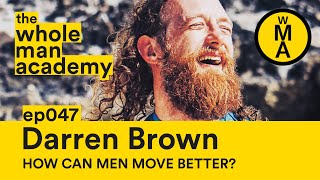
Podcast interview (EP047) with Darren Brown, a natural movement practitioner. Darren describes his movement background (gymnastics, dance, acting, personal training), explains the harms of modern sedentary ‘domestication’, and advocates daily varied physical activity (citing Hadza ~1.5 hrs/day), martial training for male rites-of-passage and self-regulation (Muay Thai, BJJ), and nature-based 'rewilding' retreats (Kenya Treehouse, safari/fly-camping). Practical advice includes breaking up sitting, more outdoor exposure, cooking from scratch, sleep/circadian hygiene, barefoot/ground contact, and joining community-oriented practices.
So this is the whole Man Academy podcast. My guest today is Darren Brown. Darren is a natural movement practitioner. I just checked up that was his correct title to get it right. Today we're going to talk about how men can move better, the power of retreats and nature, the discipline of fighting, tips to become a whole man and how you rewild your body. Also added to that list we're going to talk about breathing. Mr. Wim Hof being one of the targets. So Darren, how are you? Where are you?
Very well, thank you. Thank you for having me Anthony. It's been a long time since we saw each other in person. The last time was the first Wholeman Academy actually. So I haven't really seen you and obviously we've not been able to be in person for a long time now this year. But I'm good, I'm very good. I'm in London which is actually for once sunny.
Nice.
Yeah. Just enjoying the sunshine here in London.
Well that's a good point to start with is to how we met because what, what made you come to the. Because I was trying to think whether it was the first or second event that we did.
It was the first one.
So the first one I was looking back quickly at the photos to see. But what, what, why did you come along to it?
It's because I know Matthew. Yeah. Who obviously is the founder of Wholeman Academy, used to be my client at Gymbox where I was a personal trainer when I first started.
Yeah.
So and then I was in the process of researching more about mental health and well being within the workplace and doing that research for the retreat company that I own and work with rewarding retreats. So I met up with Matthew to get his kind of perspective because I knew he had gone through a period of mental health problems and I wanted to get more of an understanding of his experience and the tools that have been implemented within an organization like BBC. And then yeah then my meeting I had with Matthew then he invited me to the Holman Academy to come and meet, meet yourself and participate in one of the panels on the first Home Academy at Soho House.
Seems like a long time ago now. It was September, September 2018.
A lot of.
Yeah, it's gone, it's gone a bit strange since then to be honest. And for yourself, for your day to day, I know we're going to talk about fighting all the different things but for you how did you get into being interested in helping people move better? I guess would be an example.
So it's an interesting, I mean I Personally was very fortunate. My parents allowed me to explore movement in a variety of ways. So I did. I was a gymnast and a trampolinist at national level and competing national competitions up until my early teens when unfortunately, I had an accident playing football and dislocated my knee. And that kind of put an end to my career in gymnastics and trampolining. So I had been moving, like, from when I could crawl. It was something that I was doing four days a week, five days a week, kind of like two or three hours a day. So quite serious amount of physical exploration and training from a young age. And then I had the injury, which kind of put an end to all of that, that the hospital said I could continue with doing gymnastics and trampolining, but I'd have to have a kind of a knee replacement by my mid-20s. And I was like, yeah, maybe I'll stop. And that's one of the regrets I've had is to listening to the advice of doctors. But then I went to drama school after spending a few years of not really moving. And as part of the training as an actor, we spent a lot of time doing disciplines like ballet, tap, a bit of contemporary dance and creative movement and contact improvisation. And I realized how much I missed it and how much it was a real part of my identity, have the freedom to move and explore movement in a variety of ways. And then I moved to London in my early 20s nearly 20 years ago, and I spent a lot of time going to Pineapple Dance Studios.
Yep. Garden.
Yep. Common Garden in the institution that it is. And spent all my time there. Spent really, like two years, like, training again in dance, like, focusing on the areas that I believed I was needed work on that would help my career as an actor. But it did. It helped me in many ways. It gave me a lot of confidence physically within myself. But there's other things about the acting profession that you can't control. My physicality is one of the things that was at all something that was against me. And it just gave me a lot of freedom. And then after 10 years of being acting, kind of pursuing that career, I decided that I needed to have a bit more stability. So. So retrained as a personal trainer.
Yep.
It's an obvious move.
Finance, accountancy. I don't know, maybe something like that. But I became a personal trainer. And so that was 10 years ago. And then I kind of discovered the work of Erwin Lecour and Movna, and really kind of that resonated with me about this whole. There was a great feeling on YouTube, work out that Time Forgot which is one of Movinat's first videos. And you just see this gentleman who does look quite, we do look quite similar, both tall and long hair and beard and his physique is just lean and he's strong, he's mobile and it just again it was like okay, that what's this going away from your traditional kind of gyms, kind of, you know, everything else and free weights which I know I use and understand and it's just something I've been working with over the years because it's just native movement is innately within us and we need to explore that and to our detriment we don't within our everyday lives and the repercussions of this non exploring of movement have been felt, you know, especially now then it's something where it kind of locked in ourselves and kind of don't know what to do with our bodies and the problems we have with mental health and well being and diet, Nutrition, obesity, type 2 diabetes and all these things, these are all related to a lack of movement and to how we become domesticated animals within these kind of environments that are unnatural to us.
I think you've hit one on the head. I know I was reading something where it said, you know, people sleep in a box, we drive to work in a box, or we sit looking at a box all day, eat lunch from a box. And it's just everything is in a regimented form and so many people now are missing out on actually getting out and feeling the power of nature.
Domesticated. In the last 10,000 years, since agriculture has become the main source of providing for larger communities or communities, larger populations, we become domesticated animals and domestication is a form of control. And that's what we are now. We are being controlled by our environments and by other systems that are part of our natural or not our non natural way of living. And we become kind of desensitized to really what is to be part of nature.
Good point.
And there's a huge, I mean there is a massive mismatch, I mean we called it the evolutionary mismatch hypothesis that we haven't evolved to be living in the way that we're living. And there's a lot of research about this and the repercussions, as I say, are the problems that we have with mental health, well being and obesity, diabetes, cancer, all these things, these all come about because of the way that we live our lives, especially post industrial revolution.
Yeah.
Even now, you know, with the advent of technologies that we have, we become even more contained with, say you say within a box, because we're now staring at a box.
That was. I was talking to an osteopath last week and it was generally about what were the things that she had seen recently. And I've mentioned it on a previous podcast, but she said soon after lockdown ended, firstly there was the Joe Wick syndrome, which meant that lots of people had been trying to work out at home, you know, some hit training, but didn't have a clue what they were doing. It's not, and it's not his fault, but they're not. They're not under the guidance of a.
Professional to move in that way. And yeah, you know, it's like having a Ferrari in a garage that you've not used for years that's gathered dust and not moved and not been turned over. And then suddenly you turn up and try and crank it up and drive 150 miles an hour. It's going to end badly.
Well, that's a really good point. I mean, the other thing she said was, and I can't remember the term but about the effect she sees on people's necks because they're holding their head forward, because they're looking at their phone or their screen so much, which we know. You know, you walk along the street and people are shopping, but they're walking along with their head down and it's putting a strain on. But that's a big thing about, you know, the people that we've seen through the whole man academy that are maybe working from home, so they're not even getting maybe a walk to work or standing up on the tube or the train or something. They're literally getting out of bed and going straight to a computer and spending eight or ten hours doing that and then, you know, and missing out on any movement at all.
Yeah, I mean, and what we don't understand, the body adapts. We are the greatest adapter to anything that we give our bodies. So if you continually put a type of stress upon your body, your body responds and adapts to that. That's just evolution the way it is. So you've got to nourish your body with a continual source of variety of movement to allow your body not to adapt to one position, one way of being. And unfortunately, sitting in that kind of flex position, the head forward, that's your primary position, then that's the position your body's going to adapt to, because it costs your body energy to be able to move in other directions in other ways. So the body and the brain go, well, if I'm not moving in those ways anymore, then I don't need to have the capacity in my tissues and my joints to move. And it costs me money to maintain those neural pathways. So, sorry, I'm going to get rid of it. I'm going to form into this shape or this lack of range of movement. And then when you go outside of that range, whether you're playing with your kids or Joe Wicks was doing his workouts, you're not maintaining that capacity of movement. And then you try it and your body goes, no panic. And you wonder why. It's because we haven't maintained what natural movement is.
Yeah.
And again, to our detriment, we are now suffering from that.
So what would you. I mean, knowing so much about it, if a guy is listening and he's thinking, I mean, I know several guys, a lot of them at the moment aren't moving very much. What would be some of the kind of basic things you suggest they do? Either if they're working from home and. Or, you know, maybe they are going back to the office now.
Yeah. So it depends. I mean, you've got to look at, okay, what can I do? What behaviors can I change? How can I implement? And we've got to understand there's a difference between exercise and physical activity. Okay. We tend to think that we need to exercise for 45 minutes and tick the box. Job done. That's not the way it works because then we're going to do the other 23 hours and 15 minutes of the day.
Yeah.
Like you're spending most of time not moving. Okay. And the problem is that we think exercise is enough. Exercise is a small part of the greater whole of physical activity. And it's physical activity and a variety of ways of creating physical activities that people need to connect with and bring into their everyday life. There was a study done about the Hadza tribe and they. Well, there's been a number of studies done on the Hadza tribe, the tribe of Africa and Tanzania around there. And they strapped heart rate monitors to them and they measured their physical activity during the day and the amount of physical activity they do on a daily basis, whether it be low intensity, kind of very basic aerobic walking and moving to slightly more athletic, higher intensity moving, bigger loads or expressing power through their movement, throwing something. They spend about an hour and a half a day of physical activity. But I don't spend it all in once.
Yeah.
So if you aim for like, okay, if a good target would be an hour and a half a day. Okay? Now don't give me the excuse. You don't have time. Everyone has an hour and a half a day to incorporate more physical activity and movement in their lives. So if you're working from home, you're working eight or nine hours. Okay, take a break, 20 minutes every hour, okay. And go and move. Get a yoga mat out and just do some movement or go for a brief, brief walk around the complex where you live or something. Okay. But think about how you move in your everyday day to day movements, like how much how you brush your teeth. Now these are actually kind of things I did at drama school. We would like mind brushing teeth and things like that. But when you take look at activities that you do on an everyday basis, like in terms of training as an actor, we would then take that activity and like really make it big and comical. But it would be movement.
Yeah.
From that as a basis, I'm gonna brush my teeth. And how do I brush my teeth? What do I move? You know, you start looking at how going to the tap, turning a tap on all these things, they require a level of movement. Now how can you increase that level of movement? Okay, so like yes, people that live in Africa have to go and walk. Now you see the adverts like water rate. Oh, so and so has to walk. There's nothing wrong with so and so walking four or five miles, you know, to get water. That's a natural activity that is a benefit of to them. So how can I, okay, make my job harder by having to move more. So if you living at home, confined to a small space, try and get out first thing, try and get outside and incorporate a bit of movement. Get a dog, you know, or something. You live in London like me.
But yeah, it forces you to go and do something.
Force yourself to get into that habit to move and move in a variety of ways. You are responsible for your body. You have to make the choice and do it.
Yeah.
As simple as that. Joe Wicks People provide entertainments on the screen. That's great. That's one way of doing it. But how can you make that bigger? How can you make it more? If you are in a position where you are traveling to work? Yeah. Like if your journey is an hour on the tube. Okay, well then what? And it would take two hours to walk it. I mean I live in South London and a clinic that I work at is in north London. It would be a two hour walk. So what do I do? I get off halfway and walk for an hour. Yeah, so I get the benefits of being outside, getting exposure to vitamin D, which is so important for the current situation. I get to interact with other people around me. I'm challenged. It's not just exercises, movement, it's like the challenges of your proprioception system, your sense of smell, all these that make us who we are need to be stimulated. We need to be in environments that stimulate our system, which doesn't happen when we're sitting in our office or sitting at home. You need to put yourself there and it doesn't have to be in the wilderness somewhere. It great if it is, but even in an environment, an urban environment, you can still be stimulated by the unevenness of the pavement, you know, dodging that dog that's running at you or whatever. You know, it's an opportunity to move in a variety of ways that people need to incorporate into their lives as the foundation of physical activity.
That's one of the, one of the big frustrations for still friends that work in the city. But this is what I found. We would get to our desk at 6:45 in the morning. You would sit there till 5 or 6, depending on which market you're working on. And I kid you not, it used to drive me nuts because first I'd be so bored. But secondly, you just sat down, you couldn't really leave your desk. And I would say, right, I'm going to go out and get a sandwich. And then people would say no, I'll get it for you. And you're like, no, no, you're missing the point. You're not helping me by getting my sandwich. I want to get the fuck out the office and go and move around for literally, if it's 20 minutes, I would just try and power walk around Liverpool street and try and get some sunlight. If it was not in the winter anyway, any kind of daylight just to get out. But I know now that's, you know, people working from home, they're probably just sitting on computers all day and they're being fed unnatural light and not getting the daylight that they need.
Yeah. So I mean if you can, I hate to use the word hacks, but you can put yourself in a position where you are at least receiving more natural daylight that you are able to control the exposure to the screens, perhaps using a filter like flux I have on my computer here, because all these things play a part to our natural cycle and how our hormones respond to the stimulus. But you need to get outside and move because that has no, that just shakes up the whole system. It Needs that movement every day. And it doesn't have to be a HIIT class, as you say, getting out for 20 minutes from the office and getting a sandwich.
I think it's good for productivity as well because you would go back feeling refreshed to some extent and you'd given your brain a chance to switch off from work. And let's face it, eating your lunch at your desk is one of the saddest things you can do as far as I'm concerned.
It causes a lot of problems for me because people actually don't take time to. I mean, the whole process of eating should be a sociable thing really. And people don't take time to savor the food they are eating and therefore getting the response of producing saliva and amylase and even the mouth and then response to the body to relax and switch off, you know, from these high pressure jobs and allow a bit of digestion to take place without the body going, oh, I'm stressed, you know, and especially of an evening, I mean, having the opportunity to sit down when the sun is going down, which is what we do when on the retreats and just converse with other people and relax and enjoy the food and show interest in what you are eating rather than just a sandwich. It's a bit of fuel, you know what I mean?
Yeah.
Eating on the go, as the saying is terrible, terrible.
But it happened.
Yeah. You know, I try and say to people, I mean, that's why it's so interesting to talk to you because some people just don't understand that a lot of these things are achievable. There are a lot of little compound decisions. And they say we could call them hacks because somebody don't like that. But I agree, it's all these little things that you can change. Obviously. My partner is a nutritionist, so she really often tries to look, how can we make it achievable? Because we could say you've got to do all these sweeping changes. But people forget. And once they forget, I can't be bothered or they're too busy. I always say to people, like you said, when they say I haven't got time to exercise, you're like, look, you know, if you had a gun to your head and someone said you would make the time, you'll find some time. And even if it's one of the guys we were speaking to that we're helping on his health side, he is on lots of zoom calls, but he thankfully he's got a decent budget, so he has gone and bought a Peloton. And I said, I don't give a shit what bike it is, anything. But he can often be on a zoom call. He doesn't have to be talking, he's listening. So I said, put it. Just get on the bike for 20 minutes. You haven't got to be, you know, you're not doing interval training, literally just ticking over. But 20 minutes, you can still speak. And you might do that once a day for a week and you've done over an hour of ex. I'll tell you what to do. A lot of the people that I spoke to said, I'm going to do some stuff at home. And then they didn't do it because they couldn't be bothered because there's no accountability themselves.
I mean, they're just too damn lazy. You've got to be accountable to yourself. You are responsible for your own health and well being. Not the government, not your partner, not the company that you work for. You are. So it's your decision. If you don't do it, you just don't give a fuck. You really don't care. You don't care. And you have to admit that. Admit it and then move on. But you are responsible. No one else. So take ownership, research things. Look into what is going on around you. Look at yourself. Be introspective and understand, okay, what do I need? What do I enjoy? How can I make these small changes? Because no one's going to force you unless you do it yourself.
What a fucking great speech. I'll be using that on my Instagram. But this is the point. I mean, I know it's Jocko Willink, the ex Navy SEAL who's, you know, talks about extreme ownership. So many people have been conditioned to be lazy. And, you know, now you press a button and your food arrives at your door. You press a button and you get anything you want delivered to your door. So we're innately. That's why people at the moment struggle to even go to a demonstration about COVID Because it's like you have to get up and actually get out and it might be a bit chilly.
Domesticated. When we're domesticated, we just consume. It's brought to us. You think about fortunate industrial agricultural system that we have. When you see these videos of cattle or whatever that, you know, they're just. The food is brought to them and they're contained within. That's us. That's us with our deliveroo. That's us with how we behave. And that's not natural for animals and not healthy for them and the ecosystem that they are part of or for us, we are part of the same ecosystem. We can't separate us from them. But in our arrogance we have become separated from that. And we believe that we have more knowledge, we have understanding because we have three thoughts and we have the ability to think for ourselves. But most people don't, they don't apply what we have the opportunity to do that. And therefore they make bad decisions. And society in general makes bad decisions in the guidance that is given by governments in terms of nutrition, health and wellbeing. And they don't look beyond that. And it's an unfortunate thing that just.
You said that reminded me there's a guy who follows us on Instagram is really into his, you know, his bodybuilding stuff and he was saying how, you know, the government have come out and said about, I mean this bollocks about are we going to make a big drive for healthy eating. But actually when you look at the ingredients of all the stuff that they're recommending is basically just a sugar shit show.
Well, yeah, they're doing something with weight. I'm looking at health coaching. That's a whole interesting thing. Nhs are doing. Health coaching sounds great. Not really, but is actually very important. The methods in which they are using, the recommendations they are using. Working with weight watchers, I think and it's like, what the hell? Like why aren't you teaching people how to cook? Why are you providing information about what a whole foods diet is, whether it be plant based or whether it be an ancestral based diet. But give them that information so they can make decisions themselves. Don't give them a shake, they just mix with water, hoping that's going to have an effect because they're lazy. It's going to have an effect. It's just going to increase their laziness and maybe they'll lose some weight, but that's it.
People I know from, you know, quite a few years being in this business and Emma certainly as well, and our different friends who all do similar kind of stuff is that generally most people, they don't want to have to work hard for things and not eat things, not eat, drink, you know, not eat and drink things. It's just give me a pill. Yeah, just do it for me.
What's the hack? Give me the pill. Yeah, there is no hack, there is no pill. Like one of my favorite podcasts is nonprofit podcast which is done by Mark Twight and Michael Blevins, who Mark Twight was the founder of Jim Jones and who I had worked with years ago. And people don't want to be accountable to themselves, but they want the result. And Michael gave a great example of someone that comes up to me and says, I want to lose weight, I'll do anything, I'll do anything. And he says, cut off your arm then. And they're like, what? He says, well, you just said you want to lose weight and will do anything. I can, instantaneously, but it requires a huge sacrifice. They're like, well, that's stupid. And he's like, well, then don't say.
That you do anything.
Understand the accountability that's required of you and to the level of which you are willing to commit and work from there.
Good.
But people just want that I'll do anything, I'll do anything because they think it's an easy thing. It isn't. It requires a lot of sacrifice, especially when you go into the high levels of athletic endeavors or whatever. It requires sacrifice and accountability. Same for us living in our everyday lives. It requires sacrifice and accountability. Just because you're going to.
It's such a good point. And I think at the moment my great worries. We know for a fact that some of the natural resources that we've got online, we're talking like Facebook groups that have been around for years that will help with natural health have been deleted. You know, we know we've, we've followed some of them. Click on a link, no, all gone. And it's like people are driven towards, let's just give you a chemical or appeal and we'll fix it. Instead of actually saying, unfortunately, you have to take ownership of what your body's doing, what shape it is, how your energy levels are, how you're sleeping, etc.
Etc, but you gotta understand that we're all completely different. I was part of a gut microbiome study a couple of years ago done by Dr. Tim Spector, who's just received an OB or MBA or something for his work that he's done with research into Covid. But primarily he's been working for years doing the gut microbiota. And he did a study, the twins study where he had identical twins. And the study that I was the next stage on from that sort of wider population. But it's fascinating, he just released a book as well, which I highly recommend. But from the findings, from the whole thing is that we are even identical twins have very different gut microbiota, which means they respond differently to food, even though they're identical almost. Our bodies are so diverse that we respond to different Things in different ways. And you've got to understand that to have an effect. So you've got to investigate how do I respond to foods, how do I respond? And that has got to be part of who you are. That's how you approach things. How do I respond to things on an individual level? What works for me? Yes, there are some fundamental principles that have to be adhered to. Sleep, for example. Movement has to. These are fundamental things. But we're all different. All sleep differently, we can all move differently. And it's down to you as an individual. And Brazilian jiu jitsu, someone else might enjoy the cape or someone else might enjoy doing swing dance or something. It doesn't matter what it is. Yeah, well, let's enjoy.
Let's talk about fighting. You know, you've. I mean, we're all fighting life, whether we like it or not, but fighting what we want, fighting for what we don't want, etc. But what level of martial arts did you. Or sorry, yeah, what level did you get to and how was it for you when you were actually going into fighting people? Because most people will never understand what that's like.
Yeah, because most will understand that it's innately for men, especially in the west, we don't. We could weird. We're Western, educated, industrialized, rich and democratic and weird societies. We don't adhere to past ways of being that would have taken place or still take place within hunter gatherer tribes. So I think one of the biggest problems that we have, especially for young men and mental health and wellbeing, is that we don't have a right of passage. We have no separation from childhood to our responsibilities of being an adult and a male adult and what that entails. So for example, like kind of the reason why is that we do our retreat in Kenya is my girlfriend is Kenyan. So you have Maasai of Kenya. So they have a whole initiation ceremony that takes place at various ages for the boys whenever they're ready. And yes, it involves circumcision, but there's a whole aspect from the west we view, oh, that's cruel, that's barbaric, that's inhumane. But there's a great book that I read and got it somewhere, Initiation of a Maasai Warrior. The article that I've got. And he, the gentleman describes the whole process for them, it's about understanding of the community they are part of that they will then be a man that is eligible to participate and make decisions for the community and has a responsibility from being this boy. That everything is provided for to. To this man. Where you have to, you know, perhaps go to war, you have to participate within the community. Well, we don't have that. So without that understanding, it just creates a foundation of nothingness for most men. And the beautiful thing about martial arts and especially disciplines I do, I will favor them always because they are more combative. You know, there are martial arts that come from the east, which are more kind of, more kind of movement, dance based, I would say are very beautiful, very athletic, but they're not combat based. I prefer Muay Thai, which obviously comes from Thailand. Or you can go to Myanmar and do even worse, you know, where you have headbutts as well and no gloves. But it's about combat. It's about pitting yourself against one on one with a man. And there is no greater challenge than one on one with a man or one on one with a lion or whatever to test your physicality and your masculinity. And I think every man needs that. Like when you watch these programs to do with like selection for the army and that they always have the episode where they do milling.
Yeah.
Glued to it like it's horrific. Like one minute of milling all out. Everyone should do it. They should bring it into schools. As far as I'm concerned, every year, one minute milling, set differences, like every year doesn't matter. Yeah. Because it's a primal, innate part of us, that expression of our physicality that can be controlled and explored in our everyday physical activities and movement that we should be doing. But in the arena of one on one, you get. The greatest moments of peace I've had is when I've been in the ring, especially in Thailand. Like, you know, my brain's picking up all these kind of sounds and the commentator like taking the mick out of everything and all these people like yelling and screaming, but. And it's just me and the opponent looking at each other thinking, one more round and just think, what the hell am I doing? Like eating ten belts of shit out of each other. Why? That's okay. I'm okay with that. He's okay with that. Yeah, this is a good thing. And there's a moment of peace and realization and connection to yourself. And you're like, okay, yeah, this feels right.
I think there's such a. It's great to have the ability. I remember reading, listening to someone that was. Had been taught as a second gen from like Bruce Lee. And he was at an event I was at and he was talking about how Bruce Lee and forgive me I forget this wrong but he could literally kind of do a Bruce Lee, you know, cry out loud because switch his adrenaline on and then switch it off again. And he took us through it and he said, you know, one of the most powerful things as a, as a boy or as going to a man growing up, he's learning how to. His point was not just defend yourself, but also defend others if you need it about you and be able to have that about you. Which I hate to say it. Well, I don't because it's the fact, I think so many young men now growing up a bit pathetic because they're just, they're just looking at their phones all the time and God knows what. But you know, being able to dance in that arena and actually get hit in the face and react to it and stay calm I think is one of the most powerful things you can have.
Well, it's interesting the point that you made about the ability to switch it on. It's the ability to control and have an understanding and acceptance of that control. Now I don't know if you're aware of this. In the uae, for example, Brazilian Jiu Jitsu is their national sport.
Oh right.
No.
So especially Dubai. So you have the ad by does the competition every year. But it's become their national Sport and since 2008 they have had it as part of their curriculum. So all the boys do Brazilian jiuitsu. Okay. And they, there was a study, a long term study, I think it just been released but it was kind of finalized in 2015, 2016. And they, you know, they've said that. Yeah, there's a direct correlation between the behavior of these boys and their ability to moderate their behavior and have self control and it gives them so much more expression of oh, I can do these things. I, you know, and that's the first time that study has been done. I really recommend people read it because it's like it has a great benefit to society as a whole because suddenly now you've got these individuals who a. I mean especially in Dubai and that and Abu Dhabi, they, you know, they do, they do business as a combat sport rather than martial arts. So it is to compete. Yeah, to go one on one in a competition arena, which is horrible. If you spar with kids because they just want to break your arm getting ripped apart by these little kids, you know, what the hell. But you know, they can control it and they know within that environment it's acceptable at the right time within that environment. And then it helps their ability to self regulate Their behavior accordingly to the situation, I think brilliant. We don't have. Where we have that in the west. We don't. So there's a lot to be learned from doing a disciplined martial art or a discipline movement. Like I said, I did gymnastics and things like that, where discipline is required, as a huge amount of sacrifice is required, because then you learn to control yourself and learn to understand what you are capable of doing and all the benefits of that. Yeah, and yeah, I mean, I mean, I fought in Thailand a couple of times. I really want to go back and fight again. I used to fight over here, like every month just on amateur shows because I'm not getting paid enough to get knocked out, so. But I still want to get in the arena and do it. And I took up Brazilian Jiu jitsu kind of November time last year, so I've only did it for a few months. I just had one striped white belt. But I love the complexity of movement within that and the systems and developing, understanding your body type and the advantage that you have for your body and finding your way in your path through things.
Yes.
Self exploration. And very little is left out of doing a combination of Brazilian Jiu Jitsu and Muay Thai. You know, I can kick you in the head and I can take you to the ground and choke you out.
It sounds like a night out. Danny Maidstone, when I was about 18.
Oh, we love Maidstone. Or down Hammond Place in Rochester.
Yes. Yeah, I spent, I know, well from, from 7 years old up till I was about 20 living in Maidstone. So I saw plenty of the windmilling side. But you know what, that's interesting because you said, you know, when we watch, you know, SAS who Dares Wins, and they make them, as you say, put boxing gloves on and fight against each other. What I don't think people realize is it's exhausting very quickly now, you know, I've had one or two huge rush.
Of adrenaline and we're dealing with adrenal. Then you get that adrenaline and you get the adrenaline dump. And I know sometimes after a fight I'm like, oh, oh, my God, I can't move. Like, just pass me my beer. Recovery beer rehydration. Yeah, but, yeah, but it's a natural. That fight or flight system is a natural part of us. We never need to be stimulated and need to be able to control and understand what our body is capable of doing. And yeah, when you get that adrenaline dump afterwards, you're like, oh, gosh, this wipes you out. Yeah.
So what if. If a Guy. If a guy was watching and thought, you know what, I would like to, you know, take up something that's. And I hate the word self defense classes because that was. Reminds me of something in your village hall where, you know, you've got pepper.
Spray with you in a British hall.
So, you know, so it's. But for me it's like, what, what would you say he, in your opinion would be a good one for him to go and look for a class? What would it, what would he be looking for?
Kind of think about what you did as a child. Like, did you do roughhousing as a kid? Like, I spent a lot of time kid running around wrestling with, you know, outside pissing around with the kids and playing football and playing. Like, if you enjoyed like rugby, most of us did, especially in Kent, we did rugby especially into a grammar school. If you enjoy that physical contact and you know, if you're part of the pack and you know that, you know that aspect of that sport, then okay, I enjoy rubbing, maybe I would enjoy wrestling or form of grappling or so perhaps. But if you prefer more fluid movements or the idea of kicking or punching or boxing or whatever, then explore that. What are your interests in how you move? How would. If you were put in a position where you had to, Would you want to go back and would you feel comfortable on your back and scrambling on the floor? Or you know, what would you enjoy doing? And look at those disciplines that kind of feed into that, Your bias.
Yeah.
Find out what you enjoy.
Don't force yourself to do something that you don't enjoy naturally for any kind of exercise or physical activity. Don't do something you don't enjoy. Do the thing that you would enjoy. Like capoeira is a beautiful movement art which can be used as Angodian. Capoeira especially could be used as a combative sport. Like whatever it is, like find a way in. Like we were talking earlier about finding, you know, where to start with something to change your habits. Just find a way in and explore different things. And then be aware that within combat sports and martial arts there are hierarchies, which is great. Hierarchy is a good thing because you know your place.
Yeah.
You know, you got to understand, you got to leave your ego at the door and not submit entirely. But be submissible to those who know.
More and be prepared to learn and.
Be prepared to learn and have what you perceive to be your truth kind of thrown back in your face and be humble. Like there's nothing more humbling than going to Thailand and clinching with an 11 year old boy who weighs half your weight and he just demolishes you, you laugh, you're like, why my life is.
Over, what have I become?
Or when you're rolling with, you know, a lady who's again half your weight and suddenly she's on your back and choking you out, you're like, how? Because technically they have evolved more than you are. But you can get there and understand there's a process to getting there that's individual to you and embrace it.
That's such a good point.
You've got to understand there's a process and you've got to be again, accountable to that process, to yourself. And the beautiful thing about things like martial arts, like in Jiu Jitsu and Muay Thai, you become part of a small tribe and community. And that's a very valid connection that we no longer have. And that's so vital now to us. For many people who are, as we say, in their box, on their box.
You said the word community. We're going to change subject slightly and talk about retreats, which is dear to my heart because I know how powerful they can be. And that's one of the things we're launching at the start of next year is the whole Man Academy Mastermind, which will be for guys that are kind of basically bored with life and want more adventure. And what we want to be able to do also is have, you know, experiences. Because often I always say, I want you to get to, you know, any man to get to the end of his, say, end of his life, end of each year and not be like, yeah, I went to the gym that week and then the gym that week and then I did this. It's like, what can you remember that you did? I went here, I did that. I did something exciting. And retreats are one of the big things. So tell us about rewilding retreats and how you kind of not just obviously got involved, but how you've helped develop it.
So kind of rewilding retreats. Four years ago we went traveling around Southeast Asia. We lived in Thailand for six months. That's where I trained and fought. And then from our base in Thailand, we traveled around the Philippines and Cambodia and everywhere else. And so we went to some lovely places like Bali and Lombok. And everywhere we went I had a beach cat. My partner, she was like, nah, the beach isn't very good. I'm like my boy from Kent who went to Margate in which, yeah, Canvas.
Sounds, yeah.
These lovely beaches and the cat's like, no, the sand's not good. I was like, what is this? She's like, oh, when you go to Watamu in the east coast of Africa, like, the sand there is like powdery white sand and it's beautiful. And the oceans. I'm like, yeah, whatever, okay, I don't believe you. And then I went to Watamu with, with Kat a couple of years ago. I was like, oh, right.
Different level.
There is a level of sand. Who knew? Yeah, but again, it's just the wooden. I mean, the world is an amazing place and unfortunately we're destroying it. But retreats, when you go to these unique places, you get a sense of, of how you're part of a bigger, bigger ecosystem. You're not separate from it. So we came up with rewarding retreats starting in Kenya. I mean, long term, I would like to take it out to other places that we had been to. The Philippines is a great place. We fortunate enough to do a boat trip there on a traditional wooden sailing boat.
Lovely.
And, you know, you go to these kind of Robinson Crusoe Islands and I'd love to do that. And they had a biodynamic farm and their own pigs and stuff like that. So, you know, really bring different experiences of what rewarding and being part of nature could be. I mean, when you go to Kenya especially, we do it in a place called Potamu, which is on the coast of East Africa and the Indian Ocean. It's just stunningly beautiful. And the, the accommodation that we use is called Treehouse and it's just this big kind of structure that's part of the trees and everything else. You have all the monkeys coming at 4:00 and shit on the floor and turn your water over. Them bugger off laughing, because it's what they do. But when you're there, you become very much connected, especially with Kenya because it's so close to the equator. The sun comes up at six and goes down at six. You know, you have that 12 hour period and midday is the brightest part of the day, you know, so you become in tune to your circadian rhythms, your natural way of being. So you wake up naturally before the sun rises and Treehouse has no windows, so the sun just comes straight through. And then when it gets dark, you start to feel tired and you start to want to unwind. And it's an amazing. It's like when you go out of London, like when you're on the train, you get out of London and pass the M25 and suddenly you just go.
Yeah, I know exactly what you mean.
Imagine that tenfold. Because first thing that happens when you get. When we pick up the airport, that you come and you take your shoes off and you never put them back on again. You know, like, suddenly barefoot, like, you can feel the textures of the surfaces you're walking upon. And you can just see the trees and you can see nature. It just automatically just goes. And you lose concept of time because all you have is light and dark. So you don't. These kind of constructs that we create within the west don't exist. When you check in Instagram and you know, there's a joke about Kenya. It's called Kenya National Power and Darkness. Like, sometimes, especially in the coast, electricity cuts out. What are you gonna do? Yeah, just, you know, when we were in a place called Lamu, that's what happened. We had no electricity. Why not? So we just sat there with candles. They, you know, we had dinner and we sat candles and played cards and talked.
Lovely.
Had no access to the Internet. What does it matter? And that's the beautiful thing. And when we go. Especially when we go on, because first part of the retreat is on coast.
Yeah.
And we take them to Tsavo, which is one of the national parks on safari. So they sleep in tents. And the one that we have, that has a kind of watering hole very close by. So the elephants come to the watering hole and so do the other animals. So, like, the scarry, the Maasai scarry would say, if you want us to wake you during the night, if an animal has come, we will wake you. So the last time we were there, like, during the night, a leopard came past and went to the watering hole. So they woke us up. And we're just watching this leopard watering hole, which you'd very rarely see. And you're like, okay. And it kind of just puts you in perspective, like when you go to places like Africa. Actually, the day before we traveled to the safari, we said, look, guys, this is going to be a long journey. This is going to be like six or seven hours in the heat. They were like, I didn't realize it was that big. Yeah. Like, the content of Africa is huge.
Can't get the concept of the scale.
Of it, but when you out there and you see the concept of, you know, when you're savo as well, you can see Kilimanjaro, which is actually nowhere near you, but you can still see it, you know. Yeah. I really am quite small.
Yeah.
Insignificant. And as part of the retreat in Safari. We have the option of doing fly camping. So they just pitch up a little tent and you just sleep out under the stars. And a couple of guards on open fire hoping no lines or anything come to you, because they could. But you're like, okay, but this feels good. Yeah, I'm safe. Like we can run.
I think everybody at the moment could do with, you know, a taste of that. And even I know you said about, you know, not having Internet. What a dream. If someone could press a button and the Internet turned off for a couple of days.
You know how my childhood and yours, it never existed. Yeah. Still have the benefit of hindsight and remembering what it was to not had the Internet. I think we got the Internet the last week when I was at school and porn. Yeah.
What's this thing? What's going on?
10 minutes for it to load up, you know.
Yeah.
You know, but yeah, it's complete. To not have that stimulus is such a great tool to be able to use. And it's so important within urban environments to try and two hours before, if you can just not be on your phone.
Yeah.
On the computer. Because it affects the circadian rhythms that we are natural to and require for our bodies to function.
And that, if I'm not mistaken, is your circadian rhythm is the 90 minute blocks of sleep that you would have as well.
Yeah. How we think we tend to, we kind of be sporadic in our sleep. We don't have to sleep eight hours.
Yeah.
Again, when you're in like environment, like on safari, sleeping under size, you probably wake up. Like something will wake you up. When you've gone through those periods of deep sleep and you come out, something will wake you up and you'll wait, you open your eyes and maybe you have a drink or whatever and you go back to sleep. You know, the idea that we sleep eight hours, nine hours flat out, all the way through is not the case. Especially if you're living in small tribal communities. People would be, you know, having sex and eating and talking throughout the night and on guard and, you know, there'd always be activity around you. It'd never be on your own.
Silence.
Yeah.
You know, that's what we create in our, in our little boxes for us.
It's so interesting to talk about because I was trying to think then my question there would be to the person, the guy that's listening. And there's women listening as well. 27% of our listeners are women, which is interesting. Good effort. But most of them might be thinking, well, especially at the moment, I Can't go anywhere apart from, you know, maybe to your local woodland or something like that. So how could you rewild yourself whilst you're at home? And I know you've just said maybe it's just to switch the things off before, before bed, you know, don't have the artificial light before bed. What other things can they do?
So yeah, so you know, trying to remove those kind of blue light stimulus from screens, the foods that you eat. So we were talking about grabbing that sandwich and things like that. If you don't cook, I'm sorry, you have no excuse not to cook. Like if you can read, you can cook. Like you can and read a label, you can cook. You just need to have the patience to develop those skills. And what it is, everything is about development of skill. Okay. Movement is a development of skill. Understanding your body is a development of the skill. And you just got to take time to do it. We all do it. We all started from there as babies. We learned to move and develop those skills and to stand to get where we are. So take your time with it, don't be in a rush but do take the time, do make the time to make your meal from scratch. Understand where the ingredients come from. Try and shop local and seasonal. If you are a carnivore, try and if your budget allows, get more high quality meats from organic farmers or local butchers and develop relationships with people where you get the food from. Yeah, I grew up in Kent. We used to have a greengrocers of butchers and a fishmongers next door to each other and I used to get a lift school sometimes with the milkman in his little milk because I'll be going up the road part in the same morning. And I used to go to school miles an hour. Yeah, you know I could walk faster but it was nice. Yeah, but you would say good morning to these people and develop relationships with these people. Again idea of being part of something bigger than just you and your little box. Like make relationships and make connection. Talk to people about, well, where do you get the food from? Okay, yes, you can get your food delivered. There are some great food delivery services like Able and Cole Riverford and yeah, Field and flour do amazing meat.
Yeah, we used to have them when we lived in Kent.
Yeah, there are. And yet if, if it's available and you want to do it, but try and make the effort because if you got to break your day from the day in the office to walk, you know, we've got a really good butcher's In Herne Hill. Now, if I've got to walk 15 minutes to the butcher's and 15 minutes, but that's half hour done. But I've got my food and I've made connections with people.
Yeah.
So I'm killing many birds with one stone and just make it again. Part of your habits and your life. Cook your food from scratch. Sleep better, you know, look at your bed, your mattress. You know, you can be brave, perhaps learn to sleep on the floor with no mattress. It helps reset the system. But we like our comforts. Sleep in a cool room to try and replicate that need for our body temperature to be regulated by ourselves rather than external heat. Whatever. Try and get fresh air, get some plants in the house. The little things that can just help clean the air that you breathe. Especially in the city, like where I live. And yeah, just spend time barefoot. I don't know why people wear shoes and footwear in the house. Why you're indoors. No one's gonna see your feet. Yeah, you don't like your own feet, you've got problems.
We often go out in the garden and you know, say like with grounding, where you make sure that we get the. You know, we've got two young boys, so we say, right, get your shoes and socks off on the grass and we let them play in the mud. And Bowie eats mud. And we're like, good, you know, get involved in it because it's so important.
Eating mud. I mean, there was just literally reading a study that was released about how like being in nature, especially from a young age, and they did it. This with kids affects the development of microbiome and their immune system. And this is what you don't understand. We need to be dirty. We need to be covered in a variety of stimulus to our body because that's how we have evolved. We are not these sterile things and we should be those sterile things. Like you see in like Brave New World that's kind of just been released on sky, you know, all these clean, pristine, beautiful human beings. It's like, yeah, but no, that's not how it be.
Sterilization for children is.
Yeah, I mean, and it comes from birth, but I mean that's a whole different conversation. But you know, you've got to just be exposed to different things. But make where you live as comfortable for you, not over comfortable and as secure as it is for you, especially a bedroom. Bedroom should be nice, quiet, dark and no distractions there. You should just sleep and have sex in your bedroom and that's it. No food no eating or anything like that. Just sleep and sex. That's it. And then just.
Or sleep after sex.
Yeah, both. But, you know, just try and incorporate as much of an environment that's as natural as can be. There's a big difference between living in a city to living in the country, to living in. In. You have to. You have to adapt to those situations. You know, that somebody I know, literally, he lived in London, got made redundant in the process. He created a kind of a van that he's now living. And that's it. That's what he's doing. He's gonna be living in his van because he wants to be disconnected from that. What he had, you know, it was in the process of buying a house. Now he's just got his van. He's living at. He's been touring around, like, Scotland, the Highlands of Scotland, Wales, Lake District. He's loving it. That's one who's gone to the extreme. But, you know, that's what can be done. So find a starting point, as we said, for all this. Find a starting point and gradually introduce things bit by bit to make your environment as natural as possible. I'm not saying get rid of your TV and get rid of your chairs and get rid of your sofa. If you want to, by all means, you can spend more time. I mean, we're talking about office workers. I mean, currently I'm sitting on the floor on a cushion, and then. But we don't spend enough time sitting on the floor. So reconnect with ground living. Like, if you're spending eight hours a day on the computer at desk, you know, there's. Katie Bowman has done a great thing about sitting and that. I can give you more links and stuff that people could. But sitting positions. There's a whole variety of sitting positions on the floor and lying positions on the floor. Incorporate that. Because guess what? That's movement.
Yeah.
That's taking your joints and your tissues through ranges of movement that it needs. So you can incorporate small things into everyday life, into living in a city, in an urban environment, quite easily. And then when the opportunity arises to go outside and take a walk in a park somewhere or come on a retreat or something, then take hold of that advantage and race it. And we can't go back. We can't go back to living in small tribes, unfortunately, because with the urban environments that we're part of. But we can adapt the urban environments to our benefit, not be controlled by the urban environment.
Yeah, now that's.
That's a great saying, is, don't be controlled by it because I think a lot of people think they need to make sweeping changes. But you say look, you know what, what can you do? As opposed to just saying oh it's, there's no point because those, those little things. And again, going back to work in the city, you'd say look, you know, is there a little green space in the city or wherever you are that you can get out to?
There is. When you start looking at, looking for things, you'll be surprised what there is. I mean urban architecture now that incorporates a lot of biophilia and, and creating purposefully creative. Yeah, they're man made but they have benefit of finding those spaces. Churchyards. City of London has loads of churches, mostly built by Christopher Wren. But they have a bit of greenery and a bit of open air. You know, find those moments. You know, we have a number of parks in London. Find those places and trying to take advantage of that in your everyday life. If you can walk to halfway to work and you can walk through a park, like I could walk through High park and walk through High Park.
Yeah.
Take advantage of what is available to you in your surroundings that you are living in.
Especially whilst you're still allowed out.
Especially while you're still allowed out. Yeah. But if you want to make the big jump, like many people are in London, like do I need to be in a city because I can't be in the centre of London anymore. Do I need to be here? And I'm moving to Kent, Margate and surrounding areas because they want, they know there's a difference in quality of life when you take yourself out of that built up urbanization. And as we were saying that kind of when you go past M25, if you can do it, then do it.
I completely agree with what you said there and it's hard to explain to someone if you've not experienced it. But when I used to work in Bond street and then I'd get the train home, which would be like back when I lived at my parents and I'd get off the train down in Headcorn, you know, down in deepest, darkest Kent and I literally used to get off the train, especially on a Friday night. And literally as the train would go, you just had fields in front of you on one side at least and you'd feel like you just felt like you were you. You just kind of dumped some stress and you were in the country and.
It left on the train and you left it and let it go.
Yeah.
One of those funny things because I, I had the reverse of that when I was growing up. The excitement of coming into London from Kent, like going past Battersea Power Station, I used to love it.
I was like, yeah.
Then as you get older, you're like, excitement kind of dissipates. You reverse it, reverses it. And it's part of living in a zip. It's so stimulating. It's great. There's a lot of opportunities, you know, but the downside is that we get caught in this kind of trap and to our detriment. So take what is available to you in micro steps to begin with and progress from there. And it's a skill that you would develop over time. There's no rush, there's no, there's no end point. You know, you can go as far as you want. But I do encourage people to do it.
Just do something. I think that's, that's the, that's the thing. But, well, so I appreciate your, your time and we've, we've clocked up our hour, which is aw ways and I, I sense that you and I could, could do another hour and a half, perhaps. Willem, I was going to ask at one point, we'd love you to, if you're possible to write for our newsletter, just to give some something guys and tips. Because generally, you know, the guys that are listening to this, you know, professional men between 25 and 45 who are probably quite sedentary and the more nudges we can give them in the right direction, the better, to be honest. And for guys that are listening, we'll keep in touch because when your retreats are fully up and running again, we'll be mentioning them.
Yeah, we're looking to do a UK retreat and a Europe retreat and there's places I want to do it, but I need, well, we need airways to be open and the situation that we're in to kind of resolve to a point. But yeah, it will develop it later and yeah, we'd love to chat more another time and write the news, but.
Sounds like a plan.
Sounds like a plan.
Well, thank you for taking time. I will end it there and I'll wish you a fine weekend and hopefully we will speak to you soon.
Yep. Take care, Andy. Thank you very much for having me.
Cheers.










