EP063 - Liverpool and Life - Neil Mellor
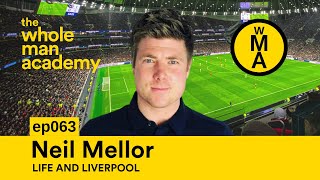
A Man Academy podcast episode (EP063) featuring former professional footballer Neil Mellor in a wide-ranging interview (recorded March 2021). Mellor recounts his football upbringing (joined Man City at age 10), major injuries (stress fracture/back injury at 16), breakthrough moments (notably a late winning goal against Arsenal and key contributions in the Olympiacos match and Liverpool’s 2005 Champions League run), experiences under managers Gérard Houllier and Rafa Benítez, and the emotional impact of fans (Anfield) — including reflections on playing with and without crowds during COVID. He also discusses retirement challenges, moving into media and keynote speaking focused on resilience and transition, and personal life during lockdown.
This is the whole Man Academy podcast. My guest today is Neil Mellor. Where do we start? Neil was a footballer, international speaker, broadcaster, commentator, a father. We're going to get into that as well. Neil, how are you and where are you, sir?
Yeah, thanks very much for having me on, Anthony. Yeah, I'm a man of many different things, as you can see there. I'm enjoying life. I know it's difficult for a lot of people, isn't it, at the moment with COVID and the different restrictions. The sun shining today. So I've got a smile on my face.
It is. I know from speaking to a client of mine this morning who said exactly the same. Like when it's, you know, when the sun's shining, it always reminds me of, you know, when the football season is, the pre season is starting, which used to be, I mean, don't know how that's going to work at the moment, but like when it's in the August time and you know, after the, after all the kids are going back to school and everybody starts playing and training again in the summer, it's. It's a good feeling.
Well, I know for you, Anthony, for some it might be. Now for me, pre season was hard. I was thinking that get through that and bring back those winter days when I was playing football. That was the preference.
Well, you've touched on. There's plenty of points to go through. One of them was about pre season and the training side because that's where, you know, it might be very well, people seeing, you know, guys playing football in front of the big crowds. But, you know, the, the hard work is done behind the scenes. So how was that for you? Because when you started, you know, obviously playing football as a youngster and then working your way through to being a, you know, on the elite side of it. So was that pre season always painful for you or.
Yeah, well, I like to think myself, because I was an attacking player, a center forward, we prefer the shorter stuff, the sprints rather than the long distance running which the defenders and the midfielders seem to prefer. So for me, the pre season was one just to get through, just to stay fit. But, but my body, because of the injuries that sustained. That was always a really challenging period for me pre season because the running was something that my body didn't enjoy and it was so much, so often it was like, oh, just get through this, did you?
That's a really interesting point because I know even with Steven Gerrard where he had, you know, a lot of the issues with kind of as Your body is growing and trying to adapt and obviously your training. So did you find that you had some of those issues from quite a young age? Because, I guess. I mean, what age did you start playing football?
Yeah, I didn't start playing football till I was 10. I mean, you look at some of the kids now and they're kicking a ball. I was kicking a ball young, course, but I didn't join a club till I was sort of 8, 9, 10. First professional club was Man City at 10. Whereas now the academies are taking boys very, very young. So that was when it all started for me. But I used to like other sports, cricket, tennis, and play them at a decent level. And I think for me, I sustained quite a bad back injury at 16, and I think it was because of the tennis was really taking its toll on me. I wasn't a great server, but I really tried to get my serve going and I think that was. My technique wasn't great. And, yeah, I had a stress fracture for, like, seven months out. It's a tough one, that.
Yeah. And I guess you never know how, as you say with something like a stress fracture, how that kind of impacts on you, you know, your longevity, especially when you're trying to get to that elite level. Well, I know if we take you back to, obviously, your. Your dad was a professional footballer and, you know, played for various clubs, including Man City. We already kind of mentioned that. What was it like for you growing up? You know, did you. I don't mean did you feel under pressure to be a footballer, but did. Did you know you wanted to be a footballer? Or was it kind of something that came gradually to you, watching your dad through the years?
Yeah, it was something I always wanted to do. The thing for me was I never got to see him play because he was. Yeah. So I was. I've got an older brother who's eight years older, and I think perhaps you could say my dad learned a lot from him, maybe pushing him a little bit too much, and then was slightly different in how he treated me. And my brother never made it. The best he got to was Aberystwythtown. I think I said that.
Right.
In Wales. I hope I've said that right.
We won't try and spell it.
No, but I watched him play, like a Europa League Qualifier 1 and he got beat to some Maltese team. I told him a bunch of waiters they were that day. He wasn't too pleased.
But.
But, yeah, so for my dad, he was a big influence on me because he played professionally, but I never got to see him play, but he was always there supporting me, school games, all those sorts of things. And his advice was invaluable.
I was just thinking, that's the thing, isn't it, when you've not got. I know we could talk about football agents as well and the benefits of them and the.
Yeah, I was going to say, okay, okay.
I've read enough football autobiographies and you know, the agents don't always come out in a great light and maybe no surprise there, but I guess having a dad who's been there, done that at the, at the high level must have been a real help. But when you first, then started, as you say, from your 10 years old upwards, at what point did you realize that you were going to be a professional footballer? Because I know there's. So it's such a small percentage of kids, especially these days, that actually go from the academies to actually signing real contracts.
Yeah, I used to play two years above myself and, and I do quite well at that level, sort of Sunday League and I'd score like whatever, 40, 50 goals a season. And it got to the point where the teams were actually complaining that I was too young to play because I was doing so. So I actually got banned from playing Sunday League because I was too, too young to be playing two years above. They were trying to protect me, but it wasn't affecting me at all. So I got banned and at that point, that was when I joined Man City, but, but it wasn't like it is now where they send, they're looking at hundreds, thousands of kids all around the area. It was a case of, can I have a trial? Yeah, okay, great. We know that you score goals and all that sort of thing and then it took it from there. I mean, back then there's only about 10 of us at the School of Excellence is what it was called then. Whereas now there's a lot more kids involved with the, the different age groups at the professional clubs.
Do you think also it's, you know, people know how much a premiership footballer can earn these days, especially if they get to the very top. And you know, I know people that have had kids that are quite good at football and they're, they're pushing them because they know that it's, it's big business as well.
It's so sad to hear that, isn't it? You know, you know, for me, I wanted to be a football player because I wanted to score a winning goal in the FA cup final. There was nothing about money back then. And back then, like I was born in the early 80s, there was no football then. Sorry, there's no money involved with the football back then. It wasn't until sort of the late 90s and early noughties where the money really came into the game. So for my generation of player, it was still about, I love football, I just want to play football. And that was what the dream was for me. I wanted to do what my dad had done. And I sort of touched a little bit on that in my keynote, actually. But that sort of passion, where we get that dream from, and that was certainly mine.
So take me back to the first. I know in one of the videos I watched of one of your talks, kind of said about being called in to sign contracts and thinking that you're going to be on a couple hundred pounds a week, and then the manager says you're not good enough. And I know for. I've got one or two friends whose kids are playing for some of the London clubs, and it's such pressure on a child when you're hoping that you're going to make it. And then you get told, and maybe it means they develop further down the line, but you get told at that point you're basically, you're not good enough. I just wondered what that was like for you at that age.
Difficult. Yeah. Yeah, it was really difficult. And I really go to town on that in sort of Makino, because that's, for me was a huge adversity, a huge challenge, which at the age of 16, which is what I was. Yeah, it was a moment where I'm going to minute. No one's ever told me I'm not good enough before. How am I not good enough? Because I've been the top goal scorer, surely I'm good enough. So it's that mental challenge to the sort of beliefs, the sort of behaviors, attitude, how you react to that adversity, that was really key for me. But it came as a shock. It definitely did. But then it was. It was something that didn't stop me wanting to get to where I got. Where I got to.
All right, well, let's. I'm gonna. I just find it so interesting for the. As you say, so much of it is about the mindset as you're going through the ranks as well, because, you know, I know certain professional players that might not have. Or they've certainly had certain knockbacks, but they still became a professional. And we'll certainly touch on your keynote. But let's take you to 2004, the goal against Arsenal, which I laughed because my brother in law is an Arsenal supporter. So I knew he'd be super excited to hear that you could be on the podcast. But I just wonder if you were still, I'd say, a young lad. It seemed like at that point when you scored that goal and it was against some of the greats, you know, the Arsenal team then was, I mean, Arsenal are rubbish now. Let's, let's be honest. And we can definitely say that because.
This, this podcast May day and Arsenal may get good again one day.
Yeah.
As we speak, Arsenal are in the bottom half of the Premier League. They are very, very average team.
It's, it's. They're still playing, they're paying their guys so much money, which I always think is quite funny. But yeah, back then they were, they were, well, the Invincibles and you know, some of their players were just some of the best around. So I just wondered if you could sum up what that feeling was like when the, when the ball dropped and you hit it from a considerable distance, especially at the cop end as well, which, let's face it, that, you know, that kind of is the icing on the cake, as it were.
Yeah, yeah, no, I definitely touched that in McKenna. I mean, the build up to that game was, it was a super Sunday. Now the Super Sundays back then, that was a big deal. You know, nowadays the kickoff times are all over the place, aren't they? But back then it was the big game on the Sunday afternoon and it was like you say, Arsenal the best team around. And I'll always remember when they got to the ground that day, there was a big buzz. I knew I was playing. I put my tickets by the, the ticket office with the, the receptionist and said, mum and dad are coming. There you go. There's my tickets for them. And then I went straight into the, into the doctor's room before the changing room because I had an injection before the game. I was struggling, I was struggling with an injury at that time and I knew I was playing, but I needed that injection of cortisone just to get through it, just to try and numb the pain from my knees. So I did that, got going and it was more surprise than anything else. Now I talk about the feeling of scoring that winning goal, but in the 90th minute we're 11 against the best team around, which Arsenal were then. And I was more surprised that the manager hadn't brought me off. As I saw, it was like, why has he kept me on? And I actually turned To Sol Campbell who was marking me that day and I said we had a free kick. Can I have your shirt after the game Now I don't even collect shirts now. Sol was a great player, of course he was but he wasn't a favorite player of mine. Like I don't collect. I have no idea why I asked him about getting that shirt or not. Anyway, the ball came up, Sol Campbell misheaded it, whatever and I've hit it, it's gone into the back of the net. And like I say in the keynote I go through that feeling of being stood in front of the carp and, and that emotion involved. I never did get his shirt, you know, after the game. Yeah, I never got his shirt after the game. But it was nice to get the winning goal instead.
What, what must that be like now as a. You know, I'm quite a few years older than you. I'm 42 now so I've been a Liverpool supporter since I was pretty much six or seven and I think I said when I'd emailed you about inviting you on the pod, you know, I've got a photo of Tony Adams presenting me with a trophy for my football accuracy skills at a summer thing but I've got my little, my little crown paints kit on. So for me and all my friends that are Liverpool supporters it's not just about if you were playing for Liverpool it is scoring at the cop end. How special is that? When you've got, I mean I guess then the capacity was obviously that much smaller than it is now but the, you know, the times I've been there, the noise is amazing. What is that like?
Yeah, what I would say is that you've heard the old cliche when ex players say what a difference. The crowd maker Anfield those special European nights and they do make a difference. They make a difference because when I'm out there as a Liverpool player the fans are with me and I can feel that and it gives me confidence. Now as a football player it's really hard to have that confidence. Believe it or not, you want something to go well for you. There's all those sort of doubts and fears that can happen as a football player but the Anfield crowd as a home player give you that confidence, give you that belief. Whereas if you're an opposition. Now I've never experienced that as an opposition player but I can only imagine you thinking oh they're all against us and they've got some great success stories in the past and yeah, no doubt create a lot of fear. I mean some of the best players have been to Anfield and struggle to cope with that sort of melted. So the fans, the fans are undoubtedly a huge, huge advantage to have when you play for Liverpool.
So you know this is one of the big things at the moment with, with no fans at stadiums and we can debate that whether I think that it just, it sucks a lot of the life out of watching it and in fact the last game I watched whilst I was abroad was the Liverpool Arsenal game and it's just not the same when you haven't got the fans there. And you know, I do wonder whether trying to think who shared a statistic about away teams are winning a much higher percentage of games in the last season or two from your. Obviously you know, lots of footballers, what's their take on playing in empty stadiums week in, week out at the moment?
Well, like I said when I wanted to be a football player it was about that buzz of scoring the winning goal and sharing the moment, connecting with the fans. The players can't do that at the moment, they can't connect with the supporters and it's really difficult. I mean the quality of the game isn't the same, the passion isn't the same. The professional footballers, of course they're going to do the best but they thrive off the fans and some players thrive more off the fans and some players thrive more without the fans and maybe that's why more away players have thought ah, there's no, there's no one inside Anfield today, mate, you know, I'm not going to get booed or and everything like that and it can make a difference, there's no doubt about that. The sooner the fans are back the sooner we can get the game. Certainly I've always loved football back the way, the way it should be with the fans because football is nothing, nothing without the fans. We all have our favorite players, of course, managers and all that but it's all about the fans.
Yeah, I think it's so important and I know from my playing at a low level of football even when you went to an away team and you know they might have had hundreds of supporters for them and you had, you know, a couple of the stalwarts that bothered to come along and it would just be that thing if you're away from home and you had them all giving you abuse, let's face they're not, they're not there to be nice and cheer you on. So you had a lot of abuse and I can only imagine now it is a much more of a part of the pun, but a level, level playing field. So, yeah, I'm just hoping that all that, that will come back. Well, the other one of the, one of the great games that you played in and scored in and assisted in was of course the Olympiacos game, the Champions League. And that what I was going to ask you first is there's probably was one of those questions of like, who's one of the, you know, the great players that you've played either against or, you know, on the, on the pitch with. And Rivaldo was on that night, who was a utter, utter wand of a left foot legend growing up. Did you get to that stage where you were playing football against some of the people that maybe for you, you kind of looked up to as a kid?
Yeah, yeah, there was always that. I mean, obviously Rivaldo, for me, when I was growing up, he was a superstar, wasn't it, at Barcelona and when we played against him that night, there was always the feeling he was capable of doing it, but he was on his, on his way down. So it wasn't like the Rivaldo that had been the world player of the year. But we knew we had to be mindful, didn't expect him to score. I'll be honest, when he scored that I was thinking, oh my God, what's going on? But we think of Olympiacos perhaps these days and think they're not a great side. That, that was a good Olympiacos team. They were top of the group when they came to Anfield on match day six that night, it was one of those incredible nights and that we still talk about, still remember today because of what happened. But at halftime, after Rivaldo had scored, it was a case of, wow, we have got a lot to do this second half. We needed to score three goals. I spent 15 minutes at halftime staring at the manager, Rafa Benitez jogging on the spot, just trying to get his eye. Bring me on because I was so that night. Please, please just, just bring me. Look at me because I'm ready. Look at me. I'm jogging on the spot. I was knackered by the end of halftime. But he never brought me on. He brought somebody else on. Cinema pong Goal.
Yes. He scored. Yeah.
I was fuming, like, what's he doing bringing him on and then he scores. I'm thinking what a brilliant decision that was to bring him on and then eventually brought me on. And I had a moment myself before Gerrard scored one of the best European goals, certainly at Anfield that the fans will remember.
Yeah, well, That. I mean, let's. Let's rewind back to the goal. You beautifully skipped over the fact that you scored the. You know, that one of the. The important three, as it were. And that was a pure kind of poacher's goal because you were kind of off balance, you know, the ball was what, like hip height. And he managed to smash it in the top of the net, but then to go on. And I know you cushioned the header for Steven Gerrard to score again from distance, you know, which is one of his kind of things that he seemed to do extremely well.
When the ball came to me, it was Jamie Carragher on the left wing.
What's he doing up there?
What is Jamie Carragher anyway? So he's dinked it up to me. Now I'm a centre forward. I've got a few options. Do I control it, maybe lay it off to somebody? Do I flick it on? Don't maybe turn and try and get a shot myself. But I went for that layoff option, which there was two players, Steven Gerrard and John Anarisa. Now, John Honorisa was a very, very good left fullback. A Norwegian international. Loved a screamer. Yeah, if I was going to nod it down to him, it was going to be on his right foot and about 1 in 600 would be on target with his right foot. So I thought I'd better go with Steven Gerrard and like I said, the rest is history. He did the business for us.
Yeah, that was ridiculous. And I always love when you can watch the, you know, on YouTube or back when DVDs were around, but you could watch the, you know, the top goals of, you know, the Liverpool campaign. And that is always one of those, I think it was, was Andy Gray that, you know, shouted what a hit or something like that. And it's just. It's just an absolute classic. But in fact, I was going to ask you about the managers that you've played under. I mean, I know there's several throughout the career, but you know, with obviously Gerard Houllier, who passed away in December, I think it was. And am I right in thinking that he gave you your professional debut?
Yeah, that's correct, yeah.
What was it like when you. Because Gerard Hillier and I know Rafa obviously as well, two kind of incredible managers. And I always wonder, what's it like when you first have that manager come in and it's up to you to impress them?
Yeah, well, I mean, for me, my first step was trying to get away from the youth team at Liverpool to try and progress to the first team where Gerard Houlier was the manager. It was the real start in football and certainly in the Premier League in England, of the change of the continental players coming in. There's a lot more of that going on and that influence of the foreign coaches. And Juli changed a great deal. He changed Melwood, the training ground. He redesigned this unbelievable new training facility. Gone was the old building and the basic that it was, it was now this. This incredible. We had a sauna, Jacuzzi, swimming pool. I had a dressing gown in my locker. It was like, oh, my, this is like a spa. But it was like after the top international players and it was a big difference. Even the diet, all of a sudden, when I first went down there, there was Sprite, there was Coke, there was Fanta in the fridge, filling my boots, Snickers, Mars Bars. That was all gone pretty soon afterwards. And that was where the change was coming in. Julio was huge for that. So when he gave me my debut, that was a huge vote of confidence because there's a lot of experience, top internationals that were ahead of me in the pecking order. But he believed in me to give me that chance. And it was a real proud moment. My family were. It was against Ipswich Town at Anfield and a night that I'll never forget.
What's it like then, when, you know, I've only spent, let's say, 38 years dreaming of being a professional footballer. So I have to ask these questions. But when you first, I know, you know you've got a chance of being, you know, in the first 11. But at what point, let's say for that, at what point did you know? Is it because a team sheet gets put up or do you get the nod a day or two before?
It varies. Honestly, it varies every game. Now I'm a young kid making my debut. The manager was good. He pulled me to one side the day before and he said, listen, and you're going to be making your debut. So that gave me time, mentally, oh, my God, I'm going to be playing. Didn't have enough time to get my hair cut. My hair was awful. But it gave me enough time to get my family there to watch what was a special moment for me. So that was. That was nice. Rather than throwing up me last minute and thinking, oh, Mum and Dad aren't there. I'm gutted, that sort of thing.
That's a funny one, because I do, I do think, you know, you wonder whether those things go through your head of if you know, you're going to be on the TV in front of thousands of, you know, possibly millions of people when you're like, sure, I haven't had my haircut. So did you. Did you ever go through a phase of, you know, with. With Gazza and Beckham, where they were changing their hairstyles to blonde and. Or did you just keep it? I said, you're slightly more sensible, but, yeah.
Can I be honest? If you look at my hair now, it's only ever changed once.
That's it, yeah.
You know what it was when I was at West Ham. I went alone to West Ham for a period early on in my career. I was struggling to score a goal and one of the lads said, you're not getting your hair cut to your score. And it took ages. I was like, my God. But when you get it done, you're going to have to have it shaved off. So I scored a couple of goals in a game and sure enough, I got it all shaved off. I looked terrible. So that was the last time I've changed my hairstyle. I've kept it to what it was when I was about five or six. Nice and simple.
I always think it's the partners that get the most pain. I remember many years ago going to the hairdressers and having a number two, or it was all over and then you go home and you whip your hat off and you're like, ta da. And your partner's like, what the hell do you look like? And you're like, yeah, this isn't. That wasn't the reaction I was expecting.
So it ruined my pictures from the 21st. I've got a twin sister and I was down at West Ham and I've had this skin I'd done just before my birthday, and everyone's like, what have you done? And obviously all the Pictures from the 21st, I've got this silly skin.
It just makes me laugh because it makes you wonder, you know, with the footballers these days, where they're having things, you know, embedded in their haircuts and logos and stuff. And I'm like, man, I wonder how much time they spend just thinking about what, you know, what. What patterns to have in their hair. That's. Old school has gone out the window. Well, I wanted to ask you, with Rafa Benitez, what was it like? Kind of, because I know from. From my view of what he was like, he's not someone like, let's talk Jurgen Klopp. He's going to be cuddling players and you Know, giving him a, a real sense of that he loves them. Whereas Rafa, I sense, was something that would just look, look at you across the room. So what was your take on Rafa?
Yeah, well, top manager. What a top manager he was. Well, funny enough, when I scored that goal against Arsenal, I scored the winning goal against Arsenal. We're in the dressing rooms afterwards and like you say, if it was Jurgen Klopp, you're probably getting a hug, maybe a prolonged hug off someone like Jurgen. It was just a caught eye with Rafa across the room and he just gave me a little thumbs up, a little smile, that was it. And that was enough for him to say, that's okay, I accept that. That was good work today. There was nothing more than that. But Rafa was a brilliant, absolutely brilliant manager. He was on the training pitch every single day. His shorts, whatever the weather was, he was out there in his shorts even though he's from Spain. The weather was completely different, of course, but he was for me, a tactical genius. He. He taught me a side of the game tactically which I'd never really experienced before. And I learned an awful lot from him. Sort of how important the shape is, the position that we need to be in, in and out of possession of the ball.
I just wonder, yeah, with Rafa, because obviously him going on and you know, being part of the Istanbul ridiculousness of the comeback, it was one of those with him where I remember thinking once he'd. Because he was laying the foundations, but you were waiting for something. You know, we never quite got to the league, as it were, and amazingly waited a long time afterwards. But let's take you through to the Champions League. After you'd kind of got through to all the, you know, the knockout stages and the quarters and semis. What was it like for you? Because I know you, you know, you're desperate to be in the team for the Champions League. What's the build up like to it?
Yeah, well, I talk about this in the keynote because for me now, I've experienced adversity a lot throughout my career and I was experienced in that, that time, yeah, when we were going to the Champions League final. But like I mentioned, it doesn't matter how I'm feeling. What's going on with me, My workplace, which is Liverpool, my organization, they're buzzing because they were about biggest game of their lives and they're my mates. You know, I have breakfast with them every day, lunch. Whilst I wasn't training with them, I was injured, but I'm still around them Every single day. And I can see them all absolutely buzzing, ready for this game. So I was looking forward to it like, like everybody else there was, we were underdogs from, from the moment we'd beat in the Olympiacos. We were always the underdogs throughout that knockout phase. Even in the final that.
It's funny we said about playing like Olympiacos with had Ribaldo but that that team, you know, playing against Liverpool had Crespo. I mean I had some unbelievable players. And I just wonder, let's say you had been, been playing. So do you look across at that kind of team and you know, how do you kind of compare yourself to them and, and try and maintain your confidence?
Not easy, is it? Not easy. Like you say when you're looking at the teams you think could have done with him being injured or something like that. It was a br and brilliant team that AC Milan had back then. But yeah, I sort of talk more about what happened at halftime. You know, that's, that's something I speak quite a lot about in my. In Makina about the mentality of the players and, and how they reacted to that. The scoreboard to go out the second half because at three nil at half time I was in the crowd. I couldn't play because I'm having that adversity. I'm thinking one more and I'm going the airport. I want to go home. These are my mates that are getting humiliated in the biggest game of their lives. You know, not just the fans inside the stadium, but around the world. Liverpool fans must have been thinking, I've been looking forward to this for so long and this is how we're going to perform. But it hurt more because I knew how much the boys were looking forward to the game. But of course that second half and extra time penalties is a night we'll all always remember.
Well, talk to me about. So were you sitting in the stands or were you.
Yeah. Yes. So I was there in the stadium that night and then, and then I got on the, on the pitch after the game as well, which was. That was a story in itself because there was. There was 69,000 fans officially inside the stadium that night. And I reckon there must have been 60,000 Liverpool fans. It was majority Liverpool. There's only a little pocket of AC Milan behind the goal. I remember it now. And at the end of the game we were part of the Liverpool contingent. There was only 10 of us. 10, 10 players that, that weren't involved. And I was one of them being injured and we're trying to get on the pitch, but all the Liverpool fans are trying to get on the pitch. And I stood there in my Liverpool tracksuit and this Turkish steward's thinking, listen, I don't know who you are.
You're not. Yeah, yeah.
It's like, listen, I've got no idea who you are. So it. Luckily one of the. One of the lads who was involved was Cuptide was Fernando Morientes.
Yes.
And he'd won the Champions League three, four, whatever, however many times he's won it. And he said to the steward, listen, I'm Fernando Morrientes. Can I go and see my teammates? And he's like, I don't believe you. Don't believe you. He had to get his passport out. He showed him his passport to show him it was Fernando Morientes. Next thing, the steward, the stewards hugging Fernando like that, thinking he's the best thing since sliced bread lets Fernando on the pitch. But then Fernando made sure every one of us got on as well so we could be there. So when Steven Gerrard lifts the trophy at the end, I'm on the podium with all the confetti. I was a great moment.
Talk to me about what happened after because what's that? I mean, that's the biggest kind of club game pretty much there is. So what's the process afterwards? Do you all just go straight back to the dressing room and start drinking or I know there's kind of press conferences and then do you just carry on partying through the night?
Yeah, yeah. I was quite lucky because at Liverpool experienced a few trophy wins, 2003, 2000, obviously Champions League 2006 as well. And the protocol was we go back to the hotel after the game, we put the trophy in the middle of the dance floor. There's a free buffet, there's a free bar and you just hit it as hard as you want. If you don't drink, that's absolutely fine. If you do drink, fill your boots. And that's sort of how the protocol was. So as you can imagine, but after about an hour or so, everyone's jumping up and down, chucking the trophy everywhere, dancing about. But the difference was back then, the kickoff time was quarter to 10, something like that at night because it had to suit the English audience. Kickoff time. So by the time we got to the hotel, it was like half two in the morning. The lads had played 120 minutes. Penalties were drained emotionally and it was like, we've got to go again. We've got to kick on to celebrate. What was an unbelievable night.
I just wonder because the next day you must wake up and feel like you've kind of dreamt. I mean, I think I said to you that I was in Budapest and I went to the bar with a big group of people and at 3 nil down I was getting barrages of texts from my mates laughing and saying, this is humiliation. And I honestly contemplated I might. I was on an early flight back to or going to Italy after that and I thought I might just swerve at half times. This is, this is embarrassing. And that point where my friend had bought us another pint, so I've got you another pint and I said, I'll just finish this and I'll go. And then it, and then it, then it kicked off from there. That is one of those nights where, you know, you just, just the comeback of it. I. It's so rare to have that. Well, unless you're Liverpool supporter. And therefore that takes me through to Liverpool's 4 nil demolition of Barcelona in the Champions League. You know, in, in recent times, were you either at the game or if. No, were you, were you watching it?
Well, I couldn't get a ticket, as you can imagine. To get a ticket for that was so hard to get. We're 30 down from the first leg.
Yeah.
Everyone's like, oh no, out. Salah's out, Firmino's out. We've got no chance. And I watched it in my kitchen with my 10 year old boy thinking, I just want to win the game. Just want to beat them and make a game of it. All of a sudden I think it was one nil at halftime thing. Still got a chance. Still got a chance. And the celebrations in our kitchen when that second half was just unbelievable. 2 nil, 3, no 4 Nelly. I was like, oh my God, that's one of the best games I've ever watched in my house.
Yeah, well, I was going to ask you about, you know, the fourth goal was one of those that you just, you know, we've all seen screamers and we've seen ones that come off of people's knee but you very rarely see one that's a corner where the other team was switched off. Just unbelievable. But what's your thoughts with Trent Alexander Arnold who played it and he's such a young talent. I know there's lots of young talent around the moment, but he for Liverpool is one of those as an absolute gem. What's your kind of take on the way he's risen up through the ranks?
Yeah, he's developed into an outstanding player. One of the top players certainly in terms of his position within Europe. I think that's one of the benefits Now I came through at Liverpool Academy from the age of 16. He's been there from a very young age. He understands what the football club's about. He's got that connection with the supporters because he's a local boy and he's been really able to develop well at Liverpool Academy. Rather than some players going out alone, they've nurtured him so that he was ready for the first team and and he's taking his opportunity. He really has. He's still a young man but he's done extremely well to be in the position he is now.
Well, seeing as we're talking of the current day Liverpool which you know it's. I know in the last. I know this season's just been a slippery slope down. Well they started very well but a slippery slope downwards at the moment. But how much of that do you also put down to you know the, let's say the. The best central defender in the world getting injured and basically I think he played pretty much every game last season and this season, you know, very early on he got quite frankly a horrendous tackle. If they'd done that with your nightclub you'd probably get arrested. But how much of the impact you think on Liverpool's kind of season has losing that? You know Virgil van Dijk is one of the, one of the greatest players around at the moment.
Yeah, it's been disappointing, hasn't it? I mean it was a note awesome season last year for Liverpool to win the Premier League title and we thought same again we'll really mount a serious challenge this season. But it hasn't been. I think the fact that Virgil van Dijk like you say has been a huge loss for Liverpool. There's been a lot of injuries, a lot of different centre half partnerships. I think 18 in all competitions.
I saw you shared that stat on your Instagram of the different partnerships which is ridiculous.
Well that sort of disruption is going to affect anyone. The fact that our third most longest standing center half partnerships being two central midfield players. It's gonna, it's gonna impact. There's no doubt about that. You can look at other reasons as well. I think a big factor has to be the no fans. You know Liverpool just haven't been at that same level without, without the fans. So the sooner the fans get back the better. And of course the other teams have been desperate to beat Liverpool this season to get their own back. So it hasn't been a good season for Liverpool. There's still a lot to fight for for top four. The importance of Champions League football. That's how football's changed. You know, I'm talking about me growing up as a young player. I just want to play of England, want to play in the FA Cup. Now it's all about playing in the Champions League, isn't it? For a lot of these young players coming through. And that's how important it is for these top clubs. So we. So Liverpool really need to be in the Champions League and there's a big battle ahead between now and the end of the season to get in there.
I was just thinking it's one of those where. I don't know about Van Dijk and his. When his comeback would be but at the moment you kind of look at the league is completely written off. But then it becomes. It seems ridiculous to be saying if I'd have said last year that Liverpool were just concentrating on the top four, you'd have said you've gone nuts. But yeah, I just realized what a huge blow it was. Now let's go on to talk about Jurgen Klopp. I mean he. I actually had dinner with him. I was in a nightclub in Ibiza a couple of years ago and this is what I loved about him. I can imagine or I set the scene. It was a. It was a pretty cool nightclub, nightclub, restaurant. And he was sitting there with like white. White box dress, trainers, a suit but you know, black suit but with a white T shirt underneath and sitting there smoking a cigarette. And I think it was his partner there and some friends but he was so. I couldn't imagine. I know David Moyes sitting there in Ibiza with. It didn't think quite work like that. But he was at the bar chatting to people and he just seemed like such a cool character. What's. What's your. I don't know what's your take on him? Because obviously he's a great manager. But for you have you had much kind of dealing with him?
Yeah, a little bit. I think what I would say is he's really bought in and connected to what Liverpool Football Club's all about. And I think that's one of his big strengths that he's really been able to do. He's brought a togetherness to the club that Liverpool. I think every football club wants that sort of togetherness, don't they? I want to be part of our football club. I want to be able to connect with you as my manager, I want to like you as my manager. And I think Jurgen certainly has brought that at Liverpool and the mentality, the winning mentality, delivering trophies and also the fact that I'm not sure about you, but I want to hug from Jurgen when we win, I'm thinking I want to be on the pitch.
I'm up for that.
Yeah. And even that, like you said, he looks cool on holiday. He just looks chilled. He's not like, got some big ego. He's not bothered what he looks like. If he, if he's not had a shave, not at a haircut, he's not bothered, you know, he just wants to get out there and do his best for Liverpool as the manager. So I think that's been really appealing and quite refreshing to see in today's game.
I definitely think he's one of those managers that you look at and friends of mine that aren't even Liverpool supporters but say you'd like to play for him because of the energy and the positivity that he kind of brings to everything. And when he celebrates, it's just, it's kind of comedy because, you know, that's real, real passion for you. Well, I was going to ask you, talking about passion, what's it like for you when you kind of left the game? How do you replace that? I know the fun of training, the camaraderie and the banter of being in the dressing room, because I only know from my career working in London for huge companies where there was hundreds and hundreds of guys on the same floor doing the same job and you spent a lot of your time pissing around. That was what the fun part was. You had to do some work sometimes. But what was it like for you when you finally said, you know what, I'm not playing anymore. And you leave that kind of environment behind. A bit difficult.
It was difficult because from the age of five, I've always had a structure in my life. I've always been told where to be. There you go. Go to school, primary school, go to secondary school. From the age of 16, when I leave secondary school, I'm in a football environment, I'm told where. So all I have to do is turn up and play football. So. So when I left football, it was like no one telling me what to do. There was no one paying me any money. It was like, oh wow, I've really got to take responsibility. And it was a big shock. I bought my first ever diary. I was like, I better stop filling this in and trying to give myself A structure. I mowed the lawn for the first time. I was like, I've always had a gardener because I was a football player I could pay for until it was like, wow. The reality really struck home and it's difficult. And that was where the mentality side of thing was really important for me because I've seen a lot of mates struggle coming out of the game and lose everything. So the mentality, it was a difficult time, it was a challenging time. But I had to focus on the, on what I wanted to do next. And for me that was that media side of things which I really enjoy doing and still enjoy doing now. And now I've moved on to the keynote which is another area that I really enjoy talking about some of my experiences, the insights from, from playing football. But make it relatable to people who haven't played football as well.
Yeah, I think it's, you know, you, for guys that have, like yourself that have played in those high pressure environments, there's so much to learn not just from your experiences from, but from what you've learned from the people like your Rafa, Gerard Houllier and different people like that. And I just wondered for yourself, did you obviously moving into doing the keynote speaking and also kind of working for sky and is it Liverpool TV as well? But did you have that as your plan when you left or was it like shit, I've left now what do I do?
I always enjoyed the media side. So as I came to the end of sort of the late 20s, I was still playing, still feeling good. Yeah, I liked the media side of things. I wrote in, I was playing for Preston, I was wrote in the, I had my two page spread in the, in the match day program. I was working a little bit at local radio so I enjoyed that side of it. And I attacked a degree as well, thought right, I'm going for it, I'm going to do a degree while I was still playing because I thought that's where I want to go down long term, not the coach. And it was more the media side of things. So I knew I wanted to go down that route. But when my career came to an end it was like, I've got to go for it right now, I've got to chuck everything into it. So it was, it was challenging in the aspect in the reason why you're saying it was really inconvenient. So I'm working for no money for free. I'm working at daft times, taking phone calls at like 6 in the morning, 11 at night. Just to try and work out my identity certainly within the media world. And in the end, that persistence paid off to be where I am in terms of the work I do now.
That's a really important point because one of the things we talk about through the whole man academy for guys is how important it is having a purpose. And for a lot of guys, I think some people think that the answer to their problems would be if they have loads of money, then they haven't got to go to work. And then you realize that very quickly we know either guys that have retired or guys that have maybe had been made redundant and got really good payoffs or left the company. And very quickly you're like, what am I actually doing? So I guess I know from different kind of autobiographies I've read guys that are leaving, there's a huge void to fill because you're missing out on the day to day task. And I remember, I think it was Rio Ferdinand who had just moved down to Chislehurst where I used to live. So I'd see him at the station because he was setting up his. I think he's got kind of a media agency company in the same building I used to work in. But. But I remember on one of the documentaries he spoke about not having a clue like how to work the washing machine and stuff like that because everything was taken care of for you. So did you find that?
Yeah, no, exactly that, like I say, mowing my lawn, it was like never had to do something like that. It was all of a sudden having to take responsibility for things that because I was playing football in a privileged position, I could be lazy. Of course I was lazy. You're almost encouraged to have a lazy mentality as a football player because everyone does everything for you. All you've got to do is turn up and play football. You know, you don't have to take responsibility. So. So that was a big thing for me, learning to handle that. But the lack of structure is massive for any player, certainly football player. I think people in the armed forces have said something similar, haven't they? When they come out of. Certainly that it's right. I've got to find something to do to occupy my mind. Yes, you can talk about the money side of things and you need that, of course, to. To. To maintain your living. But the structure for your mentality is so important.
Yeah, that's actually funny you say that. The podcast that was released last week, one of the guys is a former Royal Marine and I think two or three weeks ago I interviewed a guy who went through the special forces in the Special Boat Service and he'd spoken about that thing of, you know, you come out and you're like, well, I've lost my identity. Because, you know, you're not a Royal Marine or a commando or a footballer or whatever it was, fill in the blank anymore. You're just you. And yeah, it's certainly a certainly interesting time. Well, let me talk about red cards now. I'm going to bless you with my football career. I played a center back. I was extremely good, as you can imagine, and I only got booked once in my whole career because I was so good at timing tackles. But what about yourself with red cards?
You hid my keynote.
I've read a little bit of it, yeah.
I did touch on, yeah. Do you know what? I never got red carded once at school. Never got booked for dissent. In my entire professional career, I never got booked for dissent, never got red carded. But one time I did get red carded was in this one game for Liverpool, which was a pre season game and I speak about that in Makino. And I needed var. I needed var. Of course I did, because there's no way, if somebody would have seen that on the telly, they would have given a red card. It was a heat at the moment thing. Yeah, the referee might have made a mistake, but I can forgive him now. But at the time I was thinking, ref, please change that card from head to yellow.
Well, I just wonder for, I mean, if we, if we pick Steven Gerrard as the example of someone that you played, played alongside and he, you know, had some of those heat of the moment ones where I'm trying to think what game it was where he came on and was it against Everton? Came on and got red carded. You know, pretty much. I was there, right, Manchester United, Man United, that's it.
In his last season. And. And I text him because I said, stevie, I want my kids to watch you play for Liverpool. So, so pick any game you want. Rubbish game. It's like, yeah, fine, no problem. So text him early on in the season. He said, right, I've got your tickets for Man United at home. I said, that's one of the biggest games.
Jackpot.
I was like, no, honestly, just give me Fulham, give me West Brom, anything like that. I just want my kids to see you play at Anfield, so it's fine. So I said, right, I want to see you afterwards, sign a couple of pictures for the kids, a little few pictures, all that get to the Game. He's on the bench. He's on the bench. How can Steven Gerrard be on the bench for Liverpool at Anfield against Manchester United? So we're not happy about that. Anyway, it's 1 nil to United at half time and Steven Gerrard's warming up so we've gone down for a cup of tea thinking right we'll get a cup of tea. Gerrard might be on at halftime. I might come on. Second half as we start walking up to the, to the seats because where the players lounge was where we had tickets, it was a three or four minute walk. Everyone said Gerard's on, Gerard's on. So come on kids, let's get up there. So we get into the stand and we're like, where's Gerard someone? Gerard's been sent off. We've literally missed two minutes of the second half and he's come on and been sent off. So my kids never even got to watch him play at Anfield and sure enough, of course they never met him after that game because he was so upset afterwards. But it was so I missed the sending off. It was like unbelievable.
That's one of those classics where you couldn't make it up. I'm going to tell you that when Liverpool, in fact when Gerrard scored against West HAM in the FA cup final, Liverpool were 32 down with about a minute to go and I had to drive down to Kent and I thought I can't, I cannot sit and watch Liverpool lose to West Ham who weren't, you know, had Paul Koncheski playing for them. Come on. And so I left and I drove down with the radio off. When I got to my friend's house, I got out and it was summer's day and he went, wow, those penalties are amazing. You go what? What penalties? In the Liverpool game you're like hey, what? So yeah, it's one of those classics where like just, I don't know, you couldn't write that kind of stuff. Well, let's go on to your transition from, from footballer into the speaking world because doing your kind of keynote speaking and pushing, you know, aside the football side to talk more about resilience. What was that like when you first kind of decided okay I'm now going to start speaking about it because it's a difference between having a, maybe a relaxed chat with the one on one but then when you're standing up on stage with a, you know, I know you've played in front of thousands of people but when it's just you and it's you speaking. I just wonder what that was like.
Difficult, really difficult. And for somebody certainly for me who's used to being on sort of screen with a lot of the TV work that I do I would think I'll be fine. Yeah but when it came to I was like all of a sudden my voice was going, I was getting all nervous, I was like sweating, I was like mumbling. I was all it was, it was not good at all. It was a huge difference and I struggled. I really really struggled. There was a lot of vulnerability about going into it for me I think that for me is now I'm an ex football player. A lot of ex sportsmen do the sort of after dinner side of things which is that Q and A and it's a different sort of environment which is something I didn't enjoy too much because I felt as though my name wasn't strong enough to really hold the room together. Yes I played for Liverpool which was fantastic but didn't play four or five hundred games. So I've gone down the keynote where I have had moments for Liverpool. I've been around some of the best players, Stephen Jones some of the best coaches as well and I've got a lot of stories to tell and insights with my experiences that suit that side of things a lot more. And I've really enjoyed talking about it to people who don't even like football. I've had people come up to me after hearing me talk and say I don't even like football. But I got what you were saying and for me that's what it's about getting that message across where people can relate to me even though they don't like Liverpool, even though they don't like football. And that's a side of it that I've really really enjoyed doing. But on stage it was hard to start with. There was no getting away from that. You've got to get through it unfortunately.
I guess also I look at it as I've done talks to I say crowds of kind of up to like 150 so not huge crowds but it's still that moment where you stand there and just before you're about to start you have like a voice in your head and you can see already looking be like yeah go on impress me. Go on then. And you're thinking right let's get this right. How would you sum up kind of keynote talking about resilience is it? Are you basing it on the learnings that you've had throughout your career?
Yeah. Yes. So for me, it's about my experiences and my insights that to be able to relate it then to my audience, but do it in a way where it's not specific to football. So I can give different examples to help people relate to maybe things I've experienced that they're thinking. I didn't realize that was linked to maybe how you've experienced that as well. But it's, it's a 45 minute, it's a full on, there's laughs in there, there's a serious side there, there's a educational side there, motivational side there. So it's something for everyone. And I really try and keep everyone engaged. Certainly in that sense, I think it's.
So important, especially at the moment where, you know, this year, this 12 months, it seems like a whole year of lockdown. Whether we've had some little bits in between where we've been let out to play, the rest of it has been a kind of a painful experience for a lot of people. I just wondered for yourself, I mean, you've got kids and, you know, and a partner and family and how's it been for you with the effect of, you know, the uncertainty of the last year?
Yeah, yeah, Difficult. Yeah, absolutely. The first lockdown was, you know what, I didn't work for six months. It was a long time. And you're thinking, what's going to happen? What's around the corner for my kids now? My kids are both in, in senior school now. It was the last few months of my little boy's primary school experience which was taken away from him. Now, we all remember those last days, don't we, of primary school, the fun days out and all that side of things. And yeah, that was taken away from him. That was really sad. And it was painful to see not knowing what was going to happen long term, but also the fact that they weren't allowed to go to school, they weren't allowed to see the grandma and granddad, they weren't allowed to see people with felt trapped. Now we're a close family because there's four of us and we're fortunate because we've got a small garden where we could go in the garden, have a kick about and that sort of thing. But, you know, it was really tough to think about how much people are really struggling at this time. And so, I mean, this lockdown again, the kids not being able to be at school, both in senior school, my little girls approaching GCSES in a couple of years and it's a time where they want to Be socializing. They want to be in a different environment. They're in the bedrooms all day learning and it's, it's not right for me when they go back in a couple of weeks. I think they're the ones who deserve huge credit. Yes, of course us parents are thinking how we just want them back to normal life, but they've had to put through, so being put through so much. I'm talking about resilience in my keynote. Resilience kids have had to show and if you can come through it. And no doubt they're all been affected because they've all had to struggle through this. It's. Cause I just want to see them back into school as soon as possible.
Yeah, I think it's. And like you said, there's so many different examples of, you know, I've got family where little aunt and Teddy who are kind of. They've just had recent birthdays, but you know, just at senior school and like you say, you think back to all the stupid stuff that I was doing at that age and you know, the parties or you'd be going to cinemas and you'd be going to this and that and all that's been taken away and for them, they're just spending, you know, eight hours a day looking at a screen and that's not what kids should be doing, you know. So, yeah, I'm all for getting the kids back to school. Let me ask you for yourself, especially through lockdown, because it must be really hard for the footballers in the first lockdown to be keeping fit. And I saw a few kind of, you know, online videos of them all doing their own, you know, they've all got their houses where they can train and stuff like that. But what about for yourself in that six months, do you still stay motivated to. I'm not saying keep match fit as such, but what's your level of fitness now and how do you maintain it?
Oh, John, to be honest. Yeah, I mean, for me, I finished playing professional football through an injury with my knees, so running for me is quite a challenge. I can go sort of run around the block in a straight line, but any kind of change of direction, that's where my body really struggles. There was lots of bike rides. I bought myself a cross trainer. Not an expensive one, just a couple of hundred pound and I battered that. I was doing 5, 6K a day, sort of keeping ticking over, keeping motivated that way. I mean, the weather was unbelievable, wasn't it, in the first lockdown? So I was, I mean, going on bike Rides for periods that I thought I'd never do because no one was on the road. So I felt quite safe as well.
Yeah. So you're quite close to the countryside, so you're easily accessible to.
Yeah, yeah. So I live on the coast, so it's quite nice. There's a few nice walk paths and cycle paths to go on as well. So it was a nice time. In a strange way, I kept myself fit. Whereas now the weather's not being great, you're thinking, gotta go on that cross trainer for a few.
So what about, seeing as you're on a podcast. What about podcasts? Do you listen to them? If so, what do you listen to?
You know what, I'm not a big listener when it comes to podcasts. There's only one that I listen to and that is the whole Man Academy, as you know. Yeah, big believer. Great, great show, Great podcast. No, no. So for me, I'm not big on my podcast at the moment, but something that I will get into.
It's one of those. I know it's a growing thing when you've got. I mean, there's so many podcasts around. I know the Peter Crouch podcast was. Was very popular as well.
Well. But he stayed over one night at my house, Crouchy.
Oh, really? In what bed? Because he's too long.
Yeah, well, he just moved to Liverpool and I was injured at the time, said, come on, Crouchy, we'll go out for a night out. So we ended up going for a night out and he said, can I stay at yours? I was like, yeah, fine, no problem. So, honestly, it's that classic line where I said, listen, you're in the spare bed. And so he's got in the spare bed. I've gone in in the morning to say, come on, we need to go to the training ground. And his feet were dangling out of the bed. Crouchy, that's embarrassing. Come on. Yeah.
What a character. I know, I've read his. Whether it's book one or book two, dunno. But yeah, he's on my long list of people that he'd like to have in the podcast one day just because he's, you know, you're gonna end up. God knows what you could be talking about. Well, I just wondered. I mean, with the whole Man Academy, one of the big things for us is about the importance of guys getting together to talk. And it's a bit like at football, you know, what a lot of guys have missed out on in the last year is being with groups of lads, mates at pubs Football, you know, all that at work, all these different things. What about for yourself as you've, as you've kind of gone through your career as a footballer and then the keynote speaking side, who would you say kind of you would turn to, to kind of talk things through with?
My dad, still very close to my dad. Speak to him quite often. My brother, my older brother. I said he's eight years older. I was best man for his wedding. He was best man for my wedding. Still very close with him. I'm on a few WhatsApp groups where there's a lot of interaction. Thankfully, with football, aren't we sort of predicting. We have like league table. We have to predict one team every weekend who we think will score the most goals. So there's a little bit of fun that way and it certainly keeps you, keeps that interaction going certainly when times are low and you need that little bit of interaction with some of your mates.
Yes, that's one of the big things. I know plenty of guys are missing at the moment and actually the podcast recorded last week, it was four guys who have started online fitness training platform in London, but. But for the hour it was great to talk about fitness, resilience, health, wellness and have a laugh and that's one of the big things I think that most people are kind of missing out on. And for yourself with the keynote speaking, what's next? Is it keynote speaking and then you kind of. What's the word? Like bring out kind of more talks and develop them?
Yeah, yeah, absolutely, yeah. So at the moment the strongest one is resilience, but I'm going to go into the transition one certainly as well, because I feel as though that's an area of half written, that one at the moment because you have to put a lot of sort of time aside to write it to make sure it's at the level needed. So resilience, that's out in the bag delivering that, which I'm really enjoying doing, delivered to Liverpool actually, which is a good one. So it's nice to be enjoying that. But as soon as this lockdown's lifted, I can't wait to be going to different places and having the bigger audiences and being able to really interact and not, not pick on people in the crowd, but maybe have a little bit more of a laugh rather than thinking it's a bit harder on the, on the old zoom remote calls. Yeah, there'll be more different areas to go into. But even in my resilience one, this teamwork that I discussed is leadership as well. This Communication, all within that resilience one because of some of the people I've come across and dealt with.
It's such a big word these days, resilience. And I don't think I'd ever really thought about my level of resilience when I was younger. But I know the more I got into personal development, the more I understood that you can't help what happens to you, but you can help how you react to it. And I just wondered for yourself, how do you, for the guys that are, well, probably 75% of our listeners are guys. So how for you would you consider that they can kind of be more resilient in life like, you know, day to day?
I think it's that, isn't it the fact that we can't change what's happened in terms of that, that challenge, that adversity? You know, I talk about rejection, I talk about mistakes, injury, those sorts of things. They've happened, but it's. We do and we can change how we react, how we respond, how we believe we can change those beliefs to what's happened. And the impact they can have is enormous in terms of wanting to have the positive outcomes. We all want to have positive outcomes. Of course we do. We want to be successful, we want to be happy. And the power that just being aware of those beliefs, of those reactions, what responses will help us, Even though it's hard, it's not easy. Of course it's not easy. Even though it is hard, being aware of them a little bit more can help us in times where we are really struggling. So something that I'm really conscious of now and everyone has adversity, of course, we all do in different ways, don't we? And there's no limit. Once you've had a certain amount of adversity in life, it's not a case of, right, you're done, that's it, finished. It still goes on and still goes on. So if we can have some kind of a go to thing which, which is what I have from an adversity which I talk about in my, in my talk, then it may help one or two people.
Yeah, I think that's it. That's. I know, don't. That's one of the key things about any of the kind of talks that either I give or things I listen to, I'm always looking for. We always say like the golden nuggets because someone can sometimes speak for an hour and you might not be able to remember most of it, but if you can take one thing out of, be it a keynote or a podcast or an interview or something like that. And I just wanted to. Going back to the. I mean, not just the Liverpool managers, but all the different managers you've played under, you know, which one for you or. No, I should change the question to which ones of those were more focused on resilience? Because as a footballer, we know if you go, you know, one nil down, you can either crumble or you kind of, you know, know that there's still X amount of minutes left.
Yeah, well, I think to be a manager, you're gonna have to have had an incredible amount of resilience to be in that position anyway. And they all had it in their own ways. But I think the most successful one would probably have been maybe Rafa Benitez, because of what he's achieved throughout his career. I mean, even when La Liga with Valencia up against Barca and Real Madrid, and I mean, even coming to England, not really understanding the language in itself, that's, you know, that's an adversity. That's a challenge in itself, thinking, wow, I've got to deliver and talk to 20 lads and get what I believe and what I want them to do on the training pitch every day. And that language barrier was. Was something that he overcame and that resilience. So for me, I think Rafa has continued to display that throughout his managerial career. But do you know what? Some of the managers that I played for, all great in their own ways. The best ones are the ones who play you every game when your name's on that team sheet, they are my favorite manager.
Yeah. I'll tell you why I laughed. What you said earlier from my illustrious football career. I was very rarely a substitute, mainly because I moaned so much if I was. But I knew I would do the same thing where you'd make sure you warmed up right in front of the manager. Stretching, jogging, whatever you wanted to do, just whatever you were doing, just do it right in front of him. And you assumed that if you were in his way, he'd have you on his mind. So there's a little tip for any young footballers out there.
It didn't work at half time for me.
It's one of those things, isn't it? You never know if you're trying that stuff. Now, I was going to ask you, out of all the goals that you scored, what was the. I don't know, what was the one that was most memorable for you? Would it be the Arsenal one?
I think if I want to be sort of selfish I'll say, yeah, Arsenal, because obviously it was. I was on the back of every newspaper in the country. The next day on the Monday, my mate was in Australia. He was like, oh my God, you're on the back page of newspapers in Australia. I was like, what?
Really?
He was like, yeah. So in terms of that personal accolade, that was unbelievable. But for me, it was the night I was involved with against Olympiacos to score, to be part of the celebrations and what we went on to achieve was incredible. So, yeah, both great. And you know what? I never even went out after either night. Never even went out celebrating. I went home after I'd scored against Arsenal, sat on the couch, Mum and dad, Mum made me a cup of tea and I watched Match of the Day. So there you go. Shattered. I was absolutely shattered.
Do you know what I was just thinking? It's one of those things where people assume you want to go out partying, but I'm sure the emotional, you know, the toll on you means it say maybe for some of you just need to go home and take a bit of a rest. Well, I know I've taken up an hour of your valuable time, but I was going to ask you. The last question was with Liverpool, where do you think that the. Where do you think the team is going to finish this year and what do they need to do differently to get back up to where they were last year?
I think Liverpool finished top four. There's 13 games to go. I think there's a real battle on between three, four, maybe five teams involved with that top four. Liverpool certainly good enough to finish in the top four. I think could do without any more injuries. You know the tragic news about Alisson, the goalkeeper losing his dad. He may miss a few games now for Liverpool. Henderson's out for a few more games. So that's a blow. Jota will be back which will help Liverpool's attacking players still playing in the Champions League. Of course I think Liverpool will get top four I think next year if they want to compete again for the title. Just need to hopefully not get as many injuries, get value van Dijk backfit and hopefully have a little bit of luck that way. Maybe another signing may come in in the summer which will help Liverpool as well strengthen certainly in terms of the team that way. So Liverpool aren't far off completely.
The thing is it's not like people are sitting there saying they need to add certain people to the team. It's like if just don't. Don't have so many injuries because if you bring back, you know, half the people that are injured, you've got a super strong squad.
Yeah, I think it's always good to freshen it up with at least one decent sign. I think the club may well do that. Still talk about Wijnald and possibly leave him with his contract situation. So it'd be interesting to see how that one pans out and maybe another attacking player.
Be interesting to see. And it's been more painful with Man United going back up above Liverpool with my friends that support Man United are all suddenly come out the woodwork again. So with their. With their memes and their. And their text messages. So it's no surprise there. What's your plan for this afternoon? Friday afternoon?
Friday afternoon I've got to go for a COVID test because I'm working for Liverpool and if you. So I'm going to go and watch the under 23s against Arsenal. Liverpool v Arsenal under 23s. So if I want to go to the Liverpool have to have had a COVID test. So that is my plan. Gotta have a COVID test which is the joys of Friday afternoon for me. There you go.
It's just what you need. All right. Well I appreciate. I appreciate all your time. I could literally just spend hours talking about Liverpool so. And thanks to Ranny for putting us in touch as well. Yeah, appreciate your time and appreciate all the. Some of the great memories you've given me and my. My friends at football fans. Because it's. It's priceless. That kind of stuff.
Stuff. Thanks for having me.
It's a pleasure. All right. I'll speak to you soon.
Brilliant. Thanks.
See you.










