EP066 - Scoring and Setting Goals - Nicky Forster
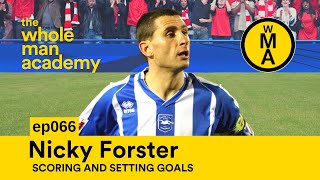
Nicky Forster, a former professional footballer, talks about penalty-taking under pressure, recovering from an ACL injury, and his five-step approach to goal-setting: start with the big picture, get specific, find your emotional why, write it down and share it, then plan the work. He credits daily rituals like cold showers and breathing exercises with building the consistency that turns goals into action.
Okay, so this is the whole Man Academy podcast. My guest today is Nicky Forster. Let's go through it. Keynote speaker, goal setting coach, former professional footballer and manager. We'll get into that. He's director of the Spot Gym and Wellness Centre in Surrey. He runs marathons, competes in triathlons. We're going to talk mindset, motivation, cold showers and men's staff. Nicky, how are you and where are you?
I'm really good, thanks, Anthony. It's a pleasure to be here. And I'm sat in my little office at the back of my wellness center in Godstone in Surrey.
Well, firstly we say thanks to Neil Mellor for making the connection, but we just speaking before we start recording this and you mentioned there were penalties and I wanted to jump straight into. We're going to talk all about mindset, but you know, how many penalties do you reckon you've taken in your professional career?
I didn't start taking them actually until slightly later on in my career. So in terms of how many have I taken? Probably 25, probably 30 penalties. I haven't actually looked into that.
So what was it like when you knew, you know, it doesn't matter necessarily, the size of the crowd, but when you know the pressure is on you, you know it's not, it's not an instinctive shot or a header or something. It is, you've got time to do the walk up and take the penalty. Talk me through what that was like for you.
Well, the really thing that you've focused on there is time. If you don't get a lot of time, whether it is a penalty or whether it's running through on goal, then it's almost the decision has to be instant. You just take the decision and it becomes an instinct thing. But when you have time, then you've got start, you've got the ability to start thinking of different options and deciding. You've got a decision making process which you've got more time to do. And that's the problem. Decision or indecision is what really sort of kills you, if you like. So in terms of a penalty, if the penalty was given, I could put the ball on the spot and the whistle was blown, I could just go and take the penalty. I was all right, but then, but the longer and the more sort of unforeseen delays there were in terms of players arguing with the referee, whether someone was injured, so you had treatment. So the longer that period went on, the more the pressure built, the more difficult it became. But from my point of view, penalties, there's no doubt about it. The emphasis, the benefit, the advantage is with the penalty taken, not the goalkeeper. So that's why you're expected to score. So I always thought, you know what, hit the target number one, which is as a striker I say when I coach young strikers or pros. Now when I do some mentoring with pros, just hit the target, that's your first thing, make the keeper make a save. Because if you miss the target you've got no chance of scoring clearly. So hit the target hard and low because that's the most difficult place I think for them to get down to. And you know what, if you do those two things, hit it in the corner hard and low and they save it. Sometimes you've got to hold your hands up, but more often than not they'll go in.
What is it like for you? Or did you miss any?
I did, I did. I don't want to talk about them today, funny ass.
Because I just think one of those, you know the, until the last World cup when we finally won a penalty shootout and you know in, in the tournament, you know we had a real terrible kind of history of it and even at a lower level of playing football myself, you know, I took a fair few penalties. Only missed I think one or two in the whole time. Yeah, it's those ones that I remembered and not that you know, I couldn't of course.
I mean it just eats away at you didn't know. And I say about that time to think and overanalyze and we talked about that before coming on sometimes that, that, that over analyze, that micro analysis as I call it sometimes just can be pretty damaging, can't it? So in terms of the missed penalties, do you know what one of the things that soon as you miss a penalty, you know there's going to be a queue in the dressing room. Next one. I'm on it. So the first row you've got is. You're not on it. I'm having the next one, you know what I mean? So you've got to try and have that sort of conversation and strong, strong arm. The next person in line to say listen, you're not having this one. If I miss the next one, I'll give it to you. But I've missed one. I've got to have the opportunity to put it right and score the next. So that was always the way. So you know there's more to it than just missing the penalty and missing a goal and possibly not winning the game. There is then the, the, the, the debate that follows about, oh, I'm on the next one. So there's lots to it. There's lots of psychological aspects to missing a penalty. And, and as I say, you're in the advantage, so you should be scoring. But thankfully I didn't miss many. Good. And I remember missing one and the referee blew because someone encroached on the box. So I had a second chance. And I remember actually it was at the Medesky Stadium, John Sulaco, who was a higher profile player than me certainly at that time, and he came and said, right, I'm taking this one. And I thought, well, if I give it to him now, that's it, I'll never be on him again. So I sort of fronted him and said, no, I'm on it. So he said, no, I'm not. Now I had the ball and as I say, possession is 9/10 of the law. So it was almost like, stick it up my jersey or hold it around the back so he couldn't get it. You know, it was that little childish game. Yeah, yeah. Really, really mature, you know, and it looked awful. I know, and it's a funny story now when I look back, although it probably didn't look great, you know, representing the club and we're arguing on the penalty spot, the ref walked over and said, which one's taking it? We both went, I am. He went, he is. So it just, it was in the end, Phil Parkinson, our captain, who was like a real sort of inspirational leader, he came over and I remember he wore a gunshield the whole time so no one could understand, he went. And everyone, we both looked at him as though, what have you just said? He went, fozzie's taking it now, let's get on with it. So he sort of went with me and I'm glad he did because I scored and, you know, and Johnny Sal was good as gold with it, so it weren't a problem. But, you know, that, that added the pressure as well because I thought, oh my God, I miss it now. Do you know what I mean?
I always love that when you do see players arguing over who's going to take a free kick. And it's the kind of, you know, the guy that actually takes it, he's on a hiding to nothing because if he scores, you know, but if he misses, it's like, well, see, that's exactly why he shouldn't have taken it. So I, I know there's, there's fights like that, you know, in, in gardens around the country with little brothers as Much as there are on the, on the Premier League, on the pitches. Well, I wanted to ask you the.
Thing, the thing with that, though, Anthony, is just that it doesn't look great. I understand that, but you know what? You'd rather three, four people wanting to take it and, and because it means. And everyone go, oh, no, I don't want to take it, I don't want to take it. You don't want a team of people that are not going to stand up. You want people who are going to stand up to the line, don't you, in that environment? Because it is a, it's a competition, it's winner takes all football. And that's, that's what sport is, isn't it?
Yeah, no, it's a good point. I think if, if you, we're going to talk about leaders, but, you know, you want to. I'm not saying you necessarily have to have a whole team of leaders because maybe there can be lots of different kind of, you know, guys trying to reach the top, but you do want that. You know, you wouldn't want anybody to shy away from taking penalties, even goalkeepers, which I was like, like to see. Well, I was going to ask you, I was looking through your Instagram and it's always good to get up. It's a window to people's soul. Having a look at social media, one of the things you'd written is it's not success or achievement or pushing myself to the limit. Not realizing my potential or looking back with regret is my greatest fear, which I thought was great. And it, quite frankly, you could have written some of our whole Man Academy letters by saying that. But talk me through about that. You know, regret, you know, not realizing your potential is your greatest regret.
Yeah, I mean, it sort of came to me one day and I thought, why do I do this? Why do I get my trainers on at 6 o' clock in the morning on a Sunday morning and go out and run a marathon on the roads and at the end of it I don't get a medal or I don't have a number. I don't have anyone cheering me on. My wife has long since, you know, moved on from being impressed. She just thinks I'm crazy, but. Or it's just a cry for help, I think she thinks. But, but why do I do it? And I just, I don't know. I've always been a goal setter. I've always set goals to myself and a lot of the things I do are related to those, obviously. But more than anything Else, why do I want to put my trainers on and do that? Why do I want to run ultra marathons? Why do I want to do ultra cycling events? Why do I want to row the Atlantic either solo or with someone else? And I think it's because I came to the decision that it was. When I look back on my life, I want to have a life where I look back on things I've done and achievements and actions that not just make me proud, but I think have been really enjoyable journeys. Because reaching the goal and creating that success is great, but the journey is sometimes more of a pleasure. And there's no doubt about it, marathon training. For anyone who's run a marathon, the hardest part is not the actual, the actual run itself. The London Marathon. Let's use that as an example. Someone, one of my clients described that as the lap of honor. The hard part is all the work that we do, the training that we do in the cold, the wet, you know, the freezing, sub, sub zero temperatures through January, February, March, April, and, and they're right. But you know what, there is something about those months that, that builds char, improves mindset. And if you can do all those things on your own, then as I say, the actual event itself, when there's thousands of people lining the roads cheering you on, you know, you deserve it. And you know, I, the answer to your question is I want to look back and remember the things I've done rather than the regret, the ones I haven't.
It's a good answer and I think it's so important because yeah, that's one of the big things we, you know, try to, we tried to create thought provoking content at the whole Man Academy for Men. And it's, and that should be about, you know, aspirational thoughts, aspirational events and the language you use in your, in your own head. But one of those always for me is about, you know, how can you look back at the end of like each year and be like, yeah, what did I do? You know, what did I do this year? And not just, oh, well, I went shopping at the weekend, I went to the gym and you know, and I went to work because for me that's, that's not something you're going to. When you're 18, you're sitting in a rocking chair having a chat, be like, wow, do you remember when I went to the gym every week and just, you know, did, did those things? So what are the, what are the things for you that you still want to do or that you've Got kind of on the old, I call it, I say bucket list because it's. People think that's like, you know, things you got to do before you die. But creating your own version of that I always think is pretty powerful.
The thing with a bucket list, bucket lists are usually things that you'd like to do, go or see. Do you know what I mean? They usually say a bucket list, I need to do a skydive or I need to go to South Africa or swim with dolphins or something like. They're usually sort of events like that. Whereas goals can be anything. They can be financial, they can be materialistic, although less and less. And as we get older we probably want less materialistic things and we want more adventures, we want more, you know, occurrences, you know, things that we can actually experiences is the word I'm looking for. But there can be lots of different goals as well, can be linked to spiritual. I know that for myself as I've got older I like to, to do a little bit more meditation and I didn't want to do that at 2025. It just didn't resonate inside me and it just wasn't something that I felt I needed to take time to stop to do. But now I feel it's important for me. So bucket list, yeah, bucket list. I like that, they're fine, there's no problem with that. But goal setting for me runs deeper than that and it is, is it covers all aspects of your life. So what am I doing at the. Sorry, what am I doing at the moment? Well I obviously one of the things at the moment is that my, my wellness center, personal training center and wellness center has been closed like most lot of businesses due to lockdown. So there's a lot of emphasis now as I gear up to open that on the 12th of April can I set myself some goals, some business related goals, scaling the business back up to where it was and beyond. So that's one of my focus points now in terms of exercise related. I'm going to do a challenge 18 June I'm going to do 100 climbs of box Hill which is an iconic sort of climb in Dorking in Surrey and I'm going to do 100 climbs of that. So that's going to be for a charity. I think I'm going to do that for mind actually I'll just touch base with them and we're going to do.
It for that sounds, sounds tiring to be honest.
Training hasn't really started for it yet.
Well I was going to ask you, where do you start with a lot of the training? And you're right, I know from, you know, doing some long distance stuff and obstacle course racing and various forms of sport yourself, sometimes it helps if you actually enjoy the training, which I always have.
Yeah.
What about yourself with the football side of it? Did you actually enjoy the training?
Yeah. I mean, it took me a little while, Anthony, to understand when I came out of football. I love football, don't get me wrong, is the best game in the world, in my view. And listen, I understand people might think differently, but that's fine. But I love football. But more than anything else, I love the physical challenge with myself. I feel it. I love the physical challenge against a defender, an opponent. I loved setting myself goals, how many can I score per game, per month, per season? So it took me a while to understand that it wasn't necessarily the game I was in love with and I wasn't a student of the game in terms of learning about formations and how we can counteract someone else's plan and, or a dangerous player. It was more about the actual physical aspect of the game, the actual challenge. And you know, it took me a while to understand that. And that's why I'm now moving towards into the areas that I've moved into, which is more mindset, which is more physicality rather than the actual technical aspect of football. And that's why I soon realized that when I went into football management, I realized, you know what, maybe this isn't the avenue I want to pursue. And although I enjoyed my time there, I decided to come out of it. You know, ultimately, in terms of, in terms of your question, I think it's, I think for me, trying to help people with their mindset, trying to help people realize their potential and take action is what is fundamentally important to me. Because I think a lot of people don't understand the power of exercise. For me is my physical therapy. And especially over the last year, what we've all had is that little bit more time. Probably most of us have had that little bit more time because we've either not commuted, if we are still working, we're not commuting, or our businesses have closed down as it has in my situation. So it's given me the chance to actually really do a lot more work on this and exercise more. And for me, I'm institutionalized. I've done it for 20 years outside in a football kit and I continue to need to do it today.
I know when we spoke to Neil Miller, he said it seemed strange when he stopped playing football because he had no one telling him what to do anymore. Yeah, you know, and you're so used to, you know, being told you, you know, you've got to be here at this time and you know, you've got, you've got training and you've got matches and you've got the whole kind of breakdown of your week and then suddenly when you, when you leave football, it's, it's taken away from you and. Well, we're going to jump onto that in a sec because I wanted to ask you, where do you start with helping someone set goals? And I know like there's that, let's say the five principles of goal setting. Or you could tell, you know, majority of our listeners, the guys that would be trying to, trying to understand a bit more about the principles of goal setting.
Well, listen, and I understand goal setting is not a new concept and everyone from the leading motivation speakers like Tony Robbins to, you know, other personal trainers like Joe Wicks, the body coach, they're all talking about how important goal setting is to a sort of high functioning life. So I understand the process is not new, but I like them. I do believe that it is just fundamental to us in terms of, as I say, realizing our potential. So this, the thing with goal setting as well is because my environment is sporting and inside the dressing room, a lot of people think that it just relates to that, but it doesn't. It is a transferable skill. It can be transferred into business. And the terminology used might well be different in terms of, rather than setting goals and we're talking miles and kilometers and things like that, we start talking about other things in business like lead generation, like conversion rates and in terms of client retention and things like that. So the different metrics, but there's no doubt about it, they're transferable. So in terms of, for me, the five principles is start with the big picture. Just think about exactly the goal that you want. And I always say to people there is really some really good exercises that you can do and one of them is just to take a piece of, piece of plain paper, just take a pencil, get yourself in a quiet space, just start to let yourself go and just start to think about everything that you would like to do, what you'd like to do. Starting from short term, can be short term, medium term, long term, and just let your pen flow across that paper and it can be random. From the minutest thing like trying out a new restaurant to the Everest of goals like buying. My buying A company out, you know what I mean? You don't even know. You don't even need to know at this point how you're going to do it. It could be that, that massive Everest goal could be cloud, you know, shrouded in cloud, so you can't even see the summit. You don't know how you're going to get there. But you know, one way or another, you know you'll find a way if you want it enough. So the first thing, start with the bigger picture. Number two is get specific. So start specifying exactly what you want to achieve. And as I say, I'll use sort of an exercise related anal analogy here because it's easy for me to do, but if someone came to see me and said I want to lose weight and get fit, it's just not specific enough. Because you could sit on an exercise bike for one hour and you could argue that at the end of the hour you'd be marginally fitter and marginally less in weight, but that wouldn't constitute being a success to them. So you've got to be specific about your goals. You've got to have an emotional attachment. So find a. Why, why do you need to, why do you want to do this if you haven't got that emotional attachment? It's really difficult. Number four is to scribble it down and share. So write it down and share it. Then you become accountable to someone. And number five is just plan the way. The most important part is to plan that that way, first step to the last step. And you will find that goals all of a sudden become a lot easier. I mean, the book, the Secret, which I'm sure many people have heard about the law of attraction and whether it's true or not, there is something about if you want something enough, you'll find a way to get. And that's what the book's all about. So I mean, for me that's, that's how I, that's how I plan it. And there are lots of other aspects to all of those that, that, that are important in goal setting.
We talk a lot about, you know, that's the thing of. Do people give themselves the gift of just sitting down and actually having a think about what they want to achieve in life. And as you say, it doesn't have to be the, you know, that you are climbing Everest, but it's, you know, it could be all these, all these little things. I just think a lot of that comes down to, you know, people have a lack of clarity because you Ask the average person you do you want in life, and often they won't actually know.
Absolutely right. Well, I did this exercise recently, an exercise with a client of mine, and I said, okay, what are your goals? And they said, I don't, don't really have goals. I said, well, of course you do. So they said, no, no, no, no, I don't really have any. So they said, I've got a few things I want to do. I said, okay, let's, let's have a look then. So we took the plain piece of paper like I said, and just started sort of talking things through. And I said, okay, so five minutes from now, let's start writing them down. So let's write those few things you want to do. So start the, started flowing. I said, I don't want the pen to stop, just keep it going. And after about 25 minutes of this exercise, they had a list of 40 goals that they wanted to do, ranging from short term goals 1 year to 5 year to 10, 20 year goals. And they were amazed. You know, the thing with goal setting is that we do it on a daily basis or most of us will be doing it on a daily basis without even thinking about it. Whether it's as small as setting your alarm clock to get, getting up in the morning to get to somewhere or going to work every day so we can pay our bills, but they're pretty meaningless goals. I mean, we never sort of go, so glad I earned enough money to pay my bills this month. I'm delighted. Well done. Good. You know, we don't, you know, they're just boring, mundane, functional goals that we, but we have a set of goals to achieve by paying our bills at the end of every month.
Yeah.
And we, and we take actions to make sure that we do that. Otherwise the trajectory of our life isn't going upwards, it's going downwards. And none of us want that. We want the trajectory. We want the graph for ourselves, for our kids, for everyone that matter to us to go in that direction.
You said the word taking action there. And that's one of the things for me. You see a lot of people kind of get excited by the, you know, the process. And I always see things like YouTube videos or the rise of people that are buying online courses, but they kind of treat them as entertainment instead of actually a manual to go. At some point you've got to actually do something. And I wondered for you when you're especially. I know you said you, you touched on being the football manager, but you know, how did you find it with motivating the, the guys around you because I know you move from being a player to a player manager and I appreciate, well, I'm guessing not I've been one, but that, that creates its own challenges because you were a teammate and then suddenly you're in charge. How did you find that?
Yeah, I mean I was, I was fortunate in the way that because I was the oldest, most experienced player in the dressing room, I was the one they asked a natural one to ask to take forward. I was at 30, I was 36 years old. So in terms of how much playing time in front of me there was, there was obviously not a lot yet. 36 years old, you know, I'm coming to the end. So it made the decision to go, do you know what? This is the time to step into the management side of things and distance myself. So I made a very clear, conscious decision straight away as soon as I was offered the, the caretaker role to, they said player manager. But I thought, you know what, it's very hard to manage from the pitch and play and concentrate on the game. So I decided straight away to say, you know what, I'll stand on the sides, I won't play. So that's what I did in terms of that, that me distancing myself from the players then created more of a, you're the players, I'm the manager. Whether you like me or dislike me, I'm here to do a job, so I'm going to do it to the best of my ability. That's not to say that I just strong arm people because that's not my style. It was. I tried to have an open door policy because players always want to know why they're not playing or why they've been dropped or why they can't do this, you know, and communication is one of the most fundamental things and very often, you know, discrepancies and divisions within management and staff, if you call them that, it's slightly different with players and management, but managements and staffs, they can be brought much, you know, divisions can be brought much closer together just by dialogue, you know, mediation. And very often people are not that far apart or not as far apart as they think they are. And so I tried to sort of keep players on side as much as possible.
I always think back to the most famous player manager I could think of was Kenny Dalglish when he was at Liverpool and transitioned into that. But I know for me, if I'd have tried to do that, I'd have always still Put myself in the team because you're like, you just want to play and no one's got it up to you. Did you have that point where for you picking the players, you know, you're, you've also guess got something that your friends as well. So that makes it even harder than if you came in as an external manager and you know, you've just got a group of guys in front of you.
Anthony it was made easier by the fact that they were playing better than I was. So it was made easier if I, you know, that's the thing as a goal scorer. You know, you need a return of goals. That's what you're there for. And I wasn't playing particularly well when I took over. So it was easy because the two guys, Charlie McDonald and Gary Alexander, the two strikers, because they were playing well, scoring goals and we were starting to improve results. So the decision was easy. But going back to your point about motivation, the thing is a lot of people say to me about you're motivated, you get up and you go out and do these runnings and you do these endurance events and how come you're so motivated? Well, I weren't born with that. None of us are born with motivation as a character trait. It isn't something you've either got it or you haven't got it. It's, it's, you know, it's a state of mind. It really is. It's a mindset and as, as a result that you can learn it. And it starts with action. Because I've always, one of the things I always say is action creates momentum which creates consistency, which leads to over time, results. Action will always lead to momentum, consistency with results or success. So in terms of motivation, I can try and motivate people as you can, but ultimately it will come down to them. They have to take that action. I can't literally run for someone or lose weight for someone or help someone. They've got to do that themselves. I can just give them the framework that helps them do that. And that's what I'm here for. That's what I do these days.
There was that saying of when people want to go to the gym and you say that you can pay as many people as you want, but I can't do your press ups for you. And I always think that's, you know, from, from doing the side of coaching men. As you say, at some point you have to take responsibility for where you are in life and where you're going and say, right, you know, I Appreciate I have to put some work in as well. What about for yourself? Because you went through, obviously you played for, I mean, clubs like Brighton, Charlton, Hull, Ipswich, Birmingham, which I'm fairly, fairly close to now. But, you know, for you, when you're actually playing for those. Did you have any times where, especially through injuries that you felt like, I don't know, you felt like you had a real lack of motivation, Literally had to have a word with yourself.
Motivation? No. Did I struggle? Yes, there were times. Did I ever. I was fortunate that I was in demand as a goal scorer. I sort of was very greedy, quick greedy and scored goals. So there was a return of goals from me. So my services were wanted. So that's. I wasn't, I wasn't ever told, you're not good enough, we don't want you, we don't like you. You know, I wasn't released, so that was, that was something I never had to cope with. Did I have other things that went against me? Yes, I did. I didn't, I wasn't. There was a period at Hull where I wasn't playing and I was training with the reserves, but I sort of just, I had the mindset, you know what, I am good enough, I'm going to work really hard. And I had a six months left to go on a contract and I thought, you know what, if it's not here, then just keep training well, just keep playing well and be ready because if you go on loan, you don't want, if you, if you, if you give up and put a bit of weight on and lose that sharpness, you go to another club who could be a possible employer, you're not going to give the best version of yourself. So I kept myself sharp for that reason, managed to get back in the team because there was a few injuries from some illness going through and got back in the team and, and carried on. I played for the rest of the season, every game, and we just, we managed to get that. This was at Hull. We managed to just stay off relegation and the following season they got promotion to the Premier League. So I ended up getting runner up player of the year, which was incredible at Christmas time because there was a period of six weeks where I hadn't even kicked a ball, you know, in a first team game. So to get that award, I thought, you know what, that's one of my better achievements because I sort of almost gone 180 degrees. Gone from not being involved at all to actually being one of the key players or, or, you know, having a Consistency in a real part of the season. But. But in terms of. In terms of my playing career, there were some real low points. There's no doubt about that. I remember playing for Reading and. And I did the whole of preseason, and in the last preseason friendly game at home against Charlton, it was actually. I damaged my cruciate ligament. So I remember tweaking my knee and. Or damaging my knee, thinking, this is not good. But I'd done it on my other knee, but I didn't think it was the same thing. So I went in for a scan, and the following Monday, Tuesday, after the game on Saturday, I remember going to Alan Pardu's office and he said, foz, it's not good. So I said, okay, so what is it? How bad is it? He said, you've done your acl, your anterior cruciate ligament. He said, you're out for the whole season. And I just, like. Because I had done the ACL on my other knee, I knew the. Oh, I just knew. I was like. And I remember welling up with tears and thinking, don't cry. Don't want to cry. I got Martin Allen, I've got Alan Pardu. I don't want to cry.
Yeah.
And I remember thinking. And he said, you won't. You won't kick a ball this season. And I remember just looking down and I said, yeah, I will. And he said, no, Foz. He said, like. He said. I said, yeah, I will. I'll play. He said, I will. I said, I will have a part to play in this season. I promise you that. And I thought, you know what? That now has become my goal.
Yeah.
And I sort of got up and just. He said, do you not want to talk? I said, no, I don't need to. I know what. I know what we're doing. Let's go. Okay. So I thought, that's my goal. That's my goal straight away. And I had the operation rehabbed, and they were doing brilliantly. The team were doing brilliantly. So it's really hard going in, watching them every other Saturday at home and scoring, winning, playing well. They were top four in the. In the league one. And I. I just rehabbed, got back, got back, and I came back. I came back with about two games to go for the from. So out of 46 games, I missed 44. Yeah. Came on, played, and I then came on. I was on the bench. We got into the playoffs against Wigan. We were. I think we were nil. Nil in the game, up. And then we were one. Nil. Down at our place with about five minutes to go. And Pards put me on, said Foz, come on. And I mean, I couldn't make it up, really. When I look back now, it sort of sends shivers down my spine because I got a penalty and no, I didn't. I crossed the ball and we scored the equalizer about two minutes after coming on. And then deep in injury time, looked like it was going to extra time. I went into the box and got brought down. Penalty. Cureton took the penalty and Roy Carroll saved it, parried it out to me and I scored. And it was voted now, I think, the greatest game at the Modayski Stadium. It's just incredible. Incredible. And jackpot. Ah, just an emotionally charged night. You know, there was a lot of atmosphere in the ground. There was a fog, you know, sitting over the pitch itself, so it's almost couldn't see from one end to the other. And, you know, cue the pandemonium when I scored that goal and we weren't going into extra time, we'd gone and we went to Millennium Stadium and for the final, but the police came on. There was a big pitch invasion. There was about a minute left to play, still in injury time, and the fans were all lined up around the edge of the pitch like old fashioned times, you know, it was, it was. It sends tingles down my spine now. And I remember getting back into the dressing room again and everyone's patting me and just felt like crying, just the release because, you know, when you have that vision, that goal and everything, and you suddenly realize it, you know, you've been strong for all those months. No, this is where I'm going. This is what I'm doing. This is how I'm going to do it. You're so focused, suddenly you can just go, oh. And just all your emotion comes out relief. Yeah. Yeah. It's just. I didn't know I. I had those emotions in me. You know what I mean?
Yeah. I wanted to ask you about that because about the appreciation, you know, it's a bit like you don't know what you've got till it's gone. And, you know, I started the podcast so I could basically talk about me all the time. And I had a collapsed lung when I was in my 20s, which meant I couldn't play football for over six months. And then when I was, you know, retrained and started playing, man, I had a new love for football like you couldn't believe, because I, at some point I didn't think I'd be able to play again. And I wonder for yourself, having those injuries and then getting back on and playing at that level, do you think you found, like, a new appreciation for being on the pitch?
There's no doubt about it, you do. And that resonates at the moment, doesn't it, with us? Because there's nothing greater than you can take away than someone's freedom. And that's what we've had over this last year, isn't it? And I've got, you know, a friend, he's just been contacted by Track and Trace, and he said, I've got to isolate now for 10 days, I think it was. And, oh, my God, he couldn't come out. He lives on his own. He's a single man. Lives on his own. And he's like, I just. I just. You know. And that day when he could come out, he just went out for a walk and he said, like, just the air. He said, like the air in my lungs. And. And just seeing a different vision than either his house or his. He had a tiny little back garden. So he said, I mean that, you know, there's nothing greater than taking away a man's freedom. And that's why they send people to jail, isn't it? You know, to take away your freedom is punishment. So. But you're right. When you can't do that thing you love or that basic fundamental thing, it's very hard, you know, and for me, that's exercise. There's no doubt about it, that's exercise. My wife knows we can go on holiday, and if I haven't exercised for 48 hours, I can be sat on the beach and she'll say to me, and she can see. I don't know what the signs are, even myself, I don't know whether I'm itching or twitching. Yeah. I don't know. She says, you want to go for a run, don't you? And I said, I do. Really? And she's so great with it now because she'll say, just go and do your thing in the morning and then come back to us, and then we can have some family time. So get. You get the thing done that you need. And I understand it's incredibly selfish, but it works for me and she understands it now.
I think it's like a form of therapy for a lot of, you know, most of the. I say most of the successful people I know. And what I mean is, I don't mean success by monetary terms or. But just that are living the life that they want. So many of Them find that, you know, whatever exercise works for them is what you know, if you're having a bit of a shit time and, or a daily routine, a morning routine. I was in the gym by a quarter to six this morning and you know, getting in, showered, replying to your email and doing these bits, it means you've got the day started. And I wondered, talking about, I just said about morning routine. When you were either playing football or even now, did you have a particular kind of one or two things that you did that just worked for you in the mornings?
Well, yeah, I mean, you know what Anthony? It's as simple as when I used to get to the ground. Whether it is a training day or whether it is a match day, you know, a training day, we'd be able to go in what we like lads. Some lads came in jeans, some lads came in tracksuits themselves. But games, we either had a club tracksuit, sort of, so a livery on the tracksuit or we had to come in smart gear. So a suit, a suit and tie. But for me, the moment I got all that off and I got my shorts on, my, my T shirt on and my socks on, I felt like a player. You know what I mean? If I'm in jeans, okay, I don't mind wearing jeans. But the moment I'm in a kit, a training kit, I feel like a player, an athlete or I feel active, I feel like I've got, I'm ready to go for a run when I need to. I might not even been going for a run, but I just feel it makes me feel good. So that really is my trigger. So yeah, I mean, yeah, I mean anyone knows me, I'm a Nike man and I wear Nike because for me their slogan just do it is just the greatest slogan of any company. And there were times like all of us where I don't want to do it and I'll say that I understand that I'm fortunate that I do like exercise. I like exercise, it gives me time. I solve all life's problems when I'm out running or cycling, I think, you know what can I make you? I've got a 10 year old son, he's got a problem. Oh, why don't we just do this? And it's just almost simplified when I'm running. I don't know whether it's an increase of oxygen and it just makes me slightly more intelligent than what? I'm not that intelligent but it makes me slightly intelligent. But, but yeah, I mean, but I understand. I mean I'm fortunate that I do like that. But the problem with, I think with people that don't enjoy exercise is they focus on, it's going to be tough, it's going to be hard. It's cold outside. I haven't run for ages, so I'm going to be really unfit, or I'm not very good at running or whatever they're chosen at. They focus on those negatives rather than at the end of it. I'm going to feel so much better. I'm going to just think, how am I going to feel when I've done it? Because I've never ever seen anyone that has come to me, done some exercise and don't feel better for it. They never go, I really wish I hadn't exercised today because I feel terrible now. Never does that happen. The endorphins are proven. And you mentioned a shower after you've had your exercise in the morning. Shower is proven to lift our mood, make our feel better. So there are triggers that can really help. And focusing on those positives, like, I'll feel better when I finished, I can have a shower, I'll feel better after that, and then I can attack the rest of the day. There's no doubt about it. If you focus on those, then they are powerful motivators.
So it's a really important point there because, you know, I know for some people, actually, I remember, you know, just before we recorded this, we spoke about Leon McKenzie. And I remember when Leon spoke at our event, which was out our first or second event, I think we did, which like two years ago now. But, you know, he said when he went through a really difficult time, he really found it hard to just get out of bed. But he said, you know, you kind of focus on what can I do? And it sounds. It might to somebody sound ridiculous, but he's like, can I. Can I wiggle my fingers? Yes. What can I do next? What can I do next? And having those little targets or goals in the morning, you know, can just, we've all woken up and had a crap night's sleep. Or being the father of two little squeakers. I know what it's like when you get woken up, you know, time after time after time. Well, that brought me on to talking of kind of showers, Wim Hof. And I know on your Instagram you'd mentioned him and we've been following his stuff. There was two questions there. One is, do you. Do you get involved with kind of cold showers or anything? Or also, did you have to do the ice baths? When you were playing.
Well, the answer is yes to both of those. Yeah, I mean, I was introduced to Wim Hof just about eight months ago now and I knew nothing of him previous and I went on a residential course and one of the guys there was one of the, he's a Wim Hof instructor. He has been to the Academy of Wim Hof and has been qualified and done the amount of hours that makes him qualified to teach the technique. If any of you don't know about Wim Hof, he is a guy, his story is really, really incredible. I mean, he lost his wife. I think his wife suffered from bipolar or some sort of health, mental health related issue and she took her own life. Sadly, he had, I think three or four children. So he was left on his own to manage his life and to manage his children, the upbringing of his children. And he had, he liked cold water therapy. And then he started to use this breathing meditation and breathing discipline where you breathe a number of times in and out, out in short succession, and then hold your breath when you breathe out on a certain number. So 30 breaths. 30 to 40 breaths and then you hold your breath called the breath retention. I'm not a Wim Hof practicer, so I'm not in terms of. I'm not a teacher, so you'd need to look this up more. But. And then you do that, three or four rounds of that and then you follow that with a cold bath or cold shower. So yeah, we had cold ice baths and just incredibly stupid to say, incredibly cold, but almost painfully cold, but incredibly awakening, incredibly enlivening, incredibly empowering. And you know what? I thought, you know what? There's something in this. So I continued it. I thought, I'm going to continue this for a month and see how I go with this. And. And here I am sort of just under a year later and I still do it. So I now do three rounds of breathing, Wim Hof breathing method every day and I have a cold shower every morning. So I'll have a two minute cold shower, two minute warm shower and a two minute cold shower after that and then I'll jump out and I feel great, Feel great.
Let me ask you, do you, do you. Does your brain try and find an excuse on certain mornings why you're running late or why it's why you shouldn't have a cold shower and then you have to have a word with someone yourself and go, no, for fuck's sake. Like, because I do.
Yeah.
Some mornings you enjoy. Other mornings, once You've done it, it's enjoyable. But I'll be like, oh, I'm, you know, I've got to do this, I've got to do that. I haven't got time. You're like, no, no, no, no, no, no. Hold on a minute, hold on.
Well, that's, that's exactly what I said when I say exercise. Some people don't like exercise. And I get that. And there are times where I get up and think, shall I miss it today? And I. And it's, do you know what? I get periods almost. It's sort of cyclical, like life is, you know, and it's, there's times where I'm like, now I'm fine, let's go and do this. This is great. I'm looking forward to where you don't just get the odd day, you get a phase, a spell, you know, two weeks where you're like, shall I miss it today? But, you know, I've got a diary that I keep each day and I write down and I tick if I've done it and I tick if I don't. And I think to myself, if you don't do it though, you won't be ticking your diary. I know it's crazy, but that is my motivation, motivator. I want to tick every day. I've done the Wim Hof breathing, I've done the cold shower. And for me it's looking forward to how am I going to feel if I don't versus how am I going to feel if I do? I don't like the actual two minutes. Although, do you know what? Every time I'm into it, I get into about a minute of it and I think this actually isn't too bad. And that's life, isn't it? In lots of ways. The anticipation, how we build it up. Certainly at school, you know, when we're kids, we do that, you know, you've got to go and see the teacher and you're like, oh, no. Oh yeah. But very rarely is it as bad as you think it's going to be. And, and you know, I'm sure people will understand and they can relate to that. And that's the same with the cold showers. You get used to them.
I always say, try it, you know, not just for one day because we, we, we spoke about it, I don't know, months ago on, on the whole Man Academy letter and that I, I write every week. Again, thought provoking content for men. And you're always trying to suggest little, you know, Little things they could try. And I got a few replies back and a couple of guys were like, yeah, I tried it, never doing it again. Other guys were like, wow. I felt so invigorated afterwards that I had, you know, a high level of productivity all morning or maybe all day, but because I'd, I'd done that and I was like, exactly. You know, you've got to try these things, not just for one day, but to try and, you know, a bit of consistency. Same as football training, isn't it? You got to be consistent. You can't have one good training session and be like, yeah, I've made it.
It in anything you do, whether it's weight loss, whether it's training for something, whether it is spirituality, consistency will lead to success. But true story, when I started doing these and I'd often get up early and that's, that's the way I do it. I get up fairly early and do it before my wife wakes up and I'll take a cup of tea up first. And she noticed within about a week, she said, I can tell you've had a cold shower. And I said, said how? She said, I can just. I don't know whether it's. I don't know if it's a feel. I can feel an energy or something. I can feel you're really awake more than I did. And she couldn't put her finger on it. And I don't know what she meant because I wasn't experiencing it, but she said, I can sense there's a difference. And that was, that was scary.
Really, Whatever it takes.
Yeah, absolutely.
That's the thing, isn't it, that getting up in the morning and starting the day the right way, I think just has a domino or knock on effect for the rest of the day. And, you know, we talk a lot about morning routine at the Holtman Academy. Just because you're like, you know what, no matter what's going on in life, if you can, you're in control of your morning routine. And if you can have those early wins, that's a, you know, like you said, a tick in the, in the box. Now, I wrote down the difference between, or the fine line between confidence and arrogance. Because I know with footballers especially, you know, you can have someone like Cristiano Ronaldo who, you could say he's arrogant, but actually he's highly confident because he spent 10,000 hours doing his free kicks and his headers and his penalties and what have you. How have you kind of, you know, navigated that one through life. Not just for yourself, but I know, like for your stepson. Plays for Charlton as well.
Yeah.
So trying to kind of mentor him as to the difference between the two.
You know, I understand that the characters like Cristiano Ronaldo and Zlatan Ibrahimovic is a great example in the football world. They divide opinion because some people love them, love their mentality, other people hate it. It just goes against their grain. And for me, I'm somewhere in the middle of both of those. You know, I was never that arrogant, but I did have an edge to me. And I think if you took away that from someone like Ian Wright, he would be half the player that he was. So. So certainly those. Those guys. Those people. Those people. Not, not just guys, but anyone, male or female, at the top of their game, they very often need that little edge and they've got that little edge that sets them apart. They've got the extra gene that makes them special, talent wise, but they've also got that edge. Otherwise they're not. Not at the top of their game for as long as they have. You look at Djokovic and Federer and people like that, you know, they're at the top of their game for time. And the Williams sisters, you know, they're the same. They've got something in terms of. I think in lots of ways, professional sport is a show nowadays, and when people talk about money, I try not to get in the money debate with people, but it invariably comes up because some people think it's fair and other thinking people think it's grossly unfair. But if you look at it in terms of an entertainment industry, which I think it's on par with nowadays, it's on par with the rock stars and it's on par with the top actors and actresses. So their pay probably should be in line whether it's immoral or not. Yeah, I think that's a separate. That's a separate debate, because whether someone should be paid 10 pounds an hour for nursing and things for saving people's lives and helping people fundamentally like that. Whereas someone else can sing on stage and earn 5 million for a night. Yeah, Is that. That. That's a different debate. But should they be paid Will, like the rest, in line with the entertainment industry? Yes, I think they probably should. So these people. These people have to have a certain level of arrogance to be able to get themselves up there in front of all those people, because a lot of people just physically couldn't do it or would not feel comfortable doing it. And power and success does breed that we see that with politicians all the time in terms of they just almost then lose touch and it just becomes they're so used to making decisions and having people do as they say, then they lose touch with that softness and that side where they connect with, with, with other people. And that's when the majority of the population then feel let down by these people because they don't feel they're reflecting what they want. So in terms of, when I lead into that with mentoring of players and I've done it with my stepson, my son Jake, who plays at Charlton, like you said, you know, we talk about that, you know, your mindset's got to be right, but just make sure that, you know, we're not, we're not offending others by our actions. We've got to, we, you know, you, you've got to have that edge about you to set you aside and, and to, for that graph to go that way, which is what we want. He's 26 years old and he's still got, you know, the graph wants to be going in that direction. So there's no doubt about it though. It's a trade off.
It is, isn't it? And I, I think there's trying to think back to, you know, even as, as I was growing up, like Eric Canton, you know, collar, collar up, scores goals, you know, some people hated him, some people loved him, but I always used to look at that and be like, yes, he, you know, some people see that as arrogant, but I see that as a, it's just confident that he's, I know he's, he was one of the greats, to be honest. And that, that lead me on to. With yourself playing, you know, for different clubs, I just wondered who were the, who are the plays that stood out for you in the years you were playing.
In terms of, in terms of. I can answer that in a number of ways. In terms of the actual out and out ability as a player. I think Peter Unlove, when I was in with him at Birmingham was just, he just had something, he just had like this, this, this extra flair, this extra skill and did things at times that was like, wow, don't even know how you, I don't know, I don't even know where I'd start. I don't even know which leg you used for that, let alone actually trying to recreate it. But, but mate, he's a lovely guy. But when he was playing at Birmingham, same club, there was a period where he just, he just grew into this almost like an extra. He grew an extra 2 inches in stature. He walked tall, he had a strut about him. And I mean, I remember one of the coaches said, coy, he looks like an international at the moment. Yeah. You know, I mean, he just had this awe around him that he was playing well, he was fit, he was on fire. You know, he was scoring goals, taking on shots, and they were coming off. You know, everything was flying in. And I looked and I thought. And. And that's the first time I thought, I know what you're talking about. He's just. He's just taking himself to another level and we're all below that level. You know, I was vying for a position alongside him or his place. You know, there was about four or five of us. Peter and Love, Dele, Adebola, Paul Furlong, myself, Brian Hughes, we were all vying for two slots and there were six of us and. And I think the rest of us thought us 5 are now only vying for one spot here because he was just, you know, you couldn't leave him out. It's just brilliant. So in terms of just that aura that we're talking about, that mindset, that was the best example I saw of it, actually, in my team. I mean, I was lucky enough to play with. With David beckham for under 21s. Yeah, it was just. Just on the tip of the verge of that meteoric rise. It was this summer we played an under 21 tournament in Toulon, and it was the. The summer that after that he went into the season and scored the goal pretty much straight away in August from halfway line against Palace. So he was just about to. Poof. He was just standing on the launch pad. And even then I could tell there was an aura about him as well. He was two years younger than us, so he'd been put up a couple of years. He was 21, 19 or 20, I think, so. Excuse me. But even then, and he wasn't big time, and he was in a dressing room where he was younger, which is a difficult thing to step into when you've got older players, and he still had an aura about him. He had an air of. Of quality and charm about him even then. And. But he was. He was a really nice guy. Really nice guy. Wasn't, wasn't. Flash, wasn't brash, wasn't. I'm the man. Just. Just a really nice guy.
He's gone on to have a fairly.
Quiet life, so all our lives have gone pretty much parallel from there. Anthony, as you can see, well, he.
Lives Just up the road to now he's probably, probably about 10 minutes away up in the Cotswold. So I know he's always at, you know, one or two of the establishments and stuff. So it's amazing to see, you know, with the, with the football team in the, in the US and stuff. It, it shows with that there, doesn't it? You can start off being a normal lad from, you know, wherever in the UK and if you wrote that out and said I'm going to write this story, people say that's just too far fetched so we won't, you know, especially after he got sent off and they were burning effigies of him outside pubs and stuff like that. If you'd have said back then people would laugh in your face.
Trouble is when you see players, footballers on a football pitch, whether you see politicians, you know, you know, Obama and people like that standing on lecterns and, or stages and plinths and giving speeches, they seem so far away, such a million miles away. You watch Tiger woods on a course and that. But fundamentally they are no different than the rest of us. They've got two arms, two eyes, one nose, one mouth, you know, two legs. They're the same. Yeah. They might have a gene that just sets them aside, just makes them that little bit special, but they are and it just the same and it always amazes me and I'm always humbled when I see someone or meet someone that's famous. I'm in their presence and I come back and say, and it's almost like you want to tell someone a certain say they're actually just really nice person, quite normal and are they going to be, what do you expect them to be? You know, walking around like celebrating like they've scored in, in front of 80,000 people when they're sitting in front of you just having a chat in a supermarket. Yeah, it's, it's almost. They've got a game face and then they've got their, their normal face and you know, there's nothing better than meeting someone that you look up to in terms of, you know, high them, hold them on a high pedestal and finding they're actually really good person.
Well, I was going to ask, I wrote down the word heroes because I always take kind of notes and say for you, you know, I said that growing up. For me, you know, I remember when it was John Barnes, Peter Beardsley and Rush were the, were the Liverpool players that I, you know, used to follow and look up to. I just wondered for you as you Grant, was there one particular footballer, one particular team that you kind of, you know, nailed your colors to.
Well, West Ham fans. So we're good with disappointments. We're used to disappointments being West Ham fans. So we can't believe it at the moment. We keep thinking, when are we going to slide? You know, because that's our mentality as West Ham fans. But we're doing really well. But I know you're a fellow. I know. Well, I know you're similar to Neil Mellor. You're a Liverpool fan. As you've said today, Kevin Keegan, for me, was the one. And I remember having the one year for Christmas, asked for the England kit, the white kit with the blue band and then the red bit or, sorry, the white kit with the band that runs across the chest. Yeah. And my mum, you couldn't get printed numbers on names in those days, so my mum embroidered a number seven on the back of it. And for me, he was, he was my hero growing up as a, as a child, as a. As a professional. The other one, the one I really looked up to and I thought, you know what, he's the man is Shearer. You know, for me, he. I mean, obviously he's the leading Premier League goalscorer, but he's the one that I sort of looked and thought, you know what? That's, that's how I should be. And that. And that relates quite nicely back to penalties where we started off today, because he, for me, he's the one that took the best penalty. No, none of these dinks, none of these chips, none of these little tiny. Trying to make the keepers look silly. He just smashed it hard or low or smashed it in. He chose where he was going to go, smashed it as hard as he could and if they saved it, fair play. But yeah, I think many, I don't think many did, did they?
No, I used to. What's the way, you know, put. Put his foot through it. Yeah, well, I'll blow, I'll blow a bit of smoke here because I was watching your. On YouTube youTubers collection of some of your goals and one of my thoughts was that a lot of them were quite Shearer esque because you were scoring with your header. You're getting into places where other people might think and some good right foot. So I'll give you the Shearer, like finisher Anthony.
I'll take it. That's it. Conversation over. We're done.
That's a podcast finish.
Welcome to Alan Shearer. That's perfect. That's all I was Looking for.
Well, talking of strikers, my last question is. Well, it's going to be longer than a question, but Clive Mendonca, did you ever know him, play with him, against him or anything?
No, I played against him. Didn't know him, but I, I played with players from Charlton. Steve Brown was. Came to Brighton Reading and played a number of times. So he played with him. Played with him when he scored in the game where he scored the, the hat trick against Sunderland. Was it. I can't remember the.
Yeah.
Or was it Bolton? Can't remember, but they, yeah, they played the, the final at Wembley when I think he scored a hat trick. Clive Mendonca.
Yeah. Well, my, my best friend Tom, who I know will be listening, he basically had a love affair, you know, unbeknownst to Clive Mendonca, to state the obvious, because Tom's happily married. But we played. Tom was part of the Charlton supporters club and they had their own little football team and they were shit. So they asked me if I would play because I was slightly better. So we played at the, we actually played at the Valley, which was probably my first experience of playing on a proper pitch. You know, that was just, just. Even though it was, I know I don't think it was Premier League, but the point was you could look away and you knew the ball was going to roll to your foot because it was, it was so nice. But I allowed Tom to have one, one question for you. Which was what was your most memorable goal that you scored?
Most memorable goal I scored. I think probably one of the, probably one of the best ones was Sheffield United away. And it was, I think a Friday night on Sky. It was. We were both right at the top of the league. They were, they were probably, their squad was probably, it's fair to say, slightly better than ours. They had some, some probably bigger names and we beat them 1 nil. We always seem to do well against them, always seem to score. And you talk about my goals. A lot of my goals were either running through, using my pace, running away from defenders or in and around the box. I never scored many long distance goals, you know, so Shearer's got a compilation of, of goals where he's smashing them in from 30, 40 yards. Never, ever did other than this one here. And, and, and so I'll take that, I'll take the, like, the, the, the, the reference to Alan Shearer and I'll add this goal to it because it's the only one goal that I scored from distance. All the others were, I mean, I was pretty good in, in the air for my height because I'm only 5 10, so it's fairly small compared to a lot of the defenders. But I was actually deceptively good. I had a good spring and so I, I think defenders thought that they would beat me easily, so I sometimes could get a run on them. And I scored a lot of goals in my head like Shira did, but this was my only long distance one. So it was live on Sky Black kit for Reading and I, I smashed it and it flew into the top right corner and we won 1 nil. So I'll take that one.
I'm gonna, I'm gonna write it down as. I'll do a little bit of homework on that when, when we finish. But. Well, last question for you is if you had to give, you know, the guys that are listening from all different countries as well. So we've got guys in the US and Canada in various kind of random places around the world. If you had to give them kind of one bit of advice on how to do life better, something that's worked for you, what would you say?
Okay, I'm going to go back to what I said and I'm going to reiterate what I said is that Nikes just do it. And that starts with action. Okay. Action creates momentum, leads to consistency. Consistency over time will equal success of whatever you choose to do.
Sounds good to me. Lovely. Well, I, I'd like to invite you at some point. We do our whole man academy zoom calls once a month on either Wednesday or Thursday night and it'd be great. I always say to the guys, if ever you'll be able to join us for even if it's half an hour and just chat to the guys about either goal setting, side of it or just sometimes they like to hear from someone that's played football or run a huge business or done something. So yeah, it's really good to speak.
To, to you 100%. Let me know when and I'll be there.
Lovely. Right, well, Nikki, I appreciate all your time, squire, and we will speak to you soon.
Anthony, lovely, thanks very much.
Thank you.










