EP097 - STEVE NICKEL - STRENGTH IN LIFE | WHOLE MAN ACADEMY
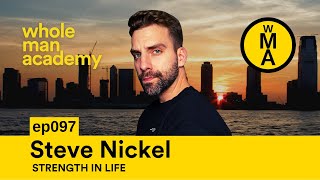
Episode 97 of the Whole Man Academy podcast: a conversational interview with strength coach Steve Nickell about his path from baseball to strength & conditioning, coaching influences (notably Charles Poliquin), and practical approaches to assessing and retraining busy men. The discussion covers lifestyle factors that shape men's health — sleep, screen time, diet (advocating high-protein/high-fat breakfasts with quality red meat), strength training to combat sarcopenia, mentorship, parenting, and mental resilience. Steve emphasizes communication-first assessments, growth mindset, efficient habits, and the importance of strength (physical and character) across life stages.
Whole Man Academy. Because the world needs strong men. Whole Man Academy is changing the game for men around the world. It's for guys who want to live an epic life of fun and adventure. No matter what we believe, deep down, all men want to go on their own hero's journey to becoming resilient, confident, fearless and fulfilled. Listening to be inspired by guys who don't settle for living a life of mediocrity. This is your call to action and call to adventure.
Are you ready? Okay. So this is the Whole Man Academy podcast, episode 97. My guest today is Steve Nickell. He's a strength coach. I've checked that one. We're going to talk all about lifestyle, fitness, nutrition, mindset, relationships, mentorship, everything in between. Steve, how are you and where are you, mate?
I'm doing well, thank you. I appreciate you for having me on. I think it's an amazing cause and amazing program that you put together. As far as the Whole Man Academy. I'm based out of Bergen county, which is New Jersey in America. I know across the pond over here. So we're over here sitting in a little bit of snow and some nice ice. So it's a good way to set the tone for the day.
Yeah, it was interesting when we just spoke before we started recording that you said about snow because today's the first day in the UK where it's been.
It's.
It's nice and sunny out and I actually, for about an hour today, I sat out in the garden with the kids, which was just to feel the sun on your face after. It feels like, you know, five months of winter. Surprising how, how good it is for your mood. I mean, is it, is it extremely cold? What's the snow like out there? Is it a fluttering? Because, you know, we're shit over here with snow.
You know what it's sitting at 30 to 35 degrees Fahrenheit. So at that point, it's a mix between rain, sleet, snow, and everything iced overnight. So it's like trying to get everything off of the windshields and trying to get the cars going. It's kind of like an eh. But it's fun to know. At least we switched as far as demographic, geographic, weather and stuff. So that's always good.
I know you've got a baby on the way as well, which we're going to get onto. But let's talk about, you know, when I kind of research the guys we're talking to from all different parts of the world, sometimes it's best to just like start with the basics. And I know you've written on your Instagram, it's about the persistent dedication to optimizing your life. So tell us a little bit about your background. How did you get to this level of being kind of, I would say, an elite strength coach?
Gotcha. Well, it has to go all the way back to essentially, you know, I was a baseball player. So in baseball, it's always a game of adjustments, right. And it's a game of failure. And the one who makes the least amount of failure or errors is essentially going to be the one who wins. Right. Being able to on the fly, be able to make adjustments within the game of baseball. Right. So always having to deal with failure, adversity, 70% of your craft and your time, you're essentially still going to be considered a Hall of Famer. So it's that ability to deal with adversity and failure and all these things that kind of shape the character of who you are at the end of the day. Right. So as a baseball player, I just got into the whole love of the physiology of the body and how the mind works and how physically you're able to acquire greatness within a sport like that. Right. So I went to school for, initially, I went to school to be an engineer, so I wanted to get into engineering. I love math, I love science. I can't do much of anything else as far as academics, but I do love science, I do love math. So that was essentially where I was getting onto the path of. And then I ended up stumbling into a team, a scout team with baseball in high school, about my sophomore year, the Long Island Tigers, because I'm essentially, I'm from Long Island, Long Island, New York. So I get into the team a few practices in and my mom starts talking to the other moms and they all start chit chatting about what they do after the games and after practice. And it was a gym, there was a performance institute in the area that they worked out at and they were all like friends and stuff for years through high school. So my mom comes home one day with this idea. Now, I've always been a lover of the weights. My dad was a big boxer in the past. He was also a fan of bodybuilding. So I was into the Dorian Yates. Then it went back to the Mike Metzner's and then it went back to the Arthur Jones. So I was into this like approach that was a little bit more on a scientific approach. It wasn't just the wider principles of just volume and just do work, do work in Arnold, Mike Metzner and Arthur Jones brought out these paradigms of working eccentrically and efforts and failure and lower rep ranges and less frequent training. So it was always something that sparked me because I always liked that, that difference. I always liked being the outlier and trying to figure out things on a different perspective, right? So we go into this facility. I agreed. I was like, yeah, you know what, let's go try it out. So I go and they do something called evaluation. I'm like, valuation. I mean, I know I love to train with weights and stuff, right? So I walk in and then it's like, okay, sit on the table. A whole bunch of length tension tests. How does your mobility or all your joints, they go through body fat testing, strength testing, and then you leave the place, like with an evaluation of where you're at currently, which is exactly that for a blueprint for the future. Right now, here's me architecturally thinking, engineering and stuff. It's like, no, the body moves like this and it doesn't move like that because there's the inhibition. So I learned all this stuff at this facility. So I was like, wow, this is engineering of the body, just on a physiology standpoint. So I said, you know what, I'm going to switch all my classes in my electives for school and high school and, and start preparing and maybe get ready for athletic training and physical therapy and just get into the. Involved in the industry, right? So I'm a baseball player going to college, not necessarily going to college for academics, but I did find through not the gym training there and all their principles, I stumble across a guy who was able to get me into a facility, into a university that I was able to play baseball and still have that background of physical therapy. So I go there four years, three out of four years. We were in the World Series, it was all American through SUNY Cortland, which is a university, upstate New York, played four very successful years, ended up getting inducted into the hall of Fame over there, which is really cool and really neat. Super proud of that because it's a great institution. It's a program that is run by a coach, Coach Joe Brown, hall of Fame coach in the state of New York and just is just on another level. And going through four years there, I started really getting into the science of training. And where I was training, I got into, who essentially became my mentor, Charles Polquin and a lot of his writings and methods. One of the most successful strength coaches in Olympic sense. Now he has trained over 800 and something Olympians. He's got medals across the board. But one of the very successful things that he has done is he has as a coach, coached 26 gold medals in 26 different sports. Yeah, Nobody, I don't think, is going to probably touch that because it's not just being very successful in one area, but it's having that wide base of success within the Olympic standpoint. So then my studies became all about trying to learn everything about this guy. I have graduation. I play another year or two of independent baseball, which is not necessarily affiliated, but it's independent baseball. I traveled a ton on the road up and down the east coast of America, and I ended up back in Long island working for the facility that I started training at.
Right.
Within the four years that I was there, I mean, we would see 600 athletes a week. It would be for three of us and some interns working with them. High level, just NCAA Division 1 Olympians, Olympic hopefuls, professional athletes, and also high school athletes developing to their scholarships.
Right.
This is where I learned everything on the job. Get thrown into it, don't ask questions, research it later, but just execute, execute, execute some very fine principles. After executing, you go back and you start doing your studies, your research and getting into what is the bulk of, you know, essentially strength and conditioning, really understanding physiology. After the four years there, I ended up, My wife got a job. I ended up having to move on. And while I was in that transition, I determined to say, listen, who is the top of the field? It's Charles Polkman. What am I going to do to become the best? Well, I'm not going to waste my time with anything but going and traveling, eating, speaking, sleeping and hanging out with the best. Because at the end of the day, you're the average of the five people you're around. So I said, you know what? I'm going to punch a few plane tickets. I'm going to travel with this guy. I've been to Canada, I've been to parts of America. I've been all across this area. And I've met so many unbelievable individuals from all across the world, many different countries. And what I saw was there's a lot of base principles of what strength and conditioning is and what strength is. And a lot of times it's usually the same information regurgitated a few more times just to sell a fat at the end of the day. Right. But what I realized is that everybody has these different perspectives on the same information. And that is where true, like, I guess greatness or knowledge really comes from. And that's how you progress in industry is understanding the same basic level of knowledge at an elite level, what said 12 different times from 12 different people in 12 different countries with 12 different perspectives and even 12 different results, because it's never always the same result, even though you apply the same information. So it was something that just drove me to try to find the way to optimize every single individual that ever come into my gym, and when I consult with them and try to understand where they come from, from the vast knowledge of relationships that I've built over the years and the experiences I've had. So you could say it all started from baseball and now we're here, and it's the everlasting or the persistent dedication to optimizing your life. But understanding that the amount of just information out there, you have to go and acquire it. You have to go out there and find it in different ways. And I think I'm at a point now where I'm just obsessed with progression, progress over everything. So at the end of the day, these relationships is what gets you that next inch and then the next inch and then the next inch inside the industry, or that goes across all boards, too.
I think it's funny because you mentioned Charles Poliquin, because further down our list of questions, I'd noticed that you had mentioned him on your Instagram. And I realized when I saw him, I was like, I know this guy. And I realized that I'd watched a interview with him, you know, several years ago with Brian Rose on London Real, which was, I think, about an hour's interview. And. And Brian, I went. I went through their podcast course. So I've kind of, you know, followed a lot of what he's done. And, and I, Yeah, when I was looking up Charles Pollock, you know, ultimately came back to being like the greatest strength coach on the planet. And I know he died in, was it kind of 2018?
It was 2018. 2018.
And I was. I was interested to listen when he said, when he was talking on the London Real podcast, one of the biggest problems, like in the uk, because he was saying that the strength of it was actually the mainstream media because they're not pushing out the right information. And I mean, we know the mainstream media, as far as I'm concerned, is a disgrace because they're always pushing out fear, fear, fear at the moment. Anyway. I know he kind of said, you've got to find the best training system for you. So how do you, let's say, say, you know, a guy comes to you now, where do you start with assessing him. Is it doing testing? Is it like scientific tests? Or you kind of just using your untrained eye or your trained eye to work out, like, where he is with his body.
Communication is number one. I never do anything other than sit down at the table face to face, and I ask just very basic questions. You'd be very surprised. I mean, what's the old adage? You have two ears and one mouth, so you might as well listen more than you speak, right?
Yeah.
Even though we're on a podcast and we're speaking a lot. Right. But you ask questions, and you ask the right question based on the information they give you. They're coming with an intention to walk in and to better themselves in some facet. They're also coming from some sort of life. They're having some sort of experience that may not necessarily be positive, or maybe they are and they're just trying to elevate or optimize their life, Right?
Yeah.
Conversation and communication. They will essentially tell you exactly what is wrong, what they need. You just, in a sense, need to reflect your experience with a situation like that. So a lot of times when they come in, it's all like, oh, I just want to lose weight and, you know, build muscle, and I just want to feel better. Nobody wants to be an elitist at the end of the day, as far as general population is concerned. So a typical man will come in, he has kids, he has a full on schedule. A lot of the people I deal with are downtown, kind of like downtown New York City. Guys, CEOs, hedge fund guys, and executives and stuff. And they come in and they just want to feel better. They want to feel strong. They just want this feeling. Because a lot of times they detach themselves from a physical standpoint based on the kind of work that they do and what's expected of them. So you need to understand where they are at first. What is the problem? We need to find a solution. And a lot of times they'll tell you exactly what the rut they're in, and then you use experience to be able to get them out of it. You know, I've had a lot of people talk about, well, I just don't sleep. I just don't do this. I don't feel good. I can't necessarily focus. I just want to put on muscle and lose fat. All right, let's get to the root cause. How is your sleep? You know, it's hard to go to sleep, but I sleep through the night. Okay, do you sleep through the Night, Is there wake ups? Is there interruptions? Do you wake up to pee? Oh, I pee like four or five times a night. All right, well that's an issue. We can't red flag. Exactly. And then you try to get a gauge on their morning, their lifestyle, how they live their life, what they do, how their day looks. Because a lot of these guys, every minute for the most part is going to be scheduled out from whether it's their assistant or job or themselves, you know, at the end of the day as well. What's that?
I assume they're sitting down at a desk for a lot as well.
And then you add to the thing. So a lot of the commonalities, especially since this whole boom, these last two years, three years into the digital world, as far as working from home, a majority of people last three years have a lot of the same issues. Athletes as well, because a lot of the fields, a lot of the practices, a lot of teams had to shut down for a certain amount of time. So a lot of time is spent even in school on the sit down position. And then you start realizing people's blood pressure is going up there. There's certain tensions that are going on their body, they're very common, they're having the same ailments. Oh, my back really hurts, my outside of my kneecap is hurting, my neck is hurting. There's something going. So when you have all these, you know, these experiences and stuff and they come in and you sit down, talk, and then you basically saying, so I can essentially predict your day. So you're probably wake up in the morning, maybe you have the crick in the neck, you wake up, you sit down, you're sitting down for eight hours, you forget to eat. Now all of a sudden your blood sugar's starting to do this drop and then you're stressing and then all of a sudden it's like. So there's a lot of things that they will tell you to really try to find solutions for them. And it all starts with communication. First you got to sit down and you got to have a conversation. And then from there that console turns into an evaluation on the table. Lie down and I'll go through a lot of length tension tests and understand where their discrepancies are as far as ailments. And like the shoulders, the neck, the knees, and I'll just move their bodies because there's a certain communication that you'll feel when people have restricted joints, restricted muscles, restrict anything. And you know, if they're stressed, there's going to be constant tension on the body as well, too.
Well, I was just going to say about that because I think back to, you know, I used to spend, let's say, roughly 200 hours a month at my desk, and then you'd be out for nights out. And I guess it's trying to find that. That balance between them. It's their wellness as well as them coming in, just doing. Doing strength work. Because also, I guess you're. You're dealing with guys that maybe you've got kids, and as you know yourself, kids fuck your sleep up like you wouldn't believe.
You wouldn't even know.
Yeah, I guess, is it. Part of it is adaptability. As they come and see, you're literally assessing where they are that day as opposed to their kind of overall, you know, if they've had a shit night's sleep.
Well, a lot of men, I think, are essentially creatures of habit, right. It's always trying to find routines and trying to find comfort within routine. And sometimes if you throw it out just a little bit, we get this anger and this rage. And I think I'm saying it for a lot of guys.
Yeah.
But a lot of it, you know, a lot of people do come in, a lot of mindsets like that that are dopamine dominant are very intense, very type A. They're essentially doing too much, and it's too much exposure to strength training. It's too much cardio, maybe it's too much phone, maybe it's too much work. It's just too much of everything. And one thing you got to understand is that flame. Let's think of a lantern or with oil, right? And that flame, the intensity of the flame and the duration of flame is all predicated on what is the oil. So if you think about Yang, the flame, yin is the reserves that are going to help that flame be controlled. A lot of guys only only focus on Yang activities. That's exposure to constantly thinking, constantly working, constantly doing this, constantly going back to doping. Receptors are being exhausted from the actual screens and technology nowadays, and then they're trying to offset it with stress. So now they're stress and wired. So what they're going to essentially do is do more training in the gym because they're trying to do more, do more, do more, instead of just pulling it back just a little bit, take one step back and make a leap forward. Those are the important things I've seen, and that is the most common thing with every man that walks in outside of sport. But, you know, all the way from 30 to 50 to 60 years old, they're just trying to do too much. And sometimes if you just scale back, find balance, find a reference point, you have a lot of ability to work with with just basic stuff.
It's, there's so much for, I mean, let's assume that it's a professional guy listening to this, trying to find that balance between the work time, the, you know, looking after your health. Maybe you've got, whether it's just a partner and, or kids as well. It is a real kind of juggling act, isn't it, to try and I always say like, it's a bit like trying to keep all these plates spinning and more. So some of the entrepreneurs that I know, you know, when you, for often when you're running your own company or you're working for yourself, you don't just finish at 5:00 and go home, there's always something else to do. So yeah, that's, that's one of the common things. I did a talk, what, two, two days ago for Company and it was basically told why it's good for men to talk. But one of the big things is about guys having so much going on in their life and then you've got social media and you know, being addicted to that kind of stuff. Of course, yes, it's a. What I was going to ask you then, what's your relationship with social media? Because there's so many, you know, I really like your stuff you do online because there's so many guys online who seem to just be posting pictures with their tops off to hope that people want to work with them. Whereas I would look at someone and be like, yeah, but show me what you're actually about. You know, what's the, what's the grit you've gotten you? Not just whether you've got amazing six pack or something like that.
Of course. And you know what, it comes back to the point that you're not just that physical aspect. You know, there's many areas to this life of what a man is considered and you know, you make a good point. A lot of men don't talk. A lot of men don't talk about their feelings or their plans or whatever, their inspirations, aspirations, it doesn't matter. They really don't talk. And having that honesty sometimes allows that confidence kind of fall through them and just flow out into everybody, inspire people. My biggest thing is I always want, I love to educate and I love to inspire. Now inspiration can come from many different ways, but being an example or leading by example is one particular way to do it. And then education. I am very much in love with just education and teaching people how to get out of those ruts and teaching people how to give them the power. Not always about holding hands, because you need to teach them so that when I'm not available in person, you're able to make those educated decisions while you're out there into the world, you know? And it goes back to what you were just saying as far as guys trying to find balance with everything. Well, it's not always about balance. Don't worry about balance. Worry about being efficient with what you do. And it all goes back to what your priority is. Priority means one, what is the one thing you're really focused on for, let's say, Q1, maybe you're getting thinking about Q2, what is your focus this week, which then you can kind of reverse engineer into each day? Listen, you know, I remember what, three years ago, before I moved into this current location, I was in. I was at a location where I was 50 minutes away in traffic. I had a kid on the way. And now I'm lost on both ends of the day. I got to work, but then it's too far to get the brakes in. So I decided, what is my party? What matters to me? Well, what matters to me is my family first. I'm a husband first, I'm a. I'm a father second or whatever. I'm a family man first. Right. I want time with them. So how do I reverse engineer a life that I can imagine by doing these things? And it's about being efficient with your time. Well, that is not being efficient time sending traffic. So I ended up coming closer to where we live and built a business out of here. Now, not everybody has that ability to do it. I decided that that's what I wanted to do. So I turned around right in the beginning of COVID Well, who knew? I opened a business right before COVID right. And I saw it's an opportunity too, right. Because I'm sitting there restarting, and then all these things are happening. So I had to really find ways to be efficient with my time. And that's what the goal is for men. You guys are juggling so many things at one time. But what is it that I have control of right now that I can have minimal effort and have maximum return? It's called being functionally lazy. Right. So you got to think about what's the minimal amount of effort I can do right now with the maximum amount of result. For example, Waking up first thing in the morning and maybe just having a brain dump in voice and recording on your voice memos, maybe that gets some of that anxiety that you have before bed and you can't necessarily get through the night for sleep. Maybe when you wake up and first thing in the morning, you just get it all out. That initiates a circadian rhythm for the entire day. Maybe when you wake up, you don't turn all the lights on. Maybe you open the windows if it's dark, you just maybe sit in darkness, maybe get a little amber light going on. But it's these little things. Breakfast. Breakfast. One of your most important meals of the day. Why? Because it dictates your neurotransmitters for the rest of the day. What you put in your mouth first thing, provided it's food, is going to dictate what your energy is going to be like for the rest of the day, what your performance is going to be like for the rest of the day, what your focus is going to be for the entire day. What that leads into is the second meal effect. Studies have shown back in the 80s that what you choose first thing in the morning to eat will influence what you choose second part of the day or the second meal of the day. And that has everything that goes back into insulin management, stress management. Now we're starting to create these small little habits of morning that are going to start dictating the rest of the day leading into maybe somebody who can't sleep at night because they have anxiety. It's constantly rolling through. All I think about is work. I'm thinking about the future, I'm thinking about the past. I'm thinking about. Nobody's ever really like stopping in the mood, you know what I mean? In the moment. And we live in three different dimensions, right? We live in imagination or we live in memory. We live in the present and we live in imagination. And that accessibility on both sides, you're never really present. You're either thinking about, you're either depressed or anxiety about what happened potentially and what may happen in the future. And that's the definition of anxiety, too. So. So it all goes back to what can I do right now in my life that I could just have maximum amount of result with one small change. And then you build those wins. And that domino effect over time.
I think that's often sound podcast. Sometimes people need to rewind it a couple of minutes and listen to it all again to make sure it soaks in. Because that is so important. I know from either some of the guys with the whole man academy and. Or kind of friends and guys you talk to or when you do talks for companies and then guys contact you and they're like, I've got so much going on, I feel like my mind is racing at, you know, 100 miles an hour. And I always try and say to them, like, you know, depends on what works for you. But how can you at least kind of find some time to quieten your mind, as you say? It's funny, actually, I've never said this before, but when I go into the gym in the morning, I'm lucky we've got a really big home gym, but I don't put the lights on. We have just one little light in the corner. And yes, I've fallen over kettlebells before because it's dark, but generally it's like first thing morning. I don't want the big bright lights on. It's just like, it's quite moody lighting. And you have some music on so you can train without feeling like it's the glare. So it's another option for guys, you know, in the morning. Just say if. As long as you. You can do is. Is put some. Put some lighter light on as opposed to something that's too bright for you. Well, I'll tell you what I wanted to ask you when we. I was going to talk about mentorship in a minute also for the guys you spoke to, but I wondered for you, what's your. What. What was your relationship like with your dad? Because I really don't know anything about you in that respect. And because some guys I speak to are like, they did or didn't know their father. I know Joe Rodones, who I spoke to, what, a couple of weeks ago from New York was like, his dad was a massive part for him of growing up and supporting him. So what about yourself?
You know, it's interesting because, you know, he's been such a massive part and you don't realize these things till later in life that all of a sudden you're like, I guess I'm a lot more like him than ever before, you know, and then you start realizing a lot of the character and the way my intensity is and the way I approach certain things with the mentality does stem from those earlier years with him.
Yeah.
And my dad, super strong. He's got old man strength since he was a kid, I guess, at that point. But I know old man strength is real because there is not a day I'll be able to take this guy out. Right. But he Was an old time boxer, used to roll with some, you know, professional fighters and some high level amateurs in Gold Gloves in the area in New York. And you know, he was a boxer, he was strong. First he, he had bricks for fists. And you know, here's an example, like one of the things that he taught me as young as a kid, and this is not a bad day, it's a good thing. But as a kid, you know, you want, you want to be strong, you want strong knuckles. You're going to go on the concrete wall in the basement after we're done training. Now I'm like 12, 13 years old. It's not like I'm four years old and I'm getting this kind of information, right? Yeah, what he said, what you do is you just nice and easy, you just punch the concrete wall and you build calluses and you build strength in your hand. And what's funny is that wild mentality is what is life of being a man. It's the constant beat against the wall that's going to build these calluses up for the future. That's character. That's the chip off the old block, right? So my dad was very strong. He showed me how to be strong. But he also showed me the light of how to always respect people. Not only just respect your elders, but respect people. Because you don't know what they're going through. You don't know the kind of shoes they're walking in. You know, it's always greeted with a very firm handshake, a direct point right into the eye. And you look at them and you give them that respect. Because you know what, we're all equal here. We're all equal here. And everybody just has different experiences and that's all it is, you know. So he taught me how to be extremely strong. And he also taught me how to work hard, you know, very hard. Because he still to this day. Listen, you don't use gloves when you work construction, right? No, you're supposed to use gloves. But he's like worry about, just grab it and toss it, you know, he took you the value of getting, you know, putting your hands in the dirt and actually having, you know, some sort of work ethic. You know, he taught me everything in that sense through action. He didn't have to sit down and tell me, I just watched it. And he's still, he's what, he's going to be 64 this year and he's still out there doing the work, doing his own thing, and he's sitting there building Houses. I mean, we just went through a full renovation of our house and we did it ourselves day by day by day with help from our brothers and you know, our brothers, our in laws and everybody around. But you know, every single day just doing work and, you know, it says a lot because that's my persistent constant obsession moving forward. Right. And always trying to be, in a sense, successful. But, you know, that's also a relative term.
It's so interesting again, coming up to, you know, nearly 100 interviews now with, with guys from all different kind of backgrounds. You know, I don't always ask the guys about their fathers, but it's been really interesting seeing that the relationship because, and I've said before on podcasts, even for my own kind of personal friendship group, the guys that even in their own admittance would say that they're a bit up and have got some issues, it's usually because they didn't have a father around or their father basically was around and just didn't give a about them.
Yeah.
And I think it's so powerful if you've got, as Joe Radonna said, you know, I'm lucky I've got. My dad's still here and he's, you know, very strong man in that respect. I think it can, it really helps you. And that's why I find mentorship so important these days. Because even if, you know, if you haven't, doesn't mean that your dad has to be strong, etc. But if you can find someone who doesn't necessarily replace your dad, but can bring some of those qualities. I always remember, I mean, we lived on a farm when I was, from when I was like 7 until I was about 16. And one day I was at school and they came in and like the, the school secretary came into class and was like, as to the teacher and she was like, oh, Anthony, you've. Your mum's here to pick you up, you've got to go. And I was like, right. And what happened is my dad was using a post rammer to do some fencing on his own because guys were like, I don't need help, I'll just do this. And he smashed himself on the head with a post rammer and he split his head open, like, bit of his tongue off, chipped his teeth, you know, was, was at the back door, the stable door with blood coming out of it. And they took him to hospital, stitched it back up. Now, I would wager that most men today would basically take a week off work and would be like sitting There watching Netflix, you with some potato chips. My dad was out the next day building stables with stitches. And he was just like, well, work. It's not that you have to keep on working. But he was like, I'm fine. You know, I stitch me back up, just push me out and I'll go again. And I see that so different to the, especially when I see some of the guys in their 20s and 30s these days who are, I don't know, don't have any grit and determination and work ethic about them. And it's as if it's by design because you see, you know, the media, I don't know, kind of maybe create slightly softer men and. Yeah, in the U.S. i guess you see that as well.
Well, you see the, the victimization or the victim syndrome, right. Everybody's a victim all of a sudden. Everybody gets to complain about it, get their 15 minutes of faith, getting sympathy, and then that's their dopamine boost. You know why? Because they're, they're now resistant to dopamine hits. And it really does come back down to, as a man, testosterone. And the depleted testosterone levels of what each generation has over the last few decades is becoming more and more apparent now. Look at the lifestyle and how everybody lives. It's more so spending time on the screen, the chin is down and we're sitting there playing on the phone all day, you know, and not only are we depleting all of our dopamine receptors be because of the blue light, the radiation effects, it's also having a cascade effect on our hormones. And as a man, you need more testosterone than estrogen. And what you're starting to see is aromatization. And a lot of men, and a lot of men that come in, I do skin fold evaluations because health does come from the inside, then out. But the outside has a communication, if you look properly about what's going on internally and what you're noticing is a lot of the soft chests out there, I wouldn't say the real term that everybody really knows about, but you essentially see very soft chest, almost like a female chest. And that is due to the fact that they're aromatizing. There's a lot more estrogen being built up in men than testosterone. And where does that come from? It comes from lifestyle. It comes from how much blue light you're being exposed to, how much screen time you're having throughout the day, how much light you're not getting anymore. And then you're also not eating properly with the high quality foods. Nobody's really training hard anymore. Everybody's all about this Instagram hack where it's got to look good. Stick your ass out, maybe do one like, you know, recording of you doing beast mode. And at the end of the day when you can't even do 1.5 times your body weight, it's not necessarily beast mode. You'd be lucky if that's a warm up at the end of the day for real strong individuals. So when we look at these things and these other factors, I just start seeing people become more victims because they don't have dopamine receptors. So they need the sympathy to feel better about themselves instead of just finding a way not to be victims. Victim. Maybe you do eat more protein than you do processed foods and goods. Maybe you do manage your insulin and that's going to manage your stress, and stress is not going to deplete your testosterone. This is a game of lifestyle. The things. And this is what brought me into this position because I'm starting to notice, guys, the man today is the one who makes a lot of money, who sits at a desk and watches a screen all day go, tick, tick, tick, tick. That's not a man. You may provide a certain numerical value, like a, like a, like money and stuff, but what else? You. What? Where's the content? Where's. Where's anything? Is there anything of you being a man to be like?
Where's the warrior?
Yeah, exactly. How could you be in a good relationship? Are you even awake all day? Are you even present all day to be a good father? Are you even present?
Steve, you just said that. Are you even awake all day? And it's so funny because even one of the guys I'm kind of working with, he owns a company and he's like coming to the company and he's got a load of guys in his office and one of them asleep on the desk. And he literally was like, yeah, are you doing.
And this is the first thing in the morning, right? Yeah.
And. And you're just like. And he's like, what are you doing?
Well, you know what he's doing? He's succumbing to the fact the, the environment that he provided himself with first thing in the morning. He probably either didn't have any breakfast, didn't have any nutrients to wake him up, or he's sitting there chugging orange juice and flipping waffles first thing in the morning. And that alone is not only going to elevate your insulin, but it's going to mismanage your hormonal. Cascade for the day. And the amount of fat you have is going to direct correlation to how anabolic you are, how manly you are or how much muscle you have, which in turn is going to be things for aging, things for testosterone development. You know, there are two very specific things or factors that people look at later in life that determine aging and that's sarcopenia and osteopenia. And this is why it's so important that the gym is the base foundation. It's not the end of the game, it's a means to the end. And to me, being strong in a gym gives you confidence. But the reaction you see that is the importance, the results you see is important because it's based off strength. Now osteopenia and sarcopenia is the loss of muscle and the loss of strength. Those are two factors that you'll notice as you age. Those are two factors that need to be focused on to slow down. You don't want to increase those things, you don't want to increase the loss of muscle and you don't want to increase the loss of strength. So utilize strength in terms to bring back the muscle, to conserve the muscle. And that alone could be anti aging in itself. Now you're here longer for your kids. Now you have more violent, just energy. You're not the, you know, the slumped up over the desk at 9am when you should be the most productive and the most energized and the most awake.
Yeah, that's, you know, I always find interesting following different guys. And I said on the, on the E letter I write the other day. I see myself as a researcher of great men now because I look all around the world for guys. You know, I saw your stuff and I was like, hey, I like this guy. I like what he's about. He's got good energy about him. And sometimes you find guys that are in their 60s and 70s who are still super strong, great shape, etc, and you're like. Then you look at if a guy is in his 20s or 30s, like you've got no excuse at all, you know. And the problem is I think it comes down to education as well, doesn't it? Because sometimes people. One of my biggest frustrations, I've said this for years and also, you know, my partner's a naturopathic nutritionist. So she's, you know, spent was it eight years now working with people on their health and optimizing it. One of my big frustrations is when people are making the effort but doing the wrong thing because you like Listen, kudos for you for spending money, spending the time, but you're kind of like running in the wrong direction.
Correct.
So I guess for you, sometimes you feel like you're writing things that they've learned that are wrong, if that makes sense.
You know what it is? It's. You only know what you know, right?
Yeah.
But the people that keep chipping away will eventually get to that point.
Point.
You know, it's the same thing with baseball you always see or any sport. You see everybody peak at a really early age. And those are the guys that go. And then they built it all on talent, they built it all in their skill, and it just kind of fades out. What you see is the guys who start a little later, bloom a little later, continue to bang their heads against it, and they have this, this obsession to catch that guy. Before they know it, they've gone all the way up through it. Because it's the constant chipping away. It's the constant growth mindset. It's not that fixed mindset. It's the growth mindset. So those guys that are just putting in the effort, eventually it's going to break. Something positive is going to come their way because they won't stop until they find it. And that's the growth mindset. That book by Carl Dweck. Mindset. Very important to understand growth mindset. You see success in everything, or at least you can understand that somehow, some way in the future, this point of information is going to help me exponentially improve my life, whether it's from a physical standpoint, mental, emotional, relationship standpoint, or connections. Like, that's how businesses are built. Businesses are built on connection. It's built on conversations you had maybe 10 years ago. You know, you just never, you just never quite know when that's going to come back around in a positive way.
That's a really important point, actually, because, funny, in the last two or three weeks, those kind of things have happened to me. Where it's someone from. I, I'm talking at an event tomorrow. It's a men's panel. And actually I'm gonna, I'm gonna tell you a question that they've put on the, on the event at the end of the podcast, which is kind of one of the best questions I've ever heard. But that was actually someone from five or six years ago that I was at a Tony Robbins event in, I think it's Miami, who, five years later, they're now hosting the event tomorrow. And I'm there speaking, like you say, you never know when this connection, who you've got, you know, is. You stay in touch with people, kind of comes out of it. But okay, I want to question. We, you know, on Instagram, I said to guys, you can, you can ask questions. One of them was about what is your favorite breakfast? Now I'm gonna say, because I know that you might ask me for me, I thought about this. You know, a. A full English breakfast for us is sausage, bacon, eggs, beans, toast, black pudding. If you even know what black pudding is and only imagine at this point. Yes.
That list.
If I told you it's. It's basically kind of blood, you know, congealed blood, which has got a lot of. I think it's iron in it and stuff. But what about yourself? I'm thinking there could be some meat in here somewhere.
Well, let me tell you, that's a star studded cast you got there at the first meal of the day, I'll tell you that much. You know, for me, my favorite. Now, at a base level, the thing that you want to do is increase energy. I'm going to give you a little background about why I choose these things. You want to improve dopamine and acetylcholine first thing in the morning. That's your creativity, that's your focus, that is your energy. And those are called neurotransmitters. They're chemicals inside the brain that are induced when you have these certain lifestyle factors that you apply to your life. Right. So with breakfast being the first thing in the morning, you want to have that positive cascade of energy, focus, and all the clarity you could potentially have to be better at your job, be a better husband, be a better father, be a better mother, brother, whatever.
Yeah.
So a high protein, high fat breakfast and then maybe a carbohydrate, depending on if you earned it or not, or if you're lean enough that has a low insulin load. So my favorite breakfast is going to be a red meat because there's enough nutrients in there as far as breaking down for increasing yang type factors inside of the brain versus what maybe a white meat may have. So the most optimal first thing in the morning is a red meat. It could be ground beef. It could be some sort of wild, wild protein such as yak. It could be beef, it could be bison, it could just be a regular steak, whatever cut it may be.
Yeah.
Secondary is going to be the fat. Now, if you choose a proper state that has fat that is from a clean source, that saturated fat will be a positive cascade for your hormones because cholesterol is your precursor to your hormones in a positive way. However, if you bring in dirty meat, that's where everybody talks about red meats being bad. Well, because you're eating grass fed, inflamed cow meats. But if you have high quality grass fed beef in the morning, it can have a positive reaction from the endocrine system. So it's a red meat first thing in the morning. That helps your focus and it drives the blood sugar up just a little bit. Okay. Your fat is what sustains the blood sugar and doesn't have the rampant drive and then drop. That's throughout the day.
That's love.
So a fat could either either come from avocado, which is my favorite, or you could do a nut source, or you can do like cashews, Brazil nuts, pistachios, and each one having different influences on the brain as well. And then I utilize dark berries, so I'll either do blackberries, blueberries. I'd even do a little bit of strawberry as well too. But I typically have that as well. So those are my three points for the most elite breakfast that I will be able to focus the best, perform the best, and stay as lean as I need to be throughout the entire year.
I'll tell you why it's important because after my, you know, many, many, many years of working in the city, imagine all the mornings where, you know, everybody bought various breakfasts in. And sometimes people would look because I'd make like overnight oats or I'd have literally chopped up steak and I'd have scrambled egg and steak and avocado or something. And I used to say to guys, you know, could you have. Instead of stopping at McDonald's and getting a. Basically a pound of shit? Because that's what it was. You know, there's no quality in that. Like you say, you know, we're so conditioned that people have the beige food. So it would be cereal, it would be toast, it would be crumpets, it would be, you know, any of that stuff. And I'd be like, could you have some mackerel, some turkey slices, some salmon, you know, smoked salmon, eggs, etc. And I ended up sometimes making breakfast for some of the other guys on the desk because they kind of didn't prepare for it. But then I would be energized for the day instead of like you say, you know, 10 o', clock, otherwise you're like, oh, I need to eat something. So, you know, always for guys listening. And I'm lucky that Emma makes my breakfast most of the Time if I'm, I come in and she's like made me something really. You know, sometimes it's got lots of like organic nut butter on it or something. But. And the important thing like you said, is about the quality because.
Right.
I would say from, especially from learning more and more about the shite that is pumped into animals these days that like you said, just things like grass fed, if you're, if you're talking about the meats or as best organic as you can, can make a big difference because otherwise people are eating, saying, oh, I'm eating meat. And you're like, yeah, but it's, it's crap. It's not the good quality stuff. So that's another thing for guys to think about. Now I want to talk about a guy which you all have. I've taken inspiration from Greg Plitt.
Yes.
Now for the guys that I think I've mentioned on a podcast before. But I went through a phase when I worked in the city where I'd found his YouTube stuff and I was like, fuck out. This guy is awesome. So I had this saying in my head when I was going out, if I was offered certain foods or drinks that I knew weren't optimal, but I was tempted. I had this same. I had what would Greg do? And I'll be like, well, he eat it? Yeah, he wouldn't eat it. So I'm not so. And it's like finding what works for you. But tell me what your kind of how you first heard about Greg Plitton, what kind of impact he maybe had on yourself with training and lifestyle.
Correct. So when I got out of baseball or retired, I got dove in strength conditioning. I loved bodybuilding. My dad introduced me to bodybuilding with the magazines. We'd be in the basement working out, constantly clanging iron. But I always had this like, you know, this like inspiration from bodybuilding first, which got me into the gym, which then got me to performance.
Yeah.
Coming out of or during at least the tail end of college and getting towards that, that graduation. And I graduated in 2010. I stopped playing baseball. 2011, 2012. So that's when I started really getting into strength conditioning and actually coaching. So I'm coming into my 10th year of coaching, which is pretty cool. Our nice little anniversary. I always thought that strength conditioning is a very academic, very. Not bland, I don't want to say bland, but it's a lot of education and a lot of times that doesn't always translate to inspiration. And I always love inspiration and watching people Now I got all this energy. So it's like, what can I kind of feel off of? Going back to your email. Researchers of great men, it's very important that you do see them. For examples. Like, my baseline comes from strength, hard work, work ethic, that's all from my father. But that's what gets you that, that step in the door. And what you start seeing is you start gravitating towards certain people at certain times in your life based on what you're going through at that moment. So at that moment I was at a crossroads. I was retiring from baseball, transitioning this passion into this strength and conditioning. This like academic world, which is all about learning and observing and test gets and revise. And I didn't really. I was like, I need some sort of performance measure. So I got into fitness modeling. Fitness. I guess at the time, it was before they called it men's physique in the NPCs and the IFBBs. But I was into WBFF. That's another one you guys probably know of over there. And it was about fitness modeling. And it was like, I'm always been into bodybuilding. So I started thinking, you know what, as I'm doing this, I'm going to be the example for say, athletes. Even though it's a performance standpoint, I'll be the example of what it needs to be. So I ended up finding this inspiration through this guy, Greg Plitt. I'm like, who's this? It was Greg Plitt. It was Rob Riches at the time, over from your guys way. It was James Ellis. It was all these, these certain characters. But Greg wasn't a competitor. Greg had a mindset. Greg had this inspiration. Greg had these words that would splice through you and create this energy you didn't think you had, you know. And he comes from background in military, so he's like. And he broke off because he. At the same token, I don't think he realized like, you know, it was like it was too structured. He just needed to be out and just go, you know, and this crazy energy. So me and this intern that I had at the facility back in Long Islands started watching his videos, like on his membership site. And it was like every week I'd work 8 in the morning till about 10pm at night. I mean, I'm doing about 60 to 70 hours. We were just doing work, right?
Yeah.
So at the end of the night, I got no responsibility other than like, I am the life. So I'm training and at the same time listening to this guy talk and start yelling at you and start giving this inspiration, these pearls and this wisdom. And then it became this personality. So I had the ability to be like this, like, guy who had this personality. I could explain in this certain way and have this energy about it and make this sometimes what could be bland, boring, strength training, information, and make it more inspiring and make it a little more edgy and make it a little bit more of a communicated piece. And I started thinking like, that research is a great man. I started becoming this, like this Charles Polquin. Not becoming him, but utilizing a lot of his strategies and information and presenting it in a way that was like Greg Plitt. And I just took it from there. And then it just, you know, it's that, that growth mindset then you're trying to find. Now, one thing I did realize, and this goes for a lot of people out there, is that if you ever want to do something, just go and do it. And what, what does that mean necessarily? What's the lesson I learned? Greg Plitt was a big inspiration from afar. I never met him. I never had the chance to meet him. He died in 15. I got out of this and into it about 2011, 2012. So on the back end, I did three fitness competitions. I won two of them. And then in NPC, I competed and I placed well. I wasn't no top 10. I was top 15, but it was all on the back end. It would have been nice to been like, you're the guy at 10 o' clock at night I trained and listened to, and you're the guy who got my ass out of bed first thing in the morning. You're the guy who gives me inspiration to be a part of this industry. Right? And that's the energy I get from. I never got the chance to shake his hand. I never got a chance to meet him. I never got a chance to speak to him. So when he died, I realized, whoa, hold on, I'm going to find the best guy. I already know who it is. I'm going to him. I checked in about three or four trips that year. I was in Toronto twice. I was in Colorado and then I saw him. No, I was in Toronto twice and two times in Colorado that year. And I went and just learned from him. I had breakfast with him, with the other guys and the other connections. I made sure I shook everybody's hand. I made sure I was a part of every possible scenario. I could be with this guy. And I listened. I just sat back. I could be, now there's a guy in your area and he started in your area. Now he's on a few different continents at this point. He's got some of the best personal training in the world. It's ultimate performance with Nick Mitchell. He was one of those guys in the early on onsets to start developing his own business based on some of the influences from Charles. Right. I got to sit down at breakfast with him. He leads all the personal training in the UK for, you know, in other countries too as well. Charles, a guy, Juan Carlos, Samoa, he's out of the Dominican Republic. I had a guy from Germany, Australia and just sat down and just did this with my coffee.
Absorbing.
Didn'T say a word. You didn't need to because you absorb the conversations they had.
Yeah.
That alone was more education than my four years university. And that taught me the lessons of failure. What not to do the things that you know. And that's always been the question. It's like, if you had to do it again, would you do it again Also, what things did you do that fell that you'll never do again, which made you make the right decision? You always got to look at failure as an opportunity. You never lose, you learn. And you got to learn from those failures from the best guys that are doing it 30 years from now, you know, because, you know, 30 years my age, 20 years my age, I could get information that it took them 30 years to get right now. And that's what I always made a point of. And it was probably one of the best decisions I've ever made as far as a business standpoint and a professional standpoint because it allowed me to go get all the information accelerated. 30 years of info in one week, one sit down, one conversation. And it goes for a lot of people because now I have these calls and conversations with guys outside of this country that massively shape like how I am today as well too because like I said in the beginning, it's all the same information. It's just how you perceive things and then how you present it to the individual at the other side of the table. Now it goes back to the conversations. I've had plenty of experiences and stories. I guarantee you on the other side of that table, they're going through something that I've seen before or heard about before for and we can get on this relationship, we can relate on this terms and then you can provide some sort of solution for them. And that's where a lot of the success comes from in there.
I love listening to this because even as you were saying about kind of sitting around a Table with these guys. It reminds me of the importance of either mentorship. And often what I try to say people is, you know, you don't have to even have met the people or they don't even need to be alive for them to be a possible mentor because you've got, you know, you've got the digital products these days. But just getting around those guys that maybe are, you know, have done what you want to do or, you know, have, have failed lots and lots of times at the things you're looking for and have learned from, I think is so, so important and probably nothing that's. I'd never really thought of that in my 20s or even my 30s until I got into personal development. And the guys I'd hang around with or I'd speak to at events who would. It's not all about money, but maybe they had a great business or they living a life of freedom and they'd be like, oh, well, actually that guy might be 40 or 50, but there was a guy 10 years or 20 years his senior who he learned from. And I'm like, I need to, I need to get around these people more. But that's why I think it's great. I mean, I, I laugh with Greg Plitt because, yeah, for me it was. I loved his YouTube videos and I would just have them on. And days when you thought, I can't be asked to go to the gym, you put that on and 10 minutes later you're like, I'm changed, I'm getting down there. So if guys. Yeah, Unfortunately, Greg. Yeah. Died in. Was it 2015, was it?
Or. Yeah, 2015.
Which is nuts because he got run over by train, didn't he?
Filming a protein or an energy drink commercial or something, as far as the reports are, you know, said. But he was trying to film a commercial, essentially. And this is. Obviously you hear about the reports, and he tried to beat the train and, and he didn't, you know, unfortunately. But he always said, if you remember, if you listen, he'll never die sitting on a couch, sulking in his misery. He's gonna die in action. He's gonna die trying to accomplish something and try to go for something, something that he believes in. So he went out.
It was a kind of a fucked up and powerful story of, like you say, his background and then to kind of what happened at the end. Yeah, but. Well, I'll tell you what I thought was really interesting. I saw something the other day and I'm just trying to think where I saw it, but it said this hard times create strong men. Strong men create good times. Good times create weak men. Weak men create hard times. And it's like I look around at our world leaders at the moment, especially in this country. I mean, we've got such weak men in power, you know, who are out of shape, lie a lot. You know, just. It's quite sad, really. But I just wanted for you with not just the guys that kind of you're hanging around with, but how much of that do you see at the moment? That, you know, life is very easy for a lot of people. It's very, you know, you press a button and people drop your food off at your door and, you know, everything can be kind of done for you. So what's your thoughts on that at the moment?
You know, essentially, I'm in an area where you have a lot of that. That, I guess, silver spoon, right? A lot of people have a lot of things given to them. Especially I work with young athletes all the way up to the ones that are the fathers giving it to the kids. You know, you gotta realize, like, you need to be the break on it. Be powerful enough in yourself to be the break for your kids or be the one that understands all of that, what you just said, and try not to allow it to happen. What does that mean? It's teaching the principles and the fundamentals of being a proper human, about being strong and independent. It's about letting your kid fail a little bit. Let the kid fall, let the kid do whatever. But always there's a lesson always to be attached to it. Right. And that's where you come in as a parent. It's to teach them that failure is okay and it's essential for success.
Yeah.
You only know what you know. And if you don't know how to fail, you'll never know how to fully succeed. Because the best people in the world have had some sort of battle or failure or issue to be able to get where they are at. But you also have to understand that if you're at a position where you're able to give, you still need to understand that there are fundamentals of what I believe, parenting. You can never tell anybody how to parent anybody. But I think you need to teach kids how to fail, how to be strong and independent. That, to me, I think, can shape them to become more wanting to accumulate more information and more knowledge. Like, go out there and fail and find out if it hurts. Well, now you know what not to do. Don't jump off that ladder again. Don't jump. You know, but you'll never know it until you experience it. And that goes for success, too. So you still got to also give them the opportunity to win as well, you know, I think it's a good balance between. Between those powers, you know? Well, you.
I mean, we know. You know, you've obviously got two kids. You've got another one on the way, and, you know, we've got two boys. Whether we have another one or not, I would say if you guarantee it was going to be a girl, the third one, then I'd say yes. I'm not sure if I need a third boy to add to, but, you know, we're having that, say, battle. It's a battle for me and my partner, Emma, with, With ourselves. Because you're so indoctrinated, maybe by how you were brought up and to then try and be very much more. Kind of like, no, hold on, you know, you. You allow the child to grow into themselves. And our two boys, you know, are only two and a half and four and a half, but already sometimes I find myself telling them what they should do. And then I'm like, no, no, hold on. Or Emil said to me, hold on. Like, you got to let them make their own mistakes. Let them fall. Yeah. Instead of being like, no, I'll put you on the swings. You, like, let them fucking climb on the swing. And if they fall off, they won't do it again. Right. I get you. So what was it like for you, being a dad? Because, you know, again, not just being a dad of one, but now it's two, and then soon to be three. So how did that change life for you?
The absolute best I'm going to say is lightly. But some may understand what I'm going to say. It made things a lot easier. Right now. What do I mean by that? Well, now I know that the extra noise and the extra efforts and the extra things that you do, that is not necessarily priority become non priority. You just open up spots. Your whole day is now predicated around taking care of a human being. And then you multiply. And then you multiply it. Right. And it's unpredictable. All we can do is provide insight and keep them safe. Here's my wisdom. Here's some insight. We're going to keep you safe. If you fall, we'll always be here, no matter what. Unconditional love, it doesn't matter. We're always in your corner. But going back to it, it's like it made things easier in the sense that all the noise doesn't clutter your Brain no more. Things become very fine, focused. And the big difference between people that are successful is the ability to focus. In my opinion, my outlook and my perspective on having kids, it made things so much easier to focus on because now certain conversations don't matter no more. Now certain things that may freak you out don't matter no more. The only thing that matters is being to provide a life for these kids. And it's like, all right, well, how's my day look? Well, I know every day I want to pick them up, have dinner at the table with my family. And I know that my day is essentially a certain time dedicated to business and then dedicated to my own sanity, which is my first thing in the morning piece. You know, I wake up at 4am two hours earlier than I need to be at the gym. But it's a time for me to just the world shut off and I get into this mindset and whatever it is that I do, I do everything that has nothing to do with family, has nothing to do with my business or my brand or what I'm doing at the current moment. It is completely like hobby esque. And it provides me a sense of self and what I can do essentially. And then it's the rest of the day. But I don't concern myself with negative things. I don't concern myself with things that just aren't going to get me anywhere forward for the next 24 hours. And that's what I mean by making it easier. It makes things really clear on what matters in this life.
That's a great answer. And what I've found has been so funny having kids is, you know, they, they're so present in the moment to state the obvious that you, you know, they don't care about the other stuff, they don't care about being late, they don't care about the consequences stuff. Often when we're trying to say, come on, we've got to go and they're so busy kind of just enjoying what's here and they switched everything else. I'm like, I wish I could be a bit more like that.
That. Yeah.
But you know, I'm, I'm a work in progress. Okay, well, last question. And let's, let's. Because I'm good. I think I might be asked this tomorrow and I haven't really thought about my answer, but at this event I'm on the panel for. They said that this would be the question maybe at the end and they said if you knew you had the listening ears of every woman in the world. For a minute, and you could tell all the women in the world one thing. What would you say? And I was like, hell, that's a good question.
Talk about on the spot.
All right, I'll tell you what. What's your thing about it? I realized in my head, I was like, it would be something along the lines of, most men want women to embrace their femininity. And it hasn't got to be that you're battling with a man. It's about, you know, because I saw that in the city that some of the women were trying to kind of be boshy and be super strong, and you'd be like, actually be better just being, you know, being okay in your femininity. And you kind of generally take guys apart the knees if you embrace that instead of trying to compete with guys in that respect.
Gotcha. So I'm gonna. I'm gonna speak on behalf of me, speaking to my daughter, speaking to my. My wife. I. I'm a girl dad now. So I'm surrounded and outnumbered in here.
Yeah.
If I had the ears of every woman in the world to whatever say, it's literally, it's going to be, you are enough. Yeah, you are enough. You do enough. You are enough. And everything you do is enough. Because I think what you have conversations a lot of females, and, you know, they're trying to do too many things, and they think they're just never enough. They're never a good enough mother, never good enough wife, never good enough at the job, never good enough. And the moment you realize all your efforts put in are enough, the more you can love thyself, which essentially is femininity. Yeah, femininity sitting there with a tongue twister. Right. But to have that security and that confidence of who you are and what you are, you have to realize your efforts are rewarded. They are enough. You can't be everything for everybody until you are you for you. And then you could be the best mother ahead. And that goes across with men, too. Yeah, you are enough. Do realize, accept it. And the faster time you accept it, the more forward you could go in this life, and the happier will be too, as well.
Even I always say, you know, selfishly, the podcasts are for the guys that listen around the world. But I take so many golden nuggets out of the different things. And I know when I was speaking to Craig Castelletto two weeks ago, I know the former kind of police detective in the States, and he said about, you know, going to your partner saying, how can I make your day? A ten. And I was like, that's cool. Because they're not saying you have to do it every day, but even if you now and again were like, okay, what could I do? You're going to learn something. But I think after this, I know Emerald will be providing or should be cooking some, you know, delicious, nutritious dinner for the boys and oh yeah, I'll have a chapter and say, you know, discuss what we've just talked about saying, you know, do you, do you think you're enough? Because as far as I'm concerned, you know, she's an incredible. She gets up early, she does her workouts, she listens to stuff while she's cooking breakfast, lunch and dinners. She provides me with stuff. She deals with the boys, she's home educated them as well. She has to deal with work stuff. And I'm like, hell, does she realize that she's doing all this stuff and she's more than enough. So that's what I'm going to take. Take out this in the next five minutes. Now. I'll say this, Steve, I think we've got another podcast in this at some point.
Brother Part 2, 3, 4, 12 and Matt, it is a trilogy coming yet.
Yeah, it could be a Lord of the Rings type thing, but, but I know over there you've got, you've got stuff to do. What's your plan? Straight after this? Is it straight into training sessions or today?
Since I broke out, some time in between, I'll be able to spend time. My wife is home so I'll have some time to spend with her. Quiet time, no kids, they're at daycare so it's nice. But then I'll still be able to get my training in which I always keep between 12 and 2.
Yeah.
And then I have a few more clients and then we do pizza night.
Very nice.
Over at the in laws. So my wife's parents do live only about 15 minutes away. So every Friday night we take the girls and we spend quality time with, you know, the grandparents, seeing their grandkids and that's, you know, at the end of the day, we don't matter no more. It's our kids. Right. So we walk in the door, it's, excuse me, excuse me, where am I? Where are my babies? Where are my grandchildren? Not us necessarily. So it's, it's a good time to allow for our children to understand kind of where we came from. But it's, it's nice because then, you know, obviously we get to have our cheat meal, have a ton of pizza, get sick for tomorrow morning, which is totally fine, but it's all worth it because it's good, you know, it's good talks, good conversations, good laughs and it's all for the kids, you know, so that'll be for the rest of my day. Today that'll be locked off there.
I like. And it is a, is a Friday we're recording this. So I'm, I'm the same after this. I've been generally working all day, but I'll, I'll kind of check a few or last emails and we're just creating some more kind of backend stuff for the whole man academy. And then I'll be going off bathing the boys and sitting down. So it's a nice Friday evening. But, mate, as always, I enjoyed talking to guys so much and you know, you and I have chatted a few times. I love your energy and everything else going on. We would definitely do this again and I hope you've enjoyed yourself as well.
Absolutely appreciate it. Thank you for having me. And right back at you. The energy and the conversations. We've had multiple before and, and it feels good to know that once again we have these conversations. Men. It's good to know that there are more men like us essentially out there, or maybe not like us and maybe like you in the screen, like there are other men out there. It's just a matter of I always go back. To be a man, you have to have both sides. You have to be on the feminine aspect and the manly aspect because you have to understand that you can share your emotions every man has. You don't have to dig it deep down inside until it pops one day. That's stress. I mean, allow yourself to have the conversation. So just know it's. It's always good to know there are other men out there trying to improve other men by the experiences they've had and honest conversation, you don't need bravado, you don't need this big chest, you don't need none of that. You need honest conversation and solutions for essentially what is brought about in your life. You know what I mean? We're all on the same page. We're all trying to fight against the, the resistance of life.
And that's exactly it. It's a, it's a good reminder. When guys hear our message, you know, you can be, you know, it's about having a strong mindset, but that doesn't mean you shouldn't be able to talk to people and say, fucking hell, things a bit shit at the moment or I'm finding things hard and stuff. So it's. I'll probably actually snippet this and put it at the front of the podcast as well so that people can double down on it. But it anyway. Right. Look, well, I will let you go. I appreciate all your time, brother, and I will appreciate you soon.
Always. Have a good one, man. Take care.
Bye bye. Thanks for listening.
Remember to sign up to our game Changing weekly E Letter that's read by men around the world. Sign up at homeanacademy.com forward/movement until next time.










