16 How to listen between the lines
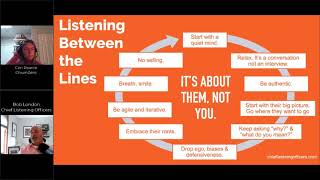
Bob London teaches listening between the lines: dropping your ego and asking small clarifying questions to understand what someone really means. He uses a real example where a prospect mentioned "safety" but the team never asked why, missing a crucial insight. The skill transforms sales calls and relationships.
Chapters
So the last section of this talk is called Listening Between the Lines, which we've all heard the expression reading between the lines. This is listening between the lines. It's inference. How do you hear the stuff that's important in between what people say or what they didn't say? So I've used this phrase. Here's what it means. It's not unlike terms like active listening or participatory listening. This is not dissimilar. The only, only way— by the way, this applies to us in our homes and family relationships, even though I don't seem to be quite as good at it at home as I am at work. It's a big joke. When I named my consulting practice Chief Listening Officers, my wife and my two sarcastic sons said, "Oh yeah, that's really great. How are you going to do that?" But the only way to do this is to listen effectively is to completely drop all of your thoughts and devote yourself to listening and understanding what the other person is saying. So whether it's marriage counseling or relationship counseling or this, it all comes down to that. And so I want to talk about a few tips for doing that. First of all, there's some very important things that, that go in between the questions, the big questions. So if those questions are kind of the logs on the bonfire of customer intimacy, pardon me for mixing metaphors, these questions are sort of the kindling that you can use to accelerate the heat. Excuse me. Why? Why did you do that? Why did you say that? What? What did you mean by that? How? How does that work today? You should be constantly not moving to the next question, but constantly seeing if one of these little crevice questions fits and can get you more information. I'll give you an example. I was recently listening in on a call between one of my clients, the CEO, and a big prospect, and the prospect said, "Yeah, I think, we think maybe your product could help us improve customer safety." So that's good, that sounds good, and my client was very excited to hear that, and he took the next 3 or 4 minutes agreeing and expounding on the safety benefit, although the problem is it turned out that the prospect, we found out half an hour later, meant something very, very different when he said safety. So we missed that chance to say, so quick clarification, what do you mean when you say safety? So if I do work in the healthcare space, I can't tell you how many different definitions there are of the same exact terminology. So it's very important to ask these little crevice questions to enhance and deepen your understanding. And then I'm going to share this with you. This really could be its own presentation, but listening between the lines, to really further help you think about what that means, it is something that takes a lot of practice. But here are sort of some tips and guidelines that I've developed based on my experience. Again, I think some of this comes naturally to me at work, not at home. Some of this are, some of these are things that I did, but I didn't realize I was doing them and they were, it turned out to be things that were important to write down. So I'll just highlight a few of them. So start with a quiet mind. Yeah, we're all busy. We're busy, you know, working from home and with all the crazy stuff and some people have kids and it's just really challenging, but try not to rush into one of these strategic customer conversations as soon as you hang up from another call. Try and take 30 seconds or a minute to get into a state of mind. Then that state of mind should be, you know what, all I wanna do is understand what this customer's world is about. I wanna be empathetic and I wanna be curious because I wanna ask good questions and I wanna ask follow-up questions. I mentioned this before, but you start these conversations with the big picture. And then you go where they want to go. I always say, in these conversations, there's really no such thing as a tangent, because if they're talking about it, it's not a tangent. It means it's important to them and you need to know it. Now, between us, there have been situations where I wish the person would stop talking about X, Y, Z, because they've clearly gone in a direction that's not going to be useful to me. But if I interrupt them, that impacts the tone of the call. And it's not gonna be productive. Drop your ego, biases, and defensiveness. This is not a call, these are not calls where you should be debating or rebutting or even explaining anything. You listen, you take notes, and in the end, you can always say, "You know, I wanted to go back to something," again, that conversational little preface. "I know you really felt strongly about X, and it seems like there's some concerns there, or we let you down." "Can we talk about that for another moment?" And of course they will, because it gives you a chance to learn what they meant. Because again, if they talk about something being a challenge or a problem, that doesn't mean you immediately understand exactly what they're talking about. And by you repeating it back to them and asking them, it gives you an opportunity to get more value and insight out of the conversation. The other thing you can say is, "Well, you know, I think the best thing to do, if you can, is I'd love to have another call in the next few days with you and our subject matter expert." and just hear you out, make sure we understand where you're coming from, and talk about some things that might help. But again, at minimum, this all gives you a chance to summarize what their concern is, play it back to them, make sure you have it right. And some— sometimes just doing that alone is enough to make them feel better or more resolved. They certainly will feel better about your company because the company is asking these questions and taking this approach. I should say that when I conclude my calls and I say, you know what, thanks, you know, if there's nothing else, thanks. And they'll say, you know what, I just want to say thank you. And I'll say, what do you mean? And they'll say, well, I just want to thank you because no one, people don't ask these questions. They don't, you're, you know, whoever my client is, they'll say, tell your client, you know, tell such and such a vendor that we really appreciate them asking because we don't have other vendors that do this in this way. Okay, next, be agile and iterative. What does that mean? It means in addition to going with the flow of their comments and their feedback and then following up accordingly for things that, you know, that you want to learn more about versus having a script, right? This is not a scripted conversation. You can drop questions that aren't working after the first few calls, or you can add questions or variations as you learn from each conversation. Often I start an engagement with a list of 20 or 25 questions, knowing full well there's no way I'm going to get the answers in a 30 or 45-minute conversation. But what I'm doing is I'm seeing how the conversation goes in real time, and I'm deciding what question to ask next that fits with where the conversation is headed. What else? Okay, try and breathe and smile. Now, we're all professionals, so it's not that you would be nervous, But especially when you start doing these conversations for the first time, there's a sense of you're kind of trying to get your balance, maybe a little, it's almost out of breath. You're doing it for the first time, going through the questions, feeling like you're maybe behind the timeline, you're not gonna get all the questions out. Just try and remember to breathe, and of course smiling is, I didn't know this, but I read that people can actually sort of see you smiling on the other end of the phone. They can feel the smile that you have. So, you know, keep that attitude up and, and remember, as we talked about before, they, they really do want to help. They want— I mean, there, there are other explanations for this, but 2,100 calls, that's a lot of calls and a lot of hours and a high response rate. So you've got to look at— they have motivation. They have motivation to make the relationship better, to get value out of your product. And that's why they're willing to talk. So don't think of it as a chore. It should not be a chore for them. And the whole, you know, so they actually, you're actually giving them a way to share insights that, or thoughts that may have been on their head, in their brain for a while. And of course, nothing will ever improve or be optimized like any skill, any methodology. You have to have some repetition. So Practice, get honest feedback from your peers, your teammates, do role plays with— I always think of different personas, you can decide what those personas are, but there's the one I always think of as the a-hole customer, you know, how do you handle a difficult call like this? And record and analyze the calls, both the practice calls, and if you want, you can record the live customer calls, although I don't make a habit of doing that, because I personally don't want to inhibit their freedom of, and comfort. But I do know situations where calls are recorded. Then you can hear how you sound, which of course, sometimes it's painful and awkward to hear it afterwards, but it's extraordinarily helpful, as you probably already know.
More from Bob




Matt Bowe, fmr. Senior Director of Member Success, Leading Hotels of the World



Beyond Words: The Art of Unveiling Customer Intent Ft. Bob London and Rijuta Bhagwat | Thinkly Talks

How to find out if your product or service is indispensable to customers. (Spoiler: Just ask them)


E21 | Uncovering the Secrets of Deep Listening: A Conversation with the Uh-MAYZING Bob London!
