In this segment, Bob London and two co‑speakers discuss how to deepen discovery conversations by using conversational pre‑positions and specific prompts that reference a prospect’s “whiteboard.” They recommend starting questions with informal, folksy intros to keep the tone conversational rather than interview‑like. The core technique is to ask, “What’s on your whiteboard now that wasn’t there 90 days ago?” which serves as a proxy for recent priority shifts, especially relevant during the pandemic‑induced uncertainty. A follow‑up question—“What absolutely has to be off your whiteboard in the next 30 days?”—adds urgency and reveals top‑priority actions. The speakers explain why these temporal markers (90‑day change, 30‑day removal) are powerful, how the whiteboard metaphor works even for remote workers, and how the pandemic has caused frequent priority re‑evaluation. The overall guidance is to use these triggers to surface current priorities, recent changes, and imminent must‑do items, thereby turning a standard interview into a more insightful, relationship‑focused conversation.
Chapters
OK, so now that we've asked a few picture questions about their big picture at the highest levels of their company, now it's time to get the conversation down to the next level, which is more aligned with their world.
So let me ask you a question, and I want to stop for a second and say these little conversational prepositions, or if you will, The thing you say right before you ask the question, I have a particular style of that.
It's sort of a, it's a little bit folksy, I've been told.
So you say, "Oh, let me ask you another question.
Let me go in a different direction here." So these little intros and phrases, if you're comfortable doing that, it's a great way to turn this into a conversation and make sure it doesn't feel like an interview.
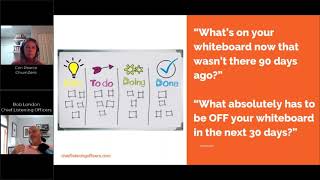
So let me ask you this. What's on your whiteboard now that wasn't there 90 days ago?
So that's what we wanna know, right?
We wanna know if we could sneak into their office, if they were working in an office, and snap a picture of their whiteboard, we'd have this big, you know, competitive, this big intelligence, this big advantage.
They'll tell you, just don't beat around the bush, just ask. Like a lot of other questions, this one is effective because it has a trigger or prompt. This time it's the whiteboard. Even if they don't literally have a whiteboard in front of them, particularly the fact that I don't know too many people who've set up whiteboards in their home office, but some have. They get it right away. Oh, the whiteboard. Yeah, that's kind of a— it's a proxy or an analogy for what their priorities are.
And you'll notice another prompt or trigger is asking about 90 days versus just saying what's on your whiteboard now.
That's an important question, particularly during this whole unprecedented, I'll use some of the words you see on commercials, unprecedented, uncertain, anxiety-producing, you know, pandemic lockdown, everyone's priorities have changed and shifted at least once, maybe multiple times.
So asking 90 days today versus 90 days ago, or maybe even 120 days ago, now that we're extending our time in this lockdown, in the pandemic, versus just asking them what's on their whiteboard now is very, very effective. And then here's a little twist as a follow-up that you can ask, which is, okay, that's fantastic, thanks.
What absolutely has to be off of your whiteboard in the next 30 days? So obviously that's a way of helping you understand, getting inside their head regarding not only their priorities, but what has bubbled to the top so much that they have to, they absolutely have to make sure it is accomplished.