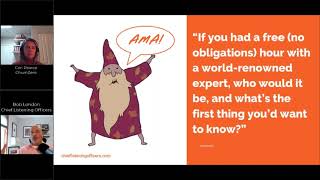
Bob London and Speaker A explore how asking "If you had a free hour with an expert, what would you ask?" reveals what customers actually want to learn. The question uncovers knowledge gaps, which functions need help, and where your solution fits into their broader business, giving CS teams insights to demonstrate strategic value without needing all the answers themselves.
Chapters
I love this one. It is one of my go-to questions. Again, you'll see the specific prompts and some vivid language that gets people to really think.
If you had a free, no-obligations hour with an industry expert, what's the first thing you'd want to know?
Why do you need to ask this?
Because every customer and every prospect, even all of you, have a knowledge gap about something. And in this case we want to know what is their knowledge gap around something related to doing their job.
But if you said, "Let me ask you this, what's your knowledge gap?" That sounds very boring and unsophisticated and it sounds like, I was going to say McKinsey-esque, but that would be offensive to McKinsey. I don't mean to be offensive. "What's your knowledge gap?" Instead, give them this hypothetical. This is a way to expand on this question. So, "Okay, look, let me put it this way." Say you have a chance meeting with someone who's a guru in your field, you know, really well-renowned, and you could ask them anything you wanted and they would never send you a bill or pitch you. What would you ask?
So your customer's answer will tell you the insights they wish they had to do their job better.
And again, if you're, if you're looking for ways to position your solution based on what's important to them, which isn't a CS job, but it's something you can bring to the table for the rest of the company and delivering or developing content that aligns with these types of insights. This is just gold. It's absolutely fantastic. And again, it doesn't mean that it's your job to activate on these insights, but it's— this is, remember, this is about CS's seat at the table, adding value to the company, helping you grow as individuals, helping your organization, your CS organization grow.
And contribute at a strategic level. This also, this question also, it's, you know, it's not a trick, it's just by its nature, it also reveals what type of expert they'd want to meet. Because you'll notice I didn't say, "So what industry?" You know, I didn't say what industry this expert is in, this hypothetical expert.
So if I'm interviewing a CFO in a manufacturing company, for example, His or her answer will reveal where their gap is and where it is. It's either it could be in finance, it could be in manufacturing, could be in supply chain, could be in billing.
And I've had—
there's all kinds of cross-pollination that you hear about people who you think are in one job and yet their knowledge gap is in an adjacent field. It's all very fascinating in the way it comes out and the way it goes together.