Full Interview: Bob London with Erik Linn, Co-founder & Managing Partner, CrossCountry Consulting
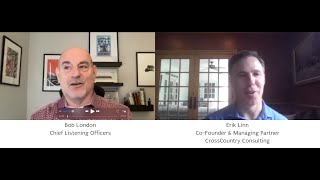
Erik Linn, co-founder of CrossCountry Consulting, built a 600-person firm in ten years around four core values: Excellence, Collaboration, Energy, Impact. The firm maintains 90%+ employee satisfaction and low turnover by protecting personal time, using behavioral interviewing, and prioritizing cultural fit over revenue growth.
Chapters
Eric Lynn, welcome. Appreciate you spending a little bit of time today to chat about some of the things that Cross Country Consulting is up to. And just for context for the, for the billions of listeners and viewers here, I had the pleasure to work with Cross country with you and your team. I was always struck by how seriously you took the prioritization of vision and mission as a company and also how that translated into how you would message and present yourself to the outside world. So for those watching, that's what we're going to talk about and I think Eric will share some things that hopefully people can get some insights from. Tell me what you do and tell me about a little bit about Cross country, if you don't mind.
Sure. So, Eric Lin, I'm the co founder and a co managing partner of Cross Country Consulting. And Bob, great to be here today. Yes, great advocates and friend to our firm over the years. So really, really appreciate it. So as a managing partner of the firm, I spent a lot of time helping set the strategic direction, help attract people to our platform. But I'm most proud of, we have really worked hard to set the tone for what makes Cross country unique and different, which is our culture. So hopefully I'm a big culture carrier on behalf of the firm and setting the tone for our close to 600 employees.
600. Okay. So it has been a while since.
We'Ve worked 600 by the end of the year at the clip we're running right now.
How does a company like yours grow to that extent? Because it's, that's, that's significant growth since I, I worked with you.
Yeah, we, we just hit our 10 year anniversary this spring.
Congratulations.
Really proud to. Thank you very much. Really proud of our progress. I think that we've been very fortunate, have aligned our firm with a lot of huge demand drivers in the market whether it be around transformation, accounting, advisory, risk compliance, cyber technology. We've really been fortunate to see some of the trends coming in the market and build around those and then we build a platform that people want to be part of. We have a really amazing group of smart, hardworking employees, but a lot of great personality and character. And so I think what's really enabled us to grow, obviously we are riding some great waves of demand in the market. We have a platform that people want to be part of. Our retention rate is significantly higher than our competitors. We do an employee satisfaction rating every year. For the sixth straight year we actually had 90% or higher employee satisfaction, which is really rare in any industry, but specifically rare in consulting.
Fantastic. You mentioned retention rate. And I know that we back in the day had discussions about, is culture something you lead with? And how does culture translate into something substantial that actually has a benefit for your clients? I know that retention rate must be one of those things, but do you want to comment on that?
Yeah, absolutely. Thanks for asking that question. Yeah. We started very early defining our culture. And so we spent a lot of time using working groups within the first few months of launching the firm of really choosing the words that were meaningful to us that, that described our culture. And we did come up with four core values. Excellence, collaboration, energy, and impact. And the description of those is what's most meaningful to our employees. But it's hard to change a culture, but it's a lot easier to create a culture from day one. And so we definitely did that. We live by those core values through our recruiting process, through our compensation process, and then we have several ways to reinforce culture throughout a given year. But we're really big. We do behavioral interviewing. So anyone who gets an offer from cross country is someone who hits all four marks. 30% of our year end bonuses is actually tied to how someone performs their job and how they perform it in alignment with our core values. Not just the what, but the how. And that's been very meaningful. We give our quarterly core value awards to the people that exemplify our values. And then we do lots of things with coach families and through social events to really bring those cultural values to life. But they're the foundation for the firm and our success.
You were in the consulting world before cross country, and I always like to ask people, did you have any formative professional observations or experiences that led you to develop the company the way you and your team did?
Absolutely, yes. I worked for what was one of the big five firms, Arthur Andersen, which is extraordinary experience for me. I learned a tremendous amount, had great mentors. But the intensity level of the now the big four firms and equivalent firms definitely sticks out. So they're great places to learn, but not necessarily places where they really cultivate and engage their employee base. So definitely had some takeaways from my big five experience that there could be a kinder, gentler, more caring environment for employee base. Then I had the good fortune of starting a firm, cap Advisory, back in the late 90s, which was sold to a bunch publicly traded company. And actually had a wonderful experience there at Navigant Consulting. But I got to see some things inside the publicly traded company model that, that we've, we've built onto. It's hard to be focused on quarterly earnings and focused on shareholders when you're in a people business. And so two of our huge takeaways from both of those experiences were we, we wanted to have a build a culture that really took the idea of people first and caring for the employees to a new level, which is just hard to do in a large 100,000 plus person firm or a publicly traded model. So the idea of employee first really resonated through those two experiences.
People first, employee first. Is it a cliche now? And how do you stand out as a company where employee first, people first mean something versus just it being a cliche?
Yeah, so we actually had the great experience in our prior lives of seeing clients first in action, which is one of the service business. Your clients have to be happy. But a lot of times firms get so oriented on clients first that they forget about their people and the employee base becomes so focused on exceptional client service that you burn people out and they don't get that extra appreciation and gratitude from their leadership. It's not just a concept for us, it is core to who we are as a firm. So we flip the model on side and we put people first. And so that means actually trying to protect people's schedules so that they're not working excessive hours and making sure they get additional time off if they've done something extraordinary and being thoughtful and gifting to people. So if someone really loves the theater and we want to thank them, we'll buy them tickets to a show. And so just really personalizing how we thank and we're more people. And I think that by flipping the model on its side and putting people first, we have happier employees, which our clients can visibly see, and it translates into exceptional client service. So we end up with the same results but with a happier employee base who's excited to be part of the cross country family.
So on that note, someone said something to me, a professional colleague whose husband is, I'll just say, the CFO of a Fortune 500 company. And they were on vacation and a call came from the CEO's assistant and said, we're having a staff meeting tomorrow and he had to leave the vacation. And she said to me, when you get to a certain level, they kind of own you. And I've set up my world to be the antithesis of that. And it sounds like cross country is similar in that you've just got a soul and a heart.
We also, the last two years have been fortunate enough to win glass doors, best places to work, so that's a platform where people can say anything about their company, good and bad. And we feel like that also validates that we are a great place to work and really walking the talk. That was the first organization. Back to your comment about the CEO calling a meeting while someone's on vacation. I think we've done a pretty good job as leaders at setting our own personal boundaries, which is a great model for our employees. You can't say your people first and then miss your son's basketball game or be in the middle of a vacation and tell your family that you have to work for two days. So we are really trying to set the tone as a leadership team that we're trying to care for our families and have very active personal lives outside of work. And so I think that does translate into how our employees model their own lives.
I'm guessing people will see this and not only be inspired, but you may get some visits to Cross CountryConsulting.comcareers because this is quite a compelling message. Somewhere there's a virtual scrap of paper or something like the cutting room floor from our work together where we did an exercise, headlines from the future, and had the team write what they thought an article should say about cross country in five or 10 years down the road, and it's at least been seven or eight years, someone wrote, we want to be known as the best place to work according to a third party. Good. I'm glad that.
Yeah, well, you should be really proud, Bob. You helped us put words to a lot of things we believed in. And sometimes it's really easy to put a thought on paper and have someone independently look at it and pull out the essence of really what you're trying to communicate. So you helped us with something we call the better experience model. So we talk a lot about it. It's all over our website that we're trying to create a better experience for our people, which translates into happy consultants and a better experience for our clients. And we started with something called the contract. We actually listed out 12 things that we. We wholeheartedly believe in. And it starts with people first and attracting and exciting the best. And then it talks about our desire to nurture and grow those employees and as professionals and hopefully nurture them personally. And then that's back to translating into a great experience for our clients. But it also includes things like impact and our view of our responsibility to give back to our community. So it was a way for us to articulate what we believe in personally, professionally, and it really kind of translates into living out those four core values that I mentioned earlier. So you should be really proud of that.
I am. Thank you.
You should have a little bit of somewhere. The credits for the Glassdoor. Best places to work.
Oh, well, thank you. I appreciate that. It's amazing how much words matter. And I think that when we think of how many words we each use in the day and how many words we hear and what percentage of those matter, I think you guys are an example. And this is why I wanted to highlight this in a conversation and document it is because it is important what you say. Yes, you have to live up to it, you have to execute. But the words that you start with and that bring the concept to life and that hopefully stick in people's heads.
Very important. Hopefully the words reflect the authenticity of the beliefs.
Exactly.
Sometimes it's easy to come up with stories, but you need someone to take those stories and turn them into absolutely clear values or crystal clear commitments. So you're amazing at that.
Well, thank you very much. So that's an important distinction. The words don't create the values. The values have to be synthesized and expressed in certain words. So I want to make that clear. It is infinitely easier and more rewarding to work with companies that have thought this through. And then they say, we need a great way to express it versus the exercise is, well, give us a vision, give us a mission, which is a little bit dicier. It can still work, but it's much better to do it the way you guys did it. So well.
Thank you. And you also were proactive in asking our clients about their experience with cross country. And so it was wonderful to get someone's perception of why they're different and unique and what they believe in. But it's even more powerful when you. You ask the clients we ultimately serve. That was a great validation to get the perspective from the people that we value so much in our clients.
Yeah. Well, not to turn this into too much of a mutual admiration conversation, but when I work with companies, I've said this before. You know, we agree that there's something needs to be done, and I'm fortunate enough to be in the mix, short list, whatever it is. And I always hold my breath when I. I say, okay, well, this. This requires going out and talking to customers before and during. That takes time and money, but I won't do it otherwise. So I hold my breath that, you know, is this a company that is going to appreciate and understand the value of it? Or maybe even say, well, of course we need to talk to our Customers. We can't do it in a vacuum. The answer is not in these walls. It's outside the walls. So you guys fit that mold perfectly.
What.
What were the conversations like internally? How did you arrive at the first. The fact that this was a priority, you know, discussing with the team or just in the shower, wherever that came from?
Yeah, we. We talked a lot about how to action our. Our values. We had been through, I'd say, around one marketing effort of trying to articulate why cross country was different and special. You know, version one is always, always a little more raw and maybe not as polished communication. So we felt really strongly that we needed a third party. And, Bob, you came so highly recommended from one of our dear friends, Christy Hedges. We were looking for someone to take our marketing to a new level. And every firm goes through rebranding over various stages. And this was really our first undertaking at not only an external rebranding, but a branding internally, helping us to be able to communicate to all our stakeholders, our employees, our clients, the communities we serve, why cross country is unique. So our leadership team was really aligned on version 2.0 of how we communicated about our firm. We are probably getting ready to do version 4.0 or 5.0 at this point.
Exciting.
As the firm expands and adds capabilities. But I'm really proud the core values we're built on, the better experience model and our commitment have never changed that. We've been unwavering. And the words that we use to describe what makes our farm unique.
That's exciting. And I think that's a lesson for folks, is these are not set it and forget it exercises. You build something and you have a foundation, a platform, and you keep improving it and revisiting it.
Why?
Because the market changes, your company changes, you grow, priorities change. And those may shift here and there from time to time and require reshuffling or reordering or revisiting or revisiting.
That's right. If a firm is growing and scaling, they're going to add more capabilities. And we definitely have. We have a bigger footprint. So we were a regional firm and then a national firm, and now we're an international firm. And so there is an exercise to go through, making sure that you can communicate the breadth of what your firm offers the market over time.
If I was walking the halls in cross country and I ran into someone and said, hey, what's better experience? What do you want them to be saying? What do you think they'd say?
Well, I want them to know that their leadership cares deeply for them. And so that starts. Starts right there. The way that translates into their day. Hopefully they have a voice about what types of clients they get to work on. So not possible.
So what? Timeout. Sorry. So that sounds unique. From the a hundred thousand person consulting firm, you don't have a choice and you don't have a choice of traveling. You know, the partner or whoever it is points their finger, lightning comes out and the person's on a plane, you know, the next five minutes later. So this is different. What you're doing is different.
That's very important. So thank you. That was a good contrast. Having a voice and being able to actually express what you're interested in and then, you know, orient your career towards doing those things, whether it's clients or learning new capabilities. We have lots of people who shift service lines over the courses of their careers. That is not easy to do with a bigger firm. Switching service lines or practices can take a couple of years in the larger firms. Wow. Yeah. And that we have. I talked about coach families earlier. Our firm is structured such that every employee is part of a coach family. And we expect that there should be a monthly meeting with your coach. And so throughout the year as you set goals, you should be able to reorient your career not just year to year, but throughout the year as you're accomplishing your goals. We like the family oriented feel, the deep caring for our employees, but also we want people who are excited to be here to grow professionally, that do have aspirations to grow their careers and add capabilities and skills and hopefully progress into our organization up to the leadership level. And since we're a fast growing firm, there are big opportunities to grow at an accelerated pace. At a firm like ours, we're proud to see people grow at a much better, better and faster clip than they might at some of the bigger firms we compete with.
In my summary would be you crack this code of the ability to say you're people first because you are actually people first and act that way. Yet the proof of landing on the Inc. 5000 fastest growing companies list multiple times, getting to 600 employees, you've managed to grow in a way that's sane and humane. As you say, kinder, gentler. So that's fantastic. I was in a roundtable the other day with some technology company executives and a couple of them were talking about having retention issues or that there was recent unexpected churn. And I think this was coming out of the lockdown, quite frankly. And I made the comment, stuck my neck out and said, you know, I'M hearing employees saying that they've had time to think during COVID and they want to have a chance to be aligned with a company that they feel proud to work with and that that company has values and has vision. And I asked the team to comment and it was not a lot of uptake on that. It was more like growth Trump's vision. And so it didn't really make sense because you can't really separate those two. I didn't get into a battle with them or anything. But I would say to you, do you feel like having the values, having the vision and living it for years on end has helped with growth? It doesn't maybe lead directly to double digit growth, mid double digit growth, but it does it make growth easier in some way. How do you relate that? The culture, the values and yes, so.
We talk a lot about this, Bob. We are really proud that we've grown, but the growth has been the outputs or the outcome of the commitment to the values and hiring exceptional people. And so we, we talk a lot about if we hire the best people in the market and we're giving them this better experience and they're staying at our firm, we're going to grow. And so we're not saying we want to grow 80% or 90%. We're saying if we hire the best people in the world and they stay at our firm, we're going to grow. And so we will walk away from growth opportunities to keep what's special about our firm. And so if we grow 25% instead of 30% just as an example, because we couldn't find enough people that fit our bar for excellence and collaboration, energy, impact, that's fine. It is. Again, it's a little bit reverse. When I work for larger companies, they would do anything to hit their growth percentages. We just have a different philosophy that if we stick to what's special about cross country, the natural byproduct will be growth. In a market like we have right now, the market is fantastic for all consulting firms. A lot of our competitors are hiring B players right now. They are hiring people that they're going to regret six to nine months from now. And that's going to translate into poor client service. And it's probably going to cause some consternation internally trying to staff people that aren't top performers. And so we're actually really proud that by being disciplined and sticking to our standards, we think we're going to outperform those other firms by not lowering the bar, by keeping our focus on what's, what's unique and special about our firm?
Fantastic. So, Eric, last question. If you had a chance to talk to a room full of your peers, just other founders and CEOs, doesn't have to be consulting, what advice would you give them in this whole area that we've covered today?
I would say start at the beginning, defining what you're all about and get the buy in from every key leader you hire to that philosophy. It's so easy to build culture from day one and it's a lot harder to change it later. So I would make the investment upfront to make sure the value proposition externally and the value proposition to your employee base is super clear from day one.
That's fantastic. Congratulations on your growth, cross country's growth. Thank you for spending time with me today. I really appreciate it.
Always a pleasure. Thank you so much. Have a great day.
More from Bob




Matt Bowe, fmr. Senior Director of Member Success, Leading Hotels of the World



Beyond Words: The Art of Unveiling Customer Intent Ft. Bob London and Rijuta Bhagwat | Thinkly Talks

How to find out if your product or service is indispensable to customers. (Spoiler: Just ask them)


E21 | Uncovering the Secrets of Deep Listening: A Conversation with the Uh-MAYZING Bob London!
