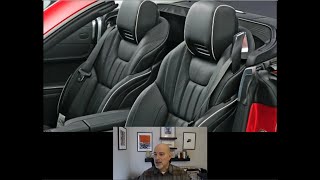
Bob London draws on 2,500 customer calls to explain why Mercedes Airscarf succeeds: it solves a problem customers never asked for. The real value lives above the line, in unarticulated needs. Listen to what customers actually need, not what they say they want.
Chapters
Hey, it's Bob London here. Look, it's a chart, not just any chart. So I've done over 2,500 customer discovery calls, one-on-one deep dives. And based on that, I have created, and I'm happy to share, the way customers define value from their perspective, not yours. Now you can read this when you have a chance, you can just pause the video, but the most important thing that you're gonna see here is this horizontal line. Why? Because everything below this line is obvious and explicit. What does that mean? It means it's written down somewhere in a scope, a statement of work, a licensing agreement. What is the product supposed to do? What will the support provide? But above that line, it gets a little less defined, right? So do you go above and beyond? Are you giving them insights to help them do their jobs better? And then ultimately, it's about innovation, bringing the customer new ways to solve challenges, and they trust you to listen to those new ways and perhaps buy them. What does this above the line all have in common? It's no one's really defining this. It's unexpected, unspoken, and that's why so much of the training I do is focused up here. It's understanding their company, their company's priorities, their company's customers and market. What's happening there? It might help for me to give an example. So I bought a car. The inside looks something like this. Really enjoying the car, and I said, what What is this? What are these? Turns out that something called an air scarf that this particular brand of automobile has developed. What is an air scarf? If you press a button on the dashboard, it blows warm air on your neck. Why is that important? Well, this is a convertible, in case you didn't notice. Just outside of Washington, D.C., the climate gets hot and cold. So when it gets cold, it helps to have this heated air scarf. Now, I defy you to tell me that any Mercedes customers looking in the showroom said, "Well, I'm really looking for a car that has an air scarf." Never happened. But what did Mercedes do? They went around and said, "With the top down for more of the year." More of the year. So instead of just the summer, let's get it into October, even November. Then that's just a nice unexpected thing that we can do. This is an example of what goes above that line. Let's say a couple is thinking about buying a car like this and they're in the showroom and one spouse says to the other, "You know, I really like it, but it's so impractical. You can only really use it in the summer and even then it's really hot. So there's only like 2 months out of the year, 3 months that you can really enjoy it." A nearby salesperson might say, "Well, we actually have this thing. We don't promote it that much, but it's called an Airscarf and here's what the Airscarf does, etc." It's the extraordinary companies that are driving differentiated value by, by looking at and paying attention to their customers up here, the stuff that's unexpected, unspoken. Just thought I'd give you a little example. Again, it's Bob London. Thank you so much for watching.