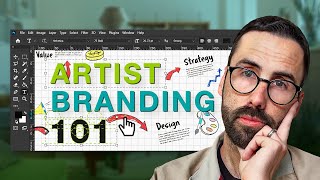
This short video by Lennon Bone explains what a personal brand is, argues that every artist already has one, and shows how artists can use storytelling (the "thing under the thing") to build trust and stand out online. The speaker distinguishes branding (who you are) from marketing (how to buy), gives a parenting/plastic-bowl example to illustrate building a values-driven brand, cites consumer-trust statistics (e.g., 46%, 81%, 54%) to support why trust aids sales, and directs viewers to a masterclass and another video on social-media habits.
Chapters
So if you're an artist who's trying to take your real life business online, you may be wondering if you need a personal brand to succeed. And what exactly is a personal brand? Will it help you sell your work? And even more importantly, like, do I have to be somebody that I'm not? Is this the equivalent of being some sort of influencer? You know, do I have to be this slimy salesperson? We're going to talk about all that today while I'm doing the dishes. I know that that's probably super annoying, but I made a promise to myself, I'm going to get these done and that I'm going to get this video done today. So what exactly is a personal brand? So a personal brand is not your art. It's not your story, it's not your beliefs, it's not your ideas, it's not your style. It's all of those things. And according to the definition that I like to use, you have a personal brand whether you like it or not. Seth Godin says it this way. A brand is just what someone says about you when you're not in the room. And it's a great practice to ask, like, what can people say about you when you're not there? What are they talking about? Because if they're just saying, oh, they're a watercolor artist or they're a songwriter, that's not really enough for people to grab a hold of and run with. It's not enough to get you to stand out. That's why all those things that I listed at the beginning are really the elements or the core structures and foundations of your personal brand. And your brand is the ultimate way to stand out. Because it's obviously like what people are talking about. It's what my buddy Jeff Bartsch calls the thing under the thing. So, for instance, let's pretend that I sell these plastic bowls. So to one person, you know, this is just a plastic bowl, but to the right person, it's something different. So if I was going to build my personal brand around selling this, I wouldn't talk about this. I'd talk about the thing underneath this. So I might say something like, you know, as a dad, I really value teaching my kids to be able to learn to do new things, to be able to feel independent and strong willed and excited about showing up and cooking, doing things in the kitchen, setting the table. And I want them to do it in a way that they can feel safe and that I feel safe, that they're not going to break something or put Themselves in harm's way. Because ultimately my kids safety, their security, you know, their opportunity to grow as a human is my biggest priority. Now in that story, I don't even have to mention this plastic bowl. I'm just holding it. But somebody could take that idea and that story and see the power of why I would have this thing in my hand. People are smart and we don't give them enough credit for it. All right, I'm going to put this thing in the dishwasher now because it's freaking gross.
So it's important to remember that with branding, you know, you're not selling anything. Branding is where you let people know who you are and marketing is where you let people know how to buy. And so in the case of selling the plastic bowls, for instance, if I'm building the brand around that, I could do a whole series of content around the importance of family. I could talk about safety tips for keeping your kiddos out of trouble. I could talk about how to have a healthy marriage or relationship with your partner. I could talk about my journey as a dad or the crazy things that kids, kids do. Right. Because everything I do revolves around this mission of helping my kids grow while keeping them safe. So you can see that we're giving valuable insights around the thing that we're selling and that just naturally leads them to the thing that you're selling. Right? And by the time they get there, they trust you a lot more. They're like more excited to support you because they know they're supporting something that they can get behind. And if you don't see the parallel here, I totally understand. I have a whole free masterclass that you can go watch called From Post to Profit, which talks about a 30 day sales plan that you can build out using this entire framework. The link for it obviously is in the description. So the next question becomes, will this make it easier for you to sell your art? And if you don't believe it will yet. Let me follow up your question with another question. Have you ever trusted someone more because you felt like you knew them or you felt like you were similar to them? And if your answer is yes, obviously you can see the power of this. So let me give you some really interesting statistics here. 46% of consumers are willing to pay more for products from brands that they trust. 81% of consumers consider trusting a brand to do what is right as a deciding factor in their buying choices. Now what does that mean, to do what is right? That's not just, you know, to do what is right. For them as the customer, that's their first priority. But then also, you know, if I'm buying from them, I'm associating myself with them. So I have to trust that they're going to do what is right beyond that, so that when my friend sees that I bought from this person or this artist, like, they associate me with them too. You know, it's why political climates are so crazy right now. Because everybody's afraid of to talk about who they voted for, because people will make some crazy judgment about it. Consumers who trust a brand are more than twice as likely to stay loyal, even when faced with competitive alternatives. And 54% of consumers have stopped purchasing from a brand in the past year due to a breach of trust. So do you need a personal brand to succeed? Well, obviously you already have a personal brand, whether you're online or not. And so my big answer here is yes. Now, how notable that personal brand is is a different story. Should you work on building your personal brand online? That's a different question. Because you can build your art business without being online, but there's a lot of potential for using the Internet. And if you're one of those people that wants to, I'd encourage you to do so. But you got to start with this question, which is, how do I want to change my little corner of the world? And who would be on board with that change? Because as an artist, you don't make art. The thing you make is an extension of you. Your beliefs, your personality, your stories, your experiences. When people see that thing you sell, if they don't see everything you represent, then it's going to be harder for it to stand out from the crowd. Because when they see what you represent in that work, I guarantee you, if they represent the same things in their life or they want to show other people that they represent those things, they're going to be way more willing to buy from you. Social media is obviously a big part of building your personal brand online. So in this video here, I go over the habits that artists need to be successful on social media. And the reason this is so important is because if you just start thinking about, like, yeah, I want to build a personal brand, give me all the tactics, give me all the how to's, but you're not thinking about, like, what's it going to take for me to actually be successful in this? Then you're missing a whole layer. Everybody talks about tactics. I'm here to give you the actual strategy. And you can't build a strategy if you don't know what the obstacles are. So check this video out and I'll see you over there.