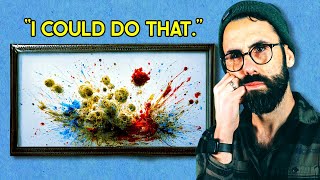
Lennon Bone explains why audiences miss the point of your art and what to do about it. Only 0.4% of musicians earn a living from streams alone. The real problem isn't the work itself, it's how you present it and the community you build around it.
Questions this video answers
0.4%.
The "Connection Blueprint" (an outline of three things every artist needs).
Neurologist Curtie Ranchod.
Chapters
Did you pay for this?
As an artist, we want the work we make to connect with other people, but that's not an easy thing to do. We either showcase our art with fear, fear that it's not enough, fear that we're gonna bug somebody, or we do it like a buzz dude at a party. We put it all out there and basically say the artist equivalent of. I'm just gonna let this body of work speak for.
And sure, somebody might connect, but the question remains, will your art become someone's boo, or will it be taking the walk of shame? So that's it? You're just gonna walk away? I know I'm not good enough for you. But first, I wanna talk about the sponsor of today's video, which is me. And I have built something for you. It's called the Connection Blueprint. And what this is is an outline for the three things that I believe every artist needs and in order to stand out from the crowd. And we're going to outline those three things together so you can put that into your content plan, your brand strategy, any of those kinds of things to not only elevate the message of yourself as the artist, but also the message of your work so people gravitate to it faster and become more connected to the things that you're creating. You can download that absolutely for free in the description below, and I truly hope that it helps you.
So let's quickly take a look at the process of an artist. It starts with inspiration, and that inspiration then moves into the creative process. And once we're done creating the thing, we either admire it and really approve of the thing that we've done, or we reject it and feel completely awful about ourselves. I know I personally have been in both camps here, but regardless, we typically want to share it with the world in some way, shape or form. And if you're like me, it doesn't take long before you're sitting there wishing that. That more people had seen it, maybe that someone had bought it. But rather than perpetuating this promotional thing, you decide to let it go and hope that the next one works instead. But deep down, we know that how we put our stuff into the world matters.
A new study showed that only 0.4% of musicians will make a living off of streams alone. And nearly all successful visual artists have multiple revenue streams that make it work. This is why building a community around your work can be incredibly important. I recently started looking at this idea in how things connect in everyday life. And I tried to look for the parallels that seems to happen, even if it's not always easy to spot. And that is some form of communication. And apparently there's even some science to back up these ideas.
So I remember the first time that I met my wife, and I kind of thought she was a bit of the B word. Based on my past, I had built this perception that if someone acts this way, they must be, you know, that kind of person. And so I didn't really care for her. But once we started to talk, I quickly realized that we both had the same sense of humor, an affinity for deeper conversations, and had dealt with troubled childhoods. But it took that conversation, it took communication for us to get past those first impressions.
To a certain degree. Just like your regular relationships, it depends on your past experiences, the things that you've been through in your life before. Neurologist Curtie Ranchod says that art is a language, a symbolic language. And just like any language, we have to use various parts of our brain to try and interpret what it says. So when we say something like this, art actually spoke to me, it really did, just not using words. And if you know more about a piece of art, other parts of your brain become engaged as well, and semantic memories can actually come into play here. The art becomes this vehicle that takes someone on this inward journey where they become self reflective, and they believe this is why we are attracted to some pieces of art and not others. All of our past experiences and the communication that's happening between the piece in our brain develops this interesting sort of reaction that is very personal to us. For me, this is one of the beautiful things about art. Your art is your language. You're creating a conversation, and you get to choose the people that you want to converse with. You get to choose how much of the conversation you lead and how much you will allow them to interpret themselves.
So obviously, only some of the relationships that our art has will actually last. But I believe when we're more vulnerable in the way that we show up and share and present the work that we make, it will find the right people to connect with.