How to Release Bottled Up Emotions (Full Guide)
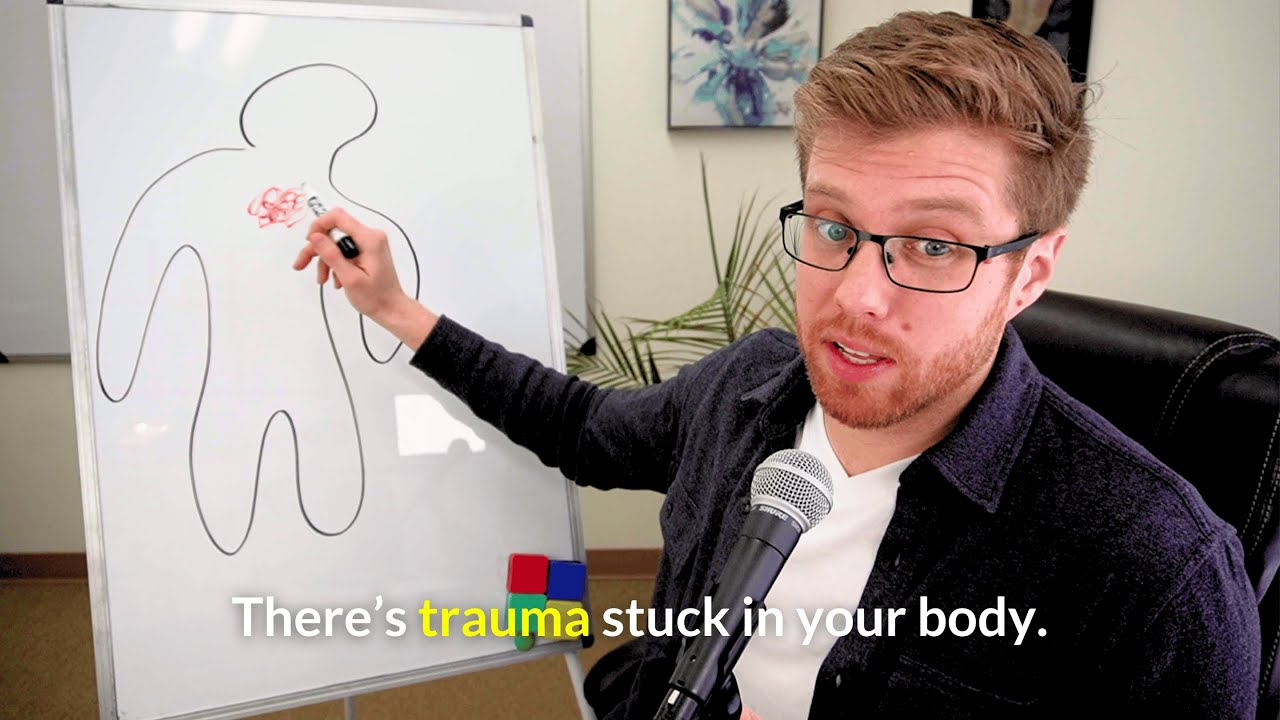
In this instructional video Brad Schipke walks viewers through a practical, body‑oriented method for accessing and releasing emotions that have been stored by trauma. He begins by teaching a simple body‑scan to develop awareness of where emotions reside in the body, then introduces the concept of a habitual "pushing force" that keeps those emotions suppressed. Drawing on Michael Singer’s "relax and release" principle, Schipke explains how to consciously relax the pushing force and allow authentic physical expression (crying, shaking, screaming) as a safe outlet. He warns against uncontrolled triggering and instead uses a soda‑bottle metaphor and the fitness principle of progressive overload to illustrate gradual, self‑controlled exposure. Finally, he emphasizes the importance of supportive self‑talk—affirmations that reassure safety and self‑love—to replace dependence on external comfort and to empower the individual as their own best supporter. The video positions these steps as a repeatable skill that, with practice, strengthens emotional resilience and aids PTSD recovery.
Chapters
Welcome everybody to this video where I am going to walk you through a step-by-step guide on how to access and release bottled up and pent up emotions caused by trauma. So if you feel a lot of chronic anxiety, a lot of chronic depression, fear, panic, what have you, if you have a lot of stress in your body, I'm going to show you how to actually access those, identify those, and release them so they are out of you For good. And this was a very important lesson that I had to learn on my own recovery journey. And it's been literally an essential piece for all of my clients as well, for the thousands of clients that I've coached over the years. So my hope is that these lessons that we have learned will also help you on your own recovery journey and help you find more freedom and more peace from your past. So now what I'm going to do is I'm going to actually walk you through on the board. I'm going to draw a diagram and show you how to actually start becoming aware of the emotions inside of your body. And how to start actually controlling them and releasing them. So what I'm going to do here is I'm going to attempt to draw a human body to the best of my ability. Maybe not the best of my ability, but an ability. So what I want you to do, and you might, if you're actively stressed out right now, you can do this exercise as we're walking through it together. And you can start to become aware of the emotions in your body As I walk you through this process. And that will actually make this even more powerful. So if you choose to do that, props to you. Awesome job. For me, this will just be an example from my own life. When I had PTSD and emotions, so much of it was stored in my chest, in my heart area. So a lot of it was stored right in here. Right now, what I noticed was that I could control this emotion by relaxing my body. So the more that I relaxed my body, the more this emotion would come to the surface. And you can actually feel this as well. It's like, as you relax your body, as you become more present with your body in the present moment, what you'll feel is that emotion starts to, instead of being so constricted within your body, it'll start to relax a little bit and come to the surface. And what I identified too is that that emotion would not only just come to the surface of my body, But it also starts to move up. And this is an awareness piece that you will need to develop yourself, yourself with your own body to identify where's the tension that I'm holding in my body. And then as I relax that tension, as I relax that emotion within my body, just become aware of how it moves. Like for me, it came to the surface of my chest and it started to actually move up towards my neck area as well. So the first step here is to become aware of that emotion, that that emotion is even there. Because I know for me, when I first started my journey, And for so many of my clients, like we're not even aware. We weren't even aware that like how the emotions were manifesting in our body. So the very first step is going to be becoming aware of your body. And a great tool to do this, to start developing the skills, is a tool called the body scan, right? Which is basically just relaxing your body, taking a few deep breaths, and you can close your eyes as well if you want to do this. And then you just start to mentally scan your body. for tension and then release it wherever the tension comes in. And what that'll do is it'll start building awareness around your body. And this is a really important point that I— a really important lesson that I learned myself too, was that the emotion in your body is the doorway to your mind. And every emotion that you feel is represented in the body as well. So one of the best ways therefore to access and release emotions is through your body. Emotions can be a weird thing. Right? It's like, well, first of all, I don't know what emotion I'm feeling. And then how do I describe this emotion? And then how do I actually release it? This really simplifies the process down. It's just the emotion is in your body, right? Obviously, it's coming from your brain, and it's a response from your brain that's causing the stress in your body. But you can access it through your body. And every emotion is represented in your body. And there's actually some really cool diagrams and, and heat maps of body, of body scans. That show that, you know, when somebody's anxious, a certain part of, or a certain part of their body increases in heat and blood flow. And when they're depressed, you know, they'll find that certain parts of their body actually decrease in blood flow. So there's actually physiological responses to the actual emotions that you feel. And there's actual science and scans, actual scans and proof that that is true. So emotions that you feel show up in your body. So the best way to become aware of emotions that you're feeling Is through your body. The best way to start releasing those emotions is through your body. Step one, start becoming aware of the emotions in your body. So write the steps here. Marker's not working. Step one, I'll put awareness of emotions. And the next piece is I'm going to call it the pushing coal. Coal. I'm going to call it the pushing force, right? So awareness of your emotions, right? Which we talked about here by scanning your body and becoming aware of how the emotions are. Manifesting in your body. And then 2, the pushing force. So get rid of that marker. What is the pushing force? What do I mean by the pushing force? So if you remember what I said earlier, when you feel this emotion and you start to relax your body around there, the emotion will start to come to the surface and you will start to release the emotion on some level. It'll start to come to the surface and you'll start to actually feel it more intensely, which is actually a good thing because it's not a comfortable process. And that's one reason why we push away the emotion is because it's actually painful. But what you'll find is when you release the emotion, the emotion will come to the surface. But then if you're, if you, if you're still aware of your body and the forces that are in your body, you'll identify another force, which is pushing that emotion back. So like I said, for me, in my body, I held a lot of tension, a lot of emotion in my chest. And when I started to relax that tension in my chest, that emotion started to actually move up. And then what I, what I identified within myself was that there's this habitual pushing force that I had that wanted to push that emotion away because If you push your emotions away for long enough, it becomes a habit, right? So it'll automatically— what you'll notice is that the emotion will come up and there'll be this pushing force that automatically pushes it back down. And you don't have to take my word for it. It's like you can, you can test this out for yourself. Identify an emotion in your body, try to relax it, and then just wait and, and, and look for that other counteracting force that's pushing it down. Because we all have the ability to control our own emotions, which is a good thing. Like, we don't want to be breaking down crying in the middle of a work meeting or, or in the middle of a party or anything else. Like, emotional control is a very good thing, and I'm not advocating for us to lose 100% of our emotional control. So the second piece here is that pushing force. So I want you to become aware of the force that's within you that actually pushes this emotion back down, because that's going to be the primary thing that we're focusing on here is relaxing that pushing force. So before you can actually release your emotions, you have to be aware of the forces and the components that are actually causing those emotions to be pushed down in the first place. So you need to be aware of the emotion and the pushing force. So what do you do next? Once you're aware of these these 2 things, the emotion in your body and the pushing force, what do you do? So the second step here, relax and release pushing force. So it's relax the pushing force and release the emotion. So step 2, once you identify the pushing force and the emotion, it's to relax the pushing force. And this was actually something that I learned from Michael Singer in his, in his book, Untethered Soul. This phrase specifically, like I kind of went through this process myself, but I really liked this phrase, relax and release. And I learned that from Michael Singer. I think it's just a good thing to keep in mind as you're releasing your emotion is, is because those are kind of the 2 main mechanisms that are required, or the 2 main actions that are required to actually release those emotions. And that's what you can think to yourself too, as you're trying to let go of emotions, release emotions, you can tell yourself, relax and release, just relax and release. When you don't know what to do, just relax your body, relax that pushing force, and allow your body to release the emotion. Right? So this is that second piece: release. What does that mean? What does it mean to release the emotion? Well, to me, and what I learned was that I needed to honestly express and release that emotion authentically. So if I, if my body needed to cry, I allowed my body to cry. If my body needed to shake, I allowed my body to shake. If there's part of me that needed to scream into a pillow, I allowed myself to scream into a pillow. So when you release that emotion, it's really allowing yourself to authentically release it honestly, because honesty, being honest with yourself is a core principle to recovery and healing. And being honest about how trauma has affected you emotionally is a key piece and allowing your body to express that emotion honestly is a key piece as well. So after you're aware of these 2 forces, you want to relax the pushing force. And release the emotion, right? And the last piece here, the third step, is just controlling your self-talk as you're going through this. Now, as you can see so far, all, all of these steps here are within, within your control. So I am not advocating that you go out and you trigger yourself. 0% advocating for that. I actually had a client who told me a story about how they went to some kind of hospital group, group therapy thing. where they would literally get people in a circle, identify their triggers, and then trigger them with that exact trigger. And the idea behind it was, okay, if we trigger you with the exact trigger that you have, and you will learn and use our tools to relax yourself, you'll learn how to relax yourself. And like, yeah, okay, but like, there's no reason to have to trigger somebody and get them— like, trigger really means like an uncontrolled release of emotions, beliefs, and thoughts from the past trauma. So you're just triggering this past memory in full force in an uncontrolled, chaotic way, and that is completely, completely unnecessary and kind of crazy, like, to even think about that. There was like a bunch of people sitting in a circle just triggering themselves, and I do not advocate for that at all. Putting yourself into An uncontrolled emotional state is not good because it's not controlled and you don't know what's going to happen. And you could just end up— and this is where people say, oh, you could re-traumatize, right? So if you're constantly triggering yourself again and again and again and again, you're not making any progress. You're just rehashing stuff in a state where you are completely out of control. So I am not advocating for that, just to be 100% clear. I am not advocating that you Trigger yourself to feel emotions. This whole process is 100% under your control. And like I said, with going back to the soda metaphor, you can release it a little bit at a time. Because once you're aware of the pushing force and the emotion, you are then in control on how much you relax that pushing force, relax that pushing force and release that emotion. You are in control of that process. So going back again to the metaphor, If you just, to the soda bottle, if you release the cap slowly a little bit, the equivalent here is relaxing the pushing force just a little bit. So you don't have to totally remove the pushing force. You can just relax it a little bit, allow one tear to come down, whatever is manageable for you at the time. And that's a really important thing because we do, we do not want to push ourselves into scenarios or situations that we are not prepared to face because one big part, huge part And again, a huge principle of recovery is facing fear, facing fears voluntarily. And that's a huge element. If you aren't being pushed into a scenario that you are not willing to face, or you are not ready to face yourself, then you could end up hurting yourself more. So, and then that's nothing to be scared of because you're going to be in control of the process 100%. But just to be aware, you do need to push yourself out of your comfort zone. You do need to feel these emotions you don't want to feel, but you can feel them at a rate that is comfortable and manageable for you. And I would say that that is actually an important thing to do because what will happen over time, just like when you are working out, one of the core principles for gaining muscle is progressive overload, which basically just means you lift as heavy weight as you can, and then that heavy weight becomes lighter, it becomes more manageable. So then what do you do? You add more, more weight to it, and then that, that motion becomes harder, right? But you get stronger, and then that weight, the heavier weight becomes manageable. And then you lift heavier weights and heavier weights and heavier weights and heavier weights. The same thing here applies with releasing your emotions. So in the beginning, you might just be able to release your emotions for 3 seconds and release 1 tear. But over time, you will become stronger. You'll, you'll become acclimated to that level of emotional release, and you'll be able to go up a little bit higher. So maybe it's 10 seconds and 2 tears. Now, obviously, like, we're not going to measure your emotional release in seconds and tears, but you get the point. is that over time you might— or in the beginning you might just be releasing a tiny, tiny bit of emotion. It might seem so insignificant to you, but what you have to realize is that, that, that is progress and that you are, you know, you are lifting the first, first level of weights. You're lifting a low level of weights, but you're lifting everything that you can at that time. And just be patient with yourself and be confident that over time your strength in releasing emotions and your skill in releasing emotions will Will increase, right? So in the beginning, it'll be a little, but after a while, after you develop this skill, because it is a skill, it's not something that just happens immediately, you'll find that you'll be able to release in very, very intense levels of motions and release big amounts, like huge amounts of pressure within yours. So in the beginning, you might just be releasing a little bit of pressure, right? And you might not feel that big of a difference after releasing a little bit of pressure, but as you get stronger, you're able to release more of that pressure. And then also have the corresponding relaxation. So a deeper relaxation after that. So that's a really important piece there. Now, like I said here, the step 3, this last step here is self-talk. So as you are relaxing and releasing, like I said, what I want you to do. So as you're doing that process of relaxing the pushing force and releasing the emotion, I want you to be hyper-aware of what's going on in your mind because it's really important. It's really important to identify, you know, if you're having negative thoughts in your head as you're going through this process, which can be common. And that's why you want to take control of your self-talk as you're going through this process. So things that you want to say is, it's okay to feel, you're safe to feel, everything's okay. I accept, I accept you the way you are and whatever emotions that need to come up right now, I want you to feel. And that's the self-talk. And you can just go through that again or do variations of that. It's okay to feel. You're loved, you're safe, everything's okay. Because the way that you want to think about this too is that you have these parts of you, these parts of your psyche that are scared. They're scared to release these emotions, and you're, you're likely scared to release these emotions, right? So you want to talk yourself through the process and the recovery journey. You know, this might sound a little weird, but like, you need to be the person that comforts yourself. You need to be the person that loves yourself. You need the person that's— you need to be the person that supports yourself on this journey. What I find with a lot of people who come to me for, for coaching is They, they start out in this highly dependent state and they expect other people in their life to comfort them, to support them, to give them all the tools, or to even do the work for them, whether it's a therapist or a loved one. But what that does is it just removes all the power off your shoulders and puts it on somebody else. And when you give your power away to somebody else, you don't have any power to change things. So by taking responsibility and be— and, and owning that you need to become your own best supporter, your own best believer. You're, you're the one that needs to love yourself and support yourself. Then you actually start changing, like, the relationship that you have with yourself. And that is actually the most important relationship that you can have. So again, I want you to become aware of the emotions that you're feeling right in your body by scanning your body, become aware of how the emotions manifest in your body, become aware of that pushing forward. And then once you're aware of those 2 things, work on relaxing the pushing force and releasing the emotion in a way that is manageable to you. Because this is all 100% under your control. And then 3, control that self-talk, telling yourself it's okay to feel, you're safe to feel, right? Everything's going to be okay. And that's the process of how to release your emotions. If you want to learn the logical side of how to recover from PTSD, that which is the other 50% of the recovery journey, watch this video right here, right now. Bye.










