5 Lessons We Learned Quitting Alcohol For 30 Days
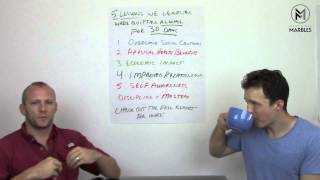
Brad Hart and Frank Erickson Merhansel quit alcohol for 30 days and noticed weight loss, better sleep, and clearer thinking. They saved money, fought less with people, and felt more in control of their choices. The point wasn't purity but learning what alcohol actually costs you.
Questions this video answers
Around 2007–2008 (started around July and lasted one year).
April 2013 (initially 30 days, later extended to about 18 months).
About 106% that year; he also says in the first three months they had a month with trading gains increasing the fund by over 35%.
"Only 40% of the adult population in the United States actually does drink," according to Brad (self-reported statistic).
Chapters
Lead the way.
Good morning. Welcome. To make more marvels, this is Brad Hart. I am joined today by Frank, Frank.
Erickson Merhansel here with hippie capitalist.
He's from hippie capitalist. And we're here today to talk a little bit about our particular struggles in the past with alcohol. I don't want to say struggles because that has kind of a judgmental feeling to it. Let's just call them challenges and how he overcame those. And actually, Frank quit drinking for over a year. Is that right?
Yes.
Yeah.
In 2007-2008, he decided to do a quick little just 365 day no alcohol challenge just for myself. It was right around July, my birthday is in September, that I decided to just set it down. And I actually had a friend of mine next to me right on midnight of my birthday. And I'm in the middle of a beer and I'm halfway through and he goes, hey, it's midnight. And I set it down and didn't pick one up again for an entire year.
That's wonderful. Congratulations. I actually, I was challenged by a coach I was working with in April 2013 to quit drinking for 30 days. Because he got to talking to me and he said, you know what? This is something you really need to consider, Brad. A lot of the actions and the things that you're doing and some of the behaviors that you've been engaged in, if you weren't drinking, you might have made different decisions. So it wasn't a judgment, it wasn't a good or bad thing. It was just the thing that I needed to do at that time. And by doing this and taking this challenge on, I actually learned quite a bit about myself. And I ended up extending that 30 day challenge into an 18 month no drinking binge. Well, you know, anti binge. Right. Which was awesome because I reconnected with myself physically, emotionally, spiritually, traveled a lot, powerful. I was way more productive than I'd ever been before. Including that was a period during which my hedge fund just took a crazy skyward jump. I think we did 106% that year. In those first three months, I had my best month of trading ever where we increased the size of the fund by over 35% in trading gains. So that was exciting. Yeah, it was just the benefits were just kind of stacking up because I felt clear and centered for the first time in probably years. Wow. Because, I mean, just a little backstory. Right. I lived in New York for seven years and New York City is a drinking kind of town. Of course, you Go out on a Tuesday, Wednesday, Thursday, Saturday, doesn't matter. People are drinking anywhere you want to go 24 hours a day. You know, I used to bartend. I could get drinks at 7 o' clock in the morning if I wanted to, just as easily as I could walk into a bar at any other.
Time of the day.
So.
Exactly.
You know, you get to that kind of point where it's like, I wouldn't say I was an alcoholic, but I drank a lot and now I drink about 99% less.
Right.
And I'm sure you have a beer or whatever here or there, but once you eliminate it from your life and then replace it back in, you're like, oh, okay, cool. Well, this is what purpose alcohol serves.
Exactly.
This is what I want out of my life. This is who I am now. And these are some of the things that I want to get out of it. So if this is something that you've been interested in checking out, if this is something that you wish that you could do and you need a little bit of a kick in the butt or a few ideas, there's no judgment here whatsoever. This is just something that we've both dealt with and we know a lot of great people at drink, we're still friends with them. That's awesome. But we've decided to lessen it in our lives and even cut it out for a period of time, just to kind of get clarity on the whole thing.
This is really for peak performance, more so than just having to eliminate something. To eliminate something. It really helps in all areas of your life, the same way that meditation can, same way that exercise does, the same way that daily journaling helps. This is just one of those extra things that you can kind of stack, stack, stack. And you apply many of these different kind of peak performance tools and tricks and tips to your life, and it will help in every aspect.
Absolutely. And similar to what a lot of people go through with food allergies, to just use a very similar kind of metaphor, people have food allergies and the only way to find out is if they eliminate certain things in their diet and if they stop having the allergy to it, then obviously it was that thing. So similarly, if you knock out alcohol and you realize that, oh, wait, five things in my life just got amazing as a result, it might have been the alcohol, and there's no shame in that. Not everybody's made to drink. We're not born needing to drink. It's not like we're getting alcohol. First thing in our lives that we Continuously need throughout the course of our lives. So there's no shame, no stigma here whatsoever. No matter what commercials will tell you, your friends will tell you, society will tell you it's okay not to drink. That's step one. Step. It's just overcoming these social crutches and these social stigmas around it is understanding that alcohol is a social lubricant for.
A lot of people.
And a lot of people have anxiety and depression, and they don't feel like they belong and they're introverted and they need something to kind of get them talking. Yeah.
They're seeking that approval a lot of times from the person next to them or across from them. And one of the easiest ways to really help overcome that social crutch for yourself is. Is the first one, if you're out partying with a bunch of friends or family or people who do drink, is just offer yourself as a designated driver. Hey, I'm the party tonight.
I know exactly what it's like.
Everybody else, you can have a great time. Everybody give me your keys and just offer to be that ride, and people will absolutely love you for it. Yeah.
And if you're doing a challenge, tell people that, like, hey, I'm just for 30 days. The next 30 days, the next two weeks, whatever it is, I'm just going to quit drinking just to see what that's like. And a lot of people will switch from, what's wrong with you? Why aren't you drinking? We're all having a good time. Yada, yada, yada. Oh, just have one, two. I respect that. I wish I could do that. And then they start to look at you in a different light, because the number one thing that was not aggravating, I don't want to say, but kind of made me feel a little bit judged was people would always ask, what's wrong? Did you have a problem? Did you have a dui? None of those things need to be true for you to decide to quit drinking. It's like apples and oranges, you know, having a problem with something where it's like dangerous or ill health or whatever it is has nothing to do with peak performance. And that's really what we're talking about. And, you know, if you really need serious help with alcohol, there's certainly different types of programs for that. You may need intensive counseling and therapy. You may need a bigger group of people who have dealt with this particular issue. That's for you to decide. And sometimes this can be a first step towards really considering those types of things. So Again, don't ever feel like you're stigmatized. There's plenty of people out there that don't drink. In fact, I just read a great statistic before I got on this video. Video? Only 40% of the adult population in the United States actually does drink. No kidding?
Yeah.
So it's less than half of adults. It's a lot less. Yeah. It's less than you think. Right. If you think about how many people live in major cities, it's skewed so far to one end. Sure, sure. That they think, oh well, everybody drinks. That's just what everybody does. But in reality, less than half of adults in America drink. I didn't know that. That's self reported data. They might be lying to. You know, statistics are statistics. So I think that kind of wells.
Nicely into the physical health benefits.
The physical health benefits. Right. Because we have so much obesity in this country with so much people being overweight and having issues with family anxiety, stress, depression, all these things which. A little bit of alcohol might help. It's kind of a band aid, but it's not really getting to the root of the problem. Right, exactly. And it's very easy to get to a point where you're over drinking and over imbibing and then creating hangovers and problems with relationships because you were drunk and all these different things and all of a sudden you're compounding what was a relatively small problem of a little bit of anxiety and stress because you didn't deal with it in a healthy way is now becoming a big issue that you got to deal with, which can lead to even bigger spirals. Right. We don't want to create that negative feedback loop. No, of course we could talk about physical health benefits all day, but why don't you just run through some of the.
Well, the easiest one is just what weight loss like we had talked about. And you see all kinds of diet pills. Right. See all kinds of magazine weight loss programs or this different workouts you can do. And really just dropping alcohol for 30 days can oftentimes drop your weight by 5, 10, 15 pounds in a very healthy way, very, very quickly. Absolutely. And sometimes it's not even the calories that you're bringing in. So a six pack of beer on average is going to have about 800 some odd calories depending on what kind you drink. But it's not just that. It's the horrible food decisions that we.
Make and the fact that you're not drinking water, something that your body has to fight, has to turn the alcohol into Acetaldehyde and all the different things that it has to do to eliminate that from your body. It just takes up a lot of energy. And it's energy that can't be used to adequately flush other toxins out of the body. It can't be used to digest proper food. It can't be used to do a whole host of things that your body would normally do with that.
And it also helps when you drink alcohol. It actually stops the burning of fat within your body. So it's not that it just adds more fat on from the sugars that you're taking in, but it actively prevents the body from burning the fat stores that are already in there.
Right. Because now your liver is going after this alcohol to break down as opposed to the fat that it normally would.
Exactly.
So that's huge. I mean, but let's talk about some of the other physical benefits. I'm talking better sleep. Oh, absolutely. Better sex, better digestion, better elimination.
You hang out in the sauna to have even more fat loss and hormone benefits. Because if you're drinking on a regular basis, never go into the sauna. It's just a horrible, horrible idea for sure. And you see people try to do that with hangovers too. They'll say, well, I need to step into the sauna to rid myself of the alcohol that's in my system.
Which works for nicotine but not for alcohol. Believe it or not. You can spit out my nicotine that way. Yeah.
You want to stay fully hydrated whenever you're going into hyper throw or high heat situation.
Sure, sure. And of course, the dreaded hangover. Right. That's one thing that we kind of loosely touched on. But the older you get and you're 31. Oh, yeah, yeah. So I'm going on 30. I mean, when I was 20, I could take a few drinks and stride. Now if I have a couple of drinks, I really feel it. So I gotta pick and choose my battles. And it's not because I'm any less healthy. I'm actually in better shape now than I was in my early 20s.
Absolutely.
But I take it more seriously too. But now when I have a couple drinks, it just kind of throws my game off for a couple days. It's not even just that next day.
Yeah, it's kind of that lingering.
Yeah. You feel like you're jet lagged, you feel tired, you're more prone and susceptible to illness.
Sure.
You know, little things that'll knock your game off for a couple days. And really, if you want to be a Peak performer. Can you really give up two or three days of optimal productivity just because.
You want to have a couple drinks on vacation?
Yeah. But, you know, at the end of the day, like, you know, if that's carrying into your Wednesday because you went out drinking on Sunday, maybe it's time to reevaluate that. Right. Because then you're only getting 70% of the productivity that you might have gotten.
Oh, yeah. For the month. Yeah. Not even for that day, but it could be. It compounds into a week. Compounds into a month. But a lot of times there's so many of us, and I used to do this. I know Brad used to do it, too. From what we talked about is that you'll drink and then you wake up the next morning, and sometimes you'll drink just to feel better from horribleness of the night before.
Oh, I've done that.
It's the hair of the dog that bit you. And you'll chase it a little bit. Or worse, you run into this cycle. Right. We've all run into this cycle where we wake up the next morning, we go, oh, I'm never going to drink again. And then the instant that that hangover is gone, let's go out again.
Let's go party. Your friends will play into this. You know, you're in this weakened cognitive state and you're not making great decisions already. And then all of a sudden, it's boozy brunch on Sunday, and pretty much you've done it all over again. So, again, these are things that just take time to learn. They take experience. But we can cut your learning curve drastically with some of these tips and experience that we've both gone through. And again, I had a very long and storied career as a drinker. I know what's up.
Yeah, we both.
I've been there. I get it. You know, there's nothing you've gone through that I probably haven't gone through in some form. So don't feel like you're alone in this or that. We're trying to preach the choir. We're not some crazy religious nuts or. No, alcohol is bad. Like, that's the place. But, you know, again, and in society.
You know, with the economic impact, the biggest hit that you really take when you drink on a regular basis is you're literally urinating out your money. You're pissing away the cold, hard cash that you're earning, and you would make more marbles with your hedge fund. You look at things a lot of times as an investment. So if I Invest this, then what do I get out of it? Whereas alcohol can have a brief positive investment a little bit if you're using it as that social crutch or that social lubricant, lowering your inhibitions a little bit. But long term, there's no real benefit. And there's a lot of compounding things that happen to your health and to your body and especially to your pocketbook.
And to your relationships. You say and do things that you might normally have not said. You can be more strategic with a clear head. I think is kind of the key. Right. I spend a lot of time with world class individuals and they don't drink. The Richard Bransons of the world don't drink. Really? You might see. I don't even think he drinks anymore. I'm not sure.
Eli, Eli was Tony Robbins top trainer. I don't think he drinks at all. Or he does 30 days, you know.
Yeah, he won't drink for a very long period of time. And like all these top performers, people that I would consider at the top of their game, have either eliminated or minimized alcohol to a point where it's almost negligible. You know, glass of wine here or there, and that's fine. And then on the converse side, I've seen a lot of people who are expert performers otherwise that get shit blasted every so often and just go off the rails. And that's, you know, it's kind of.
An 8020 rule though. It's really, what I've seen is about 80% of the really, really top level elite performers, they've eliminated or they've severely reduced alcohol from their lives. And it's at 20% and actually it's less than 20%. But we can just kind of play into that 80, 20. It's a little bit less than 20%. They can still drink on occasion and their bodies just, they can naturally deal with it a little bit better. And meditation is a lot of times the same way, where about 80% of top elite performers, when you study them, they all have some type of meditation practice which alcohol totally destroys. And then you have that 20% that don't. But if you want to be on the majority, if you want to be on the side that the vast majority of the time is in that top elite percent, that top 1%, it's a lot more helpful to really have that clear mind.
Completely agreed. And I think that really ties into the next thing, which is improved relationships. So my biggest fear, and I'm gonna get personal for a minute here, is that I used to always go on dates. And I would have drinks. Right. I had almost never gone on a date or I didn't have at least a couple drinks. I just started to create a belief around if I have a couple drinks, I'm in the mood to go on a date. I'll be more attractive, I'll be more relaxed, I'll be more sexy, whatever the hell it is. And she will be too. Yeah, she will be too. But in reality, I just ended up doing a lot of dumb shit, sleeping with a lot of women I really shouldn't have and feeling like a piece of crap after going out and getting hammered all the time. You. I would get into relationships with women I had no business being with sober. But there you were, you were hooking up because you were drunk and it was like. And you really had nothing in common. And alcoholic fueled lust can only last so long. So when you take a step back from that and you start dating from a place of sobriety, not only do you get more comfortable in your own skin and dealing with other people, but you get more comfortable in keeping your standards high. Sure. And that's really what is going to, you know, determine the quality overall of your life is how high are your standards. Right. If you have great standards and you still hold yourself up to them, then you start to attract that from other people. Right. And you start to make room for the people that you really want in your life and not just anything that comes along, which we all know can become pretty painful. Right. If you're in the relationship with the wrong person, if you're attracting the wrong type of energy, if you're hanging out with the wrong crowd, all these things can affect your life. I mean, you're the, you're the, you know, some are the average of people spend your most time with. Right. And I think that's true of everything. Sure. Your time is limited. You have 168 hours in the week. No matter who you are. When you take away time for work and sleep and play and all these different things that you normally do, if you're taking out another huge chunk because you're either drunk or drinking or, you know, spending time with people that you wouldn't have normally associated with because you're doing those things, it starts to add up pretty quick.
And even the emotional impact too. You know, the vast majority of the time our emotions are drastically shifted and it can change very quickly when we're drunk compared to when we're sober. It's much more level when you're sober. When You've eliminated alcohol. But the vast majority of anger, of combat, of pride, of ego, that shows in modern society when two people kind of get together, and this is both with men and women, it's not a gender thing at all. It's not a race thing at all. It's all across the board that there's a lot more of this skill, kind of negative, ego driven emotion that comes up and you just get into this combative or this ego defensive state when you're drunk. Much more so than you do when you're sober.
Yeah. And it just really comes down to what does alcohol do to your body? Again, it kind of shuts down your prefrontal cortex. This is the thing that separates us from lower classes of animals, right?
Yeah.
You know, we have our lizard brain and we have, you know, our limbic system. Yeah, the limbic system. And all these normal primal things which stay active, but they're very id, you know, they're very reactional and very instinctual. And what makes us human and makes us cognitively more evolved is this prefrontal cortex. And that's the first thing after one drink that goes exactly. Just shuts it down. And, you know, I used to think there are benefits to that because I thought that, oh, I'll just get more into myself and my, you know, my instincts and all this stuff.
And I'm more natural. More natural.
Whatever. Yeah, whatever. The story I was making, again, this is all a story that we, we tend to make up around ourselves. Once I eliminated it, I just realized that I was actually sharper and I got better results and I spent time with people that I actually wanted to spend time with. And I cultivated the relationships I wanted to cultivate. And it just increased the quality of my life and the quantity of good experiences exponentially. I just couldn't believe it. And that was in 30 days.
Wow.
After a year, I was like a new person. I had drops body fat, I had increased strength. I felt better, I slept like a baby. My anxiety dropped way down. It was just amazing and I couldn't believe it. So that was really the benefit that I saw most. And I recommend that anybody should just try this. Whether you drink a lot or a little, or you drink beers or whatever it is, if you don't eliminate it for a period of time, how can you know what it's actually doing?
Exactly. That leads really to our last point, is the ability to have this self awareness, this self mastery, this self discipline. Just to say that I can say no to something, anything, just the same way That I can say yes to something, anything for 30 days. And you know, there's a lot of different research out there. Sometimes it takes 21 days to form a habit, 60 days to form a habit. Others, you know, neuroscientists sometimes will say 90 days. But we can definitely all agree that at 30 days there's some kind of change that happens in your brain.
Absolutely. I founds basically, no matter what I've done, whether it's a simple thing like remembering to take my supplements or a really complex thing like quitting alcohol or do business practice, whatever it is, after 30 days, it's pretty much I don't really need to have motivation, it's set. I don't need to be inspired. I don't need anybody to remind me. It's just, oh, this is what I do at this part of the day now.
Less what you do, more who you are.
Exactly. More who you are.
Exactly.
And that's a great question just to ask and to check in with yourself all the time with any behavior, good, bad, indifferent, however it turns out, we're not again judging. But it's just to ask yourself, like, is this who I am? Is this who I want to become? Because as you know, the creative process, it's beliefs create thoughts, create words, creates actions. So if any of those things is not congruent, you might get a different result than you anticipated.
Absolutely.
So, you know, if we're going to be scientific about creating our lives, we have to be very clear about our beliefs and our thoughts and our actions in our words. So, you know, just to kind of recap, we talked a little bit about some of the things we learned. I think we actually gave a lot of great content. Absolutely excited about this. I hope you guys really enjoyed it. Talk about overcoming kind of social crutches, some of the physical health benefits. There are many, multitude of them. I'm still learning them. Absolutely. It's insane. Economic impact, of course, improved relationships, self awareness, discipline and mastery. And what we want to do now is just kind of direct you below this video. You can actually sign up for a great tips, hacks, kind of ideas guide a few steps that you can take to not only quit drinking for an extended period of time, but also some of the kind of hiccups and roadblocks that you might come into. Like what do you say when your friends kind of rag on you? What do you say when you go out on a date? What are some of the things that you can expect? And you'll be armed and be ready to make Better choices and decisions. When you're confronted with relatively, you know, normal things like and you will be. And you will be. That'll happen. It still happens to me. And I quit drinking like for a very long time and I still don't drink for months at a time. So for me it was kind of a no brainer just to have all these things rehearsed at that point. Right. So that you didn't come off sounding evasive.
Yeah.
Or weird. And you didn't come off sounding judgmental.
Or higher up, you know?
Yeah, exactly. Exactly. Like nobody wants to be that around that guy. And it's perfectly okay not to drink. And there are times when you should absolutely talk about it, but only when I think it's kind of what people want to talk about. And similarly, if people are harassing you about it, then you should have something to say about that. Because I don't think anybody should be judged for their personal choices, do you? I mean, that's just not the world I want to live in.
The overarching theme is freedom. To have the freedom to be able to pick it up, to set it down, to stay off for 30 days, to, you know, to do what you want to with it, but have that freedom in your life to do exactly what it is that you want to do that's not harming anyone else around.
Absolutely. Making a choice every day to either do the thing or not the thing or some other thing, whatever it is, it will improve the quality of your life to some degree.
Absolutely.
Maybe it'll be a 500% increase, maybe it'll be a little bit of an increase. But I guarantee if you give it a shot, it'll improve your life. So check out the thing below and let us know what you think and we're happy to answer questions. Please shoot us an email and we will see you soon. Thank you so much. This has been make more marvels. Thanks Frank for coming by. Check out hippiecapitalist. Com.
That's it.
And we will be back with more stuff like this. So talk to you soon.
Talk then. Bye bye bye.
More from Brad

The #1 Reason AI Isn’t Working for You (Yet) #AI #businessowner #founderenergy




What tasks would the best assistant ever be able to do for you? #BusinessSystems #BusinessOperations



Nobody expects you to use a harder way when there's a better way. #AI #businessowner

Which side of the table will you be on in 2026? #AI #Mastermind #BusinessOwner

