How to analyze and pick the right crypto project!
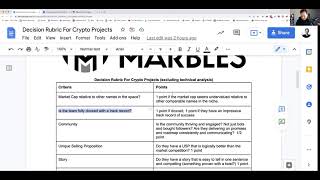
Brad Hart and JJ Steelman walk through a scored checklist for evaluating crypto projects: market cap, smart-contract audits, team track record, community engagement, liquidity, business model, and delivery on promises. They grade real projects like LooksRare, Nouns, and Axie Infinity to show how the rubric works.
Chapters
Sa.
Hey, everybody, and welcome back. It's myself, Brad Hart and JJ Steelman. What's up, jj?
Hey, Brad. How we doing today?
Doing really good. And we're here from the crypto community, the NFT crypto community, to be exact, where you can always find us@nft cryptocommunity.com and today we have a really fun presentation. It's going to be on how to basically see the various merits and score them of fundamental analysis for crypto assets. Now, the folks with traditional finance background, like me, might be screaming your head, like, how? Well, there are no fundamental ways to analyze crypto investments. And I would mostly agree with you. However, there are ways that you can kind of look at these different projects, blockchains, NFT projects, whatever they might be, and start to pick out the ones that might have a higher correlation to a chance of success versus not right. And everything is probabilities. So throughout this training and the training that we're going to do on technical analysis, I want you to just be reminded, like, hey, hold on. Speaker view. Yeah, speaker view. I just want you to be reminded that none of this is a certainty. There is no such thing as a sure bet. There are only degrees of possibility and probability. And to which extent you have a high probability of something does not mean it's guaranteed. Even if you are 99% sure of something, it still means there's a 1% chance it can completely fall on its face. So I will never speak in terms of certainties. I'll only speak in terms of probabilities and possibilities. And when you're scoring these, you can use it as an individual scoring system, but there are no warranty or guarantees related to that. So again, investing requires risk management. There's a high probability that you can lose money, especially with very volatile assets. So just use this as a tool. Don't use this as a, you know, be all and end all recommendation or anything to the, to the counter of that. And just a reminder, you know, we're not recommending you to buy any of this stuff. It's not appropriate for everybody. It comes down to your own suitability. And, you know, I want to make the proper disclosures, as always, so let's go ahead and share this tool. We're happy to provide this for you free of charge. If you're interested in talking to us more about the various services we offer, you can reach out to us via the group again, nft cryptocommunity.com all right, awesome. So here's the decision rubric. I'M going to make this a little bigger. And I put these together based on a point system. Now there are more than 10 points. The point here is to, we'll first kind of hit it that anything 0 to 5 I consider like not worth and it's not investable.
Right.
Anything five to nine is, you know, an increasingly good bet as far as the probability goes. But then again, anything can happen, anything can change. These are basically, we're betting on people's stories and projects and the people may or may not be known. Typically I don't touch anything that's not docs at this point, but we'll talk more about that. And if you have a score of a 10 or more in this system, it might require you to be a little more discerning. We don't want to be Pollyanna or overly rose colored glasses with any crypto investment. We got to realize a lot of this stuff is a crapshoot. You don't have enough data to really make defensible financial investment decision or case for any one of these particular investments. If I had a publicly traded company, I could look at all the financials that are publicly audited that are available to me without any commentary. I can just look at the numbers, I can look at the news, I can look at the sentiment, I can look at the technicals and the charts. There's a lot of liquidity. They're traded on various exchanges that are all regulated. Um, there's a high level of certainty that I can make, you know, pretty good decisions based on that data. Whereas none of that exists in the crypto space or if it does exist, it's, it's very sporadic and can't be relied upon at all times. So if you're seeing things like consistently you're, you're scoring things as 7, 8, 9, 10 or more, you might want to be a little more harsh in the way that you grade them. So that's, that's just the first thing I wanted to go through. So. So really there's a bunch of different criteria we're going to look at and I'll kind of walk you through how I look at these. So Market Cap would be the first criteria. So jj, pick a project, any project that would be on coin market Cap and we'll take a look at it.
Any project. Let's look at Guardian.
Okay, great. So let's go to market cap, coinmarketcap.com and we're going to go over to Guardian and that would be guard. All right, now this is something we've reviewed in the past. So right off of the bat we can see that there's not a lot of data here with regard to the current market cap. And the fully diluted market cap is estimated at $54 million. So pretty small, tiny company here. The other data that can be seen is the contract here. So you want to go over to BSC Scan, take a look at the contract. We've already gone through this in another video, so you can go back and look at that with the AJ interview. We found some holes in this contract. I remember there was an issue also that it wasn't read the contract.
Yeah, it's not audited.
It's not audited.
The contract has no audit. And for something with, you know, that kind of valuation, I definitely wanted to want to have that contract, to have some kind of audit record. The other thing too, it's using a standard open Zeppelin tokenomics contract. And it doesn't look like whoever developed it actually went through to take out the bulk of the code. There's a lot of things you can do to optimize a contract. So one, you're not taking three, four hours for something to transfer things of that nature. Little things like that actually make a contract worth seeing and worth using.
So here's something strange too. JJ is typically on these, you can actually read the code and I'm not seeing a way to.
We did read the code last time.
Yeah. So I'm only seeing the write and read contracts here.
I wonder if they watched our video.
So it's entirely possible. Let me just look at some other ones.
So if you have a premium BSE scan account, Premium Ether Scan account, you can actually opt to hide your contract.
Interesting, interesting. So that might be what's going on here, but let me just test it on a more commonly traded ERC20 token. Let me take a look at.
I think Mana is bsc, right?
Yeah. Let's look at like Axie. Right. That would be one. Right. That's kind of erc. Now they're on their own blockchain too. Let's look at. What'd you say Amana was? Erc.
Yeah. Is Mana erc or let's find it right now.
So Decentraland Mana. This is interesting. So if we go over to the Ethereum blockchain, we take a look at this contract because you would think that a company that. Yeah, interesting. Maybe this is an update across all of Etherscan.
This is interesting.
All right, let's check one more just to be certain. It might have nothing to do with that individual Actor. So this is so fun. As we make these videos, we learn new stuff. All right, so Guard was one, Mano is another. Let's go to Bytes. I know Bytes for sure had their contracts up and running. So let's look at Bytes. So I go to Dex Tools. Now we're going to go to bytes.
Dropped to $10.
Yeah, it's. It's taken a huge hit over the last. It's got nuked, basically. Not fun.
Well, everything's been nuked. And that's the thing people need to understand. Don't get all scared to start selling your crypto unless the team rugs you.
All right.
And then if the team rugs sell fast.
I'm looking for copy address. Yeah, rug pulls are basically endgame in most cases. Unfortunately, there's not a lot of opportunity to be made whole in those situations. So let's go to Etherscan again. We're gonna look up this contract. All right. Now the contract is. Yeah, so this is what should show up. You should be able to just read the freaking source code. And I'm not sure why some of these are not anymore. And then you'll be able to tell like, you know, what we're dealing with here. But on some of these, we're not. So interesting.
Yeah, I'm wondering if a lot of these bigger coins and stuff like that are taking their contracts offline. So you're not getting the FUD from the contract.
It's a possibility, but that's a red flag in my opinion. I think if there's nothing to hide, then obviously there should be access to the contract.
100%.
Yeah. Okay, cool. Yeah, that's a new thing. So, generally speaking, we should be able to look at the contracts, we should look at the market cap, we should be able to pay attention to the various aspects of these coins and then relate them to other coins in the ecosystem that are similar. So you can't really compare ethereum to an ERC20 token. One exists on top of the other. It's a totally different level. But you could theoretically compare Ethereum to Cardano or Solana or Avalanche, Polkadot Polygon to some extent. Any of the layer ones or ones that want to be layer 1s or layer twos that work on the system. If you use those as a reference point, you can say, okay, well, the market cap of Ethereum is X, the market cap of Avalanche is Y. Therefore, as a function of this, if this became as large as that, and so on and so forth, that'd be an investable thesis So I would do this in the regular stock market. I would look at different stocks, I would compare them to the industry in which they're in versus all caps. And it pays attention. You're paying attention. Like how big is the whole market cap of all cryptocurrency was 1.62 trillion. So that's $1600 billion. So if there's only $1600 billion of money in the whole market to go around at this moment, and 293 billion of it is in Ethereum, well that's a data point, right? So then if you're thinking, okay, well just to use an example, I'm not saying this is my theory, but Avalanche is going to overtake Ethereum or become a larger, or take up a larger portion of its market cap. Well, it's only 2 billion, 2 1/2 billion. Now it could easily gain 10% compared to where Ethereum's at now. And these tend to grow and shrink together. So when you're buying on a, on a dip, the market cap is going to be lower and when you're buying on the higher end, it's going to be higher. So you want to pay attention to market cap as a function of where are you actually buying? Because the price will lie to you, the price can change, there can be splits, there can be more tokens included in that number. But the market cap never really lies unless there's some fraud or fuckery going on. So I think it's just a really important metric to pay attention to. And with regard to this rubric, you really looking to see whether you think that this market cap seems undervalued relative to other comparable names in the niche. So if I feel like I'm buying something too expensively, I might want to wait to get in, even if I believe in it based on the market cap versus something that's relatively cheap. Or I'm like, well, if it drops a little more, I like that at this price. But I definitely like it at this price because I have a long term thesis that I might want to be investing based on. So this is just one point, right? The next one I think is very important is the team fully doxed, with a track record and this is actually increasingly hard to come by. Although I think it's starting to change because most crypto projects unfortunately don't dox their teams. Meaning that all of the developers, all of the producers of this content or NFT or Coin or whatever are completely anonymous. Now this can go really well in the case of bitcoin. Which has been very successful, even though the pseudonymous creator, Satoshi Nakamoto has never been doxed. We don't know who this person or people are and they might be dead for all we know. Bitcoin's doing just fine, whereas Vitalik Buterin from Ethereum is doxed. We know exactly who he is. We can go to his blog, read his thoughts, we can see what his thoughts are in the community. We can look at his wallet, which is at Vitalik Eth, and start to really get a good sense of that. So I'll just show you real quick how to do that in case you're ever interested. So if I wanted to look up Vitalik's wallet, who's a real person, who I know his dad never actually met him, but he exists in three dimensional reality. We know he created Ethereum. Come on now, Etherscan. Get your act together. See if it just goes straight there anyway. You just look up the Ethereum address, either numbers and letters or the ETH domain would send you right there as well. For whatever reason, it doesn't seem to want to load. Am I coming through okay on your end? J.J. is it just this site?
You're coming through just fine.
Okay, great. So it's not the Internet, it's just this particular website anyway, so you could look up what's in his wallet, what transactions have gone on, and we've done that in other videos, so you can go back and look at that if you want. I don't want to spend too much time waiting on the Internet. But basically that's a point, right? If they are docs, if they are public, then I consider that a higher factor for trust that they're going to stick to the project, that they're, you know, they have a reasonable fear of, you know, ruining their reputation. They'll probably do the right thing. Push comes to shove, they're probably not going to rug pull because it'd be really easy to track them down and you know, essentially, you know, law enforcement would, would not have a hard time finding them with an undocs project. That's a red flag because, you know, even if they have the best intentions, who knows what their real, you know, push comes to shove, what they're actually going to do, you know. Cause a good person put in a bad situation might do something that they later regret. I'd rather not have my money up for grabs in case that happens. And then.
Oh, sorry, go ahead, Brad.
Yeah, no, fine, go ahead and then I'll finish.
Yeah. And just to add to the whole doxing process you can look at. And I'm not going to go out and do a bunch of tangent about this, but you can go and look. There's a lot of projects where, when the team finally got doxxed, you found out you had criminals, you had people who just got out of jail for, you know, Ponzi schemes in general that, you know, are killing other projects that they were a part of. So here's the thing. Eventually they're going to find out who you are. Is it Basie just. They found out who all the creators and founders of basie was. Because BuzzFeed's like, I'm going to do the investigation. I'm going to find these people.
You're not Banksy, like the artist?
No, Basie, the board. Apes Yacht Club.
Oh, I got it. Got it.
They weren't doxed. Now they're doxed. And now they're suing BuzzFeed because BuzzFeed, you know, gave their names out there. So.
So it's, you know, it could go either way, right? It could be good actors trying to protect their identity for reasonable reasons, and it could be bad actors trying to, you know, trying to obfuscate who they are so that, you know, people will trust them and they can basically become con artists and be anonymous.
Yeah, I've been a part of a project. I've been a part of a couple projects where, you know, the guy had four different discords and created four different NFTs and just pump and dumps.
Yeah, a hundred percent. Cool. So I talked about the contract before we move on in the market cap. I think that should be its own criteria, but I don't. I want this to be accessible for most people. The contract, whether or not it has holes in it, is. It takes a coder to kind of really evaluate that and somebody who has, you know, a lot of experience, knowledge and, you know, can really render an opinion. I don't even consider myself that. So I didn't put it in here because I want this to be relatable to the average person. But in an ideal world, like let's say you were an institutional fund manager, you would hire coders to audit contracts to make sure there was no red flags that you can, you know, reasonably foresee so that you could make a better judgment. But for the average person, most people aren't going to be able to do that. So I'm not going to put it here, but I do think it's important, especially if you want to be safe, to invest that kind of money. If you're going to be investing big dollars, that would be the way to do it. So going back to that, the fully docs of the track record. So we're going to give them one point if they're docs and one point if they have an impressive track record of success. So not just, hey, we did a few little projects or whatever, but they've actually built something that people know about that has been exciting in the past, that maybe they had an exit, maybe they've been successful in some way, shape or form. I would give another point for that as well. So if you. They are docs, look at their track record and see what they've done in the past. And you know, I would reference that back to. Because everybody's CV is shiny and perfect, right? I'd reference that back to articles or anything else you could find to kind of validate that information. Next would be community. So we're up to three points now. Is the community thriving and engaged? Is it not just bots and bot followers? Right? You want to kind of like look through the ether a little bit and see, hey, are these people actually engaging? Are they asking questions? Are they thoughtful? Are they responding in a thoughtful way? Is it just a bunch of troll farms? Are the followers engaged that they just bought? You want to make sure that the community has grown in a reasonable amount over time. So if you've been watching it for a while, if you see a giant jump in the community that's not tied to some launch or event, it could be because they bought followers or because something happened that you're not aware of. It pays to really pay attention to that. Some of the biggest wins that I've seen people come in on. We interviewed Jeremy Abraham about his project that he was really excited about. It was Defi Kingdom. So he told us all about Defi Kingdoms and he mentions being in the community during the first thousand members and how it turned out to be a really great project. That's an amazing time to get in. It's unlikely you'll get in then, but if you join a community that's too overhyped and overblown, it's possible that you could have a pump and dump, it's possible that it could be overhyped. Ideally, you can get your investment in before everybody else as best you can. So if I was managing a fund, what I might think to do is to work with the developers as early as possible to try to catch some of the early rising stars and be involved with the project, putting real Money to work before it even goes public, before it even gets committed to the blockchain, so that my interests are aligned with theirs. And I'm not running around trying to buy things at market prices that could be overblown or difficult. And liquidity, you get liquidity. So again, you can go really deep here, depending on whether you have an individual mindset, an institutional mindset, depending how much capital you're managing. There's a lot of ways you can look at this, but the community is important. You want to be able to find communities that are engaged. You want to find founders that are giving updates on a regular basis. I mean, some of them like Wolfgang. Whether you like Wolfgang or not. Game, rather. Sorry. They put up an update every day. It's pretty impressive. I've been watching them for a while. They give me a lot more certainty in the community than a lot of other ones that are inconsistent at best, or they leave for weeks saying they're working on projects. I've found that there is a direct relationship, at least anecdotally, to people who give a lot of updates, tend to be consistent, have discipline, push out updates, stick to the roadmap, versus people who don't share updates consistently tend to end up being scammers and other things. They end up being rug pulls. They end up just ghosting the project. And I'm not saying it's 100% factor, but it's definitely a point that I would give. Right. So that's something to really pay attention to is how does the founder or the founding team engage with the community? Are they consistent? Do they share the good, the bad and the ugly? If something bad happens, do they make it? Right? Like, those are things that I believe all kind of come under this umbrella of community. And we definitely want to give a point or not for that. Yeah. So I think we could even go deeper into this as I speak it out, I think that we could even make nuances between the community exists and then the founder's relationship to the community, maybe for a half point each, but for now we're going in half a point because we had to publish this eventually. So this may continue to upgrade in the future.
Well, and that's. And that's a good point, Brad, because here's the thing. If the founder is active in the community, it's going to keep that project going as long as that founder's active. This is just business in general. So I would, I would definitely put a lot of weight into who's actually, because if they just hired some Community manager, and you don't hear anything from the founder, most likely that program, they're not going to come out with anything else.
That's a red flag. Yeah. If you're not seeing the founders engaged consistently, not that they have to be forever, but they do need to be there in the beginning to really rally. And that's where the relationships are built and that's where the trusts are built. And unless there's a transfer of trust, that trust going away could be really devastating to a community.
Exactly. And here's the thing, like I said, just even with business, this is just good practice because Tony Robbins, Dean Graziosi, the CEO of Coke, they are out there once a month doing something with their community.
That's right. That's important. So that's a great point. And we've kind of broken that up. Later we'll see other aspects of that that I might have discussed already. But I think the next thing that's important is a unique selling proposition. So we talk about this in Zig Ziglar's work. It's the usp. Do they have a USP that is logically better than the market competition? If you look at this versus other offerings in the market that are similar or totally different, does it seem to make sense and does it seem to be a good idea? And that's an objective thing, a subjective thing, but I think there's an objective value to comparing and contrasting to other offers in the marketplace and just seeing how your gut lands with it. Does this seem fun? Does this seem good? Does it seem valuable? Does it seem like something I would use? And a lot of people have found their best investments simply on the strength of this. It's something that scratches the niche that they have. Therefore, they become a client and then become an investor or a customer and an investor. The next point I would use would be the story. Do they have a story that's easy to tell in one sentence and compelling? So the best ones of these I found tend to be something with a twist, something proven that already exists in the marketplace with a twist. So one example of this is ufo. Their thing is we're the Steam of blockchain gaming. So Steam is a very popular platform for gamers, but they are very publicly issuing blockchain. And UFO is stepping in to say, well, we're going to be the Steam for blockchain games. I think that's a really powerful story. Ethereum, in one sentence, would be a decentralized computer to run smart applications on the blockchain. That's Ethereum, that has never existed before up until then. And it's very, very powerful and obviously winning. So if you can compare it to other stories in one sentence and say, hey, this is a really compelling story. A decentralized computer, we already had cloud computing, but now adding that blockchain as a twist and smart contracts made it new and unique and exciting. So that's a really compelling story. You know, NFT projects, so like Neo Tokyo, their one sentence thing would be we are the crypto gaming Illuminati. That's what we care about, that's what we invest in, that's what we're building. If you want to be in this group, that's what you know, that's who's in this group is all the gaming people. Bored Ape Yacht Club. I don't know what would be that one. Like you know, the, the most popular celebrity show off Flex ever. I don't know. I don't know what a board. Yape Ape. I'm sure you could, you know, if you did and you were really intimately familiar, you could build a better story around that. But right now you're trading people's opinions on things and the opinions of people are based on the stories they believe and the best stories win. So the story needs to be strong for your project to win. Would you agree with that? JJ, do you have anything to add?
No, 100%. I don't think there's anything I need to add to that.
Okay, great. Let's keep firing through. So liquidity would be the next thing. How liquid is the investment? Can you get in and out easily? Is it thickly traded in multiple places? Bitcoin's a pretty liquid investment. I can go on 50 different exchanges right now and trade Bitcoin. Same thing with Ethereum and a lot of other coins. But Neo Tokyo I might be able to trade on OpenSea, looks rare and a few others. There's very few exchanges that I would trust to put on a high worth or high value nft. So the liquidity therefore is lower. Additionally, if I go and do a peer to peer transaction, there's a high probability of fraud, so that's not likely to happen. If I go on NFT trader, I just don't know enough about it where I feel comfortable putting that much money on the line. So I'm stuck with a few different avenues to get liquidity for my NFT. And NFTs in general tend to be higher priced than, let's say coins and they're not fungible or divisible. So the issue becomes like, I can't actually bring this and market it on multiple exchanges and there's not a lot of buyers as well that would be able to purchase that in one shot. Whereas I could maybe sell one bitcoin to 200 different buyers and in various chunks. I might have a lot of trouble getting out of an NFT position for one chunk. I hope that makes sense. So liquidity is one point. Next thing would be edge. Do you have an informational edge relative to the market? Well, what does that mean? So does that mean I know something that most people don't know? In most cases the answer is no. And don't delude yourself in anything otherwise. Most information is known by somebody. So jj, were gonna say something?
No, I just. How many people out there? I'm the only one with this super top secret.
Yeah, yeah, it's bullshit. Like, well, you know, if you and the founders know the same amount of stuff, again coming in on the early part of the team, like that's one thing. But generally speaking, if you're a purchaser or your exit liquidity for somebody else at that point, right? If you're coming in after the fact, after it's launched, your exit liquidity for somebody else, if somebody after you comes and buys from you, they're exit liquidity from you. And that musical chairs game only can go on so long before there's no chairs left. So on a rising market, nft, stock, crypto, anything, remember, there's always got to be somebody, a greater fool bigger than you to go and buy that thing or you're screwed and you're going to be end up riding it all the way down. So until it's possible to short NFTs, which I don't believe it is, they will be. That'll be a really big and important thing to understand is you can only make money on the way up. So bet accordingly and try to get in as early as you possibly can with the informational edge that you have. There's an old equation, I guess you call it called the Black Scholes formula, which talks about edge over odds being the amount that which you bet based on. If you had, let's say just to use this in a hyperbolic situation, if you had 100% certainty, which you never have, of getting 100% return and there was zero way that you could lose, you would technically bet infinity. If you had all the information and everything was perfect and there was no way you could lose on a bet. Bets like that, that are super highly probable and certain come along every once in a while, but they're very, very rare. I would say once a decade, we're talking like George Soros can sell more. What do you call it? Sell more UK sterling pounds than the bank of England can create. That's an asymmetric bet. He's going to bet all he can. He made a billion dollars doing it. Because that's as close to an asymmetric bet as you can get when the issuer of a specific security or currency can't keep up with your ability to sell it. That's an asymmetric bet. But most bets are not that way. There's some level of like, oh, it's a 30% certain or 20% certain or 50% certain. You'll never have an exact number, but you kind of get, as a trader and an investor, a little bit more in tune to, okay, how likely do I think that this event's going to happen versus that event? And you bet accordingly. All we're doing is we're making educated guesses and bets, and we're not doing one that can completely screw us up if it goes against us, even if we feel it's very certain. The key to diversification is spreading out your risk so that even if the worst happens, you are not completely correlated to one event, meaning that your portfolio won't suffer too much if one bad thing happens. And if a lot of bad things happens, the likelihood of you having an adverse event for your whole portfolio is higher and higher. But ideally, you have things that are not correlated to one another, so that if one bad event happens, something positive will happen in some other part of your portfolio. That's the best way to set up your portfolio. Now, with crypto, there's really no correlation. It all goes up and it all goes down with a few exceptions. And there's no established ways that we can really tell based on Data the last 10 years, that one particular asset is going to do better than the other. There's theories, but we have yet to really and hypotheses where you've yet to really build them into a working model, at least in my opinion, because there's just not hundreds of years of data that we have on the stock market. Okay, cool. There's no guarantee crypto assets will be around in 10 years, let alone thriving. So that's the edge. The proven business model is similar to the usp, but it's a little bit different because the proven business model would be a combination between the story and the unique selling proposition. So the Proven business model is basically summed up, is this a major problem that exists that's looking for a solution or a solution looking for a problem. Now, this one's hard to gauge because most things, when you first hear about them, sound stupid. And I think you would agree, JJ, you've probably heard 100 ideas that you're like, this sounds stupid and it ends up being a really big thing.
For 9.99, we're going to send you two, not one, right?
But think about the first time you heard about the Internet, especially if you were a boomer and hearing about the Internet for the first time. People laughed about the Internet. They thought it would be a fad, right? They thought that only geeks and nerds use the Internet and it would never be a thing. And now guess what? We're all on the Internet. So the first time you hear something, it might not sound like a great idea, but it doesn't mean it isn't. So I only would put this at like half a point, but if you have something that's a proven business model with a twist similar to what we talked about before, that might be a big deal. So, for example, OpenSea versus LooksRare. OpenSea has up until now been a very powerful platform to sell and buy your NFTs. It's probably the most well known and well trusted, give or take, plus or minus. They had a recent hack. I haven't really caught up on all that went on with that. But generally speaking, for the past, this has been the best platform. Now any other platform can come along and compete and they are. So LooksRare basically took that model and they went more Web3 with it. So whereas OpenSea is trying to be like a Web2 company that's raising money and trying to go public, Looks rare just said, hey, we're going to take all the best people from opensea, we're going to gift them Looks tokens and then we're going to allow them to stake those tokens in order to get return on all of the fees that we're collecting. So instead of saying, hey, we're going to charge 2.5% at OpenSea and keep that money, we're going to charge 2% at LooksRare and distribute that money amongst the token holders, including ourselves. So now all of us as founders, as employees of LooksRare, are now incentivized to make this platform work, because that's how we get paid. And if our token goes to be worthless or the royalties that we get from staking end up Being worthless and there's no platform happening or I'm sorry, there's no traffic happening on the platform. No exchanges happening on the platform. We're screwed just as much as you're screwed. And you're in for no cost basis. You're in for free just based on a tax hit from the airdrop that you got. So it's pretty incredible. Picture. Godaddy started going to all his best customers and being like, hey, you got 200 domains with us. Here's some stock that's the same basic thing. And it caused their market cap to rocket up to, I think it's 8 billion. Let me take a look right now at looks. I haven't looked at it a little while because this is actually important. Etherscan decided to shit the bed while we're making a video. That's so funny. Let's see now. So we're gonna look up looks. Excuse me. All right, so here's the looks. Rare token. And this particular token has crashed since I last looked at it, but it got up to like four or five bucks. Seven bucks at the height. I got a bunch for free. I think I got like 1500 tokens for free, which is pretty cool. I'm not exactly sure what happened. I haven't dug into why it's crashing right now. Maybe just everything's crashing like JJ said. But they are consistently giving away between 10 and 20 million dollars a day in revenue that has been from people staking on the platform and transaction fees. So they basically have a proven business model, which is transaction fees in exchange for the service of allowing people to list. And they're giving that back to their shareholders. So it's a new business model and something like this. If you missed out on the first wave and you liked it up here, if nothing has changed about the business model, this is the kind of thing I start to get excited about as a value acquisition. Just because the market is shitting all over everything doesn't mean that this particular investment's bad. And again, I don't want to have this misconstrued as a recommendation. I haven't been up to speed on this. I might have looked at it in this range and before it hit seven. And then I've been off for the last little bit, so I haven't really caught up on what's happening here. All I know is that I was given 1500 of these in the beginning. I've been paying attention to it. I've been wanting to stake there was some issue with Trezor that Didn't allow me to, and now it's crapping the bed. We're not sure why it might come back, it might not. It might be a total waste. But in 30 days or so, they managed to create an entirely different business model that turned OpenSea on its head and stole away a lot of the market share. So I think that's worth paying attention to and worth noticing. When you see a new business model with a twist that's based on a proven business model, that's something to pay attention to, in my opinion. All right, so that's that. All right, so we have a proven business model. Marketing. Is their marketing plan strong? Are they delivering on promises and roadmap consistently and communicating? This is kind of what we talked about earlier when we talked about community. I would kind of break this into community and marketing. So is their plan strong objectively? Does it feel like it's going to work? Are there marketing people on the team or in the community that can help them get the word out? I think people who are doing a really good example of this is Nouns. Wtf. This is a Dow project where all of the money that is paid for them, so there's only one a day. It's auctioned off and then the money that gets paid for it goes into Treasury. They currently have about $51 million, which is 20,000 ETH in their treasury. And then based on their governance. Let's see where their governance is. Discourse, Playground, Stocks, Dao. There we go. Based on their governance, they have various proposals that come up to use these funds for various projects, and most of them have been accepted at this point. It's still held and owned by a relatively small number of people, only 200 people. Most of these people are like Silicon Valley types. A lot of money and a few celebrities. But basically they'll say, hey, we want to do a party. Okay, cool. That'll get some notoriety. We want to donate to some charities. Cool. We want to have. Where is the one. Here we go. Brave sponsored Takeover. So they estimated they would get 11 million impressions for 12 ETH, which is pretty good. If you ever bought media before, that's actually pretty reasonable. So they did that and they ended up on the homepage of the Brave browser, which is a big deal for all cryptocurrency people at NFT NYC during that whole event. That's a big deal. That probably put them on a lot of people's radar that could then buy an out. So this is just an example of who do I feel is doing it right when it comes to marketing and who has the resources to really kick ass. I mean, $50 million is a lot of money to market, so it can make a lot of sense, especially now that this treasury is really managed by the holders and not just by an individual or a group of individuals. So I really love the way that Nouns is set up. I think it's really smart. So I kind of utilize projects like this, looks rare, like a few NFT projects to kind of be the benchmark to which I compare everything else. So when I. When I've seen really high quality projects that get executed really well, I'm going to use that as the high watermark that if something exceeds that or matches that, I'm going to pay attention to. So that's another way I kind of look at this from a decision perspective. Anything else to add on marketing?
Nope, nothing to add there. Great.
Then finally, two more delivery of promise and sentiment. So we kind of talked about this in the community tab. Does the app work or the project?
Does it work?
Is it buggy? Is the project difficult to use? You know, I like to think of the grandma test like my grandma, could she figure this out? Like if I gave her the website and the instructions, could she make it work? Or would it be too crazy? If it's a game, is it actually fun to play? Right. Did you actually play it? Did you download the beta? Is there a beta? You know, I would give a point to this. If they're actually delivering on their promises, I get really excited when they deliver stuff before they ask for any money. That's where I would be like, okay, I'm going to give these people a point because anybody can raise money, but not everybody can deliver. And then finally, sentiment. How good do you feel about this? How good does the community feel about this? Is it mostly positive reviews and feedback or is it mostly negative? And that should be. Excuse me, it should be mostly Twitter and Discord. But you can obviously look in major news outlets. If it doesn't exist, then you just use Twitter and Discord. You can use, for example, on Twitter you could just put the name of the project as a hashtag or as a dollar sign, if it's a coin, and then track anything that's happening and what people are saying in real time as well as the Discord. You go into Discord, Is it a bunch of fud or is it a bunch of. Oh my God, this is exciting. Fomo. Everybody's really excited about it. I would say a positive sentiment is good and a negative sentiment means you Want to dock a point? Because now you're thinking as a contrarian, so you have to really take that into account whether you think there's a quality investment. So again, just using looks rare as an example, not a recommendation. But that's something that even if it had a negative on the sentiment, I might still consider a very strong project. Or if, say, nouns started to take a tumble, I was still considered a very strong project because I've been bullish on it up until now and. And I might look at that as something I would be contrarian on and looking to buy on a dip versus something that never really took off and now it's crashing. I would never buy, I would never touch. Right. Something that was a darling and now isn't is more likely to get an investment for me than something that was never a darling and now is not. So I hope that makes sense. So this is basically a quick and dirty guide to ranking. Again, if you're at like a zero to five points, I wouldn't touch it. This is just an easy way to kill off your darlings and just be really strong on like, okay, these are the projects I'm going to pay attention to. Five to nine is an increasingly good bet. If you're Getting scores of 10 plus, that means you might need to be a little more judgmental and give less points. But if you really find something that's a legit 10 and you scored it a couple times, you look through it a few times, you're like, okay, this is solid, then you might have found a winner. Again, not an investment advice. And I just want to point you to this disclosure here. This should never be interpreted as investment advice or recommendation to buy or selling security. Just informative and entertainment purposes. This is kind of how I think about it. Obviously, my thinking is always evolving as I learn more and I get more information as well. But this is kind of how we think about things around here. And I thought it'd be helpful content for you guys to help start making your own opinions and your own decisions. So going forward, if you'd like to be like, hey, I'd rank this as a seven or an eight or whatever it is, I think it's worth talking about. Right? I don't want to pay attention to stuff that's 5 or less. Maybe I can take a look at it and then we can kind of learn and poke holes in our ideas together because that's how we grow stronger as a community. So this is a way, I think, that just kind of cuts out A lot of the chaff, I'm sorry, a lot of the wheat and leaves. Just the chaffs that we can really pay attention to. All right, that's it for this video. Unless JJ has anything else to add, this document will be available for everybody in the group. This is Brad Hart again from the NFT crypto community. Really excited to have you all here and jj, take us out.
Yeah, definitely. So I'm going to, I'm just going to say a couple things here. One, you know, as a special thank you for being a part of this community, we are going to turn this into a spreadsheet. So keep your eye out on that. Maybe it even be interactive. We'll see. We'll see how, you know, creative I can get later or Marla can get. You know, maybe Marla, you know, she's better at Excel than I am. But one of the things I definitely want to stress about deployment, if any project is doing a Genesis project to fund a bigger project, the one thing I've noticed, it doesn't go through. I've never seen a Genesis project actually follow through. Real docs projects in NFT or crypto space has already done their level one, their level two funding for that project. They don't need to sell these NFTs to create and deploy. Another thing to look for a lot of things, and this is huge right now are using Unity asset packs. It's not their own art, it's not their own design. This is going to get shut down eventually because these asset packs are not to be used on a final product. So be very careful of that. You can just go to Unity and just search. There was one I was looking at, it was like a fight P2E kind of game. And I went on Unity, searched for the same kind of avatar design and there it was. Same exact thing, $69.
Yeah, that's a really good point. So to reiterate, basically what JJ is saying is that if you are trying to just raise money based on a scam product and putting up widely available downloadable asset packs that basically just approximate what a game should look like, because Unity and Unreal are like two of the big gaming engines. That's a pretty easy thing to figure out if that's BS or not. It's like you just take their video, you take their website, you look for the images that look like stock or could have just been created, and you go and search them in the Unity or Unreal Engine stores and if you find them for sale, then you know that the project is probably not worth paying attention to. It's probably bs. Additionally, really well doxed and well documented and great track record with huge reputation. Community builders and founders and people who have worked for other big gaming companies, they're probably going to come in with VC money. They don't need your money to start, right? So they're not going to be selling things too early because that would kind of undercut their trust in the community and then also potentially kill a little bit of their fomo. Now, that's not to say that maybe a company that's not into gaming or NFTS wants to bring their audience along. Maybe they do a free drop to get people comfortable with NFTS and what they are, you know, as a, as a thank you to the community based on prior access or an airdrop or something along those lines. That's slightly different. But if they're just like grabbing for the cash grab right away, then that's a red flag. So I would probably dock a point or two for that too. Okay, cool. Jj, let's wrap this up. We're going to talk about technical analysis next. Thank you so much for being a part of this community. I hope you're enjoying the content. Please leave any comments questions below and if you're not part of our group, please go to nft cryptocommunity.com to join and we'll see you there. All right, guys, cheers.
More from Brad

The #1 Reason AI Isn’t Working for You (Yet) #AI #businessowner #founderenergy




What tasks would the best assistant ever be able to do for you? #BusinessSystems #BusinessOperations



Nobody expects you to use a harder way when there's a better way. #AI #businessowner

Which side of the table will you be on in 2026? #AI #Mastermind #BusinessOwner

