Building a 24/7 Nearshore Call Center in Central America | 🎙 The Nearshore Cafe Podcast
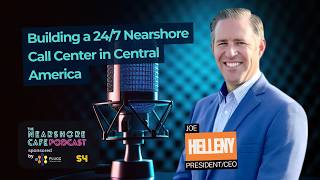
Joe Helaney, founder of CourtMoney, built a 24/7 call center in Nicaragua to handle customer service. He shares how he vets and trains remote teams, why the time zone matters, and what he learned from his background in ATM and payments operations.
Chapters
Welcome everyone to another episode of the Nearshore Cafe podcast. I'm your host, Brian Samson, and here we talk about all things nearshore doing business in Latin America. Before we get into our show, I want to thank our sponsor Plug Technologies, plugg.tech. Great way to connect talent from all over Latin America with US companies. Today, we are going to get into call centers, Central America, and how companies go about doing this for the first time, dipping their toe in and building a whole operation. So the person we're going to do it with is a dear friend of mine, one of my oldest, closest friends. His name is Joe Helaney. He's the founder and CEO of Court Money. Joe, so happy we could put this together.
Good to see you online, Brian. It was nice to see you a couple weeks ago when you came into town. Really appreciate that, by the way. But I, I watch your podcast and it's been a long time coming to be able to do this with you. So I look forward to it. Good.
Good. Well, Joe, you've been an entrepreneur really ever since I can remember. And this goes back to college days, you know, 20+ years ago, I think it's important to kind of set the scene, you know, of like where you grew up, what it means, you know, to do business in Southern Illinois and building businesses from there, the kind of businesses that you built. I think that's really going to help set context for the rest of the show.
Okay. Uh, so a little history. I'm fourth generation entrepreneur from what I know of all the way back to my great-grandfather who came over from Syria, Lebanon in the early 1900s. So I grew up in a privately family-owned business family. We were in furniture and banking. My father started a modular, commercial modular construction company, which I now run. And then straight out of college, just kind of assumed that I was also going to own a business. Didn't know what it was yet. My college background was business management, marketing, and MIS. So right at the beginning of the internet boom is when I started college. So computers were part of my collegiate upbringing, but always kind of knew that I was going to own a business and fell into ATMs first, shockingly enough, which led me into the building of an online payment website. As you mentioned, CourtMoney, we were doing cash bail transactions with credit or debit card, in 2004 for Illinois sheriffs. And that has led us down the road to utility billing payments, other government-run softwares, and then even buying a municipal software company a couple years back. And now in full software development, not just payments also.
Yeah, amazing. I love watching from a distance as you built this really integrated portfolio. Of a bunch of different companies. How have you, you know, maybe we will save the Nicaragua part for a second and just talk about how you looked at staffing, you know, for most of your business career, you know, and where your talent base was, how you thought about hiring them, managing challenges, plus some of the good stuff too.
You know, that's a good question because as you mentioned, I'm in Southern Illinois, not a lot of high-tech individuals in Southern Illinois, very rural area. You know, more, more farming, agriculture, blue-collar work. A lot of the white-collar work is medical, banking, and that kind of thing. So staffing was interesting when, especially when I got started, I got very lucky. I did have some friends in the programming field that were doing, doing programming and websites for Fortune 500 companies, believe it or not, in Southern Illinois. And as we grew, we realized we needed a 24-hour-a-day staff for our call center stuff. And of course, not a lot of that in Southern Illinois. And so we started searching the internet for call centers, ended up finding one, believe it or not, back in your hometown of Chicago, Illinois. And I appreciated the ability to, to do business in my home state. The owner and I talked a number of times, really kind of hit it off. She was a privately held company also, not large, which I liked. You know, family owned, easy to, easy to talk to the owner. And we worked very well with them for a long, long time until unfortunately she passed away and her family took over. And of course, as typically happens when a founder is gone, things change. And that's literally what happened. And that's about the time that you and I started talking, you know, you became a problem solver for me.
Yeah. Well, I want to just for fun, take a quick side for this audience because I think this is kind of interesting with your ATM business because maybe that was your first foray into banking transactions, kind of understanding how that world worked. And I remember you telling me about all the fees you were making and all the ATMs around, but just like a fun quip for the audience is Joe and I would, go to the bars together in Southern Illinois. And, you know, it would be my turn to buy a round and cash poor college student, you know, I'd have to hit the ATM. Well, who owned the ATM? It was Joe. So, you know, and it's not like I'm taking hundreds of dollars. I have very little in my account. So, you know, that I'd withdraw $20 and then it would be a $3 fee. So those, those $6 beers, $3 a piece for beers. Instead of $6, it was $9 throwing a tip, $10 for the beers for me and Joe, and, uh, 30%. And then Joe also got an extra $3 out of that.
I was profiting off the beer.
And cheese.
Yeah.
So I've always, always, as much as it cringed for me to do that, always admired your, uh, your entrepreneurship. What did you learn just about entrepreneurship way back then? You know, from your dad, from your first, you know, I guess was the ATM business like one of the first that you fully owned and had your name on? And maybe some of those early lessons.
I'll tell you what I learned from my father first was that the buck stops here. If there's a problem, you have to solve it. If a client wants to talk to you about a problem, then you're the guy. Both, you know, you take the good with the bad on that one. I watched, got to watch my father solve some problems in interesting ways. He taught me that occasionally you have to fire a client. That's not something you hear someone say very often, but every so often you do have to fire a client. And I've kind of learned that lesson. And I can, in my 22 years now of running my payments company, I've literally had to fire, I think, 2 clients because one, they were, they were not profitable, but two, they were impossible to deal with. They did not have my best interest at heart. They did not care about my business at all. And I think when you're in business, it's a partnership. You have to care about each other and come to the table and discuss things that need to be resolved. So, you know, even in the ATM business, I learned that it's a 24-hour business. If your ATM runs out of money at 10 o'clock at night on a Saturday and you're not at the bar, Guess what you're going to do? You're going to get out and you're going to go to the bar to fill the ATM. And that's the same thing with even the payments company. If a jail needs help with a cash bail transaction at 2:00 AM, I'm awake. That, you know, that's the way it works. The sheriff appreciates that, that knows that his correctional officers who are up at 2:00 AM are going to get great customer service because the owner of the company is going to help them and get everything done.
Yeah. Yeah.
I agree.
The initial call center team, could you rewind on the clock a little bit? When did you first know you needed a call center?
I think when I realized that transactions needed to have phone support 24 hours a day, and I think I was in business maybe 3 years. And while I still handled support calls. My call center would take payments. So, so when we started getting into more court-related things and utilities that would, would need support, not everybody has a PC, not everybody has a laptop. And this was back before smartphones had really taken over. So people would need to make a utility bill or even a court-related payment at 2:00 AM, because while I might be 8 to 5, you might be 8 to 5. Our time zones don't even interact. Now we're, we're 5 hours apart. And so my call center would handle those late night calls or early morning calls when I wouldn't be awake. And I realized I didn't want to be awake taking those phone calls.
Yeah. Yeah. Was there a, um, was it purely about hours or was there like a, like a number of calls, like a threshold that was hit? You're like, okay, I I can afford this now, or it, it's worth it to me to have this.
Yes, it was a number of calls, but you know, we also added a call fee to that. So we attempted to at least offset a decent amount of that monthly cost in our call fee. We've never been able to do it. We've never fully offset. Typically we're around 40 to 45% of that monthly cost in our call fees. But what we realized more than anything is that we weren't getting payment calls all the time. We got a lot of calls asking about maybe a court date or what's my utility bill or how, when is court. We end up getting a lot of phone calls I never anticipated. I anticipated we were only gonna get payment-based calls that were going to be revenue generating. That's not the case at all. We became the information base for things that we knew nothing about.
Yeah. Can you tell us about, um, that Chicago call center? And how you thought about your role because, um, I guess it was technically an outside agency that was running it, your role in training them, your role in evaluating the talent, making sure that they took care of your customers, but you're not on all those calls. How did you think about that?
So first off, when we build our systems, we build them to be very intuitive, very easy to figure out. So we had created a how-to system, not only for our clients, but then we had to build, we'll call it a call center portal to access only payment forms instead of our administrative side. So we had built that, and which was very easy to look up a client, to then find the exact payment form for that client to access what they needed instead of having to search for it in our administrative side. Now, The thing that I learned from them was that they also outsourced. They didn't have like a typical room, like you would see the cubes of people, right? They outsourced all over the country also. So they were in different time zones. So that's where it kind of got me thinking, wait a minute, okay, if we're not in a room full of cubes, we can be remote-based. We can be outside of just that, you know, the old stodgy room of you know, a call center. You can be at a home. And that was my first introduction to remote-based employees. You know, they had people in California and Florida and Texas and East Coast covering every time zone.
Yeah.
So it was easy to train, we'll call it train the trainer, to then they trained their individual people when they would bring them on.
Yeah. From my experience, the Philippines have really become the world's call center. you know, whether it's United Airlines or whoever, you often get routed to staff in the Philippines. Was that ever on your radar? Did you ever think about that? Or were you mostly focused on where can I get the best value in, in the States?
I think before you and I had talked, I was attempting to really try to stay in the United States. I was cognizant and sensitive to the fact that a lot of Americans don't want to deal with a an accent outside of the United States. What's interesting about that is the amount of Americans who have very thick accents.
True.
Who then will say, you know, pot calling the kettle black. You get somebody from the South go, I don't want to deal with one of them Yankees. I'm like, come on, folks.
Yeah. Yeah. Well, I think that's a good segue into, so for transparency, as Joe was telling me about his problem one day, and we talk about all sorts of stuff, baseball, family, everything. I was always sensitive to not like, I do business with a lot of acquaintances, but I'm careful about mixing it with my closest friends because sometimes if it goes south, so does the friendship, right? And I think you were cognizant of that too. So I think I just kind of casually said, hey, have you ever thought about Latin America? And if we could go back in time 2 years, what do you remember maybe from like that first call or two, just as that idea resonated?
I think that when— if I remember back then, one of the things that kind of struck me was it's close to home. Are the accents going to be what I really want? And I'll be honest, I'm just not very knowledgeable about Latin America. The closest I've ever been is Cancún off a cruise ship. So even thinking about Mexico had me a little scared. I don't know about their culture. I don't know about their education level. I really don't know much about it. And so it kind of worried me that we weren't going to get the professionalism or the English speaking that I really needed. And you really educated me on that and kind of got me and pushed me along to thinking, hey, you know, this might fit your need. This might be what you're looking for.
Yeah. Was time zone a key factor too, having them on your time zone, or was it really more about they could be anywhere as long as they were professional? And spoke clean English?
They can be anywhere really. Yeah. As long as they spoke a clean English with, with very little accent. I had spoken to some companies that, you know, had people all over the world. So time zone really didn't bother me as long as they were willing to be up at the middle of the night.
Sure.
Or the middle of the day, their time, you know, whatever it might be. That really didn't bother me.
Sure. So I think this is really, really interesting because as other people are listening, a lot of other founders are listening and they're thinking about, Um, there's almost, you know, two key pieces here of like when I need, as founder, need to get out of the way so I can, I can worry about higher level tasks and not be on support calls all day. So I think that's kind of part one that you talked about. And then part two is looking at Latin America as a key leverage piece for your business. When you, so we quickly got me out of the way because I wanted our solution to stand on its own, not be, well, you know, Brian's a friend of mine, so I guess I'll throw him a bone. So we were, we were very, very adamant about that. So you met a few people from our team and they helped to talk through the solution, design the solution. Can you talk more about the, um, the concerns that you had and how you were vetting the solution and maybe even designing the solution collaboratively?
So When we moved over to your, to your staff, first off, they're, they're wonderful. They took a lot of time to listen to what I was worried about, what I needed to be educated on. They did a really good job of understanding that first off, I needed a payment solution. I needed someone to be able to take a credit and debit card payment. I needed somebody who could be background checked. I need somebody who could be professional. They understood that very quickly that I had very specific needs and I wasn't going to deviate from those because I know my clients also. And while it's interesting that, you know, my operators with you now are a lot of times more educated than some of the clients or my clients and even the credit and debit card clients who they talk to, they're always very professional. We have interacted very well with them and your staff has always listened to what I need. The communication is very good.
Yeah. How about the, um, the English, the clean English? Huge concern for you going in. What has that been like for you?
It's been great. It's been great. Um, I've always been able to, uh, speak with one of the employees, uh, before they hired on. We have, uh, if you ever talk to one of those employees, I, I will spend 30, 40 minutes, uh, with them occasionally when I'm driving on the road. I'll call in and I'll get one of them. And next thing you know, it's 40 minutes we've been on the phone getting to know each other. So it's been great getting to know the people down in Nicaragua. They're wonderful souls, wonderful individuals.
Yeah. You know, something that I hammer on a lot about, you know, and I think the Philippines is excellent for many, many things, but back to my United Airlines example, and I think this will resonate with you. When I have a very straightforward issue, it's no problem. You know, like I need to change the date on the ticket, but if I need to change the date on a ticket and reroute through a different city, and I want to use miles for part of it to upgrade a seat, oh my God, you know, like it might as well, you know, be trying to, you know, uh, build and build a satellite, you know, it's just way outside of the box, way outside of the scope. And you can just kind of feel their panic. Of what do I do? This is outside of my script, outside of my box. And the way you're talking, Joe, I don't want to put words in your mouth, but it feels like you're confident that this Nicaragua team can go off script and can think creatively and go outside the box if they need to, because business is kind of like 80% the same stuff, but then there's that 20% that you just don't know what you're going to get with that. Situation.
I would agree with that. You know, one of the things that I've also given the staff the leeway of is I don't tolerate somebody calling in and berating or treating one of my staff inappropriately. And I told, I told them when they came on, I said, listen, if you have somebody like that, feel free to hang up the phone on them. They're calling you for help. They're not calling you to get upset and be mad at something. At the same time, they've appreciated that if there's something, we'll say it inside that 20% that they need that they've never handled before, my administrative staff is available to them right away. And so we're all on the same phone system. It's very easy to put one of them, put a client on hold and say, you know what, I need to get you to an administrative staff member. And that handles, that happens very quickly.
That's awesome. That's great.
Yeah, it's really nice. And my clients have really appreciated that also, that while they know they're calling a call center, they can get to somebody else very quickly. It's not a 5 minutes on hold or something. Yeah.
I want to shift gears to some other tech stuff, but is there anything we didn't talk about with this call center that you'd like to share?
It's been an absolute blessing. I'll tell you that. It's been really nice. As I said, they're all great people. They've been very easy to get ahold of. Very easy to talk to, get to know better, learn about their families and their culture. It's really nice. It's been really nice.
That's good. That's good to hear. Well, you've always been one of the more tech-forward friends that I have. What are you thinking about for your own businesses with AI, automation, all this other stuff that's happening faster than we can, we can even react to it?
It's been interesting because you keep hearing the people that are going to lose their jobs because of AI and that SaaS is going to be gone. Well, shoot, that's my business model. You know, you start to read a lot more about bots being able to decide what you need based on your schedule and automatically ordering it for you. And so I've started problem solving going, all right, you know, we're in the utility billing. How is this going to affect us? How are we going to be able to research things? And so we, we have, we're building a new utility billing software now that will be able to handle a lot of things. And we are building that in such a way that we will be able to outsource things. We may not be able to automate every payment, but we'll be able to do customer support differently. Maybe not in an AI sense, but we're building things in such a way that people will not only be able to see what they owed, what they, um, what they owe or will they, what they will owe at the beginning of the month, but what they, what their, maybe we'll say their water bill, what their water bill might be as of right now. And so it's interesting, the partners that we're, that we're working with in the utility billing space to be able to build that into our systems for later this year.
Yeah. Yeah. That's awesome. Well, Joe, this has been everything that I hoped for and more. I love just the story of as you've evolved your business, really portfolio of businesses, you've thought about staffing, you've thought about operations, taking care of your customers, professionalism, and designing different solutions. And Latin America, thankfully, was a problem solver for you.
It is. And, you know, I don't know if you know this or not, but I'm working with your team right now as a possible programmer in Latin America.
Amazing.
So outside the call center. Yeah, you guys, you guys have been so good that we're working on things outside the call center space now.
Well, we're honored to have your business. We appreciate that. Well, let's start to wind this show down here. Plug Technologies is our sponsor. That's plugg.tech. Great way to connect talent from all over Latin America with US companies. We're so thankful to have our honored guest, Joe Helaney, founder and CEO of Court Money. Joe, if anybody were interested in your business or contacting you, what's the best way to do that?
My email's very simple, joe@courtmoney.com.
Excellent. You're listening to the Nearshore Cafe Podcast. I'm your host, Brian Samson, and we will see you next time.
More from Brian

From BPO Agent to Client Experience Manager: Ana Rodriguez on Nicaragua's Nearshore Talent

From BPO Agent to Client Experience Manager: Ana Rodriguez on Nicaragua's Nearshore Talent

Building Sales Teams in Mexico: Mario Oliveros Figueroa on LATAM Talent & Cross-Border Selling

From Automation Engineer to Data Platform: Victor Fernandes on Brazil Tech Talent

H1B Crackdown & The Nearshore Shift: Robert Bouchard (H1B Guy) on LATAM Talent | 🎙 TNC

Nearshoring Yourself; step by step to building an expat life in Mexico |🎙 The Nearshore Cafe Podcast

Scaling high-performing teams in Costa Rica staffing legend Doug Firestone on growing to 225 LATAM

How to Scale in LATAM? Navigating Currency, Taxes, and Labor Laws | 🎙 The Nearshore Cafe Podcast



AI in LATAM: How to Break Into Mexico’s Tech Market |🎙The Nearshore Cafe Podcast