Building a Salesforce team in El Salvador
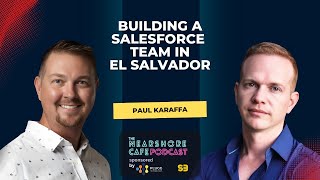
Paul Carafa built a Salesforce consulting team in El Salvador after his Hawaii startup needed to scale. He partnered with a local training company to educate developers and teach English, creating a joint venture that supplied steady talent. He emphasizes fluent English, a strategic local partner, and four-hour daily overlap between time zones as keys to making it work.
Chapters
Welcome everyone to another episode of the Nearshore Cafe podcast. I'm Brian Samson, your host. If you're interested in Central America, particularly El Salvador, and building a remote team out there, this is going to be a great episode for you. I've got Paul Carafa, CEO of a couple companies that have really built some amazing overseas talent. Before I do that, let me thank our sponsor, Plug Technologies, plugg.tech. Great way to connect talent from all over Latin America to growing US companies. Paul, it's great to have you on the show.
Thanks for having me, Brian. So happy to be here.
So So for our audience, it's kind of fun as we talk about nearshoring, both Paul and I are in Hawaii. And when you think about nearshoring, you know, Hawaii is the— I think it's like the population center or the largest population center that's like not close to anything in the world.
Yeah, it's most isolated. Yeah.
Yeah. So maybe, maybe let's, let's start there. As you were, you're building Cloud Pacific and we'll get into that and what it did in a second, but just like what was going through your head as you started to need to grow your team a little bit? 'Cause you, Hawaii, it's like there's no natural option, which means you've got a lot of options. So yeah, just walk us through, you know, how you thought about that.
So yeah, you know, it was originally just me and, It happened because I was laid off from my previous job. We had gone through a merger. I originally had been like employee number 10. I was with that company, it was a startup company into doing the energy storage space. And I was with them for almost 5 years, 250 people. We merged with Siemens, you know, obviously with stuff like that, you know, some people get laid off. So, you know, I was one of those people unfortunately, but it gave me an opportunity to spend some months sort of thinking about what I wanted to do next. And so I refocused my attention on building out an IT consulting firm. Obviously it started with just myself and, um, I had a contract for about 9 months. And at the end of the 9 months, I was like, well, this is coming to an end. Um, they let me know they weren't gonna be renewing it. They didn't need to. Uh, everything was built. And I was like, I was just out there hunting for more contracts. And just so happened, I got 2 at the same time. And there was something in inside me. I was like, I could do two, I could do two at the same time, you know, but there was also a piece of me. It was like, yeah, I probably know to get, need to go get some help at this point. And so that's when I made my first hire and, you know, slowly started to grow it. And, you know, I grew to about, I think it was like 5 or 6 people. No, no, no. It was probably closer to around like 8 or 9 people. And that was at in 2020, and I was stressed out of my mind. I remember thinking that I wanted to burn the whole thing down. You know, I was trying to go through this like process of scaling it in a reasonable way. And, you know, there's just have a bunch of different scaling steps that you sort of have to go through. I was going through some painful ones. I ended up meeting up with a number of different executives that were running similar companies to me, uh, you know, some for advice and somewhere I just wanted to, you know, see if they would— they— what would they do, right? Would they buy my company? Would they sell? You know, do they think I had a reasonable ability to sell this company? You know, we were doing a lot of business, but it was sort of all over the place. And none of them said that they would have ever bought the company. So I thought that was like— I was like, okay, great, thanks for letting me know, you know. And you know, you know, it just wasn't set up in a way to sort of operationally grow, um, and it wasn't, it wasn't sellable even though we had valuable contracts. And so, um, you know, I decided that I was going to come up with a strategy to then grind through forming a company while scaling it, um, that would be operationally smooth, that would be able to scale in a reasonable way, and that ultimately I'd be able sell. Um, and, you know, that led me to making the decision that I needed to outsource a significant amount of the load in order to grow it as fast as I needed to grow it. Um, Hawaii is amazing. Um, unfortunately, there's a lot— a lack of IT talent here. Um, we literally— so we grew to the— to be the largest Salesforce consulting firm in the state, um, and we were sopping up pretty any, basically anybody that needed a job that was in the Salesforce space, we were hiring. So, you know, there were other companies, you know, banks and stuff that were hiring people too, but, you know, a lot of people were very cozy and cushy in those, those jobs. But if they were looking for new work, they were talking to us. Um, and, you know, most, most people we were, we were picking up. Yeah.
So the first, uh, like 8, 9 people were all local in, in Oahu.
For the most part, we had a few people on the mainland. We had a couple people that were former clients of ours and they ended up leaving and going to different companies and they were just extremely capable. So some of them we brought on part-time, some of them we poached. Yeah.
What were the first couple hires you made outside of the US? How did you even start?
Yeah, so I didn't really know what I was doing, but I knew that I wanted a company or I wanted people that would align with the continental United States because, you know, obviously being in Hawaii, it's not very great. Somebody would align well there. And then people that were, you know, really good at English, trustworthy and reasonable rates. And, you know, that was, that was really my criteria. Um, so I, I literally got on LinkedIn and started looking at, uh, anybody that really had a Salesforce architect or Salesforce developer, um, title that lived anywhere in Central America or, uh, uh, or Central America, uh, or sorry, South America or Central America. And I just started setting up calls and talking to people and I was going after anyone and everyone that had a senior title. And the thing is, is that there just wasn't that many people. I mean, that was kind of shocking to me. You know, I thought there'd be a lot more people, but you know, as an example, like I had interviews with a few people in Costa Rica and the lack of people in Costa Rica, you know, with those sorts of titles and expertise just blew my mind, right? And so when I was talking to these people, Most of them are extremely good, you know, but they were also, you know, charging basically US rates. So it was sort of a little bit of a damper on things of like, okay, I mean, they're very big fish in a very small pond here and it could be difficult. And then some other countries were a little bit easier, you know, to meet people and sort of get, you know, a little bit more reasonable rates. Those countries being like Peru, Argentina was one, Brazil, um, you know, ones that were not great were Costa Rica, Jamaica was the worst, you know. Yeah, so we was talking to people in the Caribbean as well. And what ended up happening is I found that there seemed to be a pretty good treasure trove of people in El Salvador. And I was like, this is interesting, a small country, you know, like let's grind into this a little bit. And I ended up finding this really great lady and we had a conversation and I ended up making her an offer. And it was like the next day or the day after I got an email from this guy named Gino. Well, Gino was the owner of the company that she worked for. And, and, He was like, hey, you are trying to poach my top people. And, but he was super cool about it. It was like, hey, you're trying to poach my top people. Maybe. And I think he also knew like, you know, I would eventually be able to top poach somebody, right? But, you know, he was like, hey, instead of us like working against each other, how about we talk and see if we've got some synergies and there's some ways we can work together. So I was like, okay, let's go. You know, cause my whole plan was like, I wanted to find somebody not really to just be like a developer there. I wanted to find somebody to lead and build a team. And so, you know, I met with him and, uh, he, he owned two different companies. One was a consulting branch that did exclusively Salesforce in El Salvador. And the second was a training company where they took people in El Salvador, essentially didn't know anything. And trained them to know a lot of things. And they, you know, also gave them like crash courses in English. And so, you know, I was very intrigued and the rates were reasonable. So, you know, I ended up partnering with, with him and we built a company, a completely separate company in El Salvador where he would train people up in his normal company I would essentially interview them once they were done, and then we would export them to the joint venture that we had, uh, and then those people would work, uh, for Cloud Pacific exclusively, uh, in Hawaii. So that was sort of the structure. A lot of funny stories along the way, of course, but, um, yeah, that was, that was inevitably how we did it. And because we set it up that way, it was so scalable. He already had an operation of bringing in people that were very good, you know, very— they were hungry, they were ready to They're hard workers, you know, they had to put themselves through this training program. I got to interview them. And so it was just, we were just stacking people so quick, you know, to be able to service the demands that we have here in the United States.
So interesting. I'd be remiss if I didn't talk a little about the climate there. So not long before you started to hire in El Salvador. Bukele came in as the president and really transformed the country. Did that impact your business at all? You know, how did it— what did it mean for you guys and your talent?
So I— we signed our partnership agreement, I think it was just like a handful of months after Bukele came in. Um, and so there wasn't any tangible effects that I saw from that. Uh, the biggest thing is that we, we had considered, because of sort of like payment methods sometimes being more expensive with wiring, uh, in terms of doing business in Bitcoin, because we actually got a, a Bitcoin reserve. Um, so we, you know, we held it as a company because we were just we had a lot of cash flow at the time. So, you know, we had talked about doing payments out in Bitcoin, but they weren't structurally ready to handle it at that point. And so the company, like a year and a half later, so, you know, that didn't come to fruition. But it probably—
did you ever visit El Salvador?
Yeah. So, so, so, you know, El Salvador and Hawaii are very similar in that, like, we have very similar climates and they are still very paper friendly, I should say. Like, a lot of stuff had to be done on paper to be official. So I had to hire— I had to go for my corporate team, legal team here in Hawaii, to hire a team in El Salvador to represent me and put together all the paper. Because we weren't just doing a normal partnership, I, I owned a company there, right? So, you know, so we had to go out there to sort of sign all the paperwork to officially, you know, become a joint venture out there. And yeah, I wanted to meet these people, right? So it's actually an interesting story. So, you know, so it wasn't that long ago that San Salvador, the capital, was like the homicide capital of the world. And so, you know, I had some reservations about flying out there. At one point I was like, should I get like I was talking to a few companies, getting quotes on like hiring a security detail. I was out there just in case, you know. And so, you know, but ultimately I decided to sort of just take a risk because I was like, if I show up, I've got a security detail with me, they're going to immediately think like, I don't trust them, you know, like, you know, there's just, you know, I just think the whole thing sucks. And I was like, no, no, no, no, no, I need to I need, I need to give, you know, show that I, I trust them, right? And we're going into business together, right? This wasn't a small business. Um, and so yeah, I just flew out. It was very interesting. It was extremely small country. The, the international airport there is, I mean, it's probably about as big as like, you know, the, the airport over on Big Island, like in Kona, you know, it's tiny. Yeah. And, uh, so, and he picked me up from the airport and Uh, you know, and his business partner Rax, they, you know, they both spoke really good English, so, you know, we were able to get on pretty well. But yeah, I, I had this one moment, I always tell the story where I was like, because I'm an adventurer, I travel a lot, I've been to like 30-some countries, you know, and I like just kind of getting lost. And at one point I was like, you know what, I'm just gonna go out there. I'm like, I left the hotel that I was staying and I was like, I'm just gonna like go for a walk down the streets, you know, it's all right. And I went up to like the end of the block and you could see like a number of the different roads. And on the end of every single road was a police officer with an enormous gun. I think it was an automatic, you know, just hit finger right there, ready to go on every corner. I was like, ah, I'm not, I'm just gonna go back, you know. But thankfully, thankfully, you know, it's, you know, the country's come so far, uh, in such a short period of time. Him, uh, and, you know, they were unbelievable hosts. You know, we had amazing good partner meetings, but they also took me around the country a little bit. Uh, we went up just to the border of Guatemala, saw some of like their, you know, more like touristy sort of towns, and we had some amazing restaurants. And, uh, they were just great people. And everybody that worked for my company, I just had nothing but positive things to say about them. They were all just really great people to have part of the team.
That's amazing. Tell us a little more about the team. You know, how would you compare the level of the Salesforce team in El Salvador versus those you had in Hawaii, those you had on the mainland? Seniority level, problem solving, you know, what were some of the trade-offs that you had to consider?
Yeah, I mean, I don't think— I mean, in terms of effort, it was pretty comparable, like in terms of like how they work, their level of knowledge. You know, I would say they're definitely hungrier than some of the people I had hired here in the United States. And actually, when I look back, a lot of the people I ended up hiring and keeping the most in the United States were either immigrants or first-generation people in the United States. So I always found that super interesting. You know, one was always like English, I think was probably the bigger thing. You know, I would hire people and it's not that the English was necessarily bad, but it needed to be exceptional in order for us to keep the sort of pace of work that we did and for things not to fall through the cracks. I had worked with offshore teams, not in Latin America prior to this, and I had not had a very good experience. And it always, to me, always boiled down to the, the language barrier and not necessarily their ability to deliver. And with language barriers, you just end up doing a lot of back and forth. And so that was the biggest trade-off. You know, there were a couple people here and there that, you know, were borderline at the very beginning when we started working with El Salvador, where the language barrier was a little bit too bad and, you know, we had to move on from them. you know, which is unfortunate. Um, but you know, it was very, you know, apparent to us like going forward, like this is sort of the level and this is how we're going to test for it and make sure that we're getting somebody that's truly proficient, you know, in the language.
Culturally, is El Salvador— do they have like a technical university that was producing this talent, or were they more like self-taught and, uh, you know, GitHub-type learning?
A bunch of people had like a little bit of self-teaching, but you know, they're, you know, they don't have a, I mean, they've got a university there, but the big one was that there was a company set up to produce them. It was basically a factory to produce, you know, talent. And, you know, there, I don't know if he's expanded outside. Well, you know, he's expanded a little bit outside of Salesforce, but, you know, there was just such a demand for so many years for talent that it just made sense to do so. And I, and one of the things that I forgot to mention is like, I made it a priority of my company to actually go for more junior level people. So it really fit well. And they did that the same, I did the same thing here in the United States. I mean, one, yes, there's cost, but if you knew how to effectively interview them and I had a very effective interview process, you know, you could find someone that was more junior, less experienced, but was exceptionally capable. And, you know, so that was sort of the direction that I took it.
And just back to the language and maybe the tools, was this a— were you guys doing more like written Slack and Jira type stuff, or were there a lot of Zoom calls? And how did you guys think about managing and, you know, across countries and oceans?
Yeah, we worked pretty much exclusively on Slack. So each of our, we were running 6 different development teams by the time I left. Each of them had their own Slack channels. And then each of the companies that we were, each of our clients had their own Slack channels as well, where we could communicate directly with them. So yeah, we had a lot of communication over Slack. That was how we did pretty much everything. You know, we had Zoom calls every day though, you know, as well, we had standups every single day with all of our dev teams. Dev teams, you know, with the leads. And if the devs needed to be involved in client calls, then, you know, obviously they were included. So yeah, it was, you know, a little bit of each, but, you know, for the most part it was Slack-based. If you're—
just like when you started your company, you asked others for advice. If people came to you asking for advice on how to build a team in Latin America, What are, what are some things that you'd, you'd advise them on, counsel them on?
Yeah, I mean, I don't think— I think the best way to probably do it is have a strategic partner in the country. I mean, somebody that has experience building teams out there that's exceptionally reliable, that is fluent in the language, and that you can partner with. If I had to do it all over again, that's That's exactly how I would do it. It just makes everything so much more easily managed. And he was able to manage things that are just sort of more expected, like, hey Paul, there's like a Salvadoran holiday coming up. And I'm like, oh, okay, I didn't know about this holiday, right? He's like, hey, like, you know, it's next month. Like, we should probably like let those people go for the day and, you know, be with their family. I'm like, okay, like I wouldn't have known that, right? You know, like those are good examples of things where like you need somebody, I think, culturally boots on the ground, maybe not to get like immediately started, but if you're going to grow to anything of like a team of 5, you know, where you really need somebody out there that, um, can manage and, uh, manage the camaraderie. Like he used to do like a couple parties, you know, every year and you bring everybody out there and, um, You know, just, it was good for the company. The entire time that we worked with them, we didn't lose a single person. So, you know, people were very happy and felt appreciated.
And we haven't talked about the elephant in the room. This is all during COVID too. So was everybody on site in an office or how did that come about?
So I never had an office space. We had, there's a coworking space called Treehouse here in Hawaii. And for like the first year and a half, I had a, you know, like an office there and then 2 offices, you know, in like, or 2 desks in a big office. And we're starting to grow that as like our space. Eventually I'm like, why am I spending all this money on it? It just makes zero sense to me. Um, so we went fully remote after that and then we would just do pauhanas. Um, and I'm sorry, what was the other part of your question? You were asking about like where we, where we were? Oh, COVID.
Yeah. I mean, you know, running, did you guys have an office then in, in San Salvador? Cause you're, you're right in the middle of COVID While you're running that?
Yeah, so they had an office, but it wasn't required that anybody come in. You know, some days they might ask people to come in, but it was fairly rare. You know, it was— I think, I think they needed to have an office to operate, and at one point they were in person, so they still had all this office space. But for the most part, it was all, it was all remote, and that's the way I preferred it, honestly. So we were, we were already a remote company before COVID hit. Um, so it was not a big transition, uh, for us, uh, at all. And, you know, I didn't start this process of looking for, uh, people in a different country to like a nearshore team until, uh, 2021. Was it? No, it was late 2020. Um, so we had, you know, we were already in COVID, um, and I think it's at that point some places were— I can't remember, it's all fuzzy— but I believe some places were starting to open up again and, you know, things were, you know, easing.
What did the time zone feel like for you? Um, and, you know, a lot of people that work in tech, they're, they're often more night people. Um, did you have much crossover and overlap, uh, like you personally with the team?
Uh, yeah, so I mean, as the owner, I would start my day at 4:15 every day. So, you know, for, for them, I mean, I, yeah, I don't— they— I think that must have been like 8 or 9 o'clock for them. I can't remember off the top of my head. Um, and so, yeah, I mean, we overlapped, you know. I started before they started and I ended my day before— after they ended their day. So it was always pretty good, you know. Like, the team leads, you know, they had to, you know, manage that a little bit closer, you know, but they would have at least 4 hours of overlap, you know, depending on where the lead was. And, you know, my— and I was also extremely liberal with how we managed the company. I did not want to micromanage everybody's time. So my take on it, and I would, when I interviewed people, I remember especially devs, you know, because I've been a dev, I know how it is. I remember like working till 4 or 5 o'clock in the morning and just being like so happy. And I remember telling them like, look, if your ideal is like, you know, work, starting work at 2 AM, uh, after playing video games and pounding Hot Pockets, I don't care. You know, I, I truly don't care.
Whatever makes you happy, man.
Like, what, what I care about is that if there's a meeting that we care about, like our stand-ups mainly, you got to be there. And other than that, you hit your deadlines. That's it. You know, and as long as you're hitting your deadlines and the volume of work we expect of you, I don't care when you do it. Um, And everybody was super appreciative of that. And we also had a lot of really good self-starters, right? And, uh, you know, they were able to manage their time pretty well.
Uh, back to your, your trips there, um, any particular food or anything that you'd want to comment on, share that, that you really enjoyed or, or maybe didn't?
No, everything I had there I loved. They, they, uh, from what, from what I understand, El Salvador is known for pupusas. I believe pupusas are where Or El Salvador is where pupusas came from. Somebody's going to yell at me, but this is what I was told in El Salvador. So if it's wrong, the people in El Salvador believe it. Okay. And it's basically like, it's almost like a tamale, right? So it's like, it's made of sort of the same, is it masa? I think the corn masa, except instead of having it in like almost like a burrito sort of thing and wrapped in corn, the husk, it's flattened in almost like a pancake. So it's like a pancake with filling. And it's so funny, like literally last weekend I'm at Costco here with my fiancée and we see pupusas. And I was like, I literally tell her, I was like, this is exactly the same as like they're known for it in El Salvador. I was like, let's get it. And we got them and they're amazing. So yes, pupusas. Yeah. You can get them on the streets or you can go to like a really nice restaurant. They'll have like gourmet pupusas that you can order. He took me to this place like on top of one of the mountains that are the, the crater there, or mountain, I can't remember, that kind of overlooks San Salvador. Beautiful, beautiful view. And, uh, yeah, we just, we ordered a ton of pupusas.
Uh, tell us more about, uh, what you're working on today, Paul.
One of the, the problems that, uh, I saw it, you know, the last 12 years being in the Salesforce industry, and certainly when I owned Cloud Pacific was that the customer service experience that platforms have, and this is not just Salesforce, but, you know, other ones, AWS, Azure, so on and so forth, they're just not really that great. I mean, once a, you know, a monopoly platform sort of locks you in, they want to sort of invest money that's sort of, they're just dropping down the drain to to service your concerns or answer your questions is not something— they just don't put a lot of money into it. Um, and so they all kind of suck. And so, you know, I came into it sort of saying like, let's create something different. Uh, so I founded a new company this year called AdminNow, and it's a digital marketplace that helps companies that are using complex systems like Salesforce or AWS get real-time video IT support. So you could imagine you're, you know, a Salesforce administrator, you're a Salesforce guru, you're the, you are the team at like an SMB that you're working at. Um, and you know, very often you have issues that come up that you just don't have answers to. You don't know how to fix it. These could be critical issues, you know, uh, while, you know, fire drills that need to be taken care of. And so, um, you know, there's just not a lot of support out there in order to get these things resolved. Really, your options are to go to Salesforce and fill out their very, very long form, and 2 days later they'll get you in touch with a junior agent that barely knows what they're talking about. Or you can go on a forum and beg, you know. I mean, and neither of these options are great. So with our site, all you do is you go to our site, you put in your, your issue, You submit it and you get instantly connected to an expert via video. Um, you can screen share, uh, to resolve your issues. Most problems are resolved in 20 minutes or less. Uh, we're building out a 24/7 network so that you have access whenever you need it. There's no contracts, it's pay as you go. Um, for our B2C offering, we have a B2B offering coming out, but, um, for B2C Just pay as you go, use it when you want. And the people that have used it so far have really loved it.
That's awesome. If anybody's listening that's interested in that, where would they find you?
Yeah, you can go to adminnow.io. You can also follow us on Instagram. That's @adminnow.io. And we are on LinkedIn. Look us up at AdminNow, all one word. 2 N's.
Are you, are you also recruiting Salesforce developers? And if so, any particular parts of the world?
So we are pulling in people globally because we are trying to create a 24/7 global network. So anybody that is interested, that speaks fluent English, that has, you know, exceptional Salesforce skills, we're looking for you. Um, uh, we, you know, it's, this is, it's basically the Uber of IT support. That's what we're building. So, you know, we do not hire anybody direct, um, but you can go and join our waitlist, uh, for, for as a, to join as a contractor to start providing services. Uh, and yeah, uh, you know, we're working our way through our waitlist now, bringing people on to, uh, uh, to service our customers. So yes, and hopefully through this next quarter, we'll be through our contractor list. If we can get through it, it's pretty extensive. So we'd love some more people and more interest.
Awesome.
Love it.
Well, Paul, this has been really great hearing about your experience. Like I said, first person ever in Hawaii to be on the podcast. I think that's awesome. And wow, what a journey in El Salvador. That's super interesting. Everyone, this is the Nearshore Cafe podcast and sponsored by Plug Technologies, plugg.tech. Great way to connect talent from all over Latin America, including El Salvador, with US companies. Thanks again for listening. Thanks, Paul, for being a guest.
Thanks for having me. Aloha.
More from Brian

From BPO Agent to Client Experience Manager: Ana Rodriguez on Nicaragua's Nearshore Talent

From BPO Agent to Client Experience Manager: Ana Rodriguez on Nicaragua's Nearshore Talent

Building Sales Teams in Mexico: Mario Oliveros Figueroa on LATAM Talent & Cross-Border Selling

From Automation Engineer to Data Platform: Victor Fernandes on Brazil Tech Talent

H1B Crackdown & The Nearshore Shift: Robert Bouchard (H1B Guy) on LATAM Talent | 🎙 TNC

Nearshoring Yourself; step by step to building an expat life in Mexico |🎙 The Nearshore Cafe Podcast

Scaling high-performing teams in Costa Rica staffing legend Doug Firestone on growing to 225 LATAM

How to Scale in LATAM? Navigating Currency, Taxes, and Labor Laws | 🎙 The Nearshore Cafe Podcast



AI in LATAM: How to Break Into Mexico’s Tech Market |🎙The Nearshore Cafe Podcast