Building a Thriving Tech Hub in Guatemala – Digital Geko’s Journey | 🎙 The Nearshore Cafe Podcast
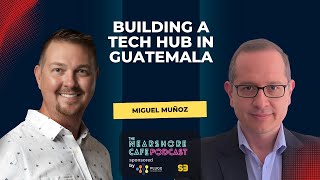
Miguel Munoz founded Digital Gecko 16 years ago in Guatemala, building it into a nearshore tech company serving banks, telcos, and fintechs. He partners with top local universities to develop talent and recently created an AI unit, positioning AI as a new tool for engineers rather than a replacement. Guatemala's large population and macroeconomic stability make it an underrated tech hub.
Chapters
Welcome everyone to another episode of the Nearshore Cafe. Today podcast. I'm your host, Brian Samson. And if you are interested in Central America, in particular Guatemala, wow, this show is going to be chock full of good information. Before we introduce our guest, I'd like to thank our sponsor, Plug Technologies, plugg.tech. Great way to connect software engineers and other talented people from Latin America to growing US companies. Without further ado, let me introduce our guest, Miguel Munoz from Digital Gecko. Miguel, great to have you.
Thank you very much, Brian, to have me on your podcast. I appreciate it and thank you for the opportunity.
As we mentioned earlier in the show, or in the pre-show, you are the first leader we are working with and talking to from Guatemala. So this is a groundbreaking podcast. If you could, you know, for our audience, myself included, who've never been in the country before. Can you just give some like macro— where is it? You know, what should people know about the country? What should people know about the evolving tech industry there? Sure.
And thank you for allowing Guatemala also in your call. It took too long to have to say— I'm kidding.
Thank you.
You know, it's a question that we get a lot. Where is Guatemala? Because everyone in the US or North America, they hear about other countries. Like Costa Rica, which has great advertising, I must say, but Guatemala, what you need to know about Guatemala is that it has been a pretty stable country in economic terms. Just today I was talking to a banker and he says that the, for example, the exchange rate is pretty stable. It has a system of banking and, and laws that keeps it very stable. It has the largest population in Central America. There is a lot of talent and One of the things is we have to do everything mentality in Guatemala, you know, sometimes we're criticized because we're not so specialized, but we need to provide the whole service and the whole activities for our customers, which gives us flexibility and we have to come up with new ideas and solutions. So we are very hard workers in Guatemala, to be honest, and you can see that in different industries in the US, for example, from roofing, construction, and also software, definitely. So we see it as a, best kept secret around the region because we have the volume, the economy, and we are really an exporter.
Yeah, I think that's really interesting. We think about the term talent arbitrage a lot, labor arbitrage, and what you're really saying there is you're getting more value than the cost. That's really how people are thinking about that. And as other countries in Latin America maybe get more expensive, the, the gap between value and cost starts to strain.
Correct. And there's competition because you might want to go to these other countries, but everybody's looking at those. So they're more expensive. Definitely.
They do have talent.
I have to say, but if because of a maybe unfounded fear, you will look at these other countries and Guatemala, El Salvador, and Honduras has great talent. And so it's, it's a good opportunity with all the benefits of time zone and all the nearshore. We know about, right?
Yeah, I think the thing that probably impacts it more than anything is reputation, right? So, you know, we see this sometimes with Mexico or Colombia, and sometimes it's just the media or movies that we might watch in the States or Netflix shows about narco—
and it works.
It happened 40 years ago, but the reputation is still there, which kind of controls prices. What do you think is the— when people might hear of Guatemala, what do you think, um, they're thinking from a reputation standpoint?
Most of the times they don't really know. I mean, some people don't know where it is at all, so that's, uh, their geography course or classes that didn't work out, but they don't know about it. That's the thing. So as you said, they have the top of mind of Costa Rica, and I even have family over there, so nothing against them. I love it. I was there last week, but they have some complications also in terms of legal stuff, but they don't have the attention, right? You have Intel, Motorola, and all the big guys there. So there is some energy that is created around those things, but Guatemala, they need to jump a couple of hoops to get to say, okay, where is it? And what kind of talent? So then we can start saying about the type of companies and that we serve in Europe or, or the fintech area where we have worked. And so they say, okay, you know our culture, you know our type of demands and, and, and what we need. So it's a good thing. We need to just need to prove we exist, and that's good.
And that's really interesting. Costa Rica will probably come up a little bit on the, on this call. And you're right, they probably have the best advertising of, you know, any, any country in marketing. Um, but actually with all that attention comes labor constriction, right? There's less talent. And you, you mentioned something I actually didn't know. So Guatemala is the most populated country in Central America. What does that mean for like labor supply and maybe labor that is more focused on domestic activity versus labor that could be exported, you know, for nearshoring potential?
There is, because as you were saying, because of pandemic, we now compete with everyone, right? So we have people from small towns. We have people already in Costa Rica and Colombia. So all over the place, just like any other company, right? But what it does is that the talent that is inside the, how do you call it, inside the country or rural towns or other growing towns is they already have success into working for US companies, Canadian. Poland. So we've had people that they're, they're very good. They get their English to a good level and then they can start work from, to, to, to these other places. Right. So what it does, it has pushed the economy for, for those different areas that just the main city, which is Guatemala City. There are others working and universities have seen that for a while and they have already planted different branches of them. There's even universities that just work over there. Right. So that has created some momentum, some pretty good momentum.
Yeah. Well, let's talk a little more about you, Miguel. Tell us about your career journey and what led to Digital Gecko.
Awesome. I'll keep it short. If I do not, please stop me anytime. So I've always been in the IT industry in terms of initially as a consultant for Arthur Andersen and Price PwC, implementing systems, then selling those. I did an MBA in London. So that gave me another perspective, which is very good. Then I worked for Microsoft selling licensing and stuff. I did work for a bank for a while. They're awesome customers, but different culture. So I was more of the entrepreneur and we started working with my partner at the time. That was already 16 years ago. We, we, we started with some customers in Europe because my partner used to live there. And that was a great adventure like that. And we have been working with mobile since BlackBerry was the thing and the manager for the general manager of the bank had the BlackBerry. So we needed to develop those things. So we went to Android, iOS, of course, Microsoft and some mobile applications, but for TV applications, I'm doing mostly custom development. So that, that was a nice venture. And 3 years ago, 4 years ago, I I joined with another group, some friends, they're French and they have another strong arm, which is digital marketing. So now Digital Geek Quiz joined with TPP, it's called, and we have a nice group and we serve telcos, banks, insurance companies, retail in the region, right? We've gone to establish companies in each of those countries and recently Chile too. And as I told you, we have people all over the place, someone even in Barcelona. In Montreal. I forgot to say that I got to live a couple of years in Montreal, 2014 to '16. So great adventure. I love the cold. Funny. Yeah, that was it. So lots of, as an entrepreneur, you know, right? It's ups and downs. I wouldn't trade it. I would have done differently maybe to do better sometimes, but I guess I had to learn like that. And we've been involved also with the local industry. And trying to reach more of joint ventures with other companies, right? We are a small country and if we don't join with other either slash competitors or friends, we cannot go to markets like the US, right? Thank God we have worked for some fintechs in the US and created different things, even from AR applications before the Pokémon game. So my customer, John Fowler, at the time, he said, you know what, we invented the Pokémon game. Too bad it wasn't so real. We did something like that because we like to tinker with things, but, uh, and that's it. And then, so we keep on growing in the region, serving banks and always looking for customers in our northern countries. Yeah.
Tell me about, um, the founding of Digital Gecko. How did this come about? And this is maybe 15 years ago. Did I read that right?
16 now. Well, founding, they always ask me why Digital Gecko, the name. To be honest, we were fed up with names like Soporte Tecnologia or names that just nuts and bolts, right? So let's come up with a nice creature, something that's funny. Let's change the Gecko to without the C, so Digital Gecko. And the domain was available. So we went for it, right? So we got that one. Again, we started with my partner who was still my friend from school. We met at 3 years old. You can imagine we're still friends. And it was a time when he came back from Europe. I was changing jobs and we, of course, were talking about starting up a business for a while. The bar was not an option at the end of the day, you know, it's always tempting, but not profitable for us. So we said, let's, let's, let's start this up. And funny enough, there's an, there was an office that, that we could use at the time. And the first project was for $100,000. That, that was the breaker, right? So, and then. And then the roller coaster to this date.
Yeah, you always remember the first project. Everyone kind of needs that, that first break. And was the client, um, in the States or they were—
That was— we had the first project was an insurance company, the whole system. This one, which was an NGO for health. And the third one was one in the Netherlands.
Wow.
So because my friend met him and we started working for, for him. So. Like 3 years after, 4 years after we started up, there was an opportunity. So he went even to the Netherlands and we even started, we founded a company in the Netherlands and we started exporting people directly, right? We took the good engineers and sent them there from Guatemala and Costa Rica. So that was also pretty good and had customers in France, the Netherlands, the UK, a little few.
Yeah. And as you, you know, you've talked about NGOs as customers. You've talked about banks, telcos. Can you talk about how your maybe core services and core customers changed over the years? And this, this is probably a lesson for any service provider anywhere in the world, you know, as services can get complicated in saying yes and saying no.
Yeah, I, exactly, exactly. To, to be honest, the most fulfilling customers are the one that have, uh, where we built up a relation with them, some mutual respect. And one of the couple of the banks that we work with, we have been working since BlackBerrys, again. So the good things about that is, well, you have to come up with new solutions. You have to take on some challenges, but most importantly, stay with open communications. That's for me, the key, being honest and when sometimes you have to take responsibility of your mistakes, the customer will appreciate that. And I'd rather have the customer that says, okay, Miguel, I got you. This is something that didn't go well, but you had the guts to tell me face to face and you kept on going. So that's very valuable, of course. And this, I think this is something very important for, for nearshore also, because we've had some customers in the US that need to get that trust. For example, hiring only freelancers. That can be tricky, right? You need to understand the culture, but also there is momentum into knowing the company and really taking the long road, right? Because you can get a developer pretty easy and change the companies, but there is value into building those long-term relations with a company, even if it's small compared to others, of course, but that's, that's the most important. Then customers will have different opinions, change. Small project, big projects, and all sorts of it.
Yeah. Miguel, if you don't mind, tell me more about the talent at Digital Gecko. Is it mostly software engineers and what kind of engineers? Sure.
We have, uh, we're mostly software development. What we do is, uh, teams, teams for development. We do have some custom development, but we, we rather put teams. So engagements of 6 months, 12 months. So, so we can maintain the people because as, as you know, there is much, a lot of shifts and people move around, but the value that we bring is precisely understanding them and really milking a culture for the company. So it's hard because they're all remote, but my HR team, I have them constantly saying, we, we are a culture. We're a team. We're not a family. It's a different thing. We're a culture. And how we can have them grow. That's their main, well, everyone's main thing, right? But we push them to grow and we know that the relation might not stay for long, right? Because people will change jobs and that's okay. But the time that they're with us, we want them to grow and really learn and, and communicate and all the soft skills that we want. But that's why we see it. Sometimes I was told that we were, uh, a school company, so they would stay for a while and then go. Now every company is like that. The thing is, how important is their lifetime during the work with Gecko, right? So that's kind of the culture I nag my HR team every day.
So I would imagine, I mean, you built relationships with some of the local technical universities and CS programs to nurture the, the talent, recruit those graduates.
Yes. Yes. We already know which, which are our best universities for what type of technology. We have full stacks, mobile developers, of course, is our strength. And of course we're partnering with AWS and other companies. So, so we're really into cloud, which has been beneficial to some customers already in the banking sector. But yeah, we, we develop, I work a lot on the culture and it's because as I tell them, I've had other lives and what is important is having that period of time with the people you like to work and be okay.
Yeah. Yeah. If you don't mind, um, could you share some of those universities that you, you've specifically appreciated?
Sure. Well, one of the, the national one, Universidad San Carlos, they have good, good base. They're strong. Universidad del Valle, they have English. So it's a, it's a, it's some good demand. Then I can say Mesoamericana. This is the one that's based a lot in, uh, Quetzaltenango, a secondary city. That one's pretty good too.
Okay, great.
Great.
Talk about AI. How is this impacting your world?
Well, we've, um, we've seen the sun come out many times already, right? So as I tell people, it's. Digital transformation or whatever you want to call it, we keep doing similar things, right? Not really automating things. So what we did is we have a company, we created a whole unit with AI. And what we are understanding from some customers in Chile and another guy we met in Chicago is that there's a lot of startups offering it because it's going to be an easy way in, right? But the value of AI that we see is we need to understand the whole process. I see it as another front end, right? We used to do web, we do mobile, we do AI too. But what's important about all these front ends is the automatization, automation, sorry, for the whole process, right? You need to have the conversation with the AI, but there's some action to be there. And then behind that, you need the data. So we got the other components to create those processes. And we have been doing it with other technologies, right? So, but I know it's pretty sexy and we have already implemented for retail sales, for bookings and stuff. So we have our own agent creation tool that we developed. And I think it's going to go that way, right? It's up for grabs. We can say anything, but it's just another way that we're going to be introducing new value or more digital products or any other thing, solutions for our customers.
Yeah, you know, I was talking to a friend of mine who's a CTO in San Francisco the other day and asking him, you know, does this, does AI mean the death of the mid-level engineer? And he's like, actually, no, not, not for a while because there's a lot of connection to do. You know, you're really integrating things. You've got, there's a lot of complexity, much more complexity now that you have to understand as, as you connect. Do you, do you see some, some truth in that statement? Totally.
It could be scary because we don't really know. I mean, we use it as Copilot for development of our chat tool too. But yes, I don't want to be skeptical, but there's, there has been other waves as you've seen in the, in the market. Now the front end is easier. Now with this Flutter, you can do multi-platform. So there will be advancements, definitely. And there will be a change into what engineers need to learn. But what we need is give solutions to the, to the business, right? When I, when I get approached by, or when I approach a customer, I always say there has to be a solution. There has to be business solution. And, and that rules everything. Technology, of course they say, but how much is it going to cost me an app that does A to B? First of all, I say, yeah, you know, they're going to cost you like 3 more times the marketing side. If it's a game, it's going to be like 10 times. But then the reality is. Does it make business sense?
Yeah. Yeah, I think that's right. You know, my prediction, uh, and I hope this is true, is that this will create a lot more entrepreneurs because the burden to build a business now is dramatically reduced and maybe even kind of democratize entrepreneurship across the Americas. You know, you could, a senior engineer who wants to start something in Guatemala has the same opportunity and chance. Somebody in New York City or Montreal or wherever.
I totally agree with you. And it's, I think it's doing that, uh, just like, uh, webmasters, right? When the web started, just creating 5 pages was very expensive. And now you get Wix, you get Shopify, you get all those things. It has created also businesses for a lot of people. And I think that's good. The thing is how it's going to be for, for us, the B2Bs. Uh, most likely, I think, and I want to hear your opinion too, is, is it going to be like they're going to go for the small businesses or they're going to trust a company that has been doing this for a while? What, how do you see it?
I think, uh, the, the quote they used to say 50 years ago of you never get fired for hiring an IBM. I think that still applies today. Large companies are large buyers and You know, and as I've, in my own career, as I've sold to large organizations, I think risk is the most important thing for them, right? Is play it safe, don't do anything that's gonna break it. So I don't see a lot of change there, but I see, um, a lot of fast-moving opportunities from small and medium-sized businesses selling to small and medium-sized businesses.
And we need to really, the way I joke about it is like the Rubik's Cube, right? We still need to find out how that turns out. But my experience was that there was this guy from Heinz, no, Heinz ketchup, Heinz, not Karl Heinz, sorry, from Heinz, a company worldwide has the other Kraft Heinz. I was close enough. So there is this guy from Kraft Heinz. He was saying that there are small AIs. And that's a problem because a large company does not need so many suppliers, right? They just need someone that can do everything. That's why that's, that's the way we're heading to. So we are a supplier of those AIs and then gather the data with the platform they need and help them out with that. Totally agree with you. There's other opportunities and people are turning into this and hopefully that's another way we plan to catch.
That's cool. I like it. I like it. Miguel, tell us more about the culture and let's even get a little more specific. People that might listen to this podcast are like, you know what, next on my list of places to visit is Guatemala. Where should they go? What should they try? Tell us about the food, all that stuff.
So about coming to Guatemala as a tourist, you mean? Okay. I thought you were swinging a bat. Uh, well, there are, uh, very nice places. You should definitely go to Tikal, which is the largest Maya ruins area that you can visit. It's an awesome trip. You're in the middle of the jungle and really discovering the ruins. You need a lot of imagination too, but it's, it's a, it's an awesome place. Definitely. Uh, you know, they've discovered the largest pyramid in the world right now. Which is up north from Guatemala, close to the Mexican border. To get there, you need a helicopter or a lot of patience because, and you'll find mosquitoes. So really into adventure, go there. Otherwise you can go to Tikal. That's definitely a must-go. Then we have Antigua Guatemala, which is pretty close to Guatemala City, and it's a colonial city. That's pretty nice. But there are many other places, the beaches, as it is a small country. But we have mountains, so you can go climb the volcanoes. You can see an active volcano pretty close. That's an awesome adventure. If you go to Tikal and you wake up early at 4:00 AM, you can go to a, a tall pyramid and you can see the sunrise in the jungle. And that's amazing. What else? Food is, I like it. It's very spicy, not as spicy as Mexico, of course. And there's always this talk about tamales. Yeah, we have tamales just like that. But there's a, there's a wide variety in that tour. Definitely stay with the agencies that have the tour if this is your first time in Guatemala, but come and find out for yourselves, right? Let's not hear it. Just come in, look around and see it for yourselves.
Are there any restaurants that you'd care to plug on the show? You know, anything, say, in Guatemala City or anywhere else that like you've got it, this is my favorite restaurant, you must try it.
Well, if you want some meat, you have to go to Montanos. Montanos, you cannot, it's always good. It's always good. And I'm trying to think about the other one that says, hi, we went with my mother recently. I'll, I'll, I have to think about it.
We'll have to put it in the show notes.
But to be honest, there's some really good restaurants and even hotels. They have, uh, have all the, all the brands here and their food is certainly good. And if you're adventurous, of course you have to try tortillas, local ones, not like Mexicans, but just, again, always the issue of who invented it. Doesn't matter. Just try them. I don't want to get into fights with them. And the spices, the spicy food is good too.
We don't want any, any fights on the show, but come on, you, you gotta tell me that Guatemala has the best tamales and tortillas, right?
Exactly. But tortillas are good. I mean, and coffee, that's the biggest thing. But you know what? Uh, sadly, one of the problems from Central America is that, uh, we got separated. That's the problem. Otherwise, it's a large, uh, it's a large economy. I mean, if you gather all the countries and there's talent in everywhere. So the bad decision was thinking that it would be good to be different, right? We're all the same, to be honest. Again, I told you, have family in Costa Rica, Honduras, El Salvador. So it's all mixed.
Yeah.
Yeah.
I think that's great. Miguel, where can people find you and where can they find Digital Gecko if they'd like to connect with you?
Sure. I appreciate it. So the website is digitalgecko. You just write it g-e-k-o.com. Send me an email there or my personal email is @mundo without the actual dienesis, right? @digitalgecko.com. And if you want to know about tortillas. Write to me, or if you want to explore business, more than welcome.
Love it. Miguel, uh, great show. This is a lot of fun. I learned a lot about Guatemala and I know our audience will too. Thank you so much for being a guest today.
Oh, thank you, Brian. I really appreciate the job you're doing with the show. I'm a follower and, um, if you want to talk about other companies, I can join them or, or I can come back too anytime. Okay. And of course you're more than welcome to come to Guatemala. Yeah. I'm sure you're about, uh, where are you located?
Uh, I'm actually in Hawaii, but, uh, if I'm out there, I will definitely look you up.
I was going to say it's a 5-hour flight, not for you, but let's say that for 90% of people, it's a little closer, but it's pretty close. Thank you very much, Brian. I appreciate it a lot.
This is the Nearshore Cafe podcast. Sponsored by Plug Technologies, plugg.tech. Thanks again for listening, and we'll see you next time.
More from Brian

From BPO Agent to Client Experience Manager: Ana Rodriguez on Nicaragua's Nearshore Talent

From BPO Agent to Client Experience Manager: Ana Rodriguez on Nicaragua's Nearshore Talent

Building Sales Teams in Mexico: Mario Oliveros Figueroa on LATAM Talent & Cross-Border Selling

From Automation Engineer to Data Platform: Victor Fernandes on Brazil Tech Talent

H1B Crackdown & The Nearshore Shift: Robert Bouchard (H1B Guy) on LATAM Talent | 🎙 TNC

Nearshoring Yourself; step by step to building an expat life in Mexico |🎙 The Nearshore Cafe Podcast

Scaling high-performing teams in Costa Rica staffing legend Doug Firestone on growing to 225 LATAM

How to Scale in LATAM? Navigating Currency, Taxes, and Labor Laws | 🎙 The Nearshore Cafe Podcast



AI in LATAM: How to Break Into Mexico’s Tech Market |🎙The Nearshore Cafe Podcast