Can a Business Analyst in Mexico support a U.S. tech team as well or better than Silicon Valley?
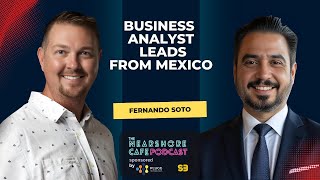
Fernando Soto, a Mexican business analyst with 16 years at Hewlett-Packard, explains why U.S. tech teams can hire nearshore talent without sacrificing quality. Mexican universities teach the same methodologies as Silicon Valley, and AI can cut analyst work by 80% when used right.
Chapters
Welcome everyone to another episode of the Nearshore Cafe podcast. This is season 3, and in season 3, we touched on a lot of really great topics. Today, we're going to meet Fernando Soto, a business analyst working from Mexico, supporting the US. Before we get into Fernando's story and how it all works, we want to thank our sponsor, Plug Technologies, plugg.tech. Great way to connect talent from all over Latin America to growing US companies. Fernando, so great to have you.
Great. Thanks. Thanks a lot.
Fernando, for those that don't know you, where are you dialing in from?
I currently live in Guadalajara, Mexico, but I was born and raised in Tijuana. So you could say I've lived half my life in each city.
Yeah.
So Tijuana gave me my roots. Guadalajara has shaped my career, actually. So both have been instrumental in shaping who I am. So personally and professionally. So what else I can say? Yeah.
Yeah. Well, maybe let me, let me ask. So for those who've never been to, so Tijuana is an interesting city because it's a place I think a lot of Americans know is like a fun place. You go, you party, but not many, we don't know many that, uh, that live there. So what should we know about Tijuana as, as a city to live, culture, food, things like that?
I recently went there and I love it. Some people say they don't like it because I don't know, they haven't lived there. Other people have said, yeah, I love it there. Anthony Bourdain, he's, he was in San Diego and I think we talked about this now. He was in San Diego and they were interviewing him and they asked him, where can you find the best restaurants, the best food? And he said, not here, go south, Tijuana. So cuisine is excellent, even better than here in Guadalajara. And some, some, uh, things, you know, some, some dishes are much better over there.
I can say when you go, when you go back to visit, what's like the, the, the number one thing you have to eat while you're there?
Chinese food.
I love that answer. Tell, tell us more. Tell us more about the Chinese food scene in Tijuana.
I think there are many Chinese from long time ago They're like behind the scenes in the restaurants, you know, and, um, it's occidental— occidentales— how do I say— occidental Chinese food, not real. Because if you go China, it's like a whole world of, uh, cuisine. But this is like they adapted the Chinese food for, for us, you know. And I know a place in Mexico also, I think it's called China Grill, which is similar. But here in Guadalajara, I haven't seen any, any other like Gibson's can match it, but they give you like very small portions. Other than that, believe me, every single restaurant is very good. And I went there. I was like, yeah, I want to go. Yeah. And it's not expensive.
That's fantastic. I love it. And then, you know, what do you remember about growing up in Tijuana? You know, is it a big place for soccer, music, you know, things like that?
I'm not very good at sports, you know, because they actually tell me here in Guadalajara, hey, do you like soccer. And I say, no, I'm from the north. And they say, oh, you like baseball? I say, wrong again. I don't know. I, I was— I used to, I used to run track and field.
Okay.
Uh, 100 meters, you know. And teachers, I don't know what's up, you know. It's like I told them 100 meters, that's it. Yeah, no, just sprint. Sprinter. They gave me— yeah, I'm a sprinter. And I gave— and I always won. I didn't have to practice or anything, or Or train or anything. And they always gave me 400, 800 meters, you know, it was like, so I just in one, one place, I mean, one time they, I just stopped at the middle of the track and I was winning. So I was like 100 meters in and then I, I was, I couldn't finish. Yeah.
The lactic acid.
My son's going like this. Oh my gosh.
The lactic acid builds up.
Um, yeah.
So were you always into IT and computers?
No, not really. No, I was, I, I, I loved animals. So this is a big twist. Yeah. So, but, you know, in Tijuana, it was, it's a small city. In that time, there were not many universities that, that had a veterinary or, or veterinary. I think I wanted to be a veterinarian, you know, go figure. And I think the closest one was in Ensenada was like a marine biologist, something like that. And I couldn't go to the United States. You know, I had a passport, but you know, I can't study there because I'm not a US citizen. Plan B, you know, I was like, what do I like second best? And I say, well, computers, let's start. And I started going to classes. I was very young. I was like 16 probably, and I started liking it. So that's, that's what I did.
Yeah.
And then I went to university and then I came here to Guadalajara. To visit my sister. It was a round trip and she was a single mother with a 1-year-old. And somehow I just left everything and stayed with her.
Yeah.
Yeah. That's, that's when I met my, my girlfriend and she became my wife and I stayed here. They didn't let me leave. I weren't taken back to my hometown, but Guadalajara, many people know this. Women from here, they will not go, they will not leave this place. That's right. So she won. I stayed.
Well, I, I want to ask more about that, but tell us more about the university scene, like the, the university. Where did you go to school? It was in Tijuana, right?
And yeah, actually, I didn't finish.
A little more about that.
Yeah, it's a funny story because it's, uh, it was called Autónoma Universidad Universidad Autónoma de Baja California. And it was like, not, not public university, but it was, it was very tied to the industry there. So they, you know, and I learned this way after, I felt, you know, halfway that the university, I felt really stupid. And I said, no, this is, this engineering is not for me. And I actually dropped and came to Ojai and continued study and finished engineering. This is the, this is a problem, you know, somehow. And I said somehow the plane, I got my IQ grew because in the university that I, that I finished it, I got like straight A's over there. I studied, studied, studied and, and couldn't make it. So later I found out that there was like a little corruption of the industries over there. Maquiladoras are called. They say, hey, stop, we don't want engineers anymore. So please don't, you know, give them a hard time. You know, like, well, that was the answer maybe from school. We were like 30 in only like 5 passed like exams, like with 1 question, like, or 2 questions. So the minimum was 7 from 0 to 10. The minimum was 7. We don't have like A, B, and we have like 0 to 10. And with a 2-question exam, you either got A 0, a 5, or a 10. So in the beginning it was 7. So I was like, oh, thank you. We had like one question exam, a problem, very difficult. So it's like 0, 0, 0, 0, 0, 0, 0, everyone's 0. It's like, wow. So I felt stupid at that time. So I talked with one of my, one of my friends who also went there and he's the one that told me, cause he was in the student union or something and he knew. That one of the teachers blabbed it out, like say, hey, yeah, there's like this companies are, and it's not the case anymore, you know, that it was that back then. And, but now that, that you have to pay for your, for your, for your university, they stopped, I don't know how they, they stopped making things harder for students, you know, so they can pass.
Yeah.
There was like an intent of bad intent.
Yeah. So you're a business analyst today supporting a a US customer, doing it from your home office in Guadalajara.
Yes.
Tell us about the last couple years and like, like what, what led to this point today. You know, even in the role itself is interesting, you know, you're kind of at the crux of business and technology and working with users.
Yes, yes, yes.
So tell us more.
I, I need to tell a little bit about the history there. So, you know, my journey in tech started at HP, Hewlett-Packard here in Guadalajara. So there I spent around 16 years and then, you know, I started as an engineer, developer engineer. So back in 2010, I was working as a developer and when I asked to join a project as a business analyst and my honest reaction was, cool, you know, what the hell is that? So I didn't know and actually nobody knew back then. Right now it's a role that is like, oh, everywhere. At that time, the only real growth path most of us saw was becoming a project manager or a manager if you, if you pull some strings there. You know, as I started learning more about the BA role through, you know, hands-on experience and later certifications, I realized I really liked it. You know, to me, a business analyst is the unsung hero of IT. So it's a low-key role, but the impact is huge. At HP, it helped me You know, I helped formalize the role internally and even created a dedicated career path for other, other BAs, you know, many, many of whom had been doing the work for years without knowing the industry even recognized it as a distinct profession. I went on to get my CBAP certification, you know, I have it here, like this, probably, you know, the first in Jalisco at the time, which is considered, you know, on par with the certification for project managers. So I was even invited to speak at a PMI conference to talk about the BA role. Funny enough, you know, after the talk, some folks from IBM— because remember that here in Oaxaca we have like, uh, all the tech companies are here— came to me and said, hey, thank you, now I finally understand what I do. So over the years, I've worked on global projects across the US, Latin America, Brazil, Europe, and Asia. You know, I've worked under both waterfall and agile methodologies, and I truly believe in the model where, you know, PM, BA, QA, and dev all operate together. We have that synergy regardless of the methodology, you know, and it leads to strong outcomes and excellent projects that we deliver. So yes, very quickly on a memorable challenge, once led a project with a team in Brazil. They didn't speak Spanish or English.
Oh, wow. Tell us, how did you navigate that? That's funny.
Yeah. And I didn't speak Portuguese. So Portuguese is very similar to Spanish, but if they speak fast, you know, it's like any, like some, any other language that you don't understand. So we spoke slowly, we typed in chat and we made it work. So it was slower. Yes, we got it done. That's the reality of nearshore collaboration there.
So Which language were you typing in the chat?
Portunhol. We invented a language. Yeah, it was like a mix of Spanish and Portuguese, you know, because English was out of the question. They didn't speak English.
Spanish and Portuguese. I like it.
That's great.
How big was that team?
I think it was about 15 people and it was a tax project. Brazil taxes are part of the, you know, BRICS and they're they're part of, they're difficult to understand. So they had to like explain to us many times, you know, and I was like, okay. So they had good presentations. So, you know, one, I want to, I was, I'm going to say the truth, you know, like I was there 16 years, you know, for me, I thought I was, you know, I was going to be there forever, you know, like I was going to retire there and everything. So there's this, they, they, I got laid off somehow, you know, I got, I was jumping between departments. There, there was a. There was a split in HP because there were like 300,000 employees worldwide, right? They split into HP Enterprise and HP Inc. And I went to HP Inc. So my team was divided in two. And they, my manager told me, hey, you know, with everything you've done with the BA role and everything, you know, and I thought I was going to be a manager or something, but nope. They said, you're going to go to HP. And it was like a business architecture role. That didn't work out. And then I ended up where I didn't want to, like as a PM. I liked it. Yeah. But you know, I did, I did the BA role in secrecy. So all the requirements I did it myself. So same, same project, you know, I was doing probably all of those because I didn't have that dynamic of PM, BA. I was in finance. Yeah. Funny part there was that there was this manager who was a micromanager and I couldn't I honestly didn't, didn't like that one. So I was like, I tried to go to another team. I went to another team and I landed on another one, another manager the same way. And then that's why, that's what, that's when, uh, it was, I was there like a couple of years and then I was, I was laid off. And for me was, uh, that has to be me.
Yeah. Sorry.
Uh, 16 years, you know, my heart and soul to that company and then I was laid off. They didn't say it was, it was me. They say, you know, this is happening all around. And it was true. You know, I recently learned that they're also laying off people with 16 years or something.
Yeah, I know it's a, it's a tough thing to go through. You know, I'm curious from your perspective, Fernando, because you've worked across so many different borders, the role of the business analyst, is it universally the same? No matter what country you're doing it from, or have you seen any like nuances or flavors that, that are put on it?
Yeah, this, this is recent, but before usually the business analyst is a liaison between business and tech team. Cause I don't know if, if in projects, if you want disaster, you take the technical team like developers and put them in a room with the stakeholder who's asking for the requirements. So they're like more business. Yeah, like, so, you know, the, this, uh, tech developer guy is going to start talking about databases, talking about spreadsheets, talking about, you know, very technical stuff and business. They want everything high level. So we are like in the middle, like, uh, yeah, I could, I can translate her translator.
Yeah, I can relate to that. Do you, do you feel like it's, well, I guess in your world, there's maybe two translations, right? Like maybe you're doing Spanish to English and then you're also doing business requirements to the technical requirements.
Yeah. Well, I actually, the way I, the way that I learned English, I learned it at a very young age. And I think, I don't think in Spanish like other ESL. I still think it's my, my mother language is Spanish, but you know, and they've told me that I, I have good pronunciation or I don't know. And sometimes they've told me, hey, I can detect your accent. Okay. Yeah. Thank you. Didn't ask you.
That's funny. Well, I want to ask you, you know, as someone who's been in this world for a long time, in the technical world, what are some best practices, you know, for like, we've got people listening that are maybe nearshore curious. They're thinking about, you know, putting a team of Fernandos, you know, in Mexico and maybe they're in the States, what are, what are some best practices or advice or guidance that you give these people to kind of set up their nearshore operation, their nearshore technical teams for success?
Well, let me see. When, when I, you know, when I, well, what I can say is we have a very good talent in, in Mexico. There are a lot of universities here, and, um, they, they teach like, uh, to global, not— they don't teach like, um, oh, you know, this company, local companies asking us for— like, like what happened to us and to me and, and, uh, in my university, that local companies are asking the university to do this, do that, you know, you know, they were like leading. So here, no, it doesn't happen here in Guadalajara or other other big cities here in Mexico, like Monterrey, Mexico City, you know, Querétaro, the universities are aware of that global, you know, global companies that need talent. And now, you know, this new trend, I think since the pandemic, you know, they realized that we can actually work from home. And it's some of the, I love it, you know, I was like, I've been since the pandemic, they told us go home, it's going to be a week. And I'm still here since then, two companies, two different companies. So I got, I got fired in my home. Yeah. And then I started a new company. I started in, in this new company with, uh, you know, they actually saved my life actually. So I'm really grateful to them and, um, and they, they really appreciate it. And I'm like, I've been telling like my wife and my friends, you know, this is how I've been doing. I did, I did the same effort, you know, the same kind of job, same effort where I was, but I, it was not appreciated. So I'm like, I'm not doing anything, anything. So it was like, it was not me. So I was like, because you know, you doubt when, when they fire you, you feel like, yeah, you get a little insecure and wonder. Yeah. And like now I do the same and I've been working the same as I always have and, and they really appreciate it and Yeah. And that the culture is great. Yeah.
So maybe like a couple of the takeaways that I'm getting is that Mexico really teaches to a global technology world and best practices in Chicago or San Francisco or London or wherever, the same, same things they're teaching in Mexico. So there's really not a whole lot of like adaptive, I need to change my style or framework or methodology. These guys are going to be able to plug right in. And then maybe the other thing, the other thing that I'm hearing is, um, that there's the same things that humans need everywhere, that employees need everywhere. They need acknowledgement, recognition, appreciation. It's no special thing we would just do for Mexicans in the IT world. It's the same things we would do for anybody.
Yep. Yep. That's, that's it. You got it. And you know, the, I don't know if it's across all companies, but this company that I— that hired me is— their culture, they have like a growth mindset culture, which is awesome. They've never treated me any different. I'm a contractor now, I'm not an employee, and I was the first one that they hired, and they told me, hey, guess what, you're, you're gonna be our guinea pig. Actually, the agency told me that you're gonna be a guinea pig And if that works for you, we will hire more. We're going to clone you. Okay. It worked. I think I did. I did. I did things well.
Yeah.
So, and, and they asked me to hire other VAs from Mexico and we, we had a bad experience with one of them and it's, you know, it's something that happens working from home. It's like for me, it's a big perk and some people don't really take that for granted. Yeah, and we had this guy who was replaced. For me, you know, he was like, uh, you know, for me, you're, you're, you're done. I'm done with you.
Sure.
Because, you know, it was his attitude. And actually, the company gave him another chance. Oh my God, I was like, wow, it's like, you know, he doesn't deserve it. And he blew it. So just imagine, for me, he was done. You know, for me, I said, I don't want to work with him anymore. So, but it's not, it's not the case, you know, it's not always the case, you know, we hired someone else and we're doing great. There are 3 people from Mexico. We have, we have actually one of them lives like 5 minutes from here.
Oh, cool.
Recently I went to a barbecue. He invited me to his home and we got together. So yeah. Yeah. So it's, it's, it's, it's good. Yeah.
Good.
Nothing like an asado to bring everybody together and Yeah, and, uh, and, you know, in, in work, I'm like leading that because when I entered, I was alone and my manager, he was like very, very busy because managers were also doing, doing like the BA work, like requirements management, you know, uh, writing tickets in Jira, uh, design and in Figma, you know, all that, talking to the, making presentations to the client. And I was like, well, when I was in HP, managers, they just managed. They didn't do like, like work, you know, like what we did. And I tell these guys, you know, like, take advantage, you're being trained in your language, because I'm training them in Spanish. And all the time, you know, because for me, I don't know what happened. But am I smarter? I don't know. I don't know. But You know, they have me, maybe they have me and it's like, they're asking me like, hey, this, hey, that, hey, hey, every, and I didn't have that. And I'm like, what, you know, you guys have me. I didn't have myself when I came in this work. So I said, well, that's good for that.
That's great. Well, let me throw one more piece out there before we go. A lot is going on in the the tech world, AI. I'm not even, you know, so maybe, maybe in like a quick kind of rapid fire, how is AI impacting the role of the business analyst today? And then what do you maybe see coming up in the next couple years?
Actually, AI is for everyone, um, because people think that AI is like cheating. Yeah, Sam, but I see it as hiring a very good assistant. Of course, this assistant has complete framework of computers, but the AI, and I just discovered it because I used it, but not as you used to. So I went to this course, I took a course, and I was like, wow, you know, like we can, we can reduce time, like one-fifth of what we do actually with AI. And companies are not catching up actually. That's what I'm saying. My niece, she's working in this company with, I think it's a realtor, and they have like this AI, they have chat, I can say them, ChatGPT, but as a community, I didn't know that you can use it. And so they upload all the documents of the company, but whenever, because it's just doing things faster, because whatever an AI robot can, I can call it robot, I call it robot. Yeah, can do— a human can do, a robot can do it faster. That's it, right? That's all. Because they— instead of you going into the SharePoint of the company and looking at all— reading all documents, AI does it like this, right? It's just the same, the same way. Yeah, AI— if I see it this way, in 20 years ago, if you didn't know English or use a computer, you were illiterate somehow, digitally illiterate. Today, if you don't go into AI, and I don't mean just asking how's the weather, or, you know, just programming it, because you can program to whatever you want. Believe me, just go into— take a course. There's— there are free courses everywhere for AI. Go there, because if you don't do it, you're, you're, you're going to be left behind. In technology. So yeah, that's mine.
I think that's great advice. Great, great advice. Well, Fernando, this has been a lot of fun. I knew it would be. I knew you'd have a lot of great stuff to say. You're listening to the Nearshore Cafe podcast sponsored by Plug Technologies, plugg.tech. Great way to connect talent from all over Latin America with US companies. And great talent like Fernando in Latin America. Thanks again for listening. We'll see you next time.
Thank you, everyone. Thanks for joining us at the Nearshore Cafe podcast. Tune in
More from Brian

From BPO Agent to Client Experience Manager: Ana Rodriguez on Nicaragua's Nearshore Talent

From BPO Agent to Client Experience Manager: Ana Rodriguez on Nicaragua's Nearshore Talent

Building Sales Teams in Mexico: Mario Oliveros Figueroa on LATAM Talent & Cross-Border Selling

From Automation Engineer to Data Platform: Victor Fernandes on Brazil Tech Talent

H1B Crackdown & The Nearshore Shift: Robert Bouchard (H1B Guy) on LATAM Talent | 🎙 TNC

Nearshoring Yourself; step by step to building an expat life in Mexico |🎙 The Nearshore Cafe Podcast

Scaling high-performing teams in Costa Rica staffing legend Doug Firestone on growing to 225 LATAM

How to Scale in LATAM? Navigating Currency, Taxes, and Labor Laws | 🎙 The Nearshore Cafe Podcast



AI in LATAM: How to Break Into Mexico’s Tech Market |🎙The Nearshore Cafe Podcast