Milei’s Impact to Argentina’s Talent Market
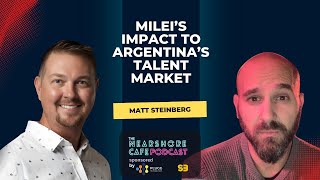
In this Nearshore Cafe episode, host Brian Samson interviews senior Latin‑American recruiter Matt Steinberg about his 20‑year journey in tech recruiting, the evolution of nearshoring from the early 2000s to today, and the practical challenges Argentine talent faces under President Javier Milei’s economic reforms. Steinberg recounts how he entered recruiting via an early Avature partnership, learned English on the job, and built expertise across a wide range of IT sectors—from cloud services to networking and financial‑tech. He offers concrete advice for aspiring recruiters, emphasizing deep technical knowledge and continuous reading. The conversation then shifts to the macro‑economic landscape: Milei’s “Plan Chasso,” the fixed 1,000 ARS/USD rate, the collapse of the parallel (blue) dollar market, and how these policies have flipped incentives between exporting services for dollar pay and working for local firms that now adjust salaries every few months. Steinberg estimates roughly 20 % of the Argentine workforce still seeks export‑oriented roles, citing distrust of the peso. They discuss the rise of BRICS, alternative reserve currencies, the “flash business model” of rapid‑turnover ventures, and high‑interest “plazo fijo” accounts as hedges against inflation. Steinberg paints a vivid picture of daily hyperinflation—prices changing within minutes—and highlights Argentine problem‑solving culture. For U.S. companies looking to set up nearshore operations, he stresses written contracts with contingency clauses, the strong English proficiency of Argentine talent, and the need to understand emerging tech stacks that are still maturing locally. He ends on a cautiously optimistic note about Argentina’s future, noting recent easing of hardware import restrictions and the potential for improved logistics. The episode is sponsored by Plug Technologies.
Chapters
Hi, and welcome to another episode of the Nearshore Cafe podcast. I'm Brian Samson, your host. If you have been following the year plus of MLE in Argentina, this is going to be a really interesting podcast for you. We're going to go deep into the economy, what it means for job seekers, companies, all sorts of stuff. Before I introduce our guest, let me thank our sponsor, Plug Technologies, plugg.tech. Great way to connect talent from all over Latin America to growing US companies. Without further ado, let me introduce our guest, Matt Steinberg, a senior technical recruiter, lead recruiter out of Latin America. Great to have you, Matt.
Great to be here. Thank you for the invitation, Matt.
Uh, we'll, um, ease into the economy questions. Uh, for those that have never met you, um, just give a little sense, like, how did you get into what you're doing and how long have you been working with people in the States?
Yeah, that's a very good question. I started out working back in the year 2005. There was no nearshoring, no outsourcing really for recruiting, I actually was lucky enough to come across a person from the United States who was, uh, say, posted here in Argentina trying to initiate a company called Avature, of all things, which is a kind of a famous ATS nowadays, but back then was kind of in a beta testing phase. So we started talking. He was putting together a group of recruiters and sourcers to support the United States from Buenos Aires. I thought that was actually cool. I was studying, I was finishing off my degree in psychology. I thought, this is kind of related. I would be lucky to, to be there. So we started talking, and in the end, I was lucky enough to get the job. And he was, you know, very good at training people because no one actually knew what recruiting was about. It was kind of the first thing in Argentina recruiting related. So he would just, uh, you know, get us all together in a conference room have us cold call candidates and people from different job boards like Monster, CareerBuilder, and all those others. And so we actually learned the trade from him. He was the old school with the Rolodex kind of recruiter, calling people from, you know, calling cards and stuff. So from there on, it was just all recruiting. I started doing work as a recruiter within RPO, then, you know, nearshore started taking form and taking shape here in Argentina. So I, I was lucky again to, you know, be associated and acquainted with people that were actually interested in investing a certain fair deal of money, uh, in expanding the RPO and nearshoring business in Argentina. So ever since, it's been like 20 years of supporting United States, Canada, European countries, you know, EMEA as a region, APAC. So I was very lucky throughout my career to be exposed to those countries and those cultures.
It's really given you a nice global perspective. I think maybe the elephant in the room with a lot of US companies is, will I be able to communicate with them? Will I be able to understand them? Will they understand me? And can you share just more about your personal journey with English and how you got to the fluency level that you have?
Well, that's a very interesting question. I don't know how to answer that honestly because I never actually studied English. I mean, I had English at school, but it wasn't really enough to get by. It was just grammar, the basic stuff. But there was one day that I actually needed a job when I was 18 or something like that, when I approached a call center that was starting business in Argentina. And I went through the interview without speaking a word of English. I just said right, yes, and no in all the right orders, I guess, and actually got the job. So from there, it was just practicing. I think every Argentinian, every guy in Latin America who prides himself or herself of actually supporting a business globally or for the United States specifically has done it at some point in their careers. Just you stand in front of the mirror, you repeat the words, or you record yourself, or you sing in English, or you watch the telly. Without actually using the subtitles, and that gives you a proper understanding of how people talk. And then you repeat it. It's just repetition. The more you repeat yourself, the better you get at it. And of course, talent does play a huge part of it. Some people are more gifted than others. I'm not one of them. I actually had friends from the UK, and I think I caught the accent. I just picked up the accent at some point, and now I can't get rid of it. It's more like a speech impediment than an accent, really. But most people who are really gifted do have that ability of repeating themselves, getting really better at it, and accelerating the learning curve. So they really get fluent at it.
Matt, share, if you don't mind, some of the types of companies and industries you've had a chance to work with from a nearshore perspective.
Wow. Yeah, I started out my career with IT, right? Within IT, technology, information and technology. That was all. I mean, But when I started, it was all about the cloud. It was 2005, 2010. Those first 5 years was all about the cloud migrations, implementations, you name it. So I supported managed hosting companies, web hosting solutions companies, managed cloud services, storage companies. So it was all like— they mentioned data, NetApp. Microsoft, actually. I support them for a few years. I worked with Lenovo. I worked with another company in the United States that actually manufactured storage devices, Intel, you know, semiconductors companies that were trying to create servers, you know, more advanced at that point. And then, you know, there are always trends and stuff that are changing and the transition from one point to the next, you know, cloud became advanced Computing services, which became professional services. And then from there on, you had two paths in front of you, hardware or software. You know, it could be everything as a service, could be internet as a service, platform as a service, networking, security. So I supported companies in networking like Arista Networks, Juniper Networks, Palo Alto Networks. I worked with Barracuda Networks. I also worked with companies on the software everything as a service side, like Lenovo had a professional services implementation a few years back, and I was lucky enough to be involved in that. So I support many, many companies in IT, and then of course financial services associated with IT, like Bloomberg and all other financial analysis companies that provide analytics into the financial markets. So they always look for financial analysts and financial people, quantitative analysts, software engineers. So it's been a long list of roles for a long list of companies for the last 20 years.
Do you have any, any tips for those in Argentina that are maybe starting their recruiting career, and any tips for them on how to, say, best connect with IT people in the US?
Yes, Brian, I think it's all about reading. People don't pay enough attention to this, but it's all about catching up with the newer trends. But it's more about reading than anything else. There's always a lingo, and there's always a certain amount, a fair amount of technical words you don't know, never heard of. You might see them on the job description. If you don't really understand them, if you don't really, if you're not really able to know the depths of it, when you speak to someone from IT, unless you are an incredibly fast typer, typist, you might have a bit of an obstacle in front of you. So the best way to come across that obstacle is by really learning everything you can about IT. I, at some point in my career, believe it or not, became a bit of a developer. I had to learn about it. I was passionate about it. But moreover, I had to learn it. I was speaking to at least 25 Java developers per day. And I didn't know the first thing about Java. So I thought, I can't. And I mean, this is my career. I can't let this be. So I had to learn. I took a course. I became a bit of an amateur developer. And from there on, it was just reading, reading about Ruby on Rails, reading about C#. What is Golang? How's that translated to data analysis? Why Python when we're looking for a data engineer? So the best advice you can give to a person getting started in I'd see recruiting or sourcing is learn as much as you know about technology. Don't let it be just a side thing for you. Get deep into it.
I think that's great advice. You know, Matt, I was curious, uh, because the, the tech industry in the US, uh, brings people together from all over the world, you know. Um, uh, so I'm, I'm— maybe this is kind of a silly question, but Did most of the engineers that you would have phone screens with, did they have any idea that you were in Latin America?
Well, you know, that's a very interesting question too, Brian, and I don't think it's a silly question at all. When you start, you don't want them to learn where you are. You don't want them to know because you feel you'll be misjudged from being Latin America. There's this misconception about Latin America that we all Latin Americans have. We're just trying to hide it away. And that's mainly the reason why most people try to work on their accents and try to sound more either American or English-speaking English, because you just don't want to be recognized as part of another world, so to speak. But the truth is, in time you realize that it doesn't matter. Most engineers are really not from the United States originally, and you actually will recognize that you end up speaking better than most people do. Because you're more articulate because the job requires you to be, because you really learn to listen, which is the most important part in communication. So it really doesn't matter. You do tell them. In fact, you're proud of being able to say, I'm calling from Buenos Aires. How's that for globalization or globalized work, right? And you tell them. And they like it too. It's a good icebreaker. It's a good way into a conversation. It's a good segue into having a proper personal rapport developed right away.
That's fantastic. That's really interesting. Let's jump into the economy, Matt. So we're about a year or so into Millet. Maybe let's just kind of start big picture and then we'll get into a lot of the pieces of it. What has that meant, I guess, for Argentinians? You know, uh, like this, this last year, how, how have their lives changed? You know, what does that mean for them?
Well, I'll try to answer that question, Brian, without getting too polarized, because that's one thing before we get started with that answer that people need to understand about Argentina. The politics in Argentina got incredibly polarized over the last 20 years. There's always been a sort of a two-party political world in Argentina, like peronistas versus radicales, right? So it's just left-wing or right-wing, or more to the left than to the center, or to the right. There's always been like a polarized thing, but over the last 20 years, it really has become a one side or the other kind of a thing. So when Milei got to power, actually won the election, it wasn't only a shock to people, it was an incredible feat. And I'll tell you why. Milley, for most people who don't know who that person was, he's an economist. He's a proper economist, someone who really studied economy in depth, right? So when he became a politician, he was just coming out of the telly. He was a panelist. He would come up on the telly and crit his eyes in a very mad mental way. Everyone who was in politics at that time. He was— he'll speak of the president or the governor or the deputies or the senators. He was criticizing the economy in an enormous fashion. So when he became an active candidate, and furthermore, he actually won the election, it was unthinkable, unfathomable. If you look back 4 years and the guy was on the telly, he's yelling like a maniac, and now the guy is the president, But he was welcome. He was welcomed by many people. I would include myself in that because the wave of politicians that we had the last 20 years was more of the same. The economy had to suffer because of it. So when this guy gets to power, it represents a change of the mentality of people who decided to vote for something different for once. So this guy has done not enough yet because he hadn't really had much time to do many things. And let's face it, he actually took an economy that was shredded shredded to pieces. It was crumbling down. It was all shredded down. And the guy is trying to pick up the pieces and shape it up into something more productive. But with that, it came something that maybe most viewers or listeners have heard of, which is the Plan Chasso, which affected the economy incredibly. For all those who don't know, in Argentina, we had 4 different values. To the American USD, American dollars currency. There was a legal one. No one had access to it because there's something called a CIPOL, which is kind of a blockage that the government put so people couldn't get dollars and get it out of the country. So you cannot— you couldn't buy anything at that real price. So that generated a second price. There was always a parallel market in Argentina for dollars. It used to be black dollar, but they had very awful connotation, so they changed it to blue. Because it had a better, better tone, better ring to it. So blue, blue dollar, the value of the currency was much higher than the real price of the American currency. That generated a huge amount of opportunities for nearshoring, for outsourcing. And I was, you know, not just me, everyone who was working for the United States earning in American dollars was benefited by it. As you all know, when you get paid in American currency, it generates a certain stability in the amount of money you get because of something called inflation and the valuation along with it. So when people started getting their wages in American dollars, they could start getting a projection how much they would earn. And if the change of the price of the value of the currency affected you when you were earning in pesos, that wouldn't happen to you if you were earning in dollars. So you could have a projection, you could have savings. So most people started getting their jobs and starting outsourcing services, sending services to the United States, to Canada, to Europe, to Australia. If you were lucky enough to get that job, you would get incredible experience working with a different culture, but more importantly a stable economy. Since this guy related to power, things have started to change. They fixed the value of dollar to 1,000 pesos per dollar, and the parallel market got stuck stagnant at 1,200. What that means is that if you're earning an hourly rate in American dollars, you'll always get the same amount. As opposed to when, you know, inflation and devaluation affected your wages. So now the projection you have is still the same, you're still stable, stabilized. But if you work for the emerging markets, companies start to get wise, to get wise, and they started adjusting your salary every couple of months because of inflation. It's actually a legal thing they have to go through, and it's the only way they have to retain, retain employees and to reduce the turnover. So nowadays, it is incredible how more beneficial it turned out to be, or turns out to be, to work for the local markets, because you have a growth in your salary every 2 or 3 months, whereas that doesn't happen when you're lending services to the United States anymore because of the blanchazo. That's something that happened over the last year and a half. That is affecting all of us, you know, working for the United States.
To me, that seems like it's like flipped the economy upside down because there was so much incentive to export services. Now there's this, you know, you're almost penalized for it, right? Because you're not going through the adjustments. Matt, from your perspective, you know, what percentage of— I mean, you've worked in the IT industry. I'm sure like your peer group is probably a little bit different, but from, you know, your best guess, are 10% of, of, um, the, uh, of the population in Argentina, you know, the working population, are they outsourcing, exporting their services? 20%, 50%, you know, like what does this kind of mean overall?
Well, what I can tell you is a huge percent, I think would be closer to 20%, exporting. Because it still means that you'll get American dollars. No one believes the economy will sustain, it will hold. And this is something comes with the history of the country and the economy. People don't believe in pesos, which is of course a reason why, you know, devaluation occurs. People don't believe in the currency because they've seen it happen many a time before, many times before. So what people do is they still outsource their services, they still lend services to the United States because they believe that earning in dollars and keeping that money in your pocket or virtual wallet, if you prefer, that helps you project, have a projection. You'll be safe from whatever happens in your country. So despite the fact that it is more convenient nowadays for this period of time to work for the local market because you do get these adjustments, people still have this mindset towards outsourcing. Because that's what we do. We don't believe in the RG economy.
You know, one thing I, I'm curious about, Matt, is, um, the rise of BRICS and, and an alternative reserve currency. Has that impacted, um, anyone in Argentina? Like, how, how are you and your friends thinking about that?
Well, it's always been difficult to buy yourself a house in Argentina because the prices, despite the fact that by comparison they're not really super high, They're still kind of unaffordable, just beyond reach, beyond the grasp of normal people. So working people cannot project because they can't even earn a salary that will allow the bank to trust them with a loan, right? There's no such thing as a loan unless you prove yourself earning a certain amount of money, which is, let's face it, less than 5% of the population who could do that. And that, that is— it has always been the case, right? It's not something that's just new. But what has been happening over the last few years is the price of bricks has been escalating, skyrocketing actually. And people that would save in bricks because that was the most stable currency, that you would just save by building yourself a house or building a flat or buying yourself a property, the price of property has gone down, whereas the price of bricks has gone up. That means is even if you buy, you'll be spending more money than you can ever get back if you sold the place afterwards. So that has created a way of thinking, which is kind of weird. I'll tell you about it if you don't mind. It's kind of interesting, funny actually. There's always been a model of work, of business that works in Argentina. It's not something you can study. It's not something that financial analysts will tell you. There's something that just happens. We call it the flash business model. It happened back in the '90s with tennis and paddle courts. It happened with something we call the Paris-Bourgeon, which is kind of a grill where people would buy chicken. And then it started happening with cyber coffee places where you would go and use a computer because you didn't have internet at home. And then from there on, it kept on changing. And every time it changes, when something actually hits, when there's one businessman or businesswoman that does it, and actually hits, hits it and just hits it big, everyone starts copying that. Now you can't save in bricks, you can't save in property. So what people do is they just start initiating businesses even though there's not real projection, there's not real figures that will tell you even if you crush the numbers again and again and again, nothing tells you you're going to succeed at it. But people do it all the same because they saw someone else do it and they saw someone else hit it big. It's just like going to the casino. You just It just paid up. It just paid. You're not going to get the jackpot again. Chances are you're never going to get it again. People go and play it again. It's the same thing. I think it's the same phenomenon.
You know, I mean, in the States, we often think about diversifying our investments. I almost feel like it's diversifying your currency in Argentina, you know, whether it's BRICS, pesos, dollars, crypto.
Exactly. Was a very good analysis, actually. Yeah, exactly like that. Now there's something called plazo fijo, right, which is you put the money in your bank and you have to keep it there for a certain period of time, and it pays an incredible margin because of the instability of the currency. Because it's so unstable, it's so difficult that you can actually know what's going to happen, that the risks outweigh the benefits. So they have to pay an incredible interest rate. Is going over the top, man, is about— I can't exactly tell you, but I think it's about 45 or 50% interest in a short period of time.
Matt, for those in the States, you know, we've experienced, in our opinion, high inflation the last couple of years, you know, as the price of eggs has doubled, you know, but give some perspective, you know, what does it feel like to live in a hyperinflation country, you know, for the last 10, 20 years. What does that, what does that feel like?
I can tell you a story. I went to this shop because I needed to buy a replacement for one of my sawing. I had a, I had a saw. I wanted to saw something. I had to get a replacement because it's all broken and rusty. So I went to this place, and as I get in, there's a line, and I see the price on the wall. Right. The price on the wall was, I don't know, $50, right? Equivalent in pesos, right? It was actually in pesos. I can't remember the figure, but it was, it was not really crazy, but it wasn't cheap either. So I wait in line and it's taking time. It's taking 20 minutes, 25 minutes, 30 minutes. And I asked the guy, what's going on? We don't have a price list yet because this keeps on changing. So people are waiting in line to get their service because no one knows how much things are going to cost. So by the time I get to the front, and I'm asking for the replacement. It was already $80 in 30, 40 minutes. So that's how it feels like. There are moments where that happens. There are moments where, you know, the whole thing becomes a bit more stagnant and you don't really feel it that way. There were times when you couldn't get anything that wasn't really here because you couldn't get imports in. So living in a country with this kind of inflation tells you you won't be able to know how much you'll be spending next month in groceries, in services and expenses. So there's really like a day-to-day kind of mindset, which is why Argentines are so good at resolving stuff, because we resolve things every day. And I think that goes for every person in Latin America, whether they have inflation or they have an unstable currency or a job market that's fluctuating. We all become problem solvers. And that's why I believe most American companies looking Latin America. Because we're great at resolving stuff. We're trustworthy, hardworking. Most of us are really devoted to what we do and passionate about it too, I might add. And really good at solving problems. Whatever the problem is, we'll find a way. We have a word, a phrase in Argentina, which is atado con alambre, which is tied up in wire. Because when you can't get the replacement part, just tie up two wires together and make it work somehow. And that we do, right? I do that every day for that matter. So it's a very interesting thing.
That's great. That's great. Thanks for explaining that. Um, maybe let's flip this to the employer side. So, you know, think you are a CEO of a tech startup in the States. You're watching podcasts like this. You wanna, um, set up operations in Argentina. Get the right talent, what are some things that they should be doing, you know, maybe currency or otherwise, to be successful there?
Well, that's an excellent question. The problem with the economy, as you well know, we were talking about it moments ago, is that you can't really know where it's going to be headed next. So if you are a business owner trying to start a nearshoring business or even starting a business in Argentina, One thing to bear in mind is that people will want to receive everything in written. People will want to have— when I mean everything written is the adjustments, any changes to their salary. So everything has to be backed up. It has to be a backup for each contingency, right? Because you never know what's going to happen. People develop this sort of radar for, you know, upcoming problems. So when talking to a new employer, people want to know the terms of the employment, how things are going to be changing over time, what if this happened, what if— so you have to have contingency paragraphs in your contract to anticipate each of these problems. In terms of talent, well, English is a huge part of it. So Argentina hasn't got that problem. People in Argentina speak rather well. And they don't really have this struggle where they have to go and learn and then come back to the markets. But they're ready to go, plug and play, right? So that won't be a problem. As for talent, Argentina hasn't received much investment, many investments in IT like Brazil has. So supercomputing-wise, we're just getting started. HPC, high-performance computing. There are certain languages people don't really yet develop in. Or they haven't been developing for years. Like, you know, you talk about Databricks, or we talk about QlikView, Qlik Sense Replicate for migrating databases, huge chunks of it. People haven't been doing it for long because it hasn't been here for long enough. So learn your markets, learn your trade, learn what really has been taking place in Argentina if you're gonna start a business here. Learn about what people are doing and what people are getting themselves into and give them time to get better at it. That's what I would say.
Matt, are you bullish on the economy right now? Do you think the country will be in a better place in 2 years? It's still hard to say. What do you think?
Well, it's always hard to say. I've been here for 41 years and it's always hard to say. I'm positive about it. I'm optimistic about it. I do believe— I don't believe that things are going to happen magically. Overnight. There has to be a certain list of things to take place for things to get better. But I am a believer that thanks to outside investments and to the talent of our people, and I hope that these new breed of politicians have a better objective in mind than just getting rich themselves. So that is a good combination of things to be optimistic about. So yes, to answer your question, I am optimistic. I think things are going to get better. Things will definitely get better. It's just need time.
I think, uh, what I'm most interested in is, uh, among many, many things, is, uh, uh, importing of, you know, different goods from around the world. Um, I, I had a bear of a time trying to get hardware into Argentina, and I'm curious, um, Is anything changing with that? Do you think that will be easier to move stuff in and out?
We're easing into it, yes. There used to be a major difficulty bringing hardware, like you put it, computers, laptops, not so much accessories, but big stuff like Apple computers. Because of what I said before, things that hit it big start being replicated as business models and people just try to make money out of it. So the government got wise and said, no, hold on. You can't bring 40 Apple computers. If you're a business owner, that affects you because you've got 40 employees that need an Apple computer and you need that to work. That can kind of, you know, create a dent in your business and develop endeavor. But it is understandable because people abused it for many years. I don't defend it. I'd love to have the possibility of importing stuff. At a lower cost. Things are very expensive to bring from other countries. I'll give you an example. I played piano and I broke a key of a piano because I've got big and heavy hands. I'm just kidding. It just tore off. So I tried to get a replacement, but no one builds it or manufactures it in Argentina or in America, not even North America, where you would say, well, there's more manufacturing. So I had to go to Europe. The cost of the item was $88. The cost of bringing it over from Sweden was about $78. It's because of the inflation, because of people doing this all the time, and because of the customs, you know, the taxation is huge. But Millais has come up with a plan, and you know, there's not Millais, but you know, the government administration has come up with a plan of reducing the cost for at least the first $400 of in products, and it helps people bring things in, and not just enough to create a business out of that, but to bring things for personal use. So that's easing into it. I think next step would be to be more considerate, considerate about how many of those things you can actually bring items. But, you know, for the time being, it's getting better.
Well, Matt, this has been an incredible conversation. I can't believe how much I've learned. This is, this is fantastic. Thank you so much for being here.
Thank you for having me.
Well, this is the Nearshore Cafe podcast sponsored by Plug Technologies, plugg.tech, and we'll see you next time. Thanks for listening.
More from Brian

From BPO Agent to Client Experience Manager: Ana Rodriguez on Nicaragua's Nearshore Talent

From BPO Agent to Client Experience Manager: Ana Rodriguez on Nicaragua's Nearshore Talent

Building Sales Teams in Mexico: Mario Oliveros Figueroa on LATAM Talent & Cross-Border Selling

From Automation Engineer to Data Platform: Victor Fernandes on Brazil Tech Talent

H1B Crackdown & The Nearshore Shift: Robert Bouchard (H1B Guy) on LATAM Talent | 🎙 TNC

Nearshoring Yourself; step by step to building an expat life in Mexico |🎙 The Nearshore Cafe Podcast

Scaling high-performing teams in Costa Rica staffing legend Doug Firestone on growing to 225 LATAM

How to Scale in LATAM? Navigating Currency, Taxes, and Labor Laws | 🎙 The Nearshore Cafe Podcast



AI in LATAM: How to Break Into Mexico’s Tech Market |🎙The Nearshore Cafe Podcast