Nearshore Hiring Cut Costs & Hire Smarter | Brian Samson on ‘What It Takes’ Podcast
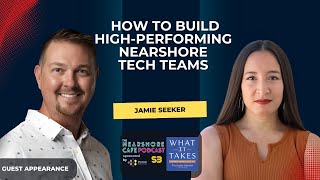
YouTube podcast interview (What It Takes) with Brian Samson (founder & CEO, Plug Technologies) discussing nearshore staffing from Latin America. Brian describes his background building teams (including relocating to Buenos Aires), explains nearshore vs offshore differences, compares costs and cultural/operational tradeoffs, outlines hiring and onboarding best practices, and gives pragmatic advice for founders considering first hires abroad.
Questions this video answers
Brian Samson — founder & CEO of Plug Technologies.
About 75 people.
He grew a business there from zero to about 80 people.
About 14 million in Greater Buenos Aires; about 40 million in the country.
Approximately 40–60% less than US pay.
Chapters
Foreign.
Welcome back to another episode of what It Takes, the podcast where we dive into the journeys of entrepreneurs who have built something from the ground up. The wins, the struggles, the lessons learned along the way. And I'm your host Jamie Seeker. Today we're talking about what it takes to build and scale a business. In today's changing hiring landscape, our guest Brian Samson, the founder and CEO of Plug Technologies has a company that helps US businesses grow by tapping into their top tier talent from Latin America. Bryant isn't just an entrepreneur, he is a hiring expert and he's built and scaled three companies to over 80 employees. He's led talent acquisition for some of Silicon Valley's top VC backed startups and even relocated to Argentina to build the foundation for near staffing. But scaling a business isn't just about hiring, it's about hiring the right people and we know that. So today we'll talk about why more companies are looking beyond borders. How remote work has transformed the hiring game and what it really takes to build a high performing team. So if you're a business owner, leader or entrepreneur looking to grow, this episode is for you. So let's dive in. Hello Brian.
Hey Jamie, thanks for having me.
So let's just start talking about your journey. Cause you kind of have, you know, a really cool one to tell. So you've built and scaled multiple companies. What inspired you to start Plug Technologies and what problem were you trying to solve there?
Yeah, yeah, just real quick. I grew up in the Midwest, ended up in California working for a bunch of VC funded tech startups and around all these brilliant founders and different apps and all sorts of stuff and probably like 2015ish had the bug. I think I can do this, I think I can do my own thing. I didn't come from a family of entrepreneurs or anything so this was a whole world for me. Ended up doing it what I think is the semi safe way. And I raised money myself so I have enormous respect for all the bootstrapping which I've, I've since done later. But I did it, you know, with, with some like a safety net of, of inve investor money. Ended up, you know, raising money to build platforms for fintech companies. So think like the next generation of banking and lending type of companies. And we put our sales office in San Francisco and we needed to put our developers somewhere so it was like where in the world should we look at? And ended up settling on Argentina. Came home one day, told my wife, hey, what do you think about moving to Argentina for a while? And she's like, where's that? So we ended up, you know, relocating there. We went to Buenos Aires, which is the capital city. It's like New York City, you know, for Argentina. About 14 million people in the Greater Buenos Aires region, about 40 million in the country. And we lived and breathed it, you know, all the volatility. So there is a lot of amazing things that I'll talk about in a second. But you know, to be authentic, there's a lot of rough things too. You know, inflation is quite high. So much so they don't have printed menus, they've got to like reprice everything almost daily. So you'll see stuff in chalk, you'll see labor strikes and long queues and a population that doesn't really trust their government. But on the other hand, you've got four hour dinners where no one's focused, phone is on the table and they're talking and building relationships and the best food and steak and wine and tree lined streets and old French architecture. It's, it's absolutely stunning. So I ended up growing a business there from zero to 80 people. Found the office space and the payroll and set up the finance and accounting and hired the first few engineers and so forth. So that kind of got me into this world. Later on I ended up in Hawaii. And there's really no easy way to go from Hawaii to Argentina. So we started to have some kids too. And it just didn't make sense for me to stay in that world of constant travel. So since then I've founded two other companies that are near focused. And near is the way we talk about the US Working with Latin America, same time zone. And nearshore is really a term about oceans and time zones. So you've probably heard of offshore. You might offshore work to India or the Philippines. And that's over an ocean. People are working different time zones. Still a great way to do work onshore, the work doesn't leave the country nearshore, you're just on time zones that are adjacent to you. So nearshore could also be the Philippines and Australia. Right. So the other companies I built, one was a recruiting focused business and the other one is Plug Technologies. And plug has about 75 people today providing software developers all over Latin America to US companies. And happy to talk more about that?
Yeah, absolutely. Well, you answered probably about five of my questions because I was going to educate everybody about the whole nearshore staffing. I mean, I don't, I don't know that a lot of people know that kind of lingo. So that was very good. But let's just jump right into cost and efficiency then. So one of the biggest concerns, I think, for businesses is cost. And I think, you know, let's talk a little bit about how nearshore hirings compare to hiring locally in the US in terms of quality, cost effectiveness, because I think most people have a general conception that it could potentially be cheaper offshore or, you know, looking outsourcing for that kind of stuff. But I don't know that they equate quality and effectiveness and efficiencies and those kinds of things along with that. So why don't you talk about your experience and just kind of your two cents in that area?
Yeah, that's a great question. A question that we get all the time. So I'm an advocate for Latin America, but I think you could talk to somebody else who's equally an advocate for Asia, and that's perfectly fine. I've never really heard someone advocate for Asia without leading with cost. Cost is usually the number one driver for looking at Asian talent. I don't think you'll find anywhere cheaper in the world than Asia. You know, and generally when we have conversations, say, with like, a director of IT or a VP of software engineering, if they've gotten that far in their career, they probably have worked with India. And what I've noticed about these conversations, like, like, no one has never worked with India, so that means they have an opinion.
Yeah, we're guilty. We. We work with. We seek our solution to my. My company that's tied to this podcast. We absolutely do.
Yeah, yeah, yeah. And I'll tell you, at least with the, with technology workers and software developers, it's a very polarizing country. So you either get people that will say, my God, it was the greatest thing ever, Jamie. Like, I built my whole code base for like $8. And, you know, it's always about, you know, this, this price point and like, like what they got out of it. The other extreme is, oh, my God, never again. I will never do that again. And a lot of that has to do with time zone. But there's also, you know, some cultural dynamics. India is a country that's more hierarchical, right. So you might have a hard time communicating directly to the person doing the work. There's usually like, multi. Multiple layers in between. The other thing that that comes up is if they don't agree with the direction that you're going, you might not know about it. Now, as a startup guy, as an entrepreneur personally, I like being told that I'm doing something stup Right. Which is many times every day. Right. So culturally, in Latin America, they're a lot more comfortable. You'll see right away, like this intense passion. Right. Especially if you talk to somebody in Argentina. But same with Mexico and Venezuela. And I don't want to generalize this whole continent, but there's a lot of passion in this region.
Yeah, that's been my experience in working with. We've worked. I think somebody was based out of Mexico City building my website and the company wasn't necessarily there, but my person happened to be there and same thing. Had no problem telling me, like the direct directives and things like that. Absolutely. I, I think that's interesting you said that, because I never even thought of that side of it is, yes, they're going to give me what I ask for, but I don't know what I don't know. And I might not have been asking for the right thing. And they can see it, but they may not necessarily give you that feedback that I never really thought of that. So that, That's a good, good point.
Yeah. I think a key word maybe in all this is ambiguity. So if you're a manager that has very specific instructions like, this is exactly what I want and exactly how I want it to be done, I think Asia is a great spot for you. But if there's some maybe ambiguity, like you're not totally sure you think you want to go in this direction or you think this is the goal, like, for me, marketing isn't where I grew up in. Kind of know enough to be dangerous, but I'm hiring an expert, so I would love for them to tell me, hey, here's some other considerations. Here's some options. Here is my recommendation. Here's one of my costs. If you do this, here's the trade off. If you do that, that is like music to my ears, right?
Oh, absolutely. Or what you're asking for is outdated. How about, have you considered this? And it's like, yes, thank you. Yes, that's really interesting. Well, and so that's good. That's actually really good advice too. So if you're already in business and you're looking at going, you know, to all these different areas or regions, I think you're right in my experience. And I don't think it's just you and I having these experiences. I mean, we work with a lot of clients as well, and you've clearly been in this industry. I think there are very specific characteristics to different regions that you'll find. And I never really thought to make the decision based off of that. And I've been doing, I've been outsourcing for the last decade since we've had our company. And yes, I did start off building all of my marketing tools and my website and everything in India and we've worked, you know, in multiple different areas. I've had, had companies in Latin America as well, Asia, I think, all that kind of stuff. So everything that you're saying were things that I've learned along the way, but not necessarily equating making decisions based off of those things. So I love that we're talking a little bit more than just, oh, you're gonna save money if you, you know, hire. Because I think that's really maybe where business owners start. That's the thing that's important to us. But you know, at the end of the day, it may cost us more if we have to continue to, if the work isn't what we need it to be. Right. And so let's talk bit about the hiring process then because I think, you know, what does a successful near shore hiring strategy look like? You're not just thinking about cost. How should companies approach recruiting and onboarding talent from outside the U.S. yeah, that's.
A great question, Jamie. So just to fully answer the last question about cost. So generally in Latin America you'll probably be somewhere like 40 to 60% less than what you might pay in the US you get a high cost city like San Francisco more, if you're in Oklahoma City a little bit less. But all in all, kind of 40 to 60% is what you might say. So when you think about hiring in Latin America, the mindset you've got to have as a business owner is going to be fundamentally different than maybe what we tend to think when we outsource or offshore or nearshore. And I think the biggest mistake these companies will make is they'll say things like our outsourced resources or like, like we're going to hire some cost resources. Like these are people, right? They're part of your team. So don't think about it anything other than you just happen to be hiring a team member in a different place. And they're a living, breathing human, just like somebody you might hire, you know, if you live in Cincinnati or Dallas or whatever. So you want to give them the same respect and courtesy and onboarding. That's really important. The, the thing that really attracted me to them and this goes with like the hiring but also the onboarding part of it. So as I talked at the very beginning of the Pod, there's volatility in Latin America and that on the headline sounds scary, but go be beneath the headline. If you're an entrepreneur or a business owner, who wouldn't want somebody who's flexible, adaptable, used to solving problems, used to overcomin, becoming adversity. I know a lot of CEOs and I can't think of anybody who wouldn't want that.
Especially if you're a startup. Right? Because that's all it is. That's the type of environment you're in. And so just doing a lot with a little making things work with what you've got. Yeah, absolutely.
Yeah. So you're working with a population in Latin America that is used to all kinds of chaos, right. Like stuff that might freak us out and it's like a once in a lifetime event. It's a Tuesday for them, right. So they're used to dealing with chaos, getting over it, solving the problem, moving to the next one. So that means your onboarding can be like a lot of startups onboarding, where it's not super baked out, it's not like a 14 step process. And this is exactly what you need to do. And I love that because I'm probably like a lot of entrepreneurs. Like I'm used to just kind of waking up, I'm okay with a blank whiteboard and kind of figuring things out out and they are too. So you don't have to stress so much about the onboarding process. I would try to have some sort of targets and goals but again like this is the ambiguity part of it. Like you can have some ambiguity because they're okay with that. You're not going to like stress them out or paralyze them. Now when it comes to hiring, we're in a nice position where we've had a chance to work all across Latin America. And it's very important to know that this continent, this region, it's not a one size fits all. So like Mexico and Chile and Argentina and Brazil and Bolivia, these are all like wildly different countries and they all have different nuances. You know, from being able to get hardware in and out of the country to develop versus developing. The more developed a country is, the higher the price point. So even think Asia, Singapore is connected to Malaysia, but the cost differentials are massive. Right. One's developed, highly developed and one is still developing. So think Central America, you've got Nicaragua and a neighbor is Costa Rica, Costa Rica, much more developed, Nicaragua, developing. But there's some really interesting roles that are on full throttle right now in Nicaragua. And that's where the arbitrage exists for founders that might have a little more risk in their bones. And we, we tend to, because you can get a cost arbitrage opportunity there and you've get highly fluent English speaking people that are motivated, can be adaptable, overcome certain things, but it's not as stable, say as Costa Rica. Right. So as entrepreneurs we kind of roll with it, we figure things out, we're a little riskier. So this is where if you're open to some of the riskier countries, you can really benefit from that.
And really it comes down to finding the right person. So in any given environment, you can have the most stable environment and bring on the wrong person and you're in just as much trouble. And you can, you know, on the flip side of that, try one of the riskier, you know, or perceivingly riskier areas or even, you know, proven riskier areas that you would say. And you just, you find, you find your golden, you know. And so I think what that comes back to is I guess it doesn't really matter what your onboarding process necessarily looks like, but that A, you have one and B, you incorporate the same type of process with your internal employees as you do wherever you're getting people from. Because at the end of the day they are people, they're there to do a job for you. And yes, there are things that may be different, but at the end of the day different personalities and different people need different things anyway, no matter where you get them from. And so as long as you have a great process and you do kind of cast the vision, give them expectations, resources to be successful, then they're going to have just about the same, if not greater success rate than anybody that you bring on board. So I think that's kind of what I'm taking from this. I know that I've had a really great experience near and offshore and obviously intern, you know, here in the United States as well. We've worked with people all over the world in fact, and, and I, I think everything that you're saying to me is at least true for my experience, my firsthand experience as well. It' been my same experience for clients that we work with and things that we're seeing trends in the industry, why people work in different areas. I think you had some really very specific insight just because you're in the industry and just kind of said things so simply that I'm like, oh yeah, I really never thought about that. But that's actually I will now know from now on, making decisions kind of where I can kind of play that risk factor or take into consideration different things. And I have different clients that need different things, right? Like, hey, the top priority for me is just excellence. Like, we need to get this job done correctly. Like, I don't really care. I have other clients that are like, cost, I don't really care what we need to do. It's the cost, the level of whatever we get or whatever we do. And although they may not be simultaneous, at least in their minds, they are. But I can take that decision and run with it. So I think that's, as a business owner and people, you know, having a company that works with a lot of decision makers like that, that is something that I'm taking away. But I wanted to ask you, as the podcast is rightfully named, what it takes. What advice would you give to business owners who are hesitant about hiring beyond the US Borders, but, like, want to grow their teams effectively as well? And to tack onto that, our signature question too, which is, like, what it, what does it take? What does it take to be able to make those kinds of decisions? When to consider, you know, all that kind of stuff. Kind of a loaded question, but I think, you know, you've, you've kept up with my conversational style. I think you, I have to get them in because you've been answering everything for me that, anything that I wanted to ask you. So what last, you know, hurrah do you have to give to our listeners right now?
Well, I appreciate the mind share that we've had on this pod. So I'll take these as two different questions. You know, one is how an entrepreneur might think about making their first hire ever outside of the, outside of their borders. The second is just entrepreneurship. You know, what I've, what I've gone through. So I think there's like levels to this. The first level is fiverr and upwork are great ways to make mistakes because trust me, you will make mistakes with hiring. Just like you'd make mistakes if you're in Dallas and you hire somebody down the street, right? Happens to the best of us. Hiring is never perfect. So I would just try to mitigate your risk. You know, do like a one week project. Like, what is a task that you Need Outsourced? Pay 50 bucks on Fiverr or 500 bucks on Upwork for somebody to, you know, get it done. And then you just keep getting better and better and better. Try to take the lesson I shared earlier about if it's like a super Specific task you could like. The more specific you make it, probably the less you have to pay for it, and the more ambiguous it is, the more you might need to increase your budget. But again, DIY upwork fiverr as you start to grow your own business a little bit. That's what agencies are for. Plug Technologies could be an agency for you to consider and you give a job spec or a job description. Like, this is what I'm trying to solve for. Can you guys go find it? And an agency like that will take care of all the compliance and the payroll and the sourcing. They just give you a short list of candidates with a clean bill rate. Like, this is the billing rate per hour or the billing rate per month, and they take care of everything else. And then you get this. Get this candidate you can interview and hire. Generally speaking, from an entrepreneurship standpoint, like, what does it take? I've gotten punched in the face a lot as an entrepreneur. I've gone through, you know, companies that really struggled, and somehow we figured it out. So I think the. The biggest advice, I might say is I've been doing this now for about 10 years as an entrepreneur, started with investor money. The current companies I have are all my own money. But I. I've told myself, and this is true, I'm not working for someone else's retirement. I'm working for my own. And that's like a very liberating thing you can tell yourself because entrepreneurship is compounding. So, like, everything you learn, all the mistakes you make, you get to take for yourself and then apply it to the next day and the next day to grow the valuation of your business and just be clear on priorities. You know, if you have 10 priorities, you have zero priorities.
I love that. And I think it's the same kind of thing we were saying about. If we want people that work for us to be successful, we set clear expectations, we give them vision, and we got to do the same thing for us. Right? But also, you got to be a little tough. You got to be able to take a hit. And that is a every. You know, I've been interviewing people for a while now, and I asked that question, but that just seems to be like resiliency and talking about just, you have got to be able to keep going. That is something that I think everyone says across the board, that you don't necessarily think of how hard that road is. You think, you know, whatever it is, people have their own preconceived notions about what their experience in business ownership is going to be. Like, and I think it, it's different if you have an investors. It is a different journey than, you know, starting up on your own and trying to figure out your own funding for things. But at the same time, what both of them have in common is it's not if it's when you're going to face challenges, you're going to like, you can't make up some of the stuff that happens to you in ownership. Right. And the level of responsibility and weight that you carry is worth noting. And it's showing how, hey, we didn't wake up and get here. You know, we had to keep going when things looked really bad. We've been through pandemics and recessions and times that were really great and, you know, you take the good with the bad and you just keep, keep moving forward. So I just want to thank you, Brian. This has been such an insightful conversation. But before we wrap up, if anybody is interested in finding you or looking at, you know, your company or North Shore or nearshore, there's, there's that Southern California girl that's coming out Deer Shore, hiring, things like that. How, how can people find you if they're looking for you?
Yeah, thanks, Jamie. If they could go to Plug Technologies. So the website there is Plug Plugg Tech. Or they can email me directly and that's simply Brian B R I A N at Plug Plug.
Great. Thank you so much, Brian. And to our listeners, thanks for joining us for another episode of what It Takes. If you found value in today's conversation the way I have, please be sure to subscribe, leave a review and share this episode with a fellow entrepreneur. And we'll be back soon with more stories of resilience, strategy and success. So until then, keep pushing forward and building what it takes.
More from Brian

From BPO Agent to Client Experience Manager: Ana Rodriguez on Nicaragua's Nearshore Talent

From BPO Agent to Client Experience Manager: Ana Rodriguez on Nicaragua's Nearshore Talent

Building Sales Teams in Mexico: Mario Oliveros Figueroa on LATAM Talent & Cross-Border Selling

From Automation Engineer to Data Platform: Victor Fernandes on Brazil Tech Talent

H1B Crackdown & The Nearshore Shift: Robert Bouchard (H1B Guy) on LATAM Talent | 🎙 TNC

Nearshoring Yourself; step by step to building an expat life in Mexico |🎙 The Nearshore Cafe Podcast

Scaling high-performing teams in Costa Rica staffing legend Doug Firestone on growing to 225 LATAM

How to Scale in LATAM? Navigating Currency, Taxes, and Labor Laws | 🎙 The Nearshore Cafe Podcast



AI in LATAM: How to Break Into Mexico’s Tech Market |🎙The Nearshore Cafe Podcast