Nearshore Hiring: From Zero to Onboarded in 14 Days | 🎙 The Nearshore Cafe Podcast
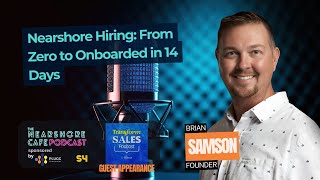
Brian Samson of Plug Technologies explains why U.S. companies are switching from Asian offshoring to nearshoring in Latin America. A San Francisco CTO hired senior Argentine developers at lower cost with matching Pacific time hours. Plug promises onboarding in 14 days and handles payroll, hardware, and currency issues.
Chapters
Welcome to the Transform Sales Podcast, where forward-thinking business leaders come to share their experiences and ideas, learn from each other, and amplify their results together.
All right, guys, welcome to another session of the Transform Sales Podcast. So, uh, service review. Today we have Brian Samson from Plug Technologies. How's it going?
Hey Dave, super excited to be here.
Awesome, awesome. So guys, today to get you guys excited, we're going to talk about how Plug Technologies go from zero to onboarded in 14 days. And this is going to be an interesting topic, so pay attention. So just so that we can get started with your offering, what were some alternatives that customers usually will go for before considering your agency?
Yeah, so generally speaking, uh, if a company's opted into hiring remote, uh, you're in the right place talking to Plug. And generally, uh, offshoring is where a lot of companies have originally started. It's mature, going over an ocean, but there's a trade with that, uh, big gap on time zone alignment. So, you know, you're staying up till midnight doing calls, or, you know, you get this like quick 15-minute overlap and then, you know, you're off to bed and they're starting their day. So a lot of companies would, would look to offshoring first, or maybe they'll use their own recruiters to try to find people San Francisco, New York, Austin, you know, kind of wherever their offices are, uh, And then nearshoring is using Latin America, and that's where we come in. So full Workday overlap, full time zone alignment, and, uh, our recruiters can jump right in to help you out.
Awesome. I did see something on your LinkedIn that I found very interesting, is why pay $200K, right, when you can easily find somebody nearshore, right? Whether Mexico, Colombia, Argentina. Tell us a little bit about that.
Yeah, I've got a friend who is a CTO of a Series B tech startup in San Francisco. And this really happened during COVID uh, you know, I want to say it was like May of 2020. So 2, 3 months into no one leaves their apartment, you know, we're all wearing masks to go to the grocery store. And, uh, my buddy, you know, sends me a text, hey Brian, so I'm spending like $200K on my dev to work from his house in San Jose California. Um, like, if they're gonna work from home, I might as well, uh, you know, get some cost savings here. We only have so much capital from our fundraise. Yeah, you know, I told my friend, well, yeah, uh, you came to the right place, let me help you out. So, uh, we introduced him in a couple days to some pretty senior developers from Argentina and, uh, on the map it looks like Argentina is kind of way out to the right. Yeah, but culturally, if you've ever been there to Buenos Aires, uh, you're eating dinner, you know, at 10, 11 o'clock at night. So the workday is almost identical to Pacific hours, and more importantly, the talent is off the charts. So we introduced him to a couple developers from Argentina massive cost savings, and no difference with workday overlap or skill set. And he was blown away.
What would you say was the percentage of performance increase, for example, or you felt like they were equal in terms of—
yeah, it was, uh, um, so equal performance, but some byproduct attributes were really interesting. Now, if you look at a country like Argentina, but I think this goes for not all of Latin America is equal, but every country has their own nuances. But there is volatility in the region, um, whether it comes from governments or inflation or things like that. Now, that's scary when you're in the States, but if you're in Latin America, often this is just daily life. And there is an advantage to this. So if you just read what the media writes, you might be nervous to do business in these countries. But think about what that does for a population that's constantly trying to navigate this. It creates a workforce that's, uh, able to overcome adversity, flexible, gritty, scrappy, creative, just true problem solvers. And I can't think of a single hiring manager that doesn't want those traits. So they get the same technical skills, and English and timezone overlap as they get with the developer in the US. But then they get all these extra things. And that is where the magic happens.
Awesome, awesome. And so I did see that you hired over 500 Latin engineers in the past 5, 5 and a half years, if I'm not mistaken. What is something that truly stands out when you're vetting these candidates that makes buyers just want to just go directly with you guys?
Yeah, so there's really, I think, 3 things that give us a key advantage. The first is, like you said, Dave, we've been there before. You know, it's like, you know, if you're playing football and you score a touchdown or a goal, you know, if it's soccer, You hand the ball back to the referee, kind of, hey, I've done this before, I don't need to make a big deal out of this, right? So hundreds and hundreds and hundreds of hires, we know how to do it. The second is we've got a lot of firsthand knowledge. I've lived in Argentina. My business partner Ruben has been an expat in Mexico, in Monterrey, Mexico. So there's this advantage we have of being able to share firsthand experience— excuse me— firsthand experience of, uh, tree-lined streets and steak dinners and, uh, currency, uh, manipulation and governments and getting hardware in and out of the country. So we can share all this firsthand knowledge to help advise and guide our customers on the best country, the best talent pocket, all of that. And third, um, we've got a really developed white glove service. One of our customers compared us to the Ritz-Carlton of nearshoring. So we go easily the extra mile, everything from getting that special custom hardware delivered door-to-door to onboarding, bilingual support, so our developers can speak to someone in their native language and we kind of catch the small issues before they become big, timely payments, all the stuff that really matters. We make sure that our customers and our candidates are well taken care of.
What the main thing I get from this is that you're focusing on the long-term relationships, right?
Correct.
Because that's, that's what buyers see. Like, in our, in our case, right, I'm obviously here in Colombia, Medellín. So when I see talent obviously from here and I see how strong they are, obviously it puts us in a position to best recommend the top shortlist of candidates, right? So this is awesome. I know you also mentioned some of the challenges in the beginning, uh, but what were some other challenges that those customers came, um, were dealing with, right? Because a lot of those people like you were, you were saying, they're doing it offshore, they come with a lot of pain points, they come with a lot of challenges they face, they come with a lot of budgets burned, right? So how do you, how do you turn that into a positive situation where they could just focus on your long-term solution?
Yeah, I think that's a great question, Dave. Um, we're really in the business of giving our customers arbitrage. That means significantly more value than they're paying for. We're never going to beat Asia in terms of cost, um, but I think by now Asia is so mature as a talent region that customers understand there's a trade. Um, you— whatever you save in cost, you might make up for in late-night calls, you might make up for in, uh, cultural misalignment, or like lots of hierarchy. So maybe you've gotta share your feedback with one person at the top and it filters down to like 7 people. And it's always like a body problem. They're behind on a deadline. It's never let's find smarter engineers, it's let's find more engineers.
Yeah.
So whatever you're saving on cost might come back to bite you later and you'll pay more. But, you know, really, that being able to do business in real time, collaborate on Slack, jump on a video call, text on WhatsApp, be able to communicate with somebody where it doesn't feel like a wooden script— they might speak English, but is it your kind of English? And are they watching the same Netflix shows you are in American-style English? Are they conversational? Does it feel unscripted? All that stuff matters, you know, and it's not talked about a lot, but it really makes a difference.
No, most of these people are in product, like it will suck to spend so much time in building and then once it gets to the engineers, they— it's like a broken phone, right? And that's something I definitely seen. And then they have to spend more budget to rebuild and it just constantly become a bigger headache, right? That's right. But this is awesome. So what I'm going to do is I'm going to display your screen. I want you to kind of walk us through your website, show us some key features of your service so that, you know, those that are looking for your specific services, they know exactly how to overcome the situations they're dealing with. That'd be okay?
Sure, absolutely. Let's do it.
Awesome.
All right, so, uh, this is us. Uh, we're a service company, we're staffing. We don't try to overcomplicate it, but what we do is we take the staffing model of finding contractors, um, whether they're short or long term. Um, and we apply all the best practices to doing this in Latin America. Uh, so we'll introduce you to great talent quickly, usually in a couple days. Uh, you'll get a shortlist of qualified people. We've got a deep network, many different talent pockets, uh, around the region. We go through interviews, background checks, offers. We've got a very high offer extend to offer accept conversion rate, and, uh, you can usually get somebody in the seat quickly. Um, but fast is only good if the quality is good, and that's the secret ingredient that we have. Um, I can get you somebody poor tomorrow. That's not, that's not, that's not hard to do. Yeah. The harder thing to do is get somebody high quality in your seat in 14 days, and that's where our magic happens.
Awesome, awesome. One of the things that I wanted to ask you is, do you vet most of these candidates directly from LinkedIn? 'Cause what we found as a B2B marketplace is sometimes most of these candidates are not on LinkedIn and they'll surprise you, like they'll crush, they're just super low-key, they don't have an account on LinkedIn. So it's very hard for us to validate 'cause usually we'll use that as the first source. To validate, but sometimes we see candidates that come in, they don't have a profile and they're just so good that if they have a profile, I just can't imagine, right, the opportunity that they'll be in front of, right? Has that happened?
Yeah, you're absolutely correct. You know, I think generally if it's your first time hiring in Latin America, you're a tiny company, maybe try Upwork, you know, see what happens. But I think you'll, you'll see a quality difference. And the big thing is because of like Upwork and Fiverr, their models are really for people that just wanna get like a quick task done.
Mm-hmm.
And these platforms take a huge percentage of the fee. They're— so if you are a really talented individual, you don't wanna give Upwork or Fiverr or all these other platforms so much of your money, especially if you don't have to.
So, uh, and especially when it takes so long to pick up on another project, it was like, hey, where's my profit? Now I have to use part of that profit to invest in ads within Fiverr, and now I don't even have profit. That's what I hear a lot of people, right?
So we're in the business of getting long-term projects, giving our talent long-term projects, and, um, sure, we use LinkedIn, uh, But, um, just because the developer has LinkedIn doesn't mean they're going to respond to you.
Yeah.
So, you know, we're able to use a lot of interesting marketing techniques to build engagement.
Nice.
More importantly, Dave, um, referrals. Referrals are huge. So we might get somebody from LinkedIn and then get 5 of their friends that are also highly qualified, because good people know good people. Those other 5 are not on LinkedIn. So that's how we built our database and really moved the needle for our customers.
Absolutely, absolutely awesome. Do you have any use cases you want to share with the audience? Because I want to make sure that they also feel connected, right? Yeah, with your industry. Do you have anything you'd like to share with us within your same website?
Yeah, there was a mid-sized tech company that was based in Atlanta. And, um, not only did we find, uh, one developer for them, we built a whole team. So we had, um, developers, QA, you know, I think there are, uh, 5 team members, uh, in this case. We put everybody together in Argentina, um, and all senior level. They became super embedded, so it wasn't like they were outsourcing it was, um, an embedded team.
Yeah.
So, uh, you know, they got to know each other's, like, families and pet names, you know. And, um, uh, you know, that leader was based in Atlanta, but he said, you know, it felt just like these guys were on his team, and he loved it. The culture was super aligned. Uh, they moved the needle. They got products out the door quicker than they expected. Notice I haven't said anything about cost savings, but the cost savings is real. Yeah, the differentiator I think with Latin America is, um, the quality is so high that companies aren't going here for cost savings, but they'll celebrate the cost savings at the end.
Yeah, 100%. Yeah, you took the words out of my mouth. One of the things that I realized, like, working with Latin audience is that They're like, you know, let's crush it. I was going to bring more opportunities, more people that we know are going to get hired. And it just becomes like a community of everybody looking to crush it so that better opportunities keep coming every year. And I say this on my background, right? When I started as a customer support rep, all the opportunities that came along after that, everybody started looking for SDRs, account executives, now for like manager roles. Now they're looking for C-levels. And that's a transition I got to see. When I started seeing all this talent arising from Argentina, because a lot of people come to us for engineers, right? And Argentina is the first one I hear every time, right? The fact that it's a little closer, right? You don't have to go to APEC. You get to, you get to visit your team, you get to bring them on board. You know, that kind of brings a little extra touch to it. But I feel very familiar to what you're saying, and I know this is something that's going to continue growing. It's going to be more quality of candidates. And I'm just very excited, honestly.
That's great.
Awesome. So I wanted to ask you something when it comes to the task deliverables and people who are involved. So let's say if I decided to go for you guys, what does that look like? You know, what is the typical ramp-up time? How long would it usually take for me to be fully onboarded? Can you give us some information in regard to that?
Yeah, one thing that I'm very proud of is despite our scale, uh, I'm still involved, and my partner, uh, Ruben, who's the day-to-day president for Plug, who also has the expat story— our customers know who we are. And I think that's a huge difference from, you know, working with other ones, um, when the, um, the key founders, the key executives are involved as your vendor, you know, you matter, and our customers matter to us. So we'll, you know, give all the advice, make sure that they're set up for success. There's a director of customer success that's involved. So, you know, they're navigating the, the actual solution, ensuring they get the right candidates. We have recruiters that are very senior level in Latin America. So all of them are involved in the shortlist, the interview scheduling, the vetting of the candidates, the pre-closing, everything that you'd want, or you'd expect, just like US staffing. And then a real secret sauce is our operations. So like offer, offer, accept to the first day of the first week, all the, um, you know, getting hardware from New York to Miami is one thing. Getting hardware, um, getting like a very specific machine to, um, Lima, Peru is a whole other thing, right?
Yeah, 100%.
Customs and, you know, different things. So, uh, we know how to do that, um, and we know how to think through, um, compensation and currency volatility and USD and payroll infrastructure, Slack and WhatsApp and all the different cultural nuances to really ensure that it's a long-term success story, right? Yeah. The placements aren't just bouncing, you know, for the next offer for a dollar increase, you know, that they're happy, everybody's set up for success for the long haul.
What I get from this is that you don't only focus on the buyer, but you also focus on the seller, and that's what keeps that connection extremely strong, right? And I feel like that's what's going to keep people for long-term opportunities.
Yeah, absolutely.
If I got the right equipment, if I have the right software, if I have everything in hand for me to do my job, and me as a buyer have all the ease to make this happen, and on top of that I'm getting cost a cost-effective solution, I think is a no-brainer, right?
Yeah, absolutely.
Awesome. So what are the KPIs ideal customers use to evaluate the success with your service? And what is the quantifiable outcome? I know we reveal the 14-day onboarding, but when it comes to the acceptance rate, do you have like a number in mind? That tends to be a question a lot of our buyers ask.
Yeah, I think there's maybe 3 things to talk about here first. Uh, you know, the first is that, um, we don't want to waste time. We're not a body shop. So if you have an opening, we're not going to send you 50 candidates tomorrow, right?
Yeah.
Um, ideally you're gonna get 3, and from those 3 that are carefully vetted, you'll get your winner that really aligns with you. Okay, that's, that's what we're truly focused on. High quality. Okay, um, the second is we work for the referral. So the most important KPI for us is that our customer refers us to their network, and that's how we've gotten most of our customers.
Yeah, nice. Perfect. Awesome. Thanks for sharing that. And when it comes to like support channels, I know you mentioned Slack, you mentioned WhatsApp, but I have a lot of buyers that usually interact with the chatbot on the website or via email. They want to stick in their channels. How do you go about that and what is the strongest channel to keep that communication effective? Yeah, and you know what's something you— I— there's two things I want to mention because in the chat what I notice is that sometimes they don't describe the issue as big as it really is, right? Next thing you know, you have a conversation with them and they need so many other things that obviously for us is, is a, is a win, right? We, we get to offer a suite of solutions, right? And then the other one is regarding the engineers, right? Uh, I, I read a stat from Lovable that said 0.23% are engineers. So obviously the pool is not as big as SDRs, account executives, and it's not just role. You just, you know, let's go for that, see what happens. You got to live by this, you got to enjoy this role. So for engineers, it makes sense because at first I didn't understand that, right? Because I had buyers come to us like, hey, I need a volume of engineers so I can have a good talent pool. But then it was very hard to achieve that, right? So that kind of pieced together. What's your take on that? Yeah, and I feel like a lot of people just want to jump on the boat. Let's get AI in there, right? But they even haven't— they haven't even updated the articles. So it's like sometimes you're just being thrown in these articles that are from last year. The links don't even work. The POCs on the, on the bottom of the, of the post, they're no longer reachable, or like they, they changed jobs. So like now you're hurting your domain. So yeah, I had that experience. I realized that with LinkedIn, if you want to get chat support, you have to spend ads and then they'll kind of give you a little bit of attention, but that would be a different topic. But I think this was a great session. I did open the listing for a reason. This is the listing that buyers tend to see so that they can get fully informed on your solution, right? Um, I left all the details. So who's watching this, you get to see who's the ideal buyer. If this falls into your specific requirements, you know, you have Tim to support you, make sure you get human touch. I will leave the listing in the description below. But Brian, I feel that this was a very interesting topic that we covered. Anything you want to say before we go? Let's do it. That's definitely gonna be the way to go. All right, catch you in the next session. I know we're gonna have more sessions coming up so that we get to display all the services you offer. Sounds good. Take care, Brian.
More from Brian

From BPO Agent to Client Experience Manager: Ana Rodriguez on Nicaragua's Nearshore Talent

From BPO Agent to Client Experience Manager: Ana Rodriguez on Nicaragua's Nearshore Talent

Building Sales Teams in Mexico: Mario Oliveros Figueroa on LATAM Talent & Cross-Border Selling

From Automation Engineer to Data Platform: Victor Fernandes on Brazil Tech Talent

H1B Crackdown & The Nearshore Shift: Robert Bouchard (H1B Guy) on LATAM Talent | 🎙 TNC

Nearshoring Yourself; step by step to building an expat life in Mexico |🎙 The Nearshore Cafe Podcast

Scaling high-performing teams in Costa Rica staffing legend Doug Firestone on growing to 225 LATAM

How to Scale in LATAM? Navigating Currency, Taxes, and Labor Laws | 🎙 The Nearshore Cafe Podcast



AI in LATAM: How to Break Into Mexico’s Tech Market |🎙The Nearshore Cafe Podcast