Nearshoring Explained: How Time Zones and Talent Change Everything | Brian Samson
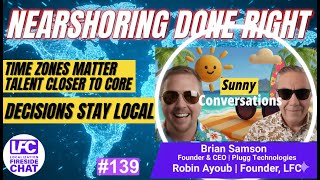
Brian Sampson, a nearshoring entrepreneur, explains why Latin American talent beats offshoring for US companies. Time zones align with US hours, developers solve problems under pressure, and his firm handles payroll and logistics. Startups and mid-market companies are his target customers.
Questions this video answers
Episode number three.
Chapters
Foreign. This is Robin Ayub from the localization Fireside Chat. And welcome to another episode and another episode. I say another episode today. This is episode number three. I'm recording. And I recorded one in the morning, one noontime and one now with my good friend and guest of honor for this conversation, Brian Sampson. Brian joins us. We were just exchanging funny stories and sharing a few laughs from Hawaii. All the way from Hawaii. And I'm talking to somebody from Hawaii. I am in Toronto. It's minus 23 degrees Celsius. You know, I feel like a little jealous, but I feel happy for you as well, enjoying the weather and the heaven that is called Hawaii. Thanks, Brian, for joining me. I really appreciate it. Thanks for taking the time.
It's an honor to be here. And you know, I, I did, I feel like I earned a little bit of my sunshine. I did grow up in the Midwest and ice scraper and snow shoveling for a lot of my life. So, you know, but now, now it's about, you know, 30 Celsius every day.
Well, you know, for us Canadian, we look to the sunshine. It doesn't matter where it come from. And you know, when we see somebody enjoying the sunshine, it's like us getting the sunshine, to be honest with you, it's just like he's got that reflection and at least from a soul perspective.
Good, good. I'm happy to hear that.
Great. Why don't we start by, you know, we say on this channel everybody's got a story. So why don't we start by telling us or telling the audience your story. Who is Brian Sanson?
Yeah, sure. Like we, we just shared. I grew up in the Midwest, right outside of Chicago, you know, Windy City. Windy City. Although a lot of people think it's because of the weather, but a fun fact, it actually, it's a nickname because the politicians are full of hot air. They talk a lot. Blustery politicians. Is what, is that what it's for?
Is that what came from, not from the weather?
No, it goes way back to the, like the World Fair days. I think of the late 1800s, early 1900s and a bunch of other Midwest cities wanted the world's Fair. But Chicago's hot air, blustery politicians, you know, if they're all full of wind, wind bags. But there are, there are some windy days here. But anyway, grew up there, got into the staffing industry. The reason I, I think I really enjoyed that was I've always been innately competitive. I was always the guy that not only knew my stats in Little league baseball. But I knew all my teammates stats and you know, if I, you know, I could nine years old and I'm calculated earned run average, you know, and things like that, you know, in my head. So I was always into, into the numbers and stats and competition and you know, my very, very first real job was I was a recruiter for a mortgage company and I'll date myself. This goes to the, you know, I was naive and young, but I probably didn't realize that one of my company was probably one of those, one of those that caused the mortgage crisis and you know, let led to 2008. But I didn't know, I didn't know any better.
Yeah, we won't tell anybody about that one.
So I was just recruiting loan officers, you know, doing what I was told. But I, you know, I got a recruiting email, someone was trying to recruit me, you know, and they told me, you know, I could get paid for the number of placements that I was making. And you know, here I was in my current company and working long hours. I loved it. But my paycheck never changed so that was a huge draw. So I went over to the official staffing industry and your boss would always say if you want to raise, make a placement. So. And I love that, you know, being in control of my income and have made that a career, you know, for over 20 years. The first third of that was, you know, traditional staffing agencies. The next third I went inside and I was in house, moved to San Francisco, worked for a bunch of tech startups and helped them build their team. And part of that, you know, electric energy. And then the last 10 years I have been in this world called nearshoring. There's a lot of definitions, but nearshoring basically means you're working with people on the same time zone. Offshore typically means there's an ocean in between. So nearshore for us Americans and Canadians is Latin America developed countries helping the developed world. And my job is to connect what I think is really the most exciting labor pool out there that we often forget about and connect these with companies that need it. So we work across Mexico, Argentina, so forth. And I have happened to spend a year living in Argentina. So I feel like I know it, I have the expat experience and can give some firsthand knowledge, you know, and advice for companies that, that are looking for it.
So is this what led you to Latin America? Is that Argentinian background? Is that what it is?
Yeah. So I, I ended up, my very first venture into entrepreneurship was just over 10 years ago I had a thesis for the tech industry. I saw these fintechs popping up, you know, financial technology companies like little lending startups and wealth management startups and they all had lots of capital and didn't really care how it was built. So I said, okay, hey, I think you know, we can, we can do this. So raised about 2 million doll and kept sales in San Francisco. And then I went out to live in Argentina day one, you know, like figuring out payroll and legal entities, growing a whole team and then you know, living, living in the city, you know, living in the tree lined streets and having a lot of stake in Malbec and at the same time, you know, seeing wild volatility and inflation and you know, kind of the, what I call, you know, the most first world of the third world countries.
You know what, I was just my earlier podcast with an Argentinian gentleman as well, just outside of Buenos Aires and I did my, what I would call the first podcast in bilingual format. So I was speaking in English and the individual was speaking in Spanish. I can't wait to publish that one. I do speak other languages, but this is the first time I do a podcast where I'm speaking one language and the guest is speaking another language. It's very interesting to see that dynamic, especially the, he was telling me that the people live where he lives, they are not necessarily recognized Spanish. They call themselves Italian with a Spanish language. So it's pretty cool. It's pretty cool to see that.
Yeah, they, you'll see, you know, not all Spanish is all the same. So you know, in, you know, we were in the pre show talking about chickens. So the way you say, you know, a lot of people know pollo, you know, P O L L O Pollo is, you know, how you might say it in chicken in Mexico, but in Buenos Aires they say sh instead of the Y sound. So it's pocho, you know, and Argentina is just its own kind of wild west of, you know, a different version of the language. It's a lot of Italian heritage. So big movements, lots of passion, you know, talk with their hands, big energy, lots of family. They never run out of things to say.
So tell me like for near shoring, which is, you know, offshoring and nearshoring. This continent has been dealing with this topic for the past three decades, four decades. I think as soon as they discovered they can get cheap labor somewhere, they've been talking about it for a while and they've been practicing it in various formats. So I remember people rushing to offshore and Then I remember clawing back that bring it back in, like call centers and all that stuff. You know, there was some rejection from the local consumer, specifically on the call center side, saying, hey, I don't want to, you know, I want to speak to somebody in my own language, in my own time zone, in my own whatever dynamics you see, like telephone companies moving some of their contact centers back to nearshore or, or inshore, if you will, in country. For you, for instance, you've been at this for a while. You mentioned like a couple of decades almost. What was the trigger? How did you figure, okay, so nearshoring is going to be an opportunity. I got to jump into it. What drove you to that?
Yeah, I really wanted my team on my time zone. So I'll tell you, like, what drove me there. But now I'll tell you what keeps me there, because I think those are two different things. So what drove me there was there are some cost benefits. You know, Argentina is not as expensive as San Francisco. Well, honestly, very, very few places are. Toronto, I hear it could be pretty expensive too. But Argentina is a lot less expensive. You know, generally Latin America overall. But having that time zone alignment is really critical, especially for a lot of the rules that we were placing, you know, software development, you know, later, we've dabbled into call center and operational stuff, you know, back office, some sales. But that time zone really got us. But Robin, what really fascinated me was Latin America overall. You know, this is a blanket statement. There's a lot of countries here. There's a lot of volatility. You know, sometimes I think we take the stability of the developed West, Canada and the States for granted. But Latin America often deals with, think about Venezuela with hyperinflation, and it cost a trillion dollars or banknotes to buy bread. Or you think about, you know, wild inflation in Argentina or sometimes like cartels and safety in places like Mexico and Colombia. So it's a little bit of a volatile place, but it's really important to recognize that this is a function of bad government, not bad people. And we sometimes paint this broad stroke like, oh, the whole population just must stereotypical, right? Yeah, the whole population must be nuts. But it's really just the government, so. But if you've lived in volatility your whole life, you learn how to be scrappy, gritty, flexible, adaptable, creative. You're really good at problem solving and you're very calm under pressure and chaos. And I don't care if you're on Honolulu or Boston or London or anywhere else in the World. These are all skills and attributes that you want your team to have. So again, ignore the government. Remember that the people have all these amazing innate attributes. And that's what keeps me there and keeps me enthusiastic and exuberant about sharing the, the amazing talent that I see there.
So for those who don't know and who don't understand the difference between near shoring and offshoring and outsourcing.
Yeah.
You know, they. This is all confused at some point. Right. So niche shoring versus outsourcing. Let's start with that.
Yeah.
What is the difference between the two? In your own, in your own definition? I guess the way you understand it. Yeah.
So I think there's a couple of vocabulary words, so thanks for bringing that up. So outsourcing in general doesn't. Outsourcing doesn't mean offshoring or near shoring. Outsourcing means that a role is done by probably another company outside of your company. Good example of this is, you know, every company kind of has, has core skill sets. So think about as you set up your org chart, if there is a VP for that function, it's probably a core role, but you can't have a hundred VPs, you know, so maybe you have a VP of marketing because you're, you know, marketing agency or you're a tech company and you have a VP of engineering. But do you need a VP of accounting? Maybe, maybe not. And so you'll probably outsource your accounting. You know, there's another company that just does that really well, or facilities and real estate or internal it. You know, we, we outsource a lot of things. Offshoring, near shoring and onshoring. The way that I think about offshoring is there's a ocean in between, which means we're not all on the same time zone. For us, in North America, offshore, it means Asia usually. And it means the developed world is being supported by the developing world. So you're thinking Philippines, India, Vietnam, lower cost labor supporting developed countries and the companies there. And nearshoring is similar to offshoring, but there's no ocean in between. So you're all on the same time zone. And I think spinning out of COVID where it felt like a rubber band kind of started here, went way far, and then snapped back. You know, I don't know if you felt like this in Toronto, but pre Covid, it seemed like nobody worked from home. And then once Covid hit, okay, I think we can make this work. And then labor just kind of went everywhere. You know, they all moved to Southeast Asia. And you know, we're digital nomads and working from the tropics. And then we realized that you lose a lot when you're not on the same time zone. You send an email and then it gets responded to you 12 hours later you want to jump on a call but they're sleeping so that rubber bands snap back. And we realized that remote work is good because it gives you access to a much bigger labor pool. But time zones matter. Workday collaboration, getting on the same, getting on a call instantly, getting out of zoom instantly. Slack chats. That's how work gets done at the rapid pace that we need to. And with the way that, with how.
Fast business moves today and in, in your world. From my, from what I understand, I guess the type of business functions are being near shored are close to the core, almost not, you know, distance from the core. If you were to think whatever core definition for a business is, you're seeing a lot of those core near the core. I don't want to say like you're not outsourcing, you're know CFO or you know, unless you're in a small company, small, medium sized company, you could do that I guess. But in a larger corporations like PwC and all these guys, they're outsourcing things that there are normally you wouldn't see being outsourced or nearshored. And, and there is a difference there between outsourcing and nearshore near shoring it because they're still technically their staff, but they are working for in another jurisdiction, another area. And you bring up like the COVID which is very interesting because I've seen a lot of people like they used to work in a large metropolitan area with higher salaries and all of a sudden they're working out of Thailand, renting a house for like 10 bucks, 10 bucks a day or something and they're cashing in on all the other benefits. Right. So some companies woke up to that, say, hey, I'm paying you too much. You want to live in Thailand, fine, you live in Thailand, but I'm paying you Thai salaries.
Yeah, yeah, yeah. 100, 100%. You know, back to your, your comment about the core. What has been really exciting to see is it's actually as capital. You know, capital goes where it's appreciated, but capital drives labor horsepower. And, and what do I mean by this? For a long time it was, it was. I like how you put a robin like close to core and distant from core core. We would only really send like work that was not consequential, you know, like software maintenance, research, nothing touching the client, you know, just stuff that would like be leveraged. But we've seen a lot of venture capital, private equity money moving to move it across the globe. And what that's created is brand new companies in places like Argentina, Brazil, Chile, Mexico, Colombia. And so this workforce is learning how to evolve from like maintenance work and integration and back office to solving hard problems for their own companies and then recycling that knowledge and then being able to apply that to American and Canadian companies. So their scopes are big, their responsibilities are big, and they understand how to do hard work in high pressure and work of consequence, which puts them much, much closer to the core. And I'd probably still advise not to have your first three or four members of your team in a different country. I think it's important to be in the same city or same office. But what's really changed is companies used to wait till like employee number 50 to do this. Now you can do this at employee number five. And you get great returns on investment with very little sacrifice.
Absolutely. In your, like from, from where you're running a company, this is, you do this for a living. So who is perhaps your target audience? Like who's your customers? Is it small to medium large corporations in a specific industry?
Sure, yeah. There's really two types and they need two different things from us. The first is small companies. It could be a tech startup, but it also could be a small agency financial services firm, you know, just small businesses. And if you're small, your every hire matters and every dollar matters. You know, you're really looking at this, you know, and maybe it's even your own money if you're the founder and you can't make mistakes. Right. So you realize that sometimes if you're say offshoring, you have to be very explicit in the instructions on the process, like step by step by step by step to offshore team members because they have to stick to a very exacting process and script that's also very time consuming. You know, we think about the cost savings, but we don't think about our own time and kind of managing that process and designing that process. With Nearshore, you can often get people with the ability to solve ambiguous problems like hey, you know, you hired this person from Mexico. Can you talk to a few of our customers and then design a customer service process and script? They can do that. Where I think if you offshore, you have to do all the heavy lifting and then, and then you hire somebody to work the Script, that's a huge difference. So if you're a small company, your dollars will go farther and it's less work for you. As the hiring manager, you know, the owner, the founder, the, the other customer is like that probably mid market, mid sized company and they're looking for optionality and flexibility, but they also want some scale. Like one hire is not going to move the needle for them. They're thinking in terms of teams, you know, 5, 8, 10, 12 people and so on and so forth. And we can do that too. You know, we can build a team with a lead, with a couple people around them. Doesn't matter if it's technical, maybe it's a sales team, maybe it's a marketing team, call center operations, you know, we can do all that and then give them advice, you know, on, based on their budget, based on their team size, based on constraints, getting hardware, you know, all that stuff. Different countries are better than others depending on what they need. Maybe it's Costa Rica, maybe it's Nicaragua, maybe it's Brazil, maybe it's Peru. And all these countries have attributes and positives and they also have some challenges and constraints and will advise, will advise the companies based on what their goals are.
Now, you know, they, it strikes me that your company is growing organically. Like you haven't really went through, you know, the thought process of I'm gonna do two parallel strategies here, one organic and the other one is M and a kind of thing, merge with another company. Sort of like you strike me as I want to be independent, I want to run my own show, leave me alone kind of guy. You know, that's what the entrepreneurial spirit is. You definitely don't want a private equity firm poking around in your business. You don't want that. What's your thoughts on the other side of growth? You know, you got the organic growth, but what about the other side of the growth?
Yeah, I've had in a prior company, so in two different worlds. You know, when I was in San Francisco, I worked for a bunch of VC funded tech companies as an employee, you know.
Oh, San Francisco's full of them.
Yeah, yeah. So in some case, you know, I was like on the executive team. So I had some more insight into what goes on there. And I think people don't quite realize how quickly you lose control of your company as soon as you take capital. And even if you say you only sell 10 to 20%, there's all sorts of clauses, you know, where they can remove you as founder, put all sorts of pressure and because they've given you money, you feel obliged to say yes and appease them, you know, quite a bit. So if they make a recommendation or suggestion, you know, you're, you're often appeasing them. And I don't, I don't think people quite recognize that. And then the same thing happened to me. You know, the first nearshore company that I had, I raised about $2 million from an investor. And I recognize that it wasn't my own company, it was shared. And the investors have a right because they're giving capital. But you no longer have full autonomy, even though you're a founder, you've got a boss. And since then, I've only put my own money into companies because I want full autonomy at all times. And, you know, there's pluses and minuses. You know, maybe, maybe growth is a little slower because I'm using my own capital or, you know, I've got to work with different financing methods, lines of credit, you know, loans if I need to, versus, you know, investor capital. But I'm also in control over the timeline, the exit. And it allows me to say no when things don't feel right. Like I've said no to different clients and decided not to work with them because this is my time and my capital, where I think if I had an investor driving that, I probably would have felt pressured to hit the numbers and hurdles that that investor is expecting. So it allows you to take a longer, more macro view. And I think I'll do that until I have no other choice now. No.
That's wonderful because, you know, personally, I'm not sure how much you know about my story or you listen to my story before because I've been interviewed about this one many times. You know, I've been through, I don't know, three, four private equity transactions.
Yeah.
And I've got this cars to. To share, but I won't share them right now because it's a long story. I've got a few T shirts with my name on them. That's the reason I asked, because a lot of people, they get to a point where they want to scale up and they need capital and they go seek capital and they lose control of their companies as in the process. However, though, I've seen a lot of evidence of success with partnerships and partnerships meaning that you get something, they get something. Right. So I do work with this company out of Dublin and they do have a, an office in Argentina and I help them. It's a recruiting agency, not a, you know, in your capacity but they, you know, put bums in the seats kind of thing, they put heads down in a. Fulfill roles, etc. So. And I was. And I'm trying to figure out a way to partner with people such as yourselves in placing people in whatever it's required. I mean, there's no commitments here, but wondering if partnership like this would work for you.
Yeah, I think, you know, I've never had anything positive happen in business that wasn't the result of a relationship, you know, and sometimes it works, sometimes it doesn't. But we, we always try to find a way to say yes if it.
Makes sense, you know, Absolutely. I mean, no, same here. I mean, I want to say I said this before on my, on one of my podcasts. I said, you know, I've been in career, I've been in a corporate environment for all my life. I left the company longstanding. I worked for for 23 years about eight weeks ago, and I started on my own. And I can't remember one time I applied for a job. It's about relationships, it's about connection, it's about conversations. That's the one we're having right now. And, and the reason behind I started this podcast, it's the whole story is that to help people broadcast their message out and to help them get to where they want to go. You know, I'm not saying like, you know, I control the airwave. I don't, far from it. But I do have a sample of connections that probably would listen and be influenced for, you know, conversation by conversations such as this one. So try to help. Not, not necessarily trying to influence anybody, but just trying to see. Be helpful to the audience, the listeners, to you get to the audience and the listeners and to those who are interested in forming partnerships and alliances with people. So that's the reason. One more thing I wanted to ask you about Latin America in comparison to other, because I do hear a lot about Latin America, which is fine, but I also hear about things like in its emerging areas like South Africa, for instance, and few other places. What's the comparison between Latin America and other regions in terms of skills, availability of skills, etc.
Man, what a exciting question to answer because we've realized that the world is full of talent everywhere. And you also look at companies like Google, which they have the resources. Where are they putting offices? Because they're not putting in an office and a place to save money. They're putting an office in a place that has the most talent. Right. So we talked a lot about Latin America but maybe I'll talk about some other parts of the world. Africa is really interesting, you know, Nigeria, English speaking country, South Africa, English speaking country and incredibly low cost. I would say Africa is offshore when you're thinking about the Americas, because there is, there is quite a time difference, you know, in between North America. So you're going to save money but you're going to have a time difference issue. But I also think there's something important to recognize is offshore like Asia, that's been going on forever. So it's very mature. I think Africa is still immature and I don't mean that as an insult. I just mean that as it's, it's so emerging that often.
But that could be an opportunity, right?
Yeah, so, so it's so emerging. And what I mean by that is I think if you, if you are needing to hire somebody with experience working with US companies, nearshore Latin America or offshore, Asia are probably places that you're going to find candidates that have worked with other U.S. or Canadian companies. They kind of know the work culture, the work style. Because I think there's kind of two pieces there. There's domain skill and then there's understanding like norms of how work gets done, how it's communicated. When you have an emerging market, education is global now and you can watch YouTube, become an expert on stuff. So we don't, in North America, we don't have a monopoly on education and skill set anymore. You know, it's truly global.
So I wish most universities are online now.
Yeah, yeah, yeah. I mean you could probably get a free education from MIT nowadays. So Africa has access to all that. But what I don't think they have is the years and years and years of experience in working with the developed world in a offshore or nearshore capacity. So they just need some time, you know, for more and more projects, engagements, mentorship, recycling the knowledge, recycling that cultural alignment. I think it's really exciting place. It just needs a few more years to develop that.
Brian, one more question on that is, especially when you're dealing with a global workforce, there are many logistics. Do you handle that or like payments, FX rates, logistics of deploying these individuals, they need a laptop for instance.
Yeah.
Do you handle that or somebody else handles that?
We are very proud to not only do all that, we provide a white glove experience. We have a dynamite operations team that works across countries, figures out customs laptops. We use DHL here, we use FedEx in this country. We, we know that hardware costs three times as much to buy in country in this Place because of tariffs and, you know, different currencies, different labor contracts. There's a whole spider web of things that we've become experts at. And our clients don't have to worry about anything. They can just deal with our U.S. entity.
And so they are paying you. They're not paying the FTEs that you've hired for them in Latin America. That's where I'm heading, correct?
Yeah. So we take care of all that and then we just invoice the client on a monthly basis based on the number of hours that that person worked.
And one more question on, you know, the global part, I guess it's all global now. Have you ever came across a language issue in your dealings? Like, I know English is prevalent everywhere, and you're serving an English customer on this side, English speaking customer on this side. How do you deal with the language barrier? In some cases, not always, but in some cases, yeah.
So, you know, what I'll say is I think you see this a lot in Latin America, where I think you're working with climbers. And what I mean by that is a labor pool that wants to make more money, have more challenging projects, do more things. And they recognize that there's two different skill sets. There's their domain skillset, the technical skill set, or could be sales, whatever, like whatever their domain is. But the second, the second is advanced English fluency. And funny enough, that second skill is the one that drives their rate more than the first skill. A great technical engineer that has mediocre English will actually earn less than a mediocre technical engineer with advanced English. So there's this market force, this market effect of learning advanced English and being able to speak in colloquialisms and slang and, you know, and they, they get that by watching Netflix shows and, you know, watching it in English, you know, they, they really care about that. So we happen to like, no one, no one's really hiring us, Robin, for junior level talent. You know, they want the arbitrage of I get a senior level person from Latin America for what I'd pay a junior person. You know, in Canada or America, they.
Need to create that delta, right?
Yeah. No one wants a junior person from Latin America, so we don't do that. So for us, a senior person checks the box on both. They've got the domain skill set and the English skill set, so our customers don't really have to struggle. Now, if we were doing massive teams, we'd probably set it up like a pyramid. And, you know, a couple people at the top that are perfect English speakers and then a whole bunch of people that are on the project. But English isn't a concern. You know, they're just communicating in their language and then it gets translated to the, to the leads and then the leads, leads talk to the client. We don't really work in that space. We're really finding team members for clients not doing large scale solutions where nobody knows who's working on the team.
So we reference clients quite a bit. So what's your go to market strategy? Like, do you have a sales team? How do you go to market? Who do, how do you find your customers?
Yeah, yeah, there's a lot of different stuff we're using. You know, we have outbound marketing. We've got a newsletter, we have a podcast with 75 episodes. Now we, we've got a really.
So I'll be invited to that, right?
Absolutely. We'll, we'll talk about doing business in Latin America. That's where, where our episodes are. I love talking about how you did business in Hawaii. I guess that'll be the next podcast is doing business in Honolulu and chickens, you know, with, with Latin America. You know, a lot of this is educational sales, you know, giving, giving a sense of people that are near shore, curious. What does it mean? Like, how does it all work? What country should they look at? So this is really a consultative educational sales process. And then we're also dabbling with some of these AI tools. You know, there's some cool AI outbound things and automation that we' incorporated and some early success, but we'll, we'll see how it works in the long run.
Absolutely. And on the topic of AI, if you were to say, like I'm using it lightly or heavily used in your internal process. I know like a lot of people are using it for outbound solutions, but internally, do you use AI for anything or no?
Yeah, yeah, we, we're using some automation tools, you know, for. There's a tool called N8N, for instance, that is kind of like the AI version of Zapier and it's all like API connectivity, you know, building automation in your workflows. And that's been a game changer for us. It's replaced a lot of manual updates. Manual work.
Wow, great. You know, my earlier podcast was around the topic of AI. This company out of Argentina, that's what they do, they develop AI agents for companies. And there was a lot of questions about trusting AI right now and where do you deploy it accurately without really having to worry about the outcome? Or did it do a good job or it did not do a good job. That's why I asked the question, how do you use it in your world?
Yeah, Yeah. I guess we got to be careful of hallucinations, right? You know, when I have a casual ask, you know, it's fine to ask ChatGPT, but if I'm doing something that I think is of real consequence, I'll try to ask multiple LLMs, you know, maybe I'll ask Gemini and ChatGPT or Grok and Gemini. And yeah, you know, and they, they often have gaps, you know, that, that they just. I was able to discover that, you know, one doesn't talk about something the other one brings up, and it gives me a more complete answer.
So I, I'm looking at the name of your company. You're involved in several companies, not just one company. Plug is one of them. Plug Technologies. And there's general. General partners. The, the Hang 10X. Hang 10X. I don't know what that is. Could you walk us through all these companies that you're involved in?
Yeah, I, I just love being an entrepreneur. Hang 10X Capital is based here in Hawaii. We, we, we, we're really, you know, we, we find little companies, a lot of tech investments we've made. But then more recently, what I call boring businesses, cleaning companies, locksmith companies, you know, where there's maybe less wild upside.
Like businesses, they never go out of.
Style, is always saying, yeah, but more, more repeatable cash flow. And then I have a company called Bali Staffing, which basically leases recruiters to growing TEC companies. And then, you know, Plug, I've been really blessed in. There's a lot of great clients and great operators in my networks. Sometimes, you know, when you, when you get to be my age, you know, 20 years in this business, you. Our value add is really just connecting people and, you know, rather than getting paid for our time, it's really getting paid for our connections.
So as we wrap the conversation up here, coming up on time, Brian, what is your hope and desire to achieve from this conversation?
I had a lot of fun, Robin. You know, no expectations other than, you know, a really great conversation, and you nailed it there. But if anybody's interested in learning more about Latin America, near Shoring, we have dozens of calls every week that are just educational, you know, no strings attached. And maybe, maybe it's a good fit. Maybe not. Maybe it's a good fit, but the wrong time. You just want to learn more. No sweat. We do this all the time so they can go to the website, Plugg Tech, T E C H Plug Tech and happy to chat.
Absolutely. And if anybody wants to reach out to Brian directly from the audience, please reach out to me. I'll be happy to facilitate an introduction and no problem. Brian and I connected on LinkedIn and I'll make that introduction happen to whoever is interested in having a conversation or touch base with Brian based on this conversation. Brian, I want to thank you so much for taking the time being with me today. I know it's Friday afternoon. I think this conversation is standing between you, me and, I don't know, a cold one for you waiting, I have no idea. But I want to wrap this up by thanking you again for being part of this conversation, Brian.
Oh, my pleasure. I really appreciate the platform and the opportunity. Thanks, Robin.
And for the audience, I really appreciate you listening in to this call to this conversation. Thanks for taking part of this. And if you have any suggestions, comments on future episodes, please keep them coming and we'll try to accommodate your requests as well. And I want to thank you one more time for listening in, for taking part of this conversation and I'll see you at the next episode. Thank you.
More from Brian

From BPO Agent to Client Experience Manager: Ana Rodriguez on Nicaragua's Nearshore Talent

From BPO Agent to Client Experience Manager: Ana Rodriguez on Nicaragua's Nearshore Talent

Building Sales Teams in Mexico: Mario Oliveros Figueroa on LATAM Talent & Cross-Border Selling

From Automation Engineer to Data Platform: Victor Fernandes on Brazil Tech Talent

H1B Crackdown & The Nearshore Shift: Robert Bouchard (H1B Guy) on LATAM Talent | 🎙 TNC

Nearshoring Yourself; step by step to building an expat life in Mexico |🎙 The Nearshore Cafe Podcast

Scaling high-performing teams in Costa Rica staffing legend Doug Firestone on growing to 225 LATAM

How to Scale in LATAM? Navigating Currency, Taxes, and Labor Laws | 🎙 The Nearshore Cafe Podcast



AI in LATAM: How to Break Into Mexico’s Tech Market |🎙The Nearshore Cafe Podcast