📊 Nearshoring Trends with Plugg Technologies 💥 Insights LATAM Growth | 🎙 The Nearshore Cafe Podcast
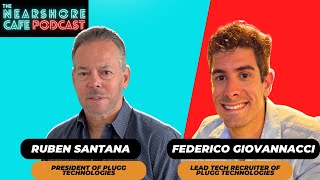
In this Nearshore Cafe podcast episode, host Brian Samson launches the new "Inside Nearshore" series with guests Ruben Santana (President) and Fede Giovanici (Lead Recruiter) from Plug Technologies, a Latin‑American talent provider. The conversation covers (1) recent travel experiences that revealed abundant software engineers across Mexico, (2) the evolution of nearshoring demand since 2023, highlighting time‑zone alignment, cultural affinity, and English proficiency as key advantages, especially for Mexico, (3) economic dynamics affecting recruitment – a strengthening Mexican peso versus a weakening Argentine peso with hyper‑inflation, leading Mexican engineers to prefer pesos while Argentine engineers chase dollar‑denominated jobs, (4) the impact of Argentina’s political shift and proposed dollarisation, and the country’s strong crypto usage as a hedge, (5) cost differentials and the move from offshore (e.g., Philippines) to nearshore locations, illustrated by a healthcare client shifting teams to Mexico, (6) a rapid placement case in Argentina where a European client received three senior consultants within 24‑36 hours, (7) perceived value beyond cost savings, with Latin‑American engineers contributing ideas, challenging legacy systems, and delivering higher quality work, (8) optimism about nearshoring’s growing visibility at industry conferences and increasing inbound interest, and (9) current hot roles – Salesforce and QA – that clients are actively hiring for. The episode ends with a brief plug for Plug’s website (plug.tech).
Chapters
Welcome everyone. To another episode of the Nearshore Cafe podcast. I'm Brian Samson, your host. And today you're in for a treat because we have a new series called Inside Nearshore, and we're going to make this a monthly series because I think the world of nearshore has changed a lot and it's changing fast. Economic impact, Labor nuances, politics, all sorts of stuff really has an influence on this. So today we're going to have two people from our sponsor, Plug Technologies. That's plug.tech, P-L-U-G-G dot tech. Plug provides software engineers and all sorts of labor from Latin America for growing US companies. And I wanted to welcome Ruben Santana, Plug's president, and Fede Giovanici, the lead recruiter for Plug based in Argentina. Welcome, guys. Great to have you.
Hey, Brian. Welcome. Thank you. Thank you.
Thank you, Brian, for having us.
Absolutely. So I think I'd mentioned at the intro, Fede is in Argentina. Ruben, you're in Atlanta. Yeah.
In Atlanta. That's right.
Yeah. So we've got people on all sides of the equator today. What's the weather like for both of you guys?
You first, Fede.
It's kind of hot right now. You know, we go by Celsius rather than Fahrenheit. It's 33 Celsius right now. Whew.
Okay. What is that, like 80? Probably in the 80s.
Yeah.
Nice and warm.
Yeah.
Yeah.
It's kind of warm.
We're at a balmy 58 here in Atlanta. Yeah.
Yeah. Yeah, I like it. I like it. Well, I think a good place to lead off is just to talk about your recent travels, Ruben. So, Ruben, for those that don't know, Ruben, based in Atlanta, has been an expat in Mexico before. And Ruben, from my understanding, you went on a little bit of an odyssey travel adventure all throughout Mexico. Tell us Tell us more about that. Where did you go? Where did you stop?
Yeah, you're right, Brian. We had a great, great, great travel through Mexico. As you know, my wife is from Mexico. I lived in Monterrey for 2 years, a little over 2 years, and really fell in love with the city, the country. So many different things, so many different aspects of Mexico, Mexican life that are very interesting. Of course, being a Latin myself, being down there wasn't a huge difference, but still very different in the sense of culturally, food, things like that that are, that are different. So we went to Monterrey, went back home to Monterrey. We went from there to a place called Merida, which is in the Yucatan Peninsula. Very interesting, very nice, beautiful place. And keep in mind, in these travels, I was able to also meet some of our consultants that we've placed in with our clients here in the U.S. So that was really a fun aspect of the whole trip. From Merida, we went to Mexico City. Wow. I can tell you this, that we didn't spend enough time there, but we loved it. We absolutely loved Mexico City, full of culture, you know, places to visit, things to do, almost like a mini New York City, which is where I'm from. So really, really loved it there. The food obviously is amazing. We met with our— had lunch with our Salesforce team that we have, one of the Salesforce teams we have. Down in Mexico City. And then we went down to the water, to the beaches, and visited Tulum, Cancun, Isla Mujeres, and a very unique place called Holbox, H-O-L-B-O-X. Really nice trip. The interesting thing is no matter where we went, no matter where we went, we found software engineers. So even in Cancun and in Holbox, and I mean, there were people there that are also software engineers, many of them working for US companies remotely. Which we know that that's, that's been going on for a while since, since the pandemic. Great trip, though. Yeah.
How do you pack for something like that?
Yeah, I tell you, it was, it was difficult. We were living out of suitcases for a while, which wasn't very comfortable. We, we definitely plan on doing something a little bit different in the future.
Yeah. Now, from my understanding, Monterey is known for steak, Mexico City tacos. Any other culinary experiences you want to, want to share?
Yeah. I mean, you know, as we were down on the coastline, whether it was Tulum or even Holbox, the fish was amazing. Some of the fish we ate there was really, really good. And of course, the prices are so cheap comparatively to, to someplace in the U.S. here in Atlanta. But yeah, that was, that's what I would say was really the highlight was the fish that we were eating along the way.
Yeah, yeah. Fedia, for those that haven't had a chance to meet you yet, could you just share a little bit about your background? How long have you been in recruiting? What kind of roles do you work on?
Yeah, sure. So as Brian said, as you said, I'm based in Argentina. I'm an engineer, I'm an industrial engineer, so nothing related to IT nor human resources. I started working as a sourcer back when I was at university, just as a side job, you know, have a little bit of like extra cash for the weekend to spend with my friends. And then I started moving more into like full cycle recruitment in IBM. You probably, everyone knows that company. Started as a junior recruiter, moved to a mid-level And then as time went by, I moved to other bigger companies. Well, not bigger, but other recruitment agencies, um, ended up working in one company based in the UK. Um, it was a semiconductor staff augmentation. So they were only doing semiconductor-related requirements, which was very interesting because I, you know, I learned a lot about semiconductors and it's a great industry. There are certainly brilliant people working for that industry, as you can imagine, like people working in very, very small microscopic chips. And then I had the opportunity to start working with Ruben. So I joined Plagg and we've been working in IT for a while. I think what's good about this is that I always had a passion for IT and for computer science. So I was always doing something like side projects with either Python, TypeScript, JavaScript. So it's like I can combine my like passion to code with my work and hire people that obviously have the same passion as I do, but they are professionals.
Awesome. Amazing. So you guys have, have been in the space for, for a couple years now. Let's just start broadly. You know, this is the Inside Nearshore edition. We're looking at trends, shifts, things like that. What did the landscape look like maybe this time last year? So think early 2023. Companies, awareness of nearshore, the labor pockets, you know, anything you can think about that reflects this time last year.
Yeah, I think it's been interesting. The, you know, last year this time, certainly as we all know, the pandemic and the idea of remote workers has certainly opened up Latin America like nothing before. Not to mention the talented engineers that are there living in so many different countries. But we saw a lot of demand, a lot of demand for software engineers, a lot of demand, a lot of interest in Mexico. Many of our clients specifically asked to have engineers in Mexico, although we have— today we have engineers in 10 different countries in Latin America. But the demand was certainly there. And what was interesting, I thought, Brian, was, you know, we saw a lot of— a number of consulting companies, even staffing companies that came to us because of our expertise and being able to recruit and find and the fact that we're networked with people all over Latin America, software engineers that are very talented came to us for help. And that certainly has been a growth opportunity for us. But even with some of our other clients, direct clients that we work with, the same type of demand. So it's been, it's been definitely increasing the interest for a number of reasons, which I'm sure we can, we can talk about a little bit later. Yeah.
Yeah.
What would you say are the reasons that Mexico tends to come up, at least in the last year?
I would say, you know, one of the biggest, the biggest things that we saw in '23 and still today is time zone alignment. So that's been a big driver in terms of where companies would like to find or have their engineers living and working out of time zone alignment. I think it's a familiarity with Mexico, the US and Mexico that makes people very comfortable. With the talent there. And then, of course, you know, other reasons such as, you know, cultural affinity, English, things like that that have made a difference in why companies feel comfortable in asking for Mexico.
Yeah, I, I maybe, um, one or two of the— just the size, the sheer size of Mexico probably makes a difference. Um, you know, uh, many other countries share those attributes, but, um, like you said, uh, everywhere you went, you saw software engineers on your trip.
Exactly. I think at the same time, they have well-known universities in Mexico, and people in the US know that those are great universities. I mean, Técnico de Monterrey is rated as one of the best engineering universities in the world. So I think that's another reason for it.
Yeah. Maybe even before I ask you about Argentina, Fede, and what you've seen in the shifts, just with Mexico in general, As there's been more demand now for engineers in Mexico, how has that impacted the recruiting market? You know, are there costs going up? Is there still enough supply? What does that look like?
Yes, I think it made recruitment a little bit harder, to be honest, because As some of you may know, the Mexican peso gained more and more power against the dollar last year. So people started like asking themselves, I don't want to work for a company that is paying me in dollars. I would rather just keep my job in Mexican pesos because the Mexican peso is doing better than the dollar. And I'm also getting a lot of benefits. So now it's not only that you are constrained to recruit out of Mexico, but you also have to deal with a lot of people that are asking themselves those questions.
Yeah. And I'm especially interested in your perspective from a country like Argentina, which sometimes has the inverse effect of how can I get dollars? How can I hoard dollars? Restaurant prices are on chalk. You never know what's going to happen. Tell me how, you know, what's maybe similar and what's different. Mexico versus Argentina the last year.
Well, I don't know if you'll know, but Argentina is not— it's not certainly not doing as good as Mexico economically. Our last inflation, monthly inflation was almost 26%. So you can imagine how, how that is. I think we, we almost, well, we ended as the country with the biggest inflation of the world in 2023. So people certainly look for alternatives. They need to earn compensation in a stable currency. The Argentinian peso is certainly not stable. So everybody that doesn't have a job in, in US dollars, you're looking for one. And they're desperately looking for one. We recently placed someone in Argentina and you can tell by his voice, his attitude, he was so thankful that we offered him that opportunity. It was like, it was an entire change in his life. So I think that there's still a lot of potential in Argentina, a lot of people that don't have a remote job for a US-based company. And those people, those consultants will thank you forever if you offer them an opportunity for a US company.
Yeah, and again, a very talented population of engineers in Argentina for sure, right? So great place to find people.
Yeah, often, you know, no fault of their own, right? Like they're just, you know, just like us. In Mexico, I was curious, maybe some of the trends that you've seen with certain cities getting more expensive, but, but wages remain flat outside of the cities? You know, anything you could share there?
I mean, I would say some of the larger cities, I mean, Monterrey for sure, being closer to the U.S. border, we see definitely higher rates there from, from the people we're talking to. We've seen some of that in Mexico City and Guadalajara, the bigger cities. We see that. And then also skill sets, you know, in Mexico, finding certain skill sets. We seem to find— and of course, the population a lot of times dictates this— but in Mexico City, we're seeing a lot more of a variety of skill sets and people that are interested in working for US-based companies.
Yeah, yeah. Staying on the economy, big news in Argentina recently. Fede, can I ask you to give your perspective on what happened, especially for our listeners that might not know so much about this?
Yes, sure. So our precedent has been, I'd say, like trending to the left for the past 12 years. And all of a sudden, the Argentinian population decided to flip it over and they an extremist right person got elected. Aside from all the changes that that brings, of course, the biggest concern for a staff augmentation company like us is something he proposed, which is dollarizing the economy. So one of his ideas is that he wants to just turn all the salaries in dollars similar to what Ecuador did not long ago. So that would be, I would say that would be a big change for us because obviously those consultants that were eager to get compensation in dollars would no longer desire that because they would get it here in Argentina on top of the benefits that they would get. But if you ask me, I don't see that happening anytime soon. It's one of those things that presidents tend to say just to get elected and to get like population excited and say, hey, I'm going to earn like 10 times more than what I'm getting right now. But obviously that, that is like a difficult decision. There are a lot of implications, economical, financial implications, and I don't see that. I don't see that happening anytime soon, at least not in the next year and a half.
Yeah. Just for my curiosity, What's the relationship to cryptocurrency from, from those in Argentina?
I think I saw some statistics about it. We were, we're really like related to cryptocurrency, like there's a strong bond between cryptocurrency and Argentinians, especially because of the exchange rate. I don't know if all of you know, but Argentina has an official exchange rate, which is what is used normally for imports. And then we have the real exchange rate, which is the one that is like the inflation dictates and the trust in the peso dictates, and that is higher. So one way of acquiring, like legally acquiring that or getting dollars with that exchange rate is through cryptocurrency. So I think that grew a lot as time went by because it was an alternative for people to get dollars just from their homes. Right. You don't need to go anywhere. You just transfer money from your bank account to another P2P and that's it.
Yeah. Yeah. No, super interesting. Thanks. I wanted to just get a feel for what's trending today. It's early 2024 from a role standpoint. And maybe I'll even lead in with the tech economy in the US is a lot different than it was even 24 months ago. Right. January 2022. Was probably the peak of the bubble, I'd say. You know, it was, everything was overheated. Labor supply in the US was drying up. Wages were going through the roof. I'd never seen compensation packages this high. There was a mad dash for however we can find software developers, right? There's a lot less money allocated today, fundraising rounds. There's bigger gaps between rounds. There's more startups that I think are dissolving, you know, studies by Carta than ever before. And the biggest impact to all this is not only valuations, which of course have been corrected, But how companies are valued has flipped entirely. And what I mean by that is especially SaaS companies, you know, the dominant type of tech company. SaaS companies used to be valued at a multiple of revenue, top-line revenue. Nobody cared how much money you lost, just top-line revenue valuation, right? And often, you know, a conservative 7 times revenue, sometimes up to 15, 20, even higher in really juicy times. I think that's over today. I think the party's over for top-line revenue valuations. There's really a push towards profitability. And I'm just really curious, here we are in 2024 with a push towards profitability, and how that has impacted the nearshoring market.
Yeah, there's still, you know, going back to some of your earlier comments there, Brian, there's still a big demand for IT talent. There's no doubt, right? I mean, Gartner says, I think, 8% more in 2024 growth in IT. So there's certainly a lot of demand for IT. I think there's a lot of different factors. You know, what we're seeing over the past year and even, even into this year now has been companies that have been working offshore are wanting to move nearshore. We're seeing a lot of that happening. And, you know, everybody thinks about price reduction, cost reduction. And obviously we all know that that's certainly going to be a factor, that that's going to be— there's going to be an interest there.
Yes.
You know, nearshore prices are lower than onshore US pricing. But what I think is surprising so many is the fact that, you know, the time zone difference for sure, there's no doubt, the English proficiency by so many that are living in Latin America, and then the cultural affinity. I think that gets overlooked by so many because we're talking about people that are, you know, talented individuals that are listening to the same shows we're listening to. They're watching the same movies we're watching. You know, they're interested in the Super Bowl just as much as we are. And so, and so all of that creates that cultural affinity, that ability to work together, that communication, the collaboration that needs to happen between— in these IT organizations. And we're seeing so much of that. And the interest there is peaking. There's no doubt.
Yeah, it sounds like there you can cut and cut and cut to profitability, but there is another side of that coin where if you cut too much, you penny pinch, you offshore, you pay the price later. Is that maybe what's driving your shore is you're getting a discount, but your discount is bigger than what you're trading? Is that maybe a way you guys look at it?
Yeah, yeah, I think that— I think so, for sure, for sure. Just, just an example, um, in terms of, um, what we've seen in one of the larger projects that we've worked on over the last year and a half has been, has been a large healthcare company that wanted to move their resources from Manila, from the Philippines, to, to specifically Mexico. And we, uh, we moved two large sales force teams, uh, QA team and a front-end development team to Mexico to help them. And a lot of, I mean, the cost difference was there, but mostly it was that time zone alignment and that they can pick up the phone and talk to people on their same time zone and have good communications and not be up till 10 o'clock at night or whatever it was or later than that to be able to speak to the developers that they need to correspond with every day.
Yeah.
Yes. Or, or even what you did, uh, last month, Ruben, which is flying over there, meeting them in person, having on-site meetings, which is, which is most of the time is needed at least a couple of times per year. So yeah, yep, yeah, yeah.
You know, I think a lot of our audience, um, is still maybe what I call nearshore curious. They hear a lot about this stuff and sometimes, um, data and stats, you know, it can be overwhelming and just anecdotes and stories, you know, help make this a little more relatable. Fede, is there maybe a recent placement you wouldn't mind talking about and, you know, share what you're comfortable with, but, you know, help us think through like what the client was trying to hire for, where you found the person, like start to finish what that process looked like. I think that'd be really interesting.
Yeah, sure. So I think the one that I was talking before in Argentina is a great example of that. That is a client that recently acquired a company here in Argentina as part of their expansion strategy. And they wanted to see just what kind of resources they could get in Argentina, what was the cost for it, what was the quality of the talent, how fast we could deliver consultants to them. And obviously since the situation in Argentina is that a lot of people are seeking for US or jobs paid in US dollars, we were able to find really, really talented people pretty fast. Within, I would say, 24 to 36 hours, we had 2 to 3 consultants in front of the client. Great quality consultants, very good English, and they were surprised. They were really surprised about this. Obviously, they ended hiring this person. The cost was perfect for them because there was a huge cost reduction even, even from Europe. This is a European-based company, so not even talking about the US, it was a cost reduction. Compared to European talent. And they like this so much and they, they were so surprised by the swiftness of delivery that they are considering opening new pods here in Argentina or Chile. So yeah, the process normally depends on the location, depends on the stack, but it's really fast and people are thankful for us giving them the opportunity to work for US-based companies.
Yeah. And then for you, Ruben, long career in US contract staffing. A lot of people have hired US contractors before. What's the difference and what's the same for a company that maybe 2 years ago was hiring a Java developer in California? but now you're introducing them to a Java developer in Mexico. Like, how is that different for them?
Right. Yeah, I mean, obviously there's, there's great talent here in the U.S. There's, but also equally, I think so many companies are finding out that there's great talent in Latin America as well. But it's been a real pleasure, Brian, you, and you know this, with working in Latin America, the type of people we're talking to every day are, are just so so amazing, so committed to their work, their work ethic, the way they do things. And I hear it every day from our clients. I'll give you an example. I was speaking to one of our clients just the other day. And here's a quick soundbite. He said that, you know, one of the, the company actually hired some people in Peru. And one of the things he mentioned is at one of our meetings, like these consultants are coming to us with new ideas. They're challenging our ways of thinking in our legacy systems that we're trying to update, and we're getting so much more out of it than we have in the past using offshore. So that to me just says a lot. Obviously, I mean, I think a lot of US companies are experiencing probably a 40% discount in terms of difference between the rate in the US. But I think more importantly, what they're seeing is the value. That's coming from these software engineers that not only cost less, but they bring so much to their organization in so many different facets. So, yeah, it's a big, big difference.
That's a really great point. I think, you know, I've been in the tech space now for over a decade, and sometimes there can be a little arrogance in the US of, you know, our engineers are the creative ones. And then outside the US it's, you know, maintenance work, integration work, you know, like the stuff that I don't want to do because I want to design and create and architect. Right. And I think that it sounds like that's really changed. Like, like the, especially the devs in Latin America are, they're bringing ideas, they're thinking through the design, the trade-offs. The architecture. It's not just the grunt work, right?
Right, right. And it sums up what Fede said earlier, is that these guys are going to some amazing universities. They're talented, and many of them have worked for U.S. companies already. Some of them have even lived here in the U.S. and gone back to their countries. So, so that kind of experience really does heighten their, their ability to work with U.S. companies and provide some real value.
Yeah. Well, as we start to wind down, I just want to ask more around optimism and pessimism for nearshoring coming up, say coming up for the rest of February. On a scale of 1 to 10, with 10 being the most optimistic about—
Yeah, great question. Yeah, I mean, I'm really optimistic, really optimistic about what we're going to see, whether it's the next month or even over the next the rest of this year. Just to give you an example, as we look at some different conferences that involve, you know, whether it's staffing or whether it's IT and tech conferences, you know, 3 years ago, nearshore wasn't on the agenda. It was never on there, right? I mean, sure, people knew about offshore, they knew about nearshore, but nearshore never appeared as a line item on an agenda. Today, as I look at some of these conferences, it's there. It's absolutely there. The interest is there. And so many companies, you mentioned nearshore curious, are just that. They're nearshore curious. They want to know about it. They want to know how do we use the talent that's just right here, you know, right next to us. And so there's a particular conference that was going on this week, and I've probably received 2 or 3 LinkedIn messages regarding, you know, appointments or asking me a couple of different questions. So that's what I mean about optimism. I see so many people that perhaps wouldn't be asking me questions being a staffing person for so many years. But now because of the interest in nearshore, I'm getting the questions almost on a regular basis.
Yeah.
And then, you know, maybe I'll ask you, Fede, with, with more of the understanding of the labor market and trends you're starting to see coming up in February, are there any positions that are hotter than others that you're starting to see?
Oh, yes, certainly. A lot of Salesforce everywhere. So everyone seems to be integrating with Salesforce at some point. So yeah, yeah, a lot of Salesforce, a lot of QA as well. So seems like developers weren't testing enough, like You got to start testing your stuff, otherwise it's going to break at runtime. So yeah, I would say those are the two most requested vacancies right now.
That's great. Well, guys, this has been insightful, informative, a lot of fun as well. So thank you for making time. Thanks for Plug being a sponsor to the show. We really appreciate that. So again, Inside Nearshore, we'll do this on a monthly basis. Hopefully we'll have Fede and Ruben back multiple times this year, share what's going on, economic trends, positions, companies, all sorts of fun stuff. Fede, Ruben, thanks again. And if you're interested in Plug, Fede, what's the website for Plug?
It's plug.tech.
Cool. P-L-U-G-G.tech. Excellent. Thanks again, guys, for joining us.
Thank you, Brian. Appreciate it. Thank you.
Thank you, Brian, for having us.
All right. We'll see you the next time on the Nearshore Cafe podcast. I'm Brian Samson. Have a great week.
More from Brian

From BPO Agent to Client Experience Manager: Ana Rodriguez on Nicaragua's Nearshore Talent

From BPO Agent to Client Experience Manager: Ana Rodriguez on Nicaragua's Nearshore Talent

Building Sales Teams in Mexico: Mario Oliveros Figueroa on LATAM Talent & Cross-Border Selling

From Automation Engineer to Data Platform: Victor Fernandes on Brazil Tech Talent

H1B Crackdown & The Nearshore Shift: Robert Bouchard (H1B Guy) on LATAM Talent | 🎙 TNC

Nearshoring Yourself; step by step to building an expat life in Mexico |🎙 The Nearshore Cafe Podcast

Scaling high-performing teams in Costa Rica staffing legend Doug Firestone on growing to 225 LATAM

How to Scale in LATAM? Navigating Currency, Taxes, and Labor Laws | 🎙 The Nearshore Cafe Podcast



AI in LATAM: How to Break Into Mexico’s Tech Market |🎙The Nearshore Cafe Podcast