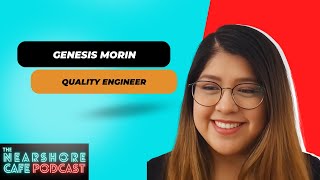
In this Nearshore Cafe episode, host Brian Samson interviews Genesis Marin, an experienced QA professional based in Monclova, Coahuila, Mexico. Genesis shares her eight‑year QA background and details her journey securing a U.S. remote role through a Latin‑American recruiter. She describes the clear recruitment pipeline—LinkedIn outreach, English‑language communication with the recruiter, a technical assessment, followed by team‑lead and management interviews—all completed within roughly two weeks. Genesis highlights the cultural differences she perceives between Mexican and U.S. teams, noting more open communication, less micromanagement, and stronger mentorship opportunities. She explains the onboarding process, receiving a brand‑new laptop, mouse, and headphones shipped via Amazon, and the daily tooling stack: Microsoft Teams for primary communication, Slack for regional groups, Jira with qTest for test‑case management, and testing tools such as Swagger, Postman, and MySQL within a two‑week sprint cadence. Payroll is handled through Plug’s Deal platform, where she logs hours on a timesheet, receives monthly direct deposits to her Mexican bank account, and manages her own taxes and health insurance with the help of an accountant. Genesis advises other Latin‑American talent to embrace English, be confident about language gaps, and appreciate the supportive U.S. work culture. She also shares personal details—her culinary arts background, family life, and how remote work enables flexibility. The episode closes with thanks to sponsor Plug Technologies, which connects Latin‑American talent with U.S. companies.
Chapters
Welcome everyone to another episode of the Nearshore Cafe podcast. I'm Brian Samson, your host, an entrepreneur who's been working in Latin America for a long time. And today we've got something special. We haven't quite dug into the perspective of the candidate going through the hiring process here in Latin America, working with the US. So if you want to hear What does it mean to get interviewed, hired, payroll, all that stuff? This is the episode for you. Uh, we'll be talking to Genesis in just a second. I want to thank our sponsor, Plug Technologies, plugg.tech. Plug is the way to find great talent like Genesis all over Latin America. Genesis Marin, so great to have you on the show today.
Thank you for having me. I love being here.
Genesis, let's start out. Um, what kind of, uh, work do you do and where are you located?
Well, I have been a QA for over 8+ years. I'm located in Monclova, Coahuila, Mexico. It's a very small town, but I love it here.
So for those that aren't familiar with that town, myself included, where is that like relative to Mexico City or just on the overall geography of Mexico?
Well, it's on the north side of Mexico. I will say it's 3 hours or 2.5 hours from the border near to Eagle Pass, Texas.
Oh, sure.
Del Rio. Yeah, it's very near the border.
Awesome. Now, have you been working with the US on past projects? Was this the first time that you'd worked for a US client?
No, I've been working for US clients, I think, 6 to 7 years.
Yeah.
But I do have teams located in Mexico. I think this is the first time that I've been solely on a team with, uh, US, um, teammates.
Okay. Okay, great. So what I think I'm interested in, and people from all over Latin America who maybe never even had a chance to work with the US before on a project, I think we're all curious on just your experience, like, um, especially with, with maybe this project to start, the, the one that you're on. Um, so I guess it was just less than a year ago, like June, July-ish that you got a call. Tell us, um, tell us a little more about that. Like, uh, the recruiter, the, um, you know, the interview process. What did that all, all look like?
Um, well, I was part of, um, a shortage on QAs in my project, my last project. So I was very trying to get a job. So LinkedIn, I was in all platforms trying to meet candidates for being hired. So I think I got a message from LinkedIn and we started the process there. It was a very clear process from the beginning. And for that, I'm very thankful because I was able to have, you know, the interviews, the assessments, having the talks with the client, which have been amazing till now. I love being in that project. Yeah.
Yeah. And so the recruiter, was the recruiter based in the US or Latin America?
I believe he is based on Latin America.
Yeah. And was the outreach, did you communicate in Spanish or English? Like how did that all work?
No, I, uh, well since his last name was a little tricky, I didn't want to, I, I wanted to play safe and he was communicating in English. I was communicating back in English, so the conversation was in English until one day I said, do you speak Spanish? Sí. Yeah, I do. Yeah. But I didn't want to assume because, uh, yep.
Yeah. You did the call with the recruiter and then how soon after did you talk to the client?
I believe it was a week after our first communication, cuz I did have a, um, you know, a chat on LinkedIn. Then we got in a call and after that I got an assessment. From— no, I think, yeah, from— I had— I got an assessment, and after that, uh, 5 days later, which was— oh wow, okay, yeah, I got a call with, uh, the team. I believe it was the team lead, and after that I got a call with, uh, management, but that was more of if they wanted to teach me about how the company works, you know, how friendly they were, and if I fit within what they could offer and I did.
Yeah.
Very, very, uh, open, open and, and they're until now, I really enjoy talking to them.
That's great. And, uh, what were some of the things that maybe you were considering? Cause I'm sure, you know, there's all sorts of opportunities out there. There's, you know, you can work with domestic companies in Mexico, you can work with certain US companies, big ones, small ones, tech companies. Some pay in pesos, some pay in dollars, some have healthcare, some have all this stuff. So, you know, what were some of the things that were maybe important to you when you were contacted?
To be honest, the work environment that the US provides. I've been working with Mexican companies before in Latin American companies, and sometimes I felt that they were kind of like micromanagement. And on the US teams, I do feel like you can raise your hand, ask questions, you don't get judged. And the light of that, you can talk, you can make jokes, that it feels more like a team. And that's what I enjoy working with the US. If, um, you get called out, but in a better way, like, why you can improve this side. So I really enjoy working with US teammates.
Yeah. So maybe you're thinking it can even like accelerate your career because you're getting more feedback. You can improve. Yeah.
Yeah. Yes. And I feel that on the technology-wise, They do too. I mean, if you don't know something, they could, uh, put, you know, a shadow on you on someone that could teach you, or, you know what, um, let's talk to someone that you can be working with that person one-on-ones and the knowledge is shared.
Yeah.
Yeah. With no hesitation.
And then Genesis, uh, how about the, the hardware situation? Like, did you use your own laptop? Was something shipped to you? How did that all work out?
No, I got provided with the equipment and that was fast too. I was supposed to start in a day and I think 2 days before I started, I got my computer since I got the email that the laptop was coming and it was a brand new equipment. It got delivered by Amazon.
Oh, cool. Okay. Yeah. So for those in the US that maybe are curious, yeah, Amazon works in Mexico. Yeah. Just like just like the US?
Yeah, I got provided with equipment and it was a laptop, a mouse, headphones, and I believe that's it. Yeah. Yeah.
And how about some of the software that you're using day in? Like, are you on Slack or Jira? You know, what else, what else are you using?
So for communication, we use Teams. And we also have a communication with our Latin America groups with Slack. And for management, we use Jira with the plugin on qTest. That's where we upload our old test cases, evidence, bug reports, PCPs, that are called a post-checkout for production. Yes. So, uh, everything is managed there. And on technology for testing, we use many, many, um, we use Swagger, Postman, MySQL, and yeah, uh, UI, um, testing, backend testing. Yeah.
And are you working in like a sprint, like a 2-week sprint structure, or how, how does that set up?
We are, but sometimes they get delayed, to be honest. That never happens in any team, right? But we do. We are on a 2-week sprint and we also have, it could be Wednesday or Monday. Monday we get production support just to verify that everything's working correctly.
Awesome. And then let's talk about just getting paid. So I'm sure people have questions, like especially if they've only worked for a domestic company in Mexico and they've gotten paid in pesos, how are you, like, what was your process? And like, what's different? What's the same that you might think about for someone who's never done this before?
Um, well, since you get paid in, uh, we use a platform that's provided by Plug and it's called Deal. It's super cool. You get to enter all your details there. Uh, and also we need to use a timesheet, um, yeah, timesheet platform where we upload the hours that we worked. So we are, we need to be very careful on how much, how many hours we upload there because according to that report, that's how much you get paid. Uh, I get paid monthly and I use that platform. You put your Mexican account or, you know, uh, the information and it gets, uh, directly deposited into our Mexican accounts. Um, since we are not, uh, based on Mexico, we need to pay our own, let's say, health insurance, our own taxes, which since I've been working this kind of way for long, I do have our accountant that's really helpful, so I don't have to worry about that.
Yeah, okay, good. Sounds a lot like in the US there's a lot of independent contractors that do the same thing. They have to take care of their taxes and their healthcare. But I think people tend to do it this way, and at least in the US, because they can make a little bit more money this way. Was that a consideration for you?
Well, since it's been a while, to be honest, I really didn't get that. But my husband works in a Mexican company and it's way easier for him, I will say, because he doesn't have to worry about anything. Every paycheck he gets, the taxes reduction and everything. But as I mentioned, I have a great accountant that helps me with that. You do get to provide kind of like an invoice just for that purposes. But yeah, we are pretty accommodated. In that area.
And then generally speaking, um, so you, it's the last day of the month, you've got your timesheet, your invoices. How long does it take to hit your account?
Well, don't wanna brag, but the guy that's helping us right now, he's being really fast. So we get paid within the first 2 to 3 days.
Oh wow. Okay. Okay.
So we used to, yeah, it used to take longer, like 5, 7 days, but right now it's easier. It's way faster. So thank you. Cool. Awesome.
And there's a lot of people who are maybe interested in like dipping their toes into this world of working with the US and these nearshore recruiting companies are becoming more popular. They're just like the US is learning about Mexico and the rest of Latin America. There are Latin America talent that are like kind of peeking their head. Ooh, I think I might want to try this too. Um, do you have any advice for them? Like, what is your top 1 or 2 pieces of advice for those that are doing it for the first time?
Um, well, I will say, um, the language barrier. Uh, I can promise you, if you don't know a word, the team will never or Americans don't tend to, US citizens don't tend to laugh that you say a word that's not the correct pronunciation. I will say, get a chance. It's, I mean, you get, you may be surprised. I really enjoy it. You know, the technology sometimes are different. The teams are amazing. I don't know. I really enjoy working here.
Yeah, that's great. And just some fun questions. What do you— you mentioned your husband. What do you and your husband like to do on weekends?
So I have a bachelor in culinary arts, so I bake all the time. Yeah. And we used to go to the beach very often. Now that we're living here, we like to go to the park. We owned two dogs. Yeah, it's a French bulldog and an English bulldog. So, yeah, they're getting fat, so we need to take them on walks. They're really pretty. But, yeah, we also have three kids.
Oh, wow.
Yes, our hands are full, but we cook, we watch movies. Travel a lot too. So being able to work, um, in, in this team has also helped me because since it's remotely, I can work from wherever I can.
Yeah, love it. Love it. Fantastic. Well, Genesis, thank you so much for being so generous with your time and sharing your perspective and experience of what it's like being, uh, uh, technical resource in Latin America and working with the US.
No, well, thank you for having me. It's really nice being here.
Good. Well, again, let's thank our sponsor Plug Technologies, plugg.tech. Plug connects great talent like Genesis to growing US companies. Thanks again for watching the Nearshore Cafe. Thank you, Genesis. Have a great day, everyone.