The Nearshore Shift: How LATAM Became the Future of Global Staffing | The Nearshore Cafe Podcast
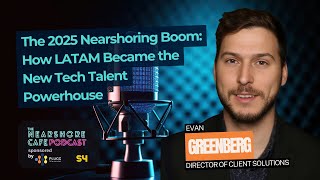
Brian Samson talks with Evan Greenberg from Plug Technologies about why companies are moving hiring to Latin America. They cover H-1B fee changes, surging demand for AI and data roles like prompt engineering, and how to spot fake resumes when vetting candidates.
Chapters
Welcome to another episode of the Nearshore Cafe podcast. I'm your host, Brian Samson. Before we get into this episode, let me thank our sponsor, Plug Technologies, plugg.tech. Great way to connect. Latin America talent with growing US companies. If you want to know what's trending right now in the world of staffing, Latin America staffing, nearshoring, AI, H-1B visas, this is going to be a great episode for you. We've got Evan Greenberg, also with our sponsor company, Plug. Evan is the director of client solutions. Evan, great to see you again. This is your second time on the show.
It is. Thanks for having me back.
Absolutely. Well, you are in it. You're talking to customers all day, prospects all day. Uh, you're reading, you're right on the front lines. Tell us about 2025. If you could kind of sum up, we're almost 10 months through the year. Kind of sum up like what did the staffing industry feel like this year? And then, uh, I'll also get into later what you see coming down the road, but let's just kind of look, look, uh, at the past for a minute, the last 10 months. How would you summarize that?
Yeah, sure. So definitely, uh, feel like there's a huge shift to Latin America. Again, we, we hear it every day, every week. In terms of companies really being attracted to the talent pool, attracted to time zone overlap. Um, companies really want people that are going to stay longer. Uh, really attracted to the idea that in Latin America, I feel like people are a little bit more loyal and, you know, that's definitely a big thing. I would say there's a huge shift from companies kind of going from India to Latin America as well for all different types of jobs, but definitely kind of see that as well.
Yeah. I see that too. See, there's two things that I wanted to hit on a little more. You talked about the loyalty factor and I agree tenure seems to be a lot quicker in the US, you know, we're only a few years removed from quiet quitting. Employees are constantly looking for new things. Also, you know, unemployment rate is still relatively low in the US. That means that recruiters are constantly working hard, you know, to poach talent. Tell me more about loyalty in Latin America. Like what, what contributes to that? Why are, why is the talent a little bit more loyal than they might be in the States?
Sure. Again, from my conversations and my experience, it just seems like people are a little more dedicated, super hardworking. Again, we, we recruit across many different countries, mostly Mexico, Brazil, but yeah, just seeing a lot of, just seeing a lot of people kind of just being more loyal than I would say US talent. Um, and maybe other places as well. I would say one other thing, uh, in terms of kind of trends this year, um, and maybe I'm kind of getting ahead, but I'll mention it kind of the whole like build, operate, transfer model. A lot of companies are wanting to secure like office, uh, office space in certain countries, but they don't want to handle compliance, payroll, and tech setup. That's becoming more popular. A lot of companies, you know, may, you know, have a huge operation, but they might want an office or something to have an entity and kind of scale up. And that's actually kind of a new offering for us just because we've seen a lot of interest in that area.
Yeah. Do you see, I mean, the optionality, I think of that is really key for companies. Do you see that as more of a larger company? Request or are small startups looking at that as well?
Yeah, I think, I mean, I think it can be both. We definitely, we definitely see a lot of, for, for larger companies, they may already have an entity or they might have multiple offices in Latin America or in a country. For that small and medium, you know, they may only have operated in the US, maybe UK, and they want to build, build out their infrastructure and people in Mexico, for instance. So it might make more sense for them. Obviously firms, you know, bigger companies might have multiple offices in one country. So like I said, they might be more down the path.
Yeah. Yeah, for sure. And then, you know, we, we also talked about, um, you know, we've talked about loyalty. We've talked about, um, kind of this trend towards nearshoring. Let's dig into that a little bit more. Um, are you seeing certain countries that are like more popular than others that are being requested and kind of why, you know, why, why is that happening?
Yeah, for, well, not for some reason, but for a good reason. Yeah, I've been in Mexico and Brazil recently. I feel Brazil, I'm going to touch on this a little later, but from Brazil's perspective, you know, 7 million people speaking English, 150 million internet users. Um, I think more than 16,000 startups. Obviously they're, you know, on a great path to being, you know, a tech powerhouse if they're not already, right? A lot of roles in Brazil are being, you know, kind of data, cloud, AI driven. So I think a lot of that comes from education system. I would say, I'll say one more thing would be the fact that, you know, companies are definitely kind of looking beyond, let's just say, you know, India and certain places in Asia. And Brazil also being in a similar time zone to East Coast and just the whole US, you know, makes it really attractive.
Yeah. Yeah. How about, how about for Mexico?
Yeah, I think for Mexico, similar. Obviously Mexico City, 25 million people, a really good education system, a really good university in Monterrey as well. Um, definitely makes for kind of that, that nearshore kind of hub, even, even in other places in Mexico, seeing a lot of talent in Guadalajara, even in the Yucatan, in Mérida, good talent as well. So yeah, I think that's, yeah, we're also seeing that.
Yeah, I wanted to, um, also dive a little bit into something that I think is on the minds of a lot of people, you know, as the Trump administration is revising the H-1B posting fee, which is essentially what it is, $3,000 in the past, jumping enormous to $100,000 H-1B posting fee. What does that mean? Like, what does that mean for staffing companies? What does that mean for India? What does that mean for nearshore? I'd love to get your take.
Yeah, no, I think it definitely, I think it changes the game for US companies to look elsewhere, right? Where traditionally maybe they're in India, other countries. I think it definitely opens the floodgates for Latin America because, you know, they can be, you can access talent much quicker, lower cost, same kind of cultural alignment and time zone, which I already mentioned. And I think it'll continue to kind of be a big thing, especially in the AI kind of data front where companies. With the boom of AI, it's just creating more data roles, data engineer, cloud engineer type roles. Um, so I definitely feel like that's, um, going to become more prevalent. Yeah.
Yeah. Well, let's talk about the conversations you're having with hiring managers. Uh, you know, first off, kind of set the stage for us. Are you talking to Startups, you talking to big companies, are you talking to engineering leaders, other roles? Kind of set the scene a little bit for us and then tell us what's on their mind, you know, what are they thinking about right now?
Sure. So yeah, I would say it's, yeah, it's a mixture of small to medium, some enterprise as well, but yeah, I would say mostly small and mid-market. Yeah, for us, a lot of here, the things that I'm hearing are frustrations. With when it comes to vetting taking too long, high turnover, project delays, things of that nature. Even in several cases, I heard, um, a head of engineering mentioned that he had a quota on hiring. So again, when you think about, when you think about that, you know, personal impact, it definitely kind of changes the game. So yeah, I mostly speak to CIOs, CTOs. Head of engineering types when it comes to software engineering jobs.
Yeah. Tell us more, like, what are they worried about? What are they excited about?
Sure. Yeah, I think the biggest worry is I would say wasted, wasted time almost.
Yeah.
Well, wasted time in terms of taking away their time from technical projects and kind of critical thinking about the business and having to spend, you know, man hours on recruiting, it's not something that maybe a head of engineering wants to spend 10 hours a week doing. So I definitely hear that a lot. I would say in many cases, companies want kind of the ability to like plug and play. So they don't want, they want someone that can come in that stays, that's loyal, but that can also mesh with their team. So I definitely have seen that as well. I would say another one, and we kind of already talked about it, but a lot of people are getting frustrated with time zone issues with South Asia. Um, and I keep mentioning it because it's probably, it's probably one of the number one things I hear. I probably hear it once a week, right? So from a, from a project standpoint, you know, you're missing out on hours and hours and hours because of misaligned time. And that's definitely a frustration. Um, I would say another one is not bad resumes, but resumes that also waste hiring managers' time. Yeah. So, um, I've seen that be a big one where, again, head of engineering doesn't want to spend X hours combing resumes and then figuring out that even in some cases, like fake resumes. And so having an extra layer to kind of sift through the resumes. Save them a lot of time is definitely something that I hear.
Yeah. Are you, yeah, I, I, I didn't realize this trend. Tell us more about the, the fake resumes. Is this 'cause of AI or like what, what's going on with this?
I think so. I mean, honestly, a client complained to me a couple weeks ago about it and they pretty much said that, you know, people are, even if they don't live in the US, they might say they do. So it's, so it's wasting time. And then there's all sorts of, you know, job scams and whatnot. So again, using a Stafflog partner like us, we kind of sift through that, just make it seamless for a, for a hiring manager to bring on talent.
Yeah. You know, and I think often companies don't calculate the cost of their hiring manager's time. Very, very, you know, correctly, um, they might just look at it like the true hourly rate, like their hiring manager makes $150,000 a year. So it's $75 an hour, but the opportunity cost of that hiring manager directing the team, moving roadblocks, creating a vision, QAing, dealing with executives. I mean, this is really like $1,000 an hour type work, right? That they're being pulled away from by dealing with fake resumes and all this other stuff. Absolutely. How does, how do you and the rest of the Plug team vet out some of the fake resumes, fake candidates to save that $1,000 an hour time?
Yeah, I think it comes down to attention to detail, understanding the client's job description, having multiple conversations with us before they even kind of get to the client.
Yeah.
So I feel like that definitely, um, yeah, that definitely fills the gap.
Yeah. Yeah. Creates a much tighter conversion, right? Of candidates that interview are much more aligned. So then it just becomes about culture and domain knowledge, not is this person in Sri Lanka really, but they're saying that they're in, you know, Minnesota or Mexico. Yep.
Right. Exactly. And then one other, one other thing, sorry, one other thing I didn't touch on earlier. One thing I hear a lot and seen a lot, uh, recently, um, with small to medium companies, even larger, is just, you know, the cost of an engineer in a major city in the US, right? I mean, on average, probably $150,000 to even $500,000 a year, right? In, obviously in Latin America, it's much less. But even beyond that, you know, the overall talent in Latin America is super strong with, with big hubs. Like I already, we already mentioned kind of Mexico City, Argentina as well, and Brazil. So just wanted to mention that as well.
Yeah. Yeah, for sure. For sure. Well, I mean, you've had a nice success story, um, in the recent months, uh, bringing nearshore talent to a client. Tell us more about that. Kind of set the scene. What kind of industry were they in? What kind of size are they? What were they looking to fill and what you did there?
Yeah. Yeah. Happy to share one. Um, of course I'll keep the name confidential. Yeah. I recently, um, worked with a cloud-focused tech firm, uh, out of the US, uh, West Coast. They were kind of building out their engineering team, so full stack. Frontend and principal engineer. Some things they were running into were kind of regional hiring blocks, I would say. So they were open to the idea of nearshore. They were also exploring Europe as well, but ultimately decided with nearshore. A couple of things that kind of stood out for them. Again, they, you know, were frustrated with some previous outsourcing issues. Most of them kind of Communication and time zone, I would say. I would say, um, I guess another thing was that, you know, lost productivity of, you know, waiting too long to hire somebody.
Yeah.
It was, was definitely affecting them. In terms of the value we brought, in terms of the value, you know, I would say a kind of rapid turnaround. I mean, we quickly, quickly made them a team of 2 to 3 in, you know, a matter of weeks, not months. Another thing that kind of stood out there, you know, we, we kind of aligned a job description from the get-go. That was really nice to, you know, not have any issues in terms of misalignment. Um, just kind of working together there. I would also say, again, some reasons kind of they picked us. Again, it came down to, it came down to, uh, the ability to, uh, you know, build a team quick, find really good talent. In this case, you know, we found talent in Brazil. They're very cloud-centric, like I mentioned, so they were looking for pretty specific kind of technical requirements. Again, with Plug, we don't, we don't have a bench necessarily. So we go recruit for each, for each role. I feel like that stood out because we found, you know, several excellent people. I'll say some other things that kind of stood out were the, yeah, just kind of listening to the client, right? For specific traits that they were looking for. You know, some things they were telling me were like someone that really shows initiative, being able to prioritize system design. you know, other things like that and just kind of throughout the process being able to, um, you know, find the right people for them and make them happy with that.
There's something that I wanted to dive deeper into what you just said, and that was they wanted engineers that showed the initiative. And I think maybe a common misnomer is, you know, engineers in the US kind of have the sense of urgency. They're self-starters. Once they kind of build the, build and architect the code base, then you throw it over the wall to people to like maintain it, right? And, um, but maybe that's not correct. Uh, companies are able to get self-starter, innovative engineers that can build things from Latin America. Tell us, tell us about that perception and, you know, myth versus reality.
Yeah, I think in this case, I think in this case it was interesting because they actually ended up going with, or they actually ended up picking engineers that were, I would say, you know, pretty young, right? But they were young, but they were self-starters, showed that initiative, serious about their work. And I feel like that was something that they really valued, right? So again, you know, a lot of companies may have, you know, 10 years on a, on a JD, but, um, I feel like, you know, in this case, they were really, they really knew what they were looking for and were open to, um, you know, really good young talent. Yeah.
Okay. Okay.
Good.
All right. Well, let's talk more about, uh, AI. It's on everybody's mind. It's not a new thing anymore. You know, companies are using it and they want to stay they want to stay current or maybe even ahead. What are they doing to make sure they've got the resources, they've got the talent, and how does nearshoring play into this, this arms race for AI?
Yeah, no, I think it plays a major role. Everyone's probably seen the OpenAI investment recently in Argentina, the $25 billion. I think that will only kind of increase the awareness of AI and kind of data jobs. Kind of moving to Latin America. I also think with the boom of AI, and I kind of mentioned this earlier, it's leading to a lot of kind of new, new titles. So like prompt engineer, even, um, there's all sorts of new titles kind of spinning off from AI.
Yeah.
I feel like, um, yeah, I mean, we see it, we see it every week in terms of, you know, I need I need an AI engineer. I need a data engineer. We're also seeing, you know, a lot of interest in, uh, you know, Databricks, Snowflake type roles as well. And that also comes from kind of the AI boom and just kind of more, more data, more eyes on it. Yeah. But yeah, with the AI boom, I definitely feel like it's, obviously it does take a lot of jobs, but it also creates a lot of jobs.
Yeah. Yeah. As we talked about, Evan, you're, you're a returning guest on the show. Last time we really dug into, you're a world traveler, you've been to a lot of different places. Is there any place that we didn't get into last time you were here that you'd like to share more to the listeners and maybe, maybe drive some interest over there?
Yeah, there definitely is. So I don't, I don't think I touched on this last time. We, we did talk about several countries and cities and whatnot. I wanted to talk about Oaxaca actually. So I went to Oaxaca a couple years back before I had a baby. And it was kind of funny how we stumbled upon it, but our, we were supposed to go to Mexico City and it was during COVID and obviously everything shut down. Right. Well, the hotel that I was supposed to go to shut down and opened up in Oaxaca. So I had this credit that I had to use like in a 2-year timeframe or something. Right. But then I started doing more digging on Oaxaca and, you know, I'm really into food culture, fan of mezcal. So we went to Oaxaca, right? We went to Oaxaca City. I just think it's a really underappreciated place. I think Oaxaca in general has, they speak like, I think they have 16 different like indigenous groups in Oaxaca, which is pretty interesting. I thought the food culture was amazing when we landed. I mean, I almost felt like We were in like a huge, huge city, but it was really Oaxaca City and it wasn't that big. I almost felt like I was in like a Miami bar, but I was in Oaxaca City. So yeah, I definitely, definitely recommend, uh, Oaxaca for anyone thinking about travel, you know, outside of Mexico City or Cancún. Just a great place. Really good, really good coffee as well. Um, but yeah, I just wanted to, wanted to share that. Okay. Cool. Cool.
Well, hopefully that inspires some people, maybe myself to go check it out.
I do recommend it.
Yeah. Any, any final thoughts, notes that we didn't touch on in the show that you want our listeners to know before we, we wrap up?
I think we, I think we touched on a lot. I mean, again, there's a huge surge of business kind of moving to Latin America. I mean, I've seen it like in my family, my wife works at a, at Lenovo, big computer company. They've had teams in Costa Rica for years, mostly on the sales side, but even HubSpot, they've had teams of customer success managers, salespeople in Colombia for a number of years as well. So I think it's no, I think it's no, I think it's no surprise that companies are moving. To Latin America, and I do think we'll see, you know, more of that moving into next year.
Good stuff. Well, Evan, thanks so much for your time here on the show. Summarizing trends, reviewing this 2025, looking ahead, some really great stuff. Thanks again to our sponsor, Plug Technologies, plugg.tech. Great way to connect talent all over Latin America with US companies. This is the Nearshore Cafe podcast. I'm Brian Samson. Thanks for listening.
More from Brian

From BPO Agent to Client Experience Manager: Ana Rodriguez on Nicaragua's Nearshore Talent

From BPO Agent to Client Experience Manager: Ana Rodriguez on Nicaragua's Nearshore Talent

Building Sales Teams in Mexico: Mario Oliveros Figueroa on LATAM Talent & Cross-Border Selling

From Automation Engineer to Data Platform: Victor Fernandes on Brazil Tech Talent

H1B Crackdown & The Nearshore Shift: Robert Bouchard (H1B Guy) on LATAM Talent | 🎙 TNC

Nearshoring Yourself; step by step to building an expat life in Mexico |🎙 The Nearshore Cafe Podcast

Scaling high-performing teams in Costa Rica staffing legend Doug Firestone on growing to 225 LATAM

How to Scale in LATAM? Navigating Currency, Taxes, and Labor Laws | 🎙 The Nearshore Cafe Podcast



AI in LATAM: How to Break Into Mexico’s Tech Market |🎙The Nearshore Cafe Podcast