Where Should You Outsource? Philippines vs Dominican Republic vs Eastern Europe 🌎 | 🎙 TNC
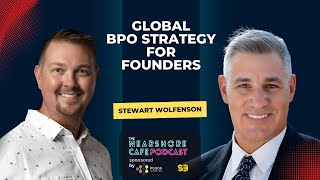
Stuart Wolfenson, a nearshore executive, compares outsourcing destinations: the Philippines excels at customer service, the Dominican Republic moves fast, and Eastern Europe focuses on tech. Latin America is becoming strategic for U.S. companies due to tariffs, time zones, and rising wages in India pushing IT work westward.
Chapters
Welcome everyone to another episode of the Nearshore Cafe podcast. I'm Brian Samson, your host. Today is going to be a great show to talk about nearshore broadly. There's a lot of trends, insights, and we're lucky enough to have a seasoned executive on our podcast, Stuart Wolfenson. Before I introduce Stuart, Let me thank our sponsor Plug Technologies, plugg.tech. Great way to connect talent all over Latin America with US companies. Without further ado, let's welcome Stuart to the show. Stuart, great to see you.
Great to see you.
As they would say in Latin America, we love, we love the bilingual opportunities here in the Nearshore Cafe podcast. We'll stick to English for the show because that's, that's most of our audience. But Stuart, you know, let me, let me maybe start here. We're lucky to have you on the show. Or like I said in the intro, veteran executive, seasoned leader, you know, in the space. Just kind of walk us through a little bit on your career journey. You know, a lot of interesting things, different places. How did you get to where you are today?
That's a long-winded question, but, but, you know, I grew up in being multicultural, multilingual, different places, and I always found that language was the way to survive and the way to connect. I was watching always my father sending telexes across the world, and I was fascinated fascinated, telex and how technology and information worked and you don't know these people and no, we've sent them a telex. So I would always send the telex and I had broken English, but she says, don't worry, stop, telex. And I knew I wanted to help build those connections and language was a key, knowing multiple. And I got into the BPO world because there was scale, speed, and lots of complexity, lots of cultural complexity. And I don't like things easy. If it's complex, if there's a hurricane, I'll swim in the hurricane. Found it fascinating how we could connect people from different places in a common task, common goal, common mission, which was helping a customer, helping customer have a great experience or solve a problem. And for me, was quite fascinating, but also found out that one thing was fascinating that you were around technology, but people were really the infrastructure, were what really matters. And that's what really stood out to me. It was all about people. I've always been a connector. I've always been a people person. And I was fascinated of what people can do to make a great experience, whether it's creating code, whether it's a call, whether it's data. It was always fascinating to me. Yeah.
Yeah. For those who, um, who don't know much about the BPO world, what does that entail? Is that customer service, IT, you know, that plus other stuff? Is it worldwide? You know, where is that moving? Can you give some more insight in that, into that world?
You know, I think it's a multiple choice question which says D, all of the above. I think what technology has allowed us is to really do multiple things and to support the mission of a company regardless of where you're sitting. And that's where technology came in. And I think BPO, it's a crazy business process outsourcing, but it's really Making business efficient through outsourcing. That's what I call it. And how have the power of people to make you more efficient regardless of where you are. You have different pressures, chart deliverability, cost, communication. It's very exciting because you can't put it in one box. It's not one sandbox. It's the entire beach, if I could put it in a context.
Yeah. What has your experience been in BPO across the world? What, what countries have you interacted with?
You know, I worked from Latin America to the Middle East to Eastern Europe to Pakistan and Philippines. So I touched many places. I touched many cultures and different takes. And it goes again, technology is technology, but people are your infrastructure. And people, we by nature, love to help and some cultures love to help more than others. And I think that's the most powerful thing about BPO work is that you're trying to solve a problem and people are willing to help.
Yeah. Yeah. Yeah. Um, can you help me think through the, like scripted versus the unscripted world of BPO, you know, and like the types of problems that come in and I'm sure it's often, you know, very similar, but everybody on the other end of the phone is a person. The customer is a person and they have different nuances and to their case and, you know, how, how maybe that's like thought through, you know, in, in, in the different countries you've had BPO operations.
You know, countries like the nature of the country will dictate sometimes the nature of the call or the nature of the task at hand. For example, the Philippines are very service-oriented. Dominican Republic, they're very quick, concussive, don't have the patience. So they might be better for something like an outbound sales call. And then you have places like in Eastern Europe that are a mix of all. They're very tech savvy, but it's culturally diverse and can really help grasp things quicker. And then you have countries like India, which is very task-oriented, in the box, in This is what it is. So, you know, I think script is very important, but I always welcome people who think outside of the box and who can really think things through. And it's not only the script.
Yeah. Where specifically in Latin America did you have BPO operations?
I worked a lot with Dominican Republic, Mexico, Brazil, of course. Even Brazil did, you know, I even, you can even do Japanese support from Brazil or out of Peru. So I discovered these things as a creative mind that I am always looking outside of the box and, and thinking about that. But, but I think Latin America, it's very well positioned right now to really be in a spot where it's going to make a difference, especially with things changing within the United States.
Yeah, maybe we'll, we'll hit on that for a second. Tariffs are on everyone's mind. Right now. We read about it all the time. Do you see that having an impact on the services sector?
You know, I always, when somebody tells me you can't do this, I always said, yes, we can. And it goes back to sí se puede, no? The thought of yes, we can. I think that things are changing, Taras, and there's a political change going on. And there's a lot of uncertainty. But it's also pushing US and European companies to change, to prioritize things and change things. And I think that's where, if you look at the Americas, I think that's what I would call it. I don't want to call it Latin America. If you see the Americas, I think it's becoming not just a trend, but more the norm because of what you saw, you said before, which is tariffs, political uncertainty that are pushing. And I think I'm a firm believer. I always been, and this is why I studied Portuguese in college, that Latin America is no longer the backup plan, it's the strategic plan.
That's really interesting. You know, especially as we think about China becoming more and more the adversary, right? And if you have a strong adversary, you know, maybe I'm going back 20 years of like, you're either with us or not. Right. And it feels like the Americas are mostly lining up with the US. You, I'd love to get your, your take on that of, you know, there will be winners and there will be losers, you know, and in the next 5, 10 years, and, and where do you see Latin America?
Well, you know, as a person who worked on the global space my entire career, I don't see China as an adversary. I see them as always as a formidable competitor that has helped the Americas not be, you know, United States has always had their back to Latin America. I think they now, they change and now they're facing Latin America and they're seeing the opportunities. And along with that, There's also geopolitical things that Latin America is a little bit more stable than it's been, and that allows— and China, on the other token, is also very unstable for other things, which is for the first time China is not selling as much as they used to. So China created, opened up the market in the Americas, and now United States is taking advantage of that. And I think if United States, if the leaders in the in the business environment see what the Americas have to offer. I mean, there's 3 vital things: cultural, time zones, language affinity. I mean, if you see those things, I mean, I could tell you stories on where, when that does not work. I really see that for the first time in a long time, the Americans can really support each other being the North America being supported by the South American market in many ways.
Yeah. And you know, when the economy is growing overall from a macro standpoint, there's somewhat of a rising tide lifts all boats, but in times of maybe stagnant growth, and I'd argue 2025 might be that time, there's really more of a India I see in the IT sector is losing to Latin America. So the IT sector is maybe stable, but Latin America is growing. That means that more projects are being moved from, say, India to Latin America. Do you see that too? Do you see Latin America, like, more work moving from other countries to Latin America?
I see 3 things going on. First of all, wages are increasing, so there's economic pressures with India. Also, there is internal pressures that talent is being moved, so there's, there's no longevity of people who are working on your projects from a technology perspective. I've seen it in the software side of the business where I see a lot of movement and people are not there as long to understand coding, to understand your business, to understand, to deliver. And also the geopolitical aspect that I think the Latin American or the Americas talent, it's much more focused on American needs, so understands very quickly what they're to what are, what is at hand, because many of them have been trained in the United States. Many of them come from that background. Many of them that have that cultural near, they feel closer culturally than any other one that I've seen in my experience.
Yeah. Yeah. Can you comment a little deeper on that, Stuart? When you say closer culturally, what does that mean to you?
Well, me, I'm bicultural and bi— I'm bicultural bilingual. So I'm the perfect example. I'm going to give an I know an interior design company that had for many years, all of their staff in the US. The pandemic changed everything. And I recommended that they move all of their operations and they try very technical architectural architects, engineers, and try it. I said, try it. And she was the person I recommended. She called me. She says, I couldn't believe it. The level of understanding, the level of adaptability, how culturally sound they were. I didn't know, I didn't think I was talking to them. They could talk up my time zones. They could, you know, all those things add value in what you bring to the table. So I think that's what I meant by saying I've seen it, I experienced, and I believe there's a lot of upside.
Yeah, I think that's spot on. I want to ask you, Stuart, you know, somebody with a lot of executive experience, you probably have worked with VCs, private equity, you track M&A activity. How is that impacting the world of nearshoring in 2025?
Well, I think there's a lot of— I don't think, I know there's a lot of cautious out there because of what's going on on the geopolitical side. And there's a lot of uncertainty. So the VC and private equities are very cautious. However, I think they're watching Latin America closely, especially in B2B services, health tech, and fintech. I mean, Monterrey is one of the biggest hubs for fintechs. They have over 200 startups. I believe those who are able to balance automation and authenticity are going to be able to come on top. Those who are bringing that sort of who brings the best mix to the table are going to be able to come on top, especially after the recent— I mean, if you're looking at the recent acquisition of Google by— of Wizz by Google, they're not located in the United States. So that tells you that companies are looking outside into the market. So I'm a firm believer that brings opportunities.
Yeah, I'm sure you get asked advice all the time, you know, and maybe I'm thinking a company post-acquisition that's integrating a US company, integrating Latin American team members or operations, absorbing that, what would be your best advice for creating a successful culture post-acquisition?
Respect the time zones, respect the cafecitos, honor local culture, lead by trust. Don't micromanage. Have a presence, but don't micromanage. But trust. There's great leaders out there in each country. I mean, each one of them, each region brings a powerful thing to the table. Colombians are very creative. Argentinians are very bold thinkers, think outside of the box. Mexicans are very entrepreneurial. Brazilians, lots of energy and trust and language. So you need to empower your local managers to really embrace holidays, build rituals, and that comes from a lesson, you know, before I moved back to this country, I was in Spain just to bring a personal story and I closed my biggest deal ever. On my last day at my last job, and I had a 2.5-hour lunch with the client. I said, why did you wait so long? He goes, I really needed to get to know you. So, you know, don't worry about closing the deal, worry about collaborate. And I think you, you'll have success.
Yeah.
Yeah.
I like that. I like that. Speaking of Spain, um, it got me thinking about how fortunate we are to have a guest like you that's so well traveled. And I know it's like picking your favorite child, but what are some of your, your favorite cities that you've been to across the globe?
Gosh, that's a great question. I'll give you, I'll give you 3 of my, of, of, of my favorite cities. Buenos Aires, of course. Great food, great wine, great people. I, I'm a beach person, so I'm gonna be biased. Madrid has an energy. It's New York on steroids. And I'm very Latin, but those are the two cities that stand out. And then Tokyo and São Paulo, because it's chaotic poems. It's chaos 24/7. There is some something about that chaos that it's very, it's like a poem. It's like a moving, it's, it's, I always said, I always use the analogy is like Blade Runner on steroids.
I like that. I like that. Tell us more about your time in São Paulo.
My time in São Paulo was crazy. You know, at that time we were opening up a multinational company. We were opening and the traffic was horrendous. So we would go and they, we would use helicopters to get from one place to another. That's, that, that's it. And of course, my favorite city of all is Barcelona, the pearl of the Mediterranean, along with Tel Aviv. Those are my two favorite cities I've ever been to. Tel Aviv is the only place where you can actually have watermelon on the beach while putting a business plan together and seeing of the next high-tech thing everybody's thinking of how we can to make things better. And Barcelona, I will never forget, at one time everybody was putting also business plans on the beach. And I said, and I would ask, and I said, and they would tell me that I was— use the story and say, why you're in the beach is because the future is straight ahead and I need to think of the future. I like that.
I like that. And then Stuart, I think in the pre-show you had mentioned something about Medellín. Can you share more about your experiences there?
Wow. You know, Medellín is very unique. The city with the best coffee on earth, brains, bandwidth, and heart.
Yeah, I like it. I like it. Good stuff. I'd be remiss if I didn't talk about your football, soccer experiences and stories. Can you share more about that?
You know, I've been involved with Real Madrid, probably the best sports organization in, in, in the history of sports. They are the global benchmark for business discipline. Creativity and values. Everything I do in life, I always think of what they have accomplished by having those three things: business discipline, creativity, and values. And I use that every day that I do things in everything I do. I learned so much. There's a book called— anybody who wants to get into the business and wants to understand business, there's a book I was part of called The Real Madrid Revolution, and it tells you a lot about the business of football and how an enterprise evolved, because it's very uniquely made, because it's not owned by a corporation or rich uncle or something. It's owned by the people and it operates like a business and it creates tremendous synergies and tremendous culture. It's not only one of my favorite sports entities, it's also one of my favorite businesses and that I've ever been involved with.
I like it. Good stuff. Well, Stuart, this has been as fun of a conversation as I was hoping, honestly more. I love the sayings, the personal experiences, the energy that you brought to the table. I want to thank our sponsor again, Plug Technologies, P-L-U-G-G. Great way to connect talent from all over Latin America to US companies. Stuart, I want to give you the last word here on the podcast because I know you have a favorite saying. Can you, can you bring it home for us with your favorite saying?
Because that's how you're all in, you know, in my life, I go all in my approach to life, work, partnerships, always is about collaborating and it's always about being all in.
Love it. Everyone, thank you so much for listening. This is the Nearshore Cafe podcast. We'll see you next time.
More from Brian

From BPO Agent to Client Experience Manager: Ana Rodriguez on Nicaragua's Nearshore Talent

From BPO Agent to Client Experience Manager: Ana Rodriguez on Nicaragua's Nearshore Talent

Building Sales Teams in Mexico: Mario Oliveros Figueroa on LATAM Talent & Cross-Border Selling

From Automation Engineer to Data Platform: Victor Fernandes on Brazil Tech Talent

H1B Crackdown & The Nearshore Shift: Robert Bouchard (H1B Guy) on LATAM Talent | 🎙 TNC

Nearshoring Yourself; step by step to building an expat life in Mexico |🎙 The Nearshore Cafe Podcast

Scaling high-performing teams in Costa Rica staffing legend Doug Firestone on growing to 225 LATAM

How to Scale in LATAM? Navigating Currency, Taxes, and Labor Laws | 🎙 The Nearshore Cafe Podcast



AI in LATAM: How to Break Into Mexico’s Tech Market |🎙The Nearshore Cafe Podcast