Why 60% of Tech M&A Deals Are Global | The Nearshore Cafe Podcast
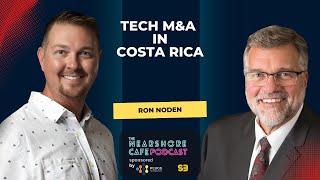
In this Nearshore Cafe podcast episode, host Brian Samson interviews Ron Noden, Senior Vice President of Tech M&A at Quorum, about the dynamics of technology and software mergers and acquisitions. Ron shares his unconventional career path—from teenage bumper‑sticker sales to senior buying roles at major retailers, to building nearshore sourcing operations—illustrating how early entrepreneurial experiences shaped his M&A perspective. He explains why Quorum focuses exclusively on tech/software firms, emphasizing that valuation hinges on product revenue growth and strategic fit rather than traditional asset‑based metrics. The conversation covers market cycles, contrasting cash‑heavy deals in up‑markets with earn‑out and stock‑heavy structures in down markets, and debunks the myth that recent valuation corrections dramatically diminish deal activity. Ron highlights that 60 % of M&A transactions span at least two countries, and argues that nearshoring—especially in Latin America and Costa Rica—adds value through talent depth, time‑zone alignment, and cost efficiency, without harming valuation. He offers founders concrete guidance on structuring teams, balancing core hires with nearshore or outsourced talent, protecting IP, and mitigating perceived risks. Ron also recounts personal anecdotes from his time in Costa Rica, describing the cultural vibe, talent quality, and lifestyle that reinforced his belief in nearshore models. The episode closes with practical ways to engage Quorum—email, website, and global events—to help founders navigate exit strategies, timing, and valuation realities.
Chapters
Welcome everyone to another episode of the Nearshore Cafe podcast. I'm Brian Samson, your host. Before we get into it, let me thank our sponsor Plug Technologies, plugg.tech. Great way to connect talent all over Latin America with growing US companies. If you're interested in the world of which is a very interesting topic right now. You are going to love this episode. We've got Ron Noden, the Senior Vice President of Tech M&A for Quorum, and his big focus is helping entrepreneurs unlock the value of their equity. And this is especially interesting as we looked at M&A across Latin America, across the US, services, staffing, all sorts of stuff. So without further ado, Ron, thanks for being here today.
Hey, thanks for having me, Brian. I appreciate it.
Ron, you've had quite the career as an operator, growing revenue, now in the world of M&A. Can you tell us more? Like, how did you get to where you are today?
You know, I, well, first of all, I don't know where I'm at today, but I think it's interesting, you know, I was very blessed to get an opportunity to learn how to do a certain thing early in my career. And in fact, when I was 13 years old, I had an idea and it created an opportunity for me to sell bumper stickers, you know, in the back of one of those cartoon magazines that they used to have these little opportunities. I actually bought one of those kits, pre-internet days. And my parents were involved with an organization that had a national convention. And I decided I was going to show up and sell bumper stickers to anybody that wanted to be affiliated with their local group and, you know, I made way more money than I expected. And I realized that the stickers took a lot longer to dry than I realized would've realized at the beginning. So some of those people had to get their stuff mailed to them, but it created an opportunity to really understand a lot about how to sell and deliver and do commerce. And I went on to, you know, work in retail at a young age and sell suits at a young age. And I became the youngest buyer at a regional retailer at the ripe old age of 19. I was going to school full-time, working full-time, and I got the opportunity to be a buyer, which is what I was going to school for, because I loved retail. And I worked at that company as a buyer. And then like a year and a half later, they fired like 2,000 of us. They decided to wipe out a whole bunch of people. And it was a great thing because I learned a lot. And I went through a series of things and went to another organization, learned some things. I became a buyer inside of another regional retailer. Retailer, and then one of the 3 largest retailers on earth called me and provided an opportunity to go there and become one of the youngest buyers that they'd ever had. And that, that was exciting and fun. And when I got there, they had a fantastic business. They had great systems and I'm involved with toy buying. But they didn't have a really particularly brilliant way of doing the allocation and distributions. And one of my coworkers had some really great ideas and we kind of looked at ways that we could make that maybe a norm of the company. And so I brought that to the attention of some folks in the technology area and they gave me the bum's rush. And then I figured out that it would probably was going to save us somewhere between $15 and $20 million a year, just in markdowns in my department.
Incredible.
And yeah, so I learned BASIC. I got that day. It was a Wednesday. I went. Home with a kit that I bought from, I think it was B. Dalton, if I'm not mistaken, how to write BASIC. And the next 5 days I learned how to write BASIC. I actually fell asleep at my desk on Saturday and slept in my office accidentally. And I created a 20-store example and dropped it with my boss in tow behind me, dropped it off to the technology folks on Monday and said, you know, with my massive amount of experience, 5 days of writing in BASIC. I could do it for a 20-store sample with multiple distribution points. You guys with all your smarts should be able to do the same thing. And so a year later we had that system, a little less than a year later. And that was encouraging, especially the fact that they kept the guts of that system for the next 2 decades. So it was a very exciting thing to see, but it gave me an understanding of what technology can do and how it can drive a business and how it can change things and how it can really level the playing field. In situations where otherwise it would be very difficult to do. I then went on to, you know, I worked there considerable amount of time and then I really understood that I wanted to be on the other side of the coin. When you're at one of the largest retailers on earth, one of the things that happens is the people that call on you are some of the best in the business at selling. And so I got exposed to, you know, the president of Mattel was our rep, or, you know, the, you know, crazy to think that you have that kind of access. So, It was interesting and it was fun and I learned a lot. And I ended up going into an organization and deciding that I was going to be involved with marketing and sales. And I grew as a salesperson, then as a sales leader, and then I kind of blended that with that technology background and took a very entrepreneurial approach to things. So I ended up growing and fixing companies and spending my time on the rev-gen side, but always in tech companies. Always, you know, IT consulting firms, nearshore sourcing, software firms, you know, a lot of different tech-based firms. And I got a nice rounded experience by doing that. And, uh, and then, you know, about, I don't know, 5 and a half years ago, our company that I had gone to, we had some massive growth. We had two great years that I was there. Uh, first year we had 32% growth and we were on track for 101% growth the second year. And we sold the company and the company that did the transaction was Coram. And I realized how brilliant they were at their approach to doing it because until you've sold a company, you don't know how difficult it is to run a company while you're selling the company. It's a lot of work. And so I had a great appreciation for what they did and magically wasn't much longer after that, after I completed my tour of duty to do the transfer, and I did a little bit of soul searching on what I did want to do. I ended up at Korm and I, uh, I've really come to love doing what I do. So that, that's kind of a roundabout way of getting there, but that's, that's my background.
Yeah. Tell us a little more about, you know, there's all sorts of companies that are looking to exit, all shapes and sizes. Is there a particular area that you're focused on?
So the company I work for, Korm, is all tech software. It's, we don't, deal with anything except tech and software. And part of that is because software firms are often misunderstood from a valuation standpoint, and certainly from an understanding of how to get the best possible transaction. So a lot of times organizations, you know, that maybe are more brick and mortar or have a facility and they have assets that are heavy and, you know, they have different ways of valuing that. In software, it's really about the product itself, the revenue that you drive and how that grows. So I focus on a lot of software firms. I do work with a lot of IT firms because I have a lot of background with IT, particularly not just IT, but nearshore sourcing-based things. It's kind of difficult to put it into one little pin because sometimes it's a fintech, sometimes it's a really cool product that hits a certain type of technology. Just depends on the situation, but tech companies in general intrigue me. They're interesting. And I think they really are different than other businesses and need to be really handled by people who get it.
Yeah. Ron, do you, do you focus on firms that have already been VC funded or more bootstrapped and they've reached a certain size?
So, you know, we do both. We've done all kinds of variations. There's other versions of that too. But, you know, sometimes when you do a VC route, you end up, you have a bit of distance between the time you can do the VC route and get really an exit. That is, is where you want to be. And, you know, everybody expects to have a round that goes as an uptick, not a downtick. And so, you know, it depends on the situation, but we've done virtually any of those. Key on it really from an M&A standpoint is understanding the company, understanding what the financials look like, because the financials paint the baseline of the picture. And then what they do in the marketplace that affects how they operate, who they deal with, maybe some of the particular strategies or niches that they're involved with that really allow them to have a different kind of value based on who's buying them. And it becomes much more strategic. So you get the financial piece, we'll give you that baseline, but how they fit really drives the value up and is a more fair representation for owners of equity. So it's very important to understand that. And it's really important to have a team that does the research so you know which buyers are going to be most likely to be involved with that, what kind of thesis they have for their buying thesis for companies, and really helping them understand how it fits and can be a real value. Because the goal here is, you know, 1 plus 1 should equal 9 or whatever it is.
Yeah.
Yeah.
I was going to ask with your comment about up rounds and down rounds, you know, where only a few years removed from the Wild West of ZIRP and everyone raises with optimism, right? Nobody raises, very few people raise with pessimism. Most are raising with optimism that they're going to have a huge uptick in valuation. So we're a couple years removed now and I'm sure valuations have in many cases fizzled. And I'm curious what that means for M&A for a lot of these companies today.
Well, the market definitely cycles. You know, it definitely goes through ups and downs. And, you know, in an up market, the deals are much more cash-oriented. In a down market, they're a lot more structured with, you know, whether it's earnouts or stock opportunities or whatever it is. And a really down market might be all stock, and it might not always be the stock that's really got a lot of mobility. It might be something that's kind of landlocked. It might not even be public stock. So, you know, those things come and go. What's interesting is, you know, right now, even though there's a lot of geopolitical disruption going on, a lot of elements that are really potentially impacting, you know, the value of things in the marketplace, we're seeing unbelievable activity and the valuations haven't really suffered. You know, if you think about it, there's $4 trillion in the marketplace that doesn't have a home yet. And that's a, a boatload of money that's gonna go somewhere because nobody really wants to give that money back. Yeah. It's, so there's a lot of opportunity and whether the market is perceived up or down, there's always places where good companies that offer really good opportunity, they're gonna do well. They're gonna do very well. And so sometimes you think, oh, well, I'm going to time the market. I don't know that anybody can time the market particularly well. You might think you're doing it well, but I think the key is knowing what your value can be in a given market, taking the time to really figure out what's the possibilities for me now and get real data and real information. I always laugh when people say, oh, I'm going to go get a valuation done by an expert. And they know they go pay $50,000 to have somebody do a valuation. The truth is your company's worth what somebody who is knowledgeable and understands your space is going to pay for it. And the valuation sometimes that come back, sometimes very high, sometimes very low. All of them are really just not all that relevant as much as maybe a guideline. The CEO of our company. He actually wrote the majority of the information in a valuation textbook for software firms that's used in colleges all across America. And you look at that and it's a different kind of valuation. I think people get caught up with, is it upmarket? Is it valued for this? You know, the next round has to be this because the last round was this. In reality, in the real world, your company's worth what somebody will pay for it. And if I get a good baseline with financials and I can drive that up because of the strategic fit or the market fit or the company fit, we win. Everybody gets to win.
Yeah. How is, uh, the nearshoring element coming into play with valuations and M&A today?
So, you know, M&A is a, is a global, uh, exercise. 60% of the transactions involve two countries at least. And so it's, uh, it's crazy how that works. And when you, when you think about it, There's businesses where that can, you know, it makes a radical difference. I think the key with nearshoring that's to me interesting is a lot of times people don't realize the real value of nearshore work. Some of the facts that really stood out to me, especially with Latin America, what I noticed was there's really good work ethic. We can find unbelievably talented people and we can do it at a reasonable price and have reasonable margins, but more importantly, it's in the same time zone. And if you have people that can communicate well, you're in the same time zone or close to it, you're not producing a lot of things that you have to do over again tomorrow because you didn't have lifetime feedback. And, you know, I think the speed of feedback, the ability to be close enough to fly there that day is incredibly valuable. Those are really important things. In Costa Rica, where I was involved with a nearshore sourcing operation, it was, it was amazing to me. It had hundreds of people in the building and maybe 4 or 5 of them didn't have a master's degree. Wow. I mean, that was incredible, the amount of talent and the knowledge and the capabilities that existed. And it was such a joy to have people that love what they did so much that you know, they, they just couldn't let it go at being okay. They had to get it great. And so that was very encouraging. A lot of fun. Yeah. You know, that to me is value. That's gonna bring value.
Yeah. I wanted to ask, um, you know, for founders coming up today, software founders that are building their teams, do you have any advice on, you know, maybe some of them have, have reservations about maybe putting their IP outside their country or, if they think about it in terms of like, is it outsourcing or nearshoring and embedded teams and any advice on how they should think about that or, or properly structure their team or mitigate their risk or things like that?
Sure. Sure. Well, you know, first of all, again, we're in a global market. So I don't think you look at the lines of countries and continents with the same lens as we might have 30 years ago or 20 years ago, or even 5 years ago. So that, that's one piece of it. The second thing that's important though is, you know, in, in a great staffing arrangement, you might look at your core needs and say, you know, we, we know we always need these functions and we have the ability to hire to 60% or 70% of our peak, but it never goes really below that. And by really figuring out your strategy for how you do your employees versus your contracted work or your project work, it really allows you to make sure you don't overhire from your team. And then once you complete the project and you don't need those people, you, you've got people hanging around. You don't really want to get rid of them necessarily. So hiring to do projects, hiring to do work that's going to morph over time, that sourcing piece, whether it's inside the country, outside the country, is is always an interesting thing to look into and make good sense of. And then when you couple that with being able to do it in a way that you're able to improve the costs and in many cases improve the timeline for getting work done, that can be a really terrific way to grow the business and get some of that infrastructure in place that otherwise, you know, you just can't hire enough people fast enough to get it done and you certainly can't afford to, you know, do it at the level that sometimes we'd like to. So being able to be a little more pragmatic when I need this portion done, I'm going to go nearshore or outsource this piece. When I need this portion, I'm going to go do that. And maybe keeping more of your project management or some of your elements that you want to keep internal that are going to be consistent. But the strategy, a hybrid environment there really does work well.
Yeah. Are there any risks in terms of valuation or maybe upside that companies aren't thinking about that if part of their team is in a different country, and you said 60% of transactions have two countries. I'm going to guess maybe the initial thesis is I need to keep all my workers in one place because my valuation might be affected later. Are they thinking about that the wrong way?
Nobody cares about that. No buyer I know of cares about that. It's interesting. I looked at an org chart of a company that we're working with and, you know, they had 12 developers still working out of the Ukraine. There's the 12, here's what they do. Here's the functionality of it. Here's how successful they are. Why would you do it any other way if it's working incredibly well? And you know, we have another company that I worked with that's sourcing out of Latin America and they look at it and you go, they have 6 or 7 developers, whatever it was that are in Latin America. They got 4 that are over here in California and they got 6 employees that are sitting in Minneapolis and they got 3 that are sitting in Barcelona or wherever it was. And it doesn't matter where it is. What matters is getting the right talent, doing the the right things at the right time for the right price so that you get what you want built. And if I have that and I'm working through it and I've got, you know, a great team, I don't care where they are. If we're performing and hitting the mark and if we're able to really blow it out of the water in terms of the ROI that we get because we did it that way, you're going to be more dinged in M&A for spending money and not finishing and not having the right products and not being ready to go to market. And they're going to appreciate and they're going to see You know, wherever you have people, it's really not a factor. It's, is it working well for you and is it efficient and effective? Yeah.
Ron, I want to go back to your career in Latin America, in particular Costa Rica. Can you dive a little deeper there? And if there's any stories you want to share?
Well, yeah, I'll try to keep them clean. Um, there's, I love Costa Rica. First of all, I have to just tell you, I love Latin America, but I particularly love Costa Rica. Spent a lot of time there, spent a lot of time on the coast, really beautiful. And I worked for a nearshore sourcing organization, both as a consultant and then as a board member. And, you know, it's interesting to me just the level and quality of people we were able to attract and the level of finishing kind of that they just, things got done well. And I always appreciated that. There was kind of something kooky though that The first couple times that I showed up in San Jose and I walked into the building, culturally, they want to come greet you. So, you know, if you have a few hundred people working there and they all get up from their job and come stand in line to come give you a hug, it could really cut into productivity. So I started, when I came in for the first time during the week, I started coming in early in the morning at 6 or 6:30 or 7 in the morning so that I wasn't disruptive, but it was always entertaining. And that particular company, they had a great American staff and they had a great Costa Rican staff and they did a lot of pitch and catch work where you might have one person working in the US and they're coordinating with a whole bunch of people that are working in various places in Latin America, but you ended up with a very connected team as a result. Because of the time zone capability, it was really added to that function as well. So I love that aspect of it. The other thing that's interesting, and this is kind of, I think, one of the things I really liked about and always have liked about Latin America in particular, is it has a little bit of a vibe to it that, you know, from a personal standpoint is very enjoyable. The people that I've run into and been exposed to, some of the best people I've ever met in my life, and that makes it entertaining and fun. But what I found was as we started to find people that really fit us and talent selection is everything. And if you have a team that can help you really pick the right talent and the right temperament and personality, it really makes all the difference in the world. And what I found was they were hiring people who really understood the goals we had and really understood how we wanted to approach things. And as a result, you know, every day was just fun to go into work. It was fun to, to work with the folks we had. It was fun to go do each of those things because you're dealing with knowledgeable people who really want to be successful. And their idea of success is, what do you want me to do? That's a really phenomenal vibe. And, uh, I didn't experience that in a lot of areas that we did sourcing from, uh, that weren't in Latin America, frankly. Yeah. Yeah. It's kind of cool.
Now, Ron, you've, you've had such a great experience in Costa Rica. You, Got a place there.
Yeah. Yeah.
Uh, tell us more about that, how that came to be, where you ended up and, you know, daily life when you're living there.
So yeah, we, during COVID we actually bought a place sight unseen based on a transaction that took place in the company we sold. Beautiful, just a stunning view of the ocean. It couldn't be prettier. One of those things where, uh, we bought it sight unseen just off of pictures and videos and we showed up and we're standing on the balcony. And if you can imagine this 38-foot-wide balcony and about a 175-degree view of water, and you've got the Gulf of Papagayo on this side and the ocean on this side, and it's just stunning. And in the background with my telescope, I can see Nicaragua on a clear day. And, you know, we stood there on the deck and it just took our breath away. Really just stunning. And then over time, what we got to realize was that even more enjoyable were the people that we met there. You know, there were Costa Ricans, expats from Canada and the US and all kinds of places and just an enjoyable environment to be in. And the vibe in the country is not driven off of daily political disruption. Like you get some places that rhyme with US and it just, there's, you know, we just would tune out to that. I'd read up about it, but I didn't fixate on it. And you know, you're working away and they get up at, uh, at, you know, from your work at noon and you take 45 minutes break to go swim in the sun and enjoy the 85-degree weather, have a little light bite and go back and work 5 more hours. Not a bad life. Just a beautiful place to be. The other thing I think is fascinating, this is the other thing I think is great about Costa Rica and really a lot of Latin America is I find that the people that I run into, there's a richness of character and there's a richness of kind of origin, if you will. And so oftentimes they bring different perspective than I might have and they ask different questions. And I noticed this when we were in the nearshore sourcing world, that sometimes their view of it forced us to think a little differently and it became a little bit more wider in our thinking than maybe typical Americanized thinking. And I found that both personally, but I also found it from a business standpoint and it made us better, frankly.
That's Ron. If, uh, if anybody listening wants to learn more about you, connect with you, learn more about Quorum, what's the best way to do that?
Well, there's, there's a bunch of ways you can do that. Probably the easiest way is, um, it's very simple. It's ronn@quorumgroup.com. It's a very difficult email. That's probably the easiest way. If you go to quorumgroup.com, you can see our website that we have, the company that I work with. Nobody's sold more technology businesses on earth than them. And it's a great operation. We have lots of researchers, love to talk to anybody. It doesn't mean that we're going to be involved with you. Happy to guide you where you need to go to find the right information. One of the things I was going to mention to you, Brian, and I don't know, you know, sometimes people wonder, you know, what's the best way to approach what I want to do with my business. Do I want to, you know, I want to sell it now? Do I want to wait? Do I, am I going to try to market time? Do I want to sell part of my business? Do I want to take some money off the table, get some more money? There's a lot of questions that people have. And, you know, one of the best ways you can really get through that is to get real good information, real solid information. We put on hundreds of events every year. We do several, I think 300 live events a year at Quorum. And we just completed a series of those in India. We have them all over the world. And you know, that's one way you can learn a lot is go to that events page on that quorumgroup.com and find an event that you think will be valuable and, and go check it out. There's a lot of great information you can get for no cost, just a little time investment, and it'll really help make you smarter on what you're trying to accomplish.
And that's great. Ron, thank you so much. This has been a really great episode. I personally learned a lot about the 60% of companies that do a transaction are in 2 or more countries. Blew me away there. Yeah, that's, that's so interesting.
That's amazing. We're in a global market. The other thing that's interesting to me, you know, before we go, I wanted to share with you, I love the, you know, the sponsor is Plug. I love the concept of no matter where the talent is, find the right talent. And make the pricing reasonable. And you know, that, that to me is like the secret of figuring out how to grow businesses without breaking the bank. And so I'm intrigued by what they're doing.
Appreciate that. Thanks, Ron. As Ron said, we'll thank our sponsor Plug Technologies. That's plug.tech. Great way to find talent all over Latin America, connecting with growing companies. You're listening to the Nearshore Cafe podcast. Thanks again to our guest, Ron, and we will see you next time. Take care.
More from Brian

From BPO Agent to Client Experience Manager: Ana Rodriguez on Nicaragua's Nearshore Talent

From BPO Agent to Client Experience Manager: Ana Rodriguez on Nicaragua's Nearshore Talent

Building Sales Teams in Mexico: Mario Oliveros Figueroa on LATAM Talent & Cross-Border Selling

From Automation Engineer to Data Platform: Victor Fernandes on Brazil Tech Talent

H1B Crackdown & The Nearshore Shift: Robert Bouchard (H1B Guy) on LATAM Talent | 🎙 TNC

Nearshoring Yourself; step by step to building an expat life in Mexico |🎙 The Nearshore Cafe Podcast

Scaling high-performing teams in Costa Rica staffing legend Doug Firestone on growing to 225 LATAM

How to Scale in LATAM? Navigating Currency, Taxes, and Labor Laws | 🎙 The Nearshore Cafe Podcast



AI in LATAM: How to Break Into Mexico’s Tech Market |🎙The Nearshore Cafe Podcast