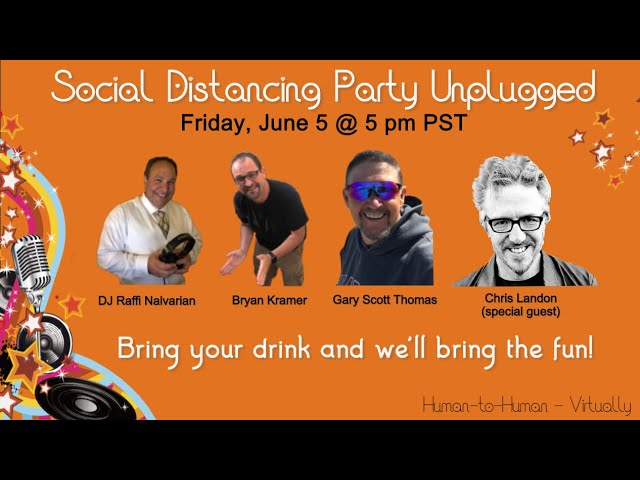
Social Distancing Music Unplugged 07/10

In this July 10, 2020 livestream titled “Social Distancing Music Unplugged,” hosts Bryan Kramer, Gary, and Rafi converse in a relaxed, radio‑style format while featuring teenage pianist Andrew Vieira as the musical guest. The show opens with light‑hearted banter about Fourth of July fireworks, pandemic‑era cardboard disposal, and holiday shopping, then shifts to a plug for Bryan’s newly launched podcast “Humanly Possible,” which he describes as a series of short, actionable conversations about making small shifts during an overwhelming pandemic. The hosts then introduce Andrew, who shares his musical background: he began piano at age 7, started with classical training, and transitioned to jazz after a teacher introduced him to the genre. Andrew discusses his learning method—ear‑based acquisition, the challenges of translating listening into playing, and his current work on an original smooth‑jazz piece. He performs a Charlie Parker composition (“Yardbird Suite”) and previews his original track, demonstrating improvisation and arrangement choices. Throughout the episode the hosts intersperse personal anecdotes (cardboard cutting, a banana skateboard story, memories of music teachers) and reflections on talent, practice, and the value of music in their lives. The conversation remains informal, supportive, and occasionally humorous, ending with gratitude to Andrew and a promise to feature him again.
Chapters
Da da da da da da da da da. Ya da da. That's I
didn't know we got a new musical thing.
Yeah, that's the intro.
Really?
Yeah, yeah. I had it done this week.
Really? Beats whistling. I guess that.
Even I can do intros, outros. You can pay me to do all kinds of stuff.
Hey, we're back. Happy, happy Fourth of July late to you all. Thanks for the— thanks for letting us have some time off. It was wonderful.
Did you see any fireworks?
Yes, I went to Idaho. I was in Idaho Falls.
Wow.
And there is, there is a lot of fireworks in Idaho Falls. And my kids got to set off some fireworks, which were fun, in a safe environment with adult supervision.
Not me. What kind of fireworks did they set off?
Uh, well, they had all kinds because it's Idaho, it's not California, so we have a hard time relating, right? Uh, so they had— there were sparklers, but there were swords. I mean, literally were swords as sparklers.
Wow.
And then there were the bottle rockets, there were the Roman candles. And then now they didn't fire it off, but the adults did. They had the big mortar shells that come in a box and then they go up and, you know, do like fireworks do, professional-grade fireworks.
Yeah.
So It was, uh, it was really good. So yeah, that was, that was fun. And, uh, it was—
I lit a firework once and I haven't done it since because it went straight up my pant leg. And in, uh, 8th grade, and it like just like grabbed onto my leg and then just went straight up and I had to pull the thing out. I was like, ah, this is not good. So, uh, I haven't done fireworks since then.
If you know Focker, you know that is a true story, folks. We're we're not telling you something. We're just not making it up. That is a true story, because that's what happened. This is reality. You know what else is reality? Our third screen is blank.
It truly
is Christmas in
July. Hey guys!
King Rafi,
you know, let me just say for the record, I mean, seeing that we don't have even a summer left, we may as well just start getting ready for Christmas.
You know, I was sitting here, I had a conversation with a friend of mine today where I said the same thing, that I have— that I am— I am literally done with summer. I mean, I'm going to enjoy summer and the weather we have, right? I'm just gonna— I'm gonna shoot toward Christmas now. And get my focus on that. And hopefully by the time Christmas rolls around, we'll have a little sense of normalcy and it'll be kind of cool. And, and that way— yeah,
yeah. I mean, you know what, what, what are we waiting for? I mean, we're, we're what, uh, 5 months away from Christmas?
And let's not forget Hanukkah.
And Hanukkah. Pick your, pick your holiday. But you know, I'm starting my shop as soon as we're done with the show. I'm heading out. I'm gonna start shopping. That's it. Just get right to it.
Wait until Monday and you can go back in the stores and all the other stuff.
Yeah, yes, it's a special kind of shopping, uh, this year. Yes, I think Amazon is gonna do pretty well.
You think?
I, I have literally— because I was out of town last week— I literally have, I'm not kidding, I— about a dozen big boxes My wife bought some furniture stuff, and you know how big those boxes come in? You know, like, like bistro chairs for the backyard and ottomans and stuff. I have that I'm gonna have to— because you have to cut it up. You can't even leave it out anymore, right? You have to cut it up and put it in the bin.
Yeah, so you can't leave it out anymore?
Uh, they haven't been— and we got a note saying that they weren't allowed to. Maybe with the new opening, maybe they'll start doing that, but for the last few months You can't. You can't leave it out. You have to put it in the bin. So you have to cut it up into small squares so it'll fit in the bin.
Wow.
And yeah, it's been
a lot of work.
Yeah. It sounds like it's it's been rough. Really
rough. The struggle is real. All I appreciate your thoughts and prayers as I cut up all that dim.
Richard, this is for you, buddy.
How you cut? Hey, uh, is that how you cut your cardboard, with nunchucks?
Okay,
I'm— I am waiting for the day that we're actually on the show and it comes back and goes—
Just hits me in the head, knocks me out cold.
Well, either that—
while you guys— while you guys are sitting in your homes, hey, it looks like Rafi got knocked out. Oh well.
Well, either that happens or you hit the computer. And that's gonna be like the best of all. I mean, it's gonna be like, okay, what do we do now? You know, people are— people are gonna be tuning in going, what is wrong with Rafi's screen? We're gonna be going, we had a nunchuck incident.
Yeah, yeah, a little incident, a little incident. You guys, can I just say I missed you guys last week? Can I just tell you that officially? Last, last Friday, I mean, we all took the day off, the day off, the weekend off to Celebrate our wonderful country, and but it was it felt a little strange not goofing around with you guys for an hour. It really did.
It did. This has become our history too. This has been part of our our lives since when did we start this March?
Yeah.
Yeah.
March of twenty of nineteen sixteen. It was a good year.
No, it wasn't. That was during the World War One. So it wasn't a good year. There were no good years in nineteen sixteen.
Wait, what year is this? Twenty ninety.
I
don't know when it was or how it is or when it's going to be anymore.
And I said this on the show the other day. Listen, this is, this is a year we should be able to return. No matter what age you're, you're 32, you get to be 32 next year too, because you didn't get to use this year.
You're right. This year is a complete and utter waste.
Yeah. So nobody sit back and tell yourself that you're a year older next year. When people ask you, what's your birthday, you go, um, 44.
38.
Yeah, weren't you 44 last year? Didn't use 2020.
That's right, it didn't count. Hey, can we say hi to our friend Joe Laguna out in Morgan Hill? He said it's, uh, hot as you know what out there. Uh, he's, uh, waiting for, uh, he's at the vet, he's waiting for his little Daphne to get the checkup. How about that? Very nice. Thanks for, uh, I did Joe's wedding a number of years ago. His dad's a big Social Distortion fan, so nice, uh, little punk rock segment for you. And, uh, Linda's joining us, Richard's here, uh, Amy, uh, Scarlato, uh, thanks for joining us. Just wanted to say hey to all of them. Well, we missed them all last week, so, uh, can I— can we just, before we jump too far into the show, we have a great guest on today, but I do want to say, can we give a little plug? Um, Bryan, can you give a little plug for your, um, podcast that you, uh That you just launched last week? I think it'd be really cool. I think people should check it out.
Sure, I would, I would love to. It's my new, uh, uh, I've been working on this podcast for 4 or 5 months now, and it's one of those things where you're never ready to go live with anything, so you just push the button and say, screw it, I'm going live with it. Um, and it's called Humanly Possible. It's about small shifts that creates big change. Our epic differences. And it's the thing that I'm focused on the most right now, which is especially with where we're at in the pandemic, there's— we're also overwhelmed. And you think you're not overwhelmed, but we're even more overwhelmed now than ever because there's so much that we think we need to be doing. And yet I think it's cool to actually chill and take a step back and slow down and just do one thing at a time. So that's what the whole podcast is about. And I have some really fun guests and things going on there. I'm trying to keep them short and sweet so people can listen to them, uh, when they can.
Yeah, I really enjoy— I really enjoyed your first one. So in— it was pretty amazing, uh, if you guys get a chance. So you've got through— how many do you have up on the site right now? Was it, uh,
I
think
you were about 4 out as of yesterday. So, uh, Rudy, uh, Rudy just came out yesterday,
right? I haven't listened to that yet. I just saw that. I haven't had a moment to listen to it.
Yeah, and that was a full circle moment with, with him that, that just made my whole, my whole year, um, regardless of who listens to it or not. That was just like one of those moments where you just sit down with somebody who made a difference in your life and you're like, I cannot believe I'm in the presence of this person right now. So that was a good one.
That's really—
I can't wait to hear that because you had told me after you'd recorded it, you said, he changed my life. And I'm like, okay, so when do I get to hear this? So I'm thrilled. But I'll be able to hear it. I'll listen to it today on my way to baseball.
There
you go.
Thank
you.
Way to go, Bryan. So congratulations on that. That's some really, really killer stuff, man. I mean, it's great to just— you know, I've known you for a while now and you always have something brewing. You're like this little, like, scientist guy who just always has something going on somewhere. Have you been like that your whole life?
Uh, yeah, yeah, actually I think I have. I think, uh, it's— I, I have ADD when it comes to just, you know, sit and, and, you know, as an, as an entrepreneur, if you sit back and do nothing, that's exactly what you'll get. So, uh, you know, you got to do something. And if you're going to keep your business going, it's not like clients are going to come to you because they just see you, uh, sitting on the sidewalk and you look like a nice guy. I mean, there's always got to be something that you're putting out there and you got to put—
Here's where I went wrong.
Gary, see, today your day has been made. You know what the path is.
I can't tell you how many hours I've spent out in that front yard just waiting.
That is a nice porch swing, by the way. I don't mean to take down your idea of the front porch.
I've been out there. I've been out there.
I've been on that porch, and, and, and I think it does, uh, qualify for a nice porch, but Maybe not a referral marketing system. I don't know.
Well, I can't wait to hear because I will tell you this, because I have actually been interviewed by Bryan and he is literally one of the best interviewers in the business. And I'm not saying that just because he's here. If he wasn't here, I would say that. I've said it all along. His ability to interview people, because the best thing he does is listen. And that's the hard part. You would think that'd be the easy part of interviewing. I do a lot of interviews myself. It's the hardest thing you do is to listen and truly hear what people are saying and not be thinking about your next question.
Yep.
Right. Yeah, that is hard.
So can we— do you want— Bryan, do you want to do the intros for our guests today?
I think you should. You, you, you know them pretty well. I'm gonna pass the baton back over to you.
Well, you know, I'll say this. Andrew's gone to school, uh, here locally with, uh, with our kids. All our, our kids, uh, here at Willow Glen Middle and Willow Glen High School. Andrew, I believe, is a junior this year. I think he's either gonna be a junior or he's going to be— no, I think he's going to be a junior this year. Um, and if I'm wrong, Andrew, you, you can punch me in the arm next time you see me. But, uh, Andrew's mom is also a, uh, a listener of ours and viewer, Tiffany. Uh, who always jumps in and has some great words of wisdom to share with us. So right now, let's bring out piano aficionado Andrew Vieira. Andrew, welcome aboard, buddy. How are you?
I'm doing great. How are you guys doing?
I couldn't be better. And let me just say for the record, Andrew, yesterday when I spoke to you on the phone, I'm going, there's no way this, this kid who's on this, this fine young man does not sound like he's 16 years old. You You, dude, you are beyond your years. I might— I'm just gonna say, I'm just gonna say, you, uh, you sound fantastic, and you just keep doing what you're doing, man. You're, you're doing a great job.
Absolutely. Thank you very much.
Um, and so you had a chance to chat with Bryan and Gary a little bit, and I know they tortured you a little bit, um, because that's what they do. Gary's very good at that. So is Bryan. And now, Gary, is it true you really were a French horn champion or something like that? Is that true?
Not that I was a champion. I don't think I could use that term, but I made the all-state band 4 years in a row, and I was only 2 people in my school who ever did that. And I'm proud of it, but to sit back and put my accomplishments next to Andrew's is crazy because that is What, what age did you start playing, Andrew?
I started playing when I was 7, um, so that, that is, uh, 9 years ago.
Wow.
See, the term precocious applies to Andrew because if you are precocious, you are absurdly talented at a young age. You are almost supernaturally talented at a young age. And most 7-year-olds— I have an 8-year-old Aren't doing that. They're not picking up music like that. Was it— was it— was it an easy pickup? Was it something that it just made sense to you the entire— because piano is a hard thing to learn. It is. It always just makes sense to you?
You know, it did. Just the way the keys are laid out in the order, it always felt natural, you know. Um, I've always thought about trying to pick up another instrument, and I've tried it, and it's just It doesn't feel natural for me. So, um, I, I would like to say I was kind of drawn to this instrument.
Well, I, I think, I think it's, it's so cool, especially if you have, uh— I, I think the piano just lends itself to so many things, and nobody ever looks uncool playing a piano. I don't care how cool you are, if you put a banjo in your hands, You no longer look cool, but a piano, you're there.
You know what though, can I just say to you guys, I mean, everyone, everyone on this is like a musician. Uh, Brian, you played tuba or, uh, saxophone? What was it?
You know, saxophone, tuba, they're just
I played the saxophone and then— yeah, so there you go.
Okay, see, you guys, you know what, you know, if I were like Andrew, I'd be like this guy who would want to learn all kinds of fun songs. I would love to learn like Motown and just some cool fun stuff like all the time. Andrew, do you find yourself doing that? Like, do you draw yourself like, oh God, this would be a really fun song to play? Do you do stuff like that?
Absolutely. Almost all of my learning is done by stuff I listen to, and then I just pick it up by listening to it. Yeah, that's kind. It's a it's a great skill to have, but it's also kind of a problem because then when you get something thrown in front of you, you know you can't always get it right away. You have to spend a lot of time because that skill is not as strong as the ear is.
So can you listen to something and go, oh, I can kind of go da da da da da da da da? I mean, are you at that level where you can listen, hear it, and go, I can probably play this part, no problem?
Yes, absolutely.
God, I wish I could do that. I wish I could just play an instrument. That's awesome. So can we have you play a song?
Yeah, absolutely.
So why don't you— what would you like to start with?
I'll start off with Yardbird Suite, a Charlie Parker piece.
All right, let's do it.
All right.
I would have— wow, so many more girlfriends. If I could tell you right now, because that's the way my mind thinks. You just let me walk. If I was in college and I could have just said, oh, excuse me, ladies, gone.
Have you ever, you know, Andrew, do you ever like go like down to the San Jose— well, I don't know if this is a weird question or not, but go to like an open space where there's a piano and just sit down and start playing? Like San Jose Airport has a, has a piano there, and I, I always just wish, like Gary just said, I could just walk up to the piano and people would just Be like, wow.
You know, when we were there, we were, um, there, the pianist usually in a certain spot. When we went last time, it wasn't there. It was right outside of security, and I was definitely gonna go play, but then it was right in security. We were already in line. It was on the other side, and sometimes security can be a disaster.
Are you guys getting a little sound issue?
There's a little lag. Yeah, a little lag. It'll probably pick up here.
Okay,
live, that's what we do. Live,
that's right.
Also, we say live.
That's so cool. Hey, so Andrew, what was the very first song you learned to play? Do you even remember?
Um, You know, I don't remember. I know we started off, I think the first, I started off classical. And I think that's how a lot of people start off classical because classical really teaches you, you have to know classical in order to understand jazz because all the theory that is used in classical comes, we borrowed it in jazz from classical. Start off with— it's really difficult to start off with just jazz because that foundation is really, I think, really important.
So foundation to this is classical, really?
It was. It was very brief, very brief period, maybe just a couple years, and then we realized that the classical was just— It was just not something that was my style and I couldn't— and I had a wonderful teacher, her name's Kathleen Goldbach. She might be on here watching, but she was amazing. And she saw that classical was not working with me and she started to try to— she went out of her way to get me some jazz music that would— that she thought was better. Fitting for me. And it was— luckily she was right. And it just, that just kind of picked up from there.
I, I gotta ask, and I know this is throwing you on the spot, but it's just like my favorite thing. Like every time I walked into like a Disneyland or somewhere when I was a kid and I'd see a piano playing Alone at Sea, and I was like, oh man, that is so cool. Do you know that song?
I didn't get that. It went.
Yeah. Oh, we have a live. We have the delay. Sorry. Do you know the entertainer by chance?
Oh, I do know the entertainer. Not not play it, but I I know exactly which song.
You know of it? Yeah. Is that song like?
Da da da. Right that one? The entertainer?
Yeah. Yeah. Yeah. Yeah.
There, you're welcome.
How's
that, Rafi? Thank you.
Yes, Scott Joplin
and The Entertainer.
Hey, why don't you do it via tuba, Brian? Come on, go
get it, it's in the other store.
Okay, well, that's— and you're talking about the, uh, the, the— as far as classical playing and lending itself to jazz, and that makes sense because, because you have to have that base, right? I mean, you have to understand the chord progression, all these different musical stuff that we're going to get into. But going through that, that base allows you to take the freeform that is jazz. You know, as the old saying is, it's not the kite that flies, it's the string. The string flies. And it's having that base of, listen, this is where the road is. And classical gives you the road, and jazz lets you do this on the road. You know?
Yes. So
I, uh,
I, I love it. You're Mr. Knowledge. You are full of your musical stuff again. Look at you go.
I love music. I just don't play it. And you know what, what we do? We do— we'll do this stuff here, and Andrew knows— we do sound checks before we go on the air, right? Have you guys ever noticed I never say anything? I have the worst musical ears. There is. I cannot tell when something sounds good, sounds bad, sounds off, any of that stuff. But as far as music itself, I love it. I have been a fan as long as I— as long as I've been alive. And I love everything. I listen to classical, I listen to jazz, I listen to country, obviously, and pop. And it's just— it's just one of those— it's so soul-gratifying. I don't know anything else that fills that niche.
Nope. And you know what, we need to—
I'd love to be in your world where, where everything is in tune.
What's that?
I'd love to be in Gary's world where everything is in tune.
That's right, that's right. When everything's out of tune, that means everything's in tune.
Oh geez. Hey, are we gonna get another song? Are we ready for another song?
Absolutely.
You're gonna play some Miles Davis?
Yeah, Miles Davis 4.
Nice.
Man, you know, I always do this, and and I wish there was like a big crowd around me doing the same because like times a hundred, it just sounds so good.
I know. I keep I keep trying to find like I used to have. of those machines that you could do that. And I will, I'm gonna find that. Andrew, you have sparked a clapping machine motion for us to move forward on. You are awesome, man. I cannot believe how— like, you're 16?
Yeah, that's correct.
No, no, you're lying.
What, what skill do you wish you guys— what skill do you wish you'd have when you were 16? Because I honestly, if I could have chosen between being great at sports Or, you know, or, or being talented as he is at the piano. I, even though I love to play golf and I wish I was good at it, I think I would rather have the piano because it's something I could always do and something I could always give. Golf is just for me. But something like that, that's something you can give to others. What he's doing today, and we're helping with the Willow Bend band program tonight if you want to donate to that. That's the kind of stuff that you can give to others, you know? And so I'm wondering, what would you pick when you were 16? You wish you could write? You wish you could— did you wish there was a specific athletic talent? Do you wish you were great at physics or what? What about you? What about you, BK?
Oh, I was so hoping you were going to call on Rafi first.
I'll go. I've got an answer already, Bryan, if you want to think.
Go for it. This one is a little— yeah, go, go, go.
Yeah, you know what, um, I'll, I'll answer that because I think, you know, where Andrew is now, he's 16. I mean, I think back to 16 and I don't— I wasn't thinking about, you know, if I look back in life, I mean, when I was 16, it's like all I want to do is play sports and, and listen to great music and go to shows. So back then you're not thinking about that. But if I look back now and say, gosh, what You know, what should I have done, or what could I have done? I, I think I would have definitely made time to really, really learn music and, uh, and probably divide between the two. It'd be really hard to decide because I love both, but I probably would have— I'd say to myself now, I'd go, make extra time for yourself to learn that other thing. Is that an answer?
Of course it is.
Is it the right answer? I guess,
yeah. Is it the right answer? No, I'm sorry. The right answer is volleyball for 75. Sorry, Ralphie. That's right. Here's a lovely parting gift.
I'm sorry, Ralphie has left the show and unfortunately he won't be able to join us ever.
He's lost. He's lost. He gave us the wrong answer, guys. And that's the rules we set up when we started the show. If you give a wrong answer, you're 86.
Loser.
No, it's a brilliant answer. I totally get what you're saying that, yeah, you would, you would so love if you could split everything up, but just to be so focused as Andrew is, and having that, and I hope you realize what a gift it is to you, Andrew, that you had that, that you had that clarity at such an early age. Because most people don't have the clarity that we fumble and mumble our way through things until all of a sudden we wake up one day and we're 32 going, What? Where'd he go? You know?
Yeah. What about you, Bryan? Go ahead. I, I just bailed you out.
It's funny, you bailed me out and I'm still like, still like, I mean, I'm just sitting here hoping you guys talk longer.
Um, all right, here, let me ask the question.
Andrew, because I don't know what I would do. That's like saying I did something.
Yeah, Andrew, when you were 9 What would you— if you were to look back at 9, what would you have— what would you do differently?
Oh, that's a bad question to ask. I wouldn't change a thing.
Oh, is that
right? See? See?
Well, it's probably because he's sitting across from him.
That's why. Well, yeah, but he's, he's, he's only got— yeah, he's got that much of a life to play with. What we need to do is we need to stay alive for another 40 years, and then we'll ask Andrew that question again.
All right, done.
Hey, Andrew, you know. All right,
Bryan, I just bought you more time. Go ahead.
Gary, what do you think?
I'm having
a hard time with this question because I really— I mean, I, I wish maybe that I played I played more intent. I did what I wanted to do, but I didn't get as focused as Andrew did. So I would say it's not that I didn't pick something up to try it. That was never my issue. But to actually go in and do something with intent as focused as you are, Andrew, that, that is, that is a thing that I totally honor you for.
Well, and don't, and don't discount the amazing talent that he had because you can have intent all over the place. But if you don't have the talent to go with it, and the young man, you know, making your fingers do different things on each hand, that's a skill set right there.
Well, I can do that.
Yeah, but they don't mean anything, right? So even, even with the saxophone, it's just a little bit— you don't have to move. You're not doing this.
Hey, Andrew, are you interested in what we're saying at all? Are we boring you to tears?
Oh no, no, I'm very interested.
Okay, I thought you were drooling there like you were falling asleep. That's fine though, don't worry. We have a tendency— we are like the somnolents of talk in livestream world.
So he's a 16-year-old boy, he's probably hungry.
Good point.
Remember when you were 16? I mean, you could not— I never got filled up. I told that to my sisters when their sons were 16, and I'm like, you have no idea how hungry a boy between the ages of 12 and 20 is constantly. You just don't know.
Andrew, are you hungry?
I am. I am hungry.
Now see, there you go. And there you go, Gary, you're on to it. There you have it.
Andrew,
somebody get that boy a ham sandwich.
Food of choice, go for it, Andrew. Food of choice right now, what's your favorite?
Well, for breakfast, I really like my scrambled eggs for breakfast. That's ever since quarantine. That's— I have a piece of toast and my scrambled eggs and some greens on the side.
And now how about something good?
Yeah, I really like a good hamburger.
Okay, good. Now you're talking. All
right, here's the question, because your mother is watching and commenting right now. She even said Andrew, what is the best thing your mother makes?
You know, she makes really, really good zucchini bread.
Lots of butter?
Zucchini bread. Lots of butter.
Well, butter, you know, no discredit to Tiffany at all, but let me just tell you something. You can put a ton of butter on a pile of broccoli and I'd probably eat it. And I don't like broccoli. Does that mean anything?
Well,
it means you're human.
Oh, okay, good. Well, okay. Brian, are you a— Brian, are you a broccoli guy?
If it's cooked right.
Oh,
if it has sea salt and butter and it's fan fried, it's bran fried. Say that 10 times.
It's what fried?
Pan fried. I keep trying to say it. Uh, or, or if, if you put it in olive oil and cook it on the barbecue, and, uh, I've got these black mats and it just singes the edges of the, uh, broccoli.
Yeah.
Um, and then you put it, you just turn it over and oh, it's so good. Yeah.
Andrew, what about you? Are you a broccoli guy?
Oh, I love my broccoli. I love my greens, but broccoli definitely.
Really?
Yeah, people say they love their greens, but you're talking to somebody from the South. All right, I'm Alabama. Actually, I saw Gary Bradley's watching. He lives in St. Croix, but he went to my high school. So Gary and I— he'll know what I'm talking about. Have you ever had mustard greens? Have you ever had turnip greens? Have you ever had collard greens?
Yes, I
have. You've had all of them?
All of them.
Did you like them?
Yeah.
Good, you can move into my house. That's great.
They gotta be
cooked right. Do your— does your mother make greens?
Uh, she makes Brussels sprouts, really nice Brussels sprouts.
Oh, but she doesn't make the mustards and the turnip and the sauerkraut and the greens?
No, usually I make those.
Good, good. You can totally move into my house. Bring your piano. We, we need, we need some help cooking, and some musical entertainment would be awesome.
There you go.
Can I just, can I just— I, I gotta bring this one thing up. Uh, Barney has the comment of the year right here. Rafi, Rafi looks like L. Ron Hubbard.
No, no, it's the other hat though. Let me get the other hat. He was— yeah, he was a sailor. I think Barney was referring to this hat.
There it is.
Yeah, I am L. Ron Hubbard, isn't it?
Well, you realize now Scientology is going to sue us. You realize that, right? I mean, that's what they do.
Oh my God, I was thinking of, um, Richie, um, Ron Howard.
Whoops. No, L. Ron Hubbard.
Gosh darn it, I was thinking Ron Howard from Happy Days. I'm like, doggone it, isn't Ron Howard Richie?
Ron Howard and L.
Ron Howard is Richie. Yeah.
Yes, L.
Ron Howard.
See, I'm sorry guys for what I just did. So, uh,
All
right, great.
Yay!
Can— let's— you know what, can we have— and you know what, people are loving Andrew's music, so let's— instead of the 3 of us blathering on and on and torturing poor Andrew and everyone else, what do you say we, uh— what are you gonna do for us, Andrew?
Well, I'm gonna show you this song I'm working on right now. I'm working on a smooth jazz song. Uh, it's It's about smooth jazz and it's very simple yet complex at the same time.
So how long have you been working on this one for?
You know, I've been working on it for about a month now.
Okay, all right.
Probably with the jazz songs that I write, it's sometimes it's what takes the longest time is how to arrange it with the A, B, A or something. Sometimes you gotta tweak it a little bit. 'Cause there's no really set course or set, you know, it's very loose.
So will you, will part of this, when you're playing now, will part of this be improvised where you're just kind of having a little fun and taking it wherever it goes? Or is this, have you kind of already worked most of this through?
No, there will be a section where it's just gonna go.
Okay. Let's do it. Let's do it. Look at that, guys. Now I'm gonna be playing that times 100. Come on.
You know, that was amazing, Andrew, and the improv was great because, because, you know, the rest of this show is scripted. Everything we said so far has been written down.
Nobody believes you. In fact, I don't think even Andrew believes you.
And and your mother just said you can like it.
I agree with you. I think that is exactly what this show is about.
Hold it. Let me script back. Okay, there's the all right. There's the L. Ron Hubbard joke. Okay, we'll move that back here. Scientology goes over here. All right, I got it. I got it. I got it. I got my script, guys. I got it.
Hey,
hold on, hold on.
Yeah,
hey,
uh, you know, this is awesome. I just gotta tell you guys, I, I don't mean to totally— Andrew, please don't take offense to this because I'm just— I'm literally right now, this is the point where like in radio or TV, this is the point where they say the guy just drove right off the road, but I just found this right now. Um, my big banana skateboard. Do you remember this, Bryan? The big banana skateboard?
I do.
Did you have one with clay wheels or the urethane ones?
Uh, I can't remember that, that little detail, but, um, yeah, I remember the banana. You know what, I do remember the banana. I have a story for you about the banana. My mom sent me to school— she's watching, so I hope you remember this— you sent me to school with the banana skateboard. It wasn't the coolest skateboard in the world because you picked it up at like Safeway or something. Mervyn's. Yeah, Mervyn's, there you go. It was a $20 skateboard. And so I was riding on skateboard day at Los Alamitos Elementary School, and, uh, and all of a sudden this guy comes up and he's making fun of my skateboard.
Oh,
and, and I'm like, okay, this sucks. Now I'm riding the worst skateboard, the cheapest skateboard of the day, and he's making fun of it. Of course he doesn't have anything. And guess what happens? Like not kidding, his mom who is work for the school walks up with the exact same skateboard.
His whoa! How is that?
Come on, hit your karma bell again. Hit your karma gong.
Karma bell. Wow! The same guy who was giving you grief.
Karma.
Oh,
karma.
I am, I am so old. I never saw a banana skateboard. I'm so old we didn't even have a skateboard. We just had a log with squirrels.
What?
You just had squirrels?
We just, yeah, we'd tie the squirrels to logs. And
how many squirrels does it take to ride a log?
How far do you want to go?
I don't know, an inch? How far can you go?
We are.
Hey guys, did we officially— are we officially— have we driven off the road?
I think the term you're looking for is jump the shark.
Or that too.
Yeah, yeah, we may have— we may have jumped the shark right now, but the good thing is, is we have an amazing musician who will save us at any time.
Yes, absolutely. But can I just say, Cindy Kelton Bullock, who's, um, who's a, a great friend and a friend of the show. Um, she said, OMG, I had one of those skateboards but it was orange. I wonder, Cindy, I don't remember the banana board coming in, uh, orange, but maybe I'm— gosh, I don't know. Maybe the— did it have a tail or was it just a flat board? I wonder. I've never seen the orange one. I remember the blue one and the yellow one, and the blue one was the clay wheels. That was like if you were the If, if your parents didn't want to kick down an extra $5, you got the clay wheels. If you wanted the— if you kicked in the extra $5, you'd get the, the urethane wheels. So there you go.
We had to catch her.
I'll never get that last 30 seconds back.
Okay, let me just do this.
Let me write that down. Let me redo the script again. Do not go with squirrel joke.
Andrew, you've done a very good job of, um, keeping the show together for us today. You're the only piece of consistency that we've had. Um, you know, it's Gary and Brian who always cause problems, and thank goodness you're here. And, uh, I, I, I personally appreciate you being here. Thank you.
No, thank you guys. Great, great opportunity.
Do you realize Bryan didn't even flinch? He doesn't even care. He's like, he's already— he's done. He's just— look at him. Look at him.
Hey, look guys, let's have Andrew play some music. He plays, we talk. He plays, we talk.
Got it.
Okay, Mr. Boss Man, go ahead.
You got the Keiko Matsui number up next, I'm thinking, right, Andrew?
This one's got a backing track.
All right.
So it's, uh, more fun, I guess.
Now we're moving up. Cha-cha-cha! Andrew, great job. Great job, buddy. That's— tell me that is as fun as I think it is, being able to play like that.
You know, this is like the fun song. We just— when we, when we're practicing, sometimes we practice here at the house for, you know, 4 or 5 hours straight, and this is the song that we always end with. You know, that way we can have fun.
Now, do you play in a jazz band at school? Do you— are you a part of an ensemble or, or what?
Yeah, I am part of the jazz band, and it actually brings up a really interesting turning point in my music. The lovely middle school jazz band teacher who is no longer the middle school jazz band teacher at Willow Glen, Mary Catherine Lee, gave me a really big opportunity. Back when I was auditioning for that jazz band, she was kind of, well, I don't know if he's really going to be jazz, but we'll let him in. And that was like— That's a big statement. The turning point. I had been doing jazz before, but this was when I really started to get into more standards like Miles Davis and Charlie Parker and Count Basie and all the other great jazz musicians.
But— To me, that's the real fun for a musician. I mean, it's one thing to play for an audience, But there's something that is just intoxicating about playing with a group of musicians. And when everything's firing on all the cylinders and everybody's having their night, you don't need an audience. You really don't. It's just the act of creating, to me, was always such a— was such a high.
Yeah, I find I don't need an audience. A
lot. Well, after this show, you don't have to worry about it. I don't think we're gonna have much.
What audience?
Yeah, people, people are tuning in to see Andrew. Thank goodness.
Thank goodness. Thank goodness they came for Andrew.
Andrew, you saved the show. Thank you.
Thank you. Thanks for being here. Hey, Andrew, can you give a plug one more time for school and, um, And, uh, the school, you know, did you ever have Miss Duarte? Or no, she was not the jazz, she was the,
uh— I did work with Miss Duarte.
She's the best, isn't she?
She was a jazz choir. I did work with her for a little while.
She was fantastic. I absolutely love, love her as a teacher. She is just phenomenal. Love her.
Yeah,
so
nobody remembers from South Alabama. Nobody remembers my teachers. Well, a couple of guys, a couple of friends. So we can go Mr. Alsop and, uh, gosh, what's his name? The guy with the mustache, one of my other teachers. I can't remember. Smith? No.
Mr. Baker? Mr. Baker?
No, I'm drawing a blank. Gunther! Mr. Gunther!
I knew it.
Mr. Alsop and Mr. Gunther were my band directors.
I had Mr. De La Rosa.
Yeah, look at you.
Oh, Mr. De La Rosa.
Yeah.
He works at, uh, West Valley.
He does, yeah. Wow, small world.
Yeah, he knows, uh, Kelly Walker, the music director at Willoughby High, and we've worked with him a couple times.
So he was at Pioneer, then he went to Lincoln, and then now he's there. Yeah,
look at Brian and his knowledge, and then Andrew dropping it like Dropping it like it's hot. Look at you guys go, man. Amazing.
6 degrees of music teachers.
That's right,
Mr. Crumb. That's right, Gary Bradley reminded me of Mr. Crumb. So we had Mr. Crumb and Mr. Alsip and Mr., uh, Mr. Gunther. So the rest of you guys have all these memories going on. I have to share my memory with the internet.
That's right, that's right. We had— I don't even remember who our music teacher was, uh, in high school. Because I didn't take any music classes, but I had Mr. Post. He was a great art teacher. How about that?
You don't remember Mr. Crumb had the, had the worst temper. Now, he never laid a hand on anybody, but he would take his little baton and wing it across the room, or he'd kick over his, his music stand. And again, this is the days, remember, back when football coaches could grab you by the face mask and throw you on the ground. So, so it was a different world when I grew up. But I just remember, as we'd all sit back, and he never laid his hand on anybody, so don't get the wrong idea, but boy, he would scare you to death. And then all of a sudden he'd be like, all right, play it again. And you'd be like—
Isn't it— it's kind of funny, like, like the names of people matches like their, their temperament. Like Mr. Crumb.
Charles Crumb. Mr. Crumb. And he had black— he looked like Groucho Marx. Yeah, but he was, he was a mean little man. It was a good teacher. And, and, and, and then Mr. Alsop was the nicest man in the world, and Mr. Guthrie was like, yeah, whatever, okay, sure,
okay, absolutely,
absolutely. And that's the thing. And Andrew, you're the same way. You'll be telling these stories 30, 40 years from now about these teachers who made such an impact, and they're still with us.
Yep. Well, just real quick, we got to take off. It's time. Andrew, I can't thank you enough. We can't thank you enough for, uh, being here and sharing your talent with us. This is amazing. You are amazing. And, uh, keep shooting for the moon, man. You, uh, you got your whole road ahead of you and, and so much that I can't wait to say, like, we had you on the show first.
Now let's be clear, you will forget us when you become a big star, but we were there.
What are you talking about, Gary? He's gonna forget about us in about 35 seconds.
No, thank you guys so much for having me. It was a lot of fun.
What did I do for the last hour? What was that?
And thank your mother, Tiffany. Tiffany, thank you.
Yeah, Tiffany, thank you so much.
Andrew, we'll have you on again, buddy. Way to go.
Yeah, because you have, you have a request. Somebody asked, can you play Canadian Sunset? So work on that for the next show.
And The Entertainer.
Oh geez.
We'll see you soon.
Have a good one, everybody. Have a great weekend.
Have a great weekend.
More from Bryan


AI Didn't Make Leadership Harder. It Made Fake Leadership Impossible | CODA Keynote | H2H 2.0
Why AI Makes Connection More Valuable | BOLD Awards Keynote Trailer | Human-to-Human H2H 2.0