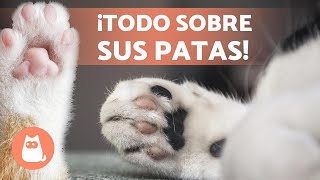
This is a YouTube video titled "10 CURIOSIDADES sobre las PATAS de los GATOS 🐾🐱 ¡Descúbrelas!" created on January 10, 2021, presenting an informative monologue by an animal expert about ten interesting facts regarding cat paws, including their anatomy, behavior, and unique features. The content is educational and focused on feline biology and behavior.
Paws are a very important and interesting part of feline anatomy. Do you want to know the features that make them so special? In this video by an animal expert, we'll tell you 10 interesting facts about cat paws that you probably didn't know. Let's take a look at them. First, they sweat and use them to mark territory Cats sweat especially through their paws. Since the vast majority of their sweat glands are located on the underside of the pads. They also have egrin glands. These are specialized in producing odors that allow them to mark the territory where they walk, scratch, claw or knead. This way, they let you know that a place already has an owner. Find out why cats knead in the video that we've included on the card. Two Pads that match their coat the pads match the color of the cat's fur and skin, since the same pigment acts on them. So in black cats, the pads will be black. In white cats they are usually pink, and in cats of various colors, they usually have several spots. 3. They wash their paws Often cats wash their paws quite a bit, so you should always make sure they don't touch dirty or unhygienic areas. This will prevent them from ingesting microorganisms, toxic, toxic plants, or small objects that could harm their health. 4. They walk on their tiptoes. Cats are digitigrade animals, which means they walk on their tiptoes, supporting themselves only with their toes when they walk, unlike us, who walk on our heels and the soles of our feet. Although it may seem uncomfortable for them, the truth is that it is not. Anatomically, they are prepared to walk this way. In addition, together with the softness and softness of their pads, they can walk, run, and jump silently so that their prey cannot hear them. 5. Their particular gait they share with camels and giraffes a way of walking that consists of first moving the front and back legs on the same side and then the same but on the opposite side. So the paws on one side are suspended while they step with the paws on the other side. In addition, with the hind paw of one side, they step on the same place where the front paw left a footprint. 6. They have great sensitivity. This is because they have many nerve endings and blood vessels, so a cut or injury to a paw causes them a lot of pain and a lot of bleeding. In addition, this sensitivity allows them to know the temperature of the surface, where they are, the state of the terrain and its characteristics. 7. They have retractable claws. Normally, their nails are stored in a skin sheath under the pads that prevents them from wearing out and allows them to walk silently. The keratin they are made of makes them grow. They only take it out when climbing or defending themselves. In addition, they scratch to keep their claws ready and sharp to use if the situation requires it. Therefore, it is important to meet this need by putting scratching posts to prevent them from scratching the armchairs or curtains in our home. 8 they prefer one paw Several studies have shown that just as people are left handed or right handed, cats tend to prefer one paw over the other. You can check this out by playing with them with something difficult to catch. They will try harder to reach their dominant paw. 9. Great flexibility their paws are very flexible and good at climbing. In fact, they can point their hind legs forward to climb up. However, going down is another matter as their front legs are not designed for that. That is why they sometimes need help to descend from certain heights. Discover more unique abilities of cats in the video we have left for you above. 10 the number of toes can vary. Most cats have 18 toes, 5 on each front paw and 4 on each hind paw. However, there are cats that show polydactyly or more than two than normal due to genetic mutations. This is more common in cats of the mankin breed. Tell us what other interesting things you have noticed about your cat's paws. Until next time, experts.